Table of Contents >> Show >> Hide
- What Is the Classic Paperbacks 1000 Piece Puzzle?
- Why Book Lovers Get Weirdly Emotional About This Puzzle
- What Makes This Puzzle “Doable” (Even at 1,000 Pieces)
- How to Finish the Classic Paperbacks Puzzle Without Losing Your Sparkle
- Step 1: Choose a workspace that’s bigger than your optimism
- Step 2: Do the edge pieces first (because it’s free structure)
- Step 3: Sort by “cover vibe,” not just color
- Step 4: Pick one cover and “complete a chapter”
- Step 5: Use typography like a compass
- Step 6: Watch for “wear patterns” as clues
- Step 7: Triage the “background-ish” pieces
- Step 8: Keep your lighting ridiculously good
- Step 9: Take photos of progress (yes, really)
- Step 10: Rotate pieces less, and compare more
- Step 11: Finish with the “connective tissue”
- Puzzle Accessories That Make Life Easier
- Should You Glue and Frame It?
- Gift Ideas: Who Would Love This Puzzle?
- Quick FAQs
- Conclusion: A Puzzle That Feels Like a Tiny Home Library
- Experiences People Love With the Classic Paperbacks 1000 Piece Puzzle (Plus a Few Lessons Learned)
If your ideal weekend includes a hot drink, a cozy corner, and the comforting feeling that you’re “being productive” while technically just vibing,
welcome: the Classic Paperbacks 1000 Piece Puzzle is basically a bookish staycation in cardboard form.
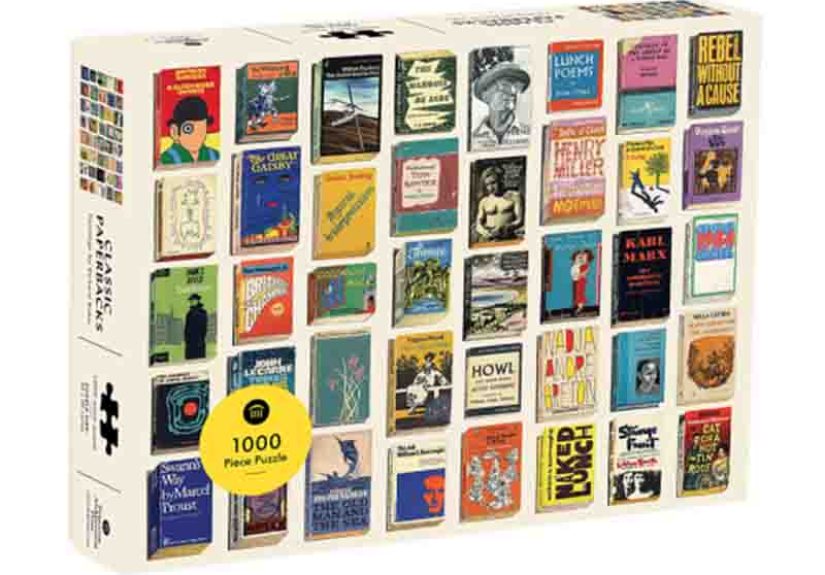
It’s a 1,000-piece jigsaw featuring illustrated vintage paperback coverscomplete with the charming “been-loved” details that make real paperbacks feel like old friends
(or like they survived a dramatic backpack semester… because they did).
This puzzle hits a very specific sweet spot: it’s visual candy for readers, design nerds, and anyone who loves the idea of a bookshelf aesthetic
without needing to dust an actual bookshelf. And yes, it’s the kind of puzzle that makes you say, “One more piece,” and then suddenly it’s two hours later
and you’ve developed strong opinions about typography.
What Is the Classic Paperbacks 1000 Piece Puzzle?
At its heart, this is a literary collage puzzle: a colorful arrangement of classic paperback covers that look like they were plucked from a golden era of reading.
The artwork is credited to artist Richard Baker, known for painting paperback editions with the little signs of life that readers recognize instantly
softened corners, gentle creases, and that “I’ve been reread in the best way” energy.
The finished puzzle is designed as a rectangular piece that’s large enough to feel satisfying on your table, but not so huge that it requires renting a second dining room.
Once completed, it’s commonly listed at about 25 x 20 inches, which makes it display-friendly if you decide it deserves wall space next to your “to be read” pile
(or, let’s be honest, on top of your “to be read” pile).
Why Book Lovers Get Weirdly Emotional About This Puzzle
Regular puzzles are fun. Book-themed puzzles? Different category. A classic-paperbacks puzzle doesn’t just give you an image; it gives you memories.
Even if you haven’t read every title represented, the vibe is instantly familiar: mid-century-to-late-20th-century design, bold colors, confident fonts,
and covers that look like they’ve already lived a full, interesting lifekind of like the best characters.
1) It’s nostalgia, but make it interactive
The best part of a classic paperback is that it feels personallike it came from a thrift store, a library sale, or that one friend who “lends” books forever.
This puzzle recreates that feeling in a way you can literally build with your hands.
2) You get micro-stories while you build
Each cover is a mini moment: a color palette, an author name, a title that sparks curiosity. You’ll find yourself pausing to think,
“Wait, have I read that?” or “That cover design is doing a LOTand I respect it.”
It turns puzzling into a slow, satisfying scavenger hunt for literary details.
3) It’s surprisingly good for your brain and your mood
Jigsaw puzzling pulls multiple skills into the same activity: visual scanning, pattern recognition, short-term memory, and spatial reasoning.
And because it’s absorbing without being high-stakes, many people experience it as calminglike focused, low-pressure “screen-free time”
that doesn’t demand you become a new person by Monday.
What Makes This Puzzle “Doable” (Even at 1,000 Pieces)
A 1,000-piece puzzle can feel intimidatingespecially if your last puzzle experience was 48 pieces and a cartoon dinosaur.
The good news: a cover-collage design often gives you natural zones to work with.
Instead of one big sky or a million nearly identical leaves, you get blocks of color, distinct typography, and edges between “covers.”
That said, it’s not a free ride. Some sections can be sneakyespecially where multiple covers share similar background shades
or where the “worn paper” texture looks the same across several books. (Translation: you may have a moment where you whisper, “Who invented beige?”)
How to Finish the Classic Paperbacks Puzzle Without Losing Your Sparkle
Here’s a practical, no-drama approach that works especially well for busy artwork with lots of small text and color variation.
Consider this your “book club, but make it jigsaw” method.
Step 1: Choose a workspace that’s bigger than your optimism
Measure your surface. You need a little extra room for sorting piles, not just the final puzzle size.
If you’re using a table, protect it with a mat or boardyour future self will thank you.
Step 2: Do the edge pieces first (because it’s free structure)
Separate all flat-edge pieces and build the border. It’s the puzzling equivalent of outlining an essay:
not thrilling, but suddenly everything feels more possible.
Step 3: Sort by “cover vibe,” not just color
With book-cover art, sorting by color helpsbut sorting by design features helps more:
big title fonts, author-name blocks, illustrated figures, solid color fields, or unique textures.
Step 4: Pick one cover and “complete a chapter”
Choose a cover with bold text or a strong color block and build it like a mini puzzle inside the big puzzle.
Each finished cover becomes an anchor point that makes the rest easier.
Step 5: Use typography like a compass
Letters are your best friends here. Curves, straight strokes, serifs, and spacing are often more distinctive than colors.
If two pieces have the same shade of orange, but one has a crisp bit of letteringstart there.
Step 6: Watch for “wear patterns” as clues
Creases, scuffs, and spine lines aren’t just aestheticthey create repeatable visual cues.
A tiny diagonal crease can help you place a piece faster than a vague blob of tan ever could.
Step 7: Triage the “background-ish” pieces
Set aside the pieces that look like plain paper texture until you’ve built more anchors.
Those pieces become much easier once you have borders between covers and can narrow the search.
Step 8: Keep your lighting ridiculously good
Good lighting reduces fatigue and helps you see fine print and subtle shade differences.
If you’re squinting, you’re making the puzzle harder than it needs to be.
Step 9: Take photos of progress (yes, really)
A quick phone photo can reveal patterns your brain stops noticing after staring for an hour.
It’s also satisfying to look back and realize you actually did a loteven if it felt like you were only finding corner pieces.
Step 10: Rotate pieces less, and compare more
Instead of spinning every piece like a tiny steering wheel, compare shapes and tabs first.
If the fit looks wrong, trust that instinct and move on. Forced fits are how puzzles start feuds.
Step 11: Finish with the “connective tissue”
Once most covers are built, you’ll have gaps between them where remaining pieces clearly belong.
This is the final stretch: less guessing, more satisfying clicks, and the sudden desire to show everyone in the house “this one cool part.”
Puzzle Accessories That Make Life Easier
If you’re planning to work on this over multiple sessions, accessories can be the difference between “relaxing hobby” and “why is the cat in my pieces again.”
Consider:
- Sorting trays to separate colors and cover elements.
- A puzzle board or mat if you need to move the puzzle between sessions.
- Storage solutions (even simple zip bags) to keep sections organized.
- Reference support like standing the box upright, so you’re not constantly craning your neck.
Should You Glue and Frame It?
This is the eternal puzzle question: preserve it forever, or break it apart and let it live again?
There’s no wrong answerjust your personal level of attachment.
Option A: Frame it (the “gallery wall” route)
If you love the image and want it as decor, framing can look fantasticespecially because book-cover collages read well from a distance.
Many people mount the puzzle to a backing board and frame it like art.
Option B: Preserve it without full commitment
Some puzzlers prefer methods that keep the puzzle intact but reversiblelike backing sheets or careful mountingso they can re-solve it later.
This puzzle, in particular, tends to be the kind people enjoy revisiting.
Option C: Break it apart (and feel zero guilt)
If you’re a “process over product” person, put it back in the box and enjoy the clean slate.
Bonus: you can lend it to a friend and become the hero of their rainy weekend.
Gift Ideas: Who Would Love This Puzzle?
The Classic Paperbacks 1000 Piece Puzzle is one of those gifts that says, “I know you,” without requiring you to memorize someone’s shoe size.
It’s especially good for:
- Readers and bibliophiles (obvious, but true).
- Graphic design fans who notice fonts the way other people notice sunsets.
- Book club members who want an off-screen activity that still feels literary.
- Collectors who love vintage aesthetics and clever packaging.
- Families who want a shared project that doesn’t require batteries or a subscription.
Want to level it up? Pair it with a bookstore gift card, a “reading snacks” bundle, or a note that says,
“This puzzle is basically a library… but flatter.”
Quick FAQs
How long does a 1,000-piece puzzle usually take?
It depends on experience and time per session. Many people finish a 1,000-piece puzzle over a few evenings or a weekend,
especially when the image has lots of distinct sections like book covers.
Is it too hard for beginners?
If you’re new to 1,000-piece puzzles, this one can actually be a friendly “first big puzzle”
because covers create natural categories. Start with the border, then build cover by cover.
What if a piece is missing?
First: check the floor, the chair, and any nearby sleeves, because puzzle pieces are tiny escape artists.
If it’s truly missing, document it and reach out to the retailer or publisher; policies vary.
Conclusion: A Puzzle That Feels Like a Tiny Home Library
The Classic Paperbacks 1000 Piece Puzzle is the perfect blend of nostalgia, visual design, and satisfying problem-solving.
It’s cozy without being boring, detailed without being punishing, and it has the rare quality of feeling like a hobby and a love letter to reading.
Whether you complete it solo, make it a family project, or turn it into a low-key game night centerpiece,
it’s the kind of puzzle that earns a permanent spot in the “do again” pile.
Experiences People Love With the Classic Paperbacks 1000 Piece Puzzle (Plus a Few Lessons Learned)
One of the most common experiences people report with a book-cover collage puzzle is the “unexpected time travel” effect.
You start out thinking you’re just sorting pieces, and then a cover catches your eye and suddenly you’re remembering the first time you read a classic in school,
the library you used to visit after class, or the battered paperback you once carried everywhere like it was an emotional support novel.
Even when the specific titles vary, the format of old paperbacksthose bold fonts and confident color blockstends to unlock memories.
Another relatable experience is how quickly this puzzle becomes a conversation starter.
People who puzzle with family or friends often notice that the table turns into a “story zone.”
Someone will place a piece with an author’s name and another person will say, “Oh! I read that one,” and then you’re suddenly swapping opinions
and making informal reading recommendations mid-puzzle. It’s especially fun in groups because the image naturally splits into mini-goals:
one person tackles a bright cover, another works on a darker section, and someone else becomes the official Edge Piece Supervisor
(a title that sounds silly until you realize it’s the backbone of the entire operation).
Many puzzlers also describe a satisfying rhythm that kicks in after the first 20–30 minutes.
Early on, it can feel chaotic: piles everywhere, pieces flipping, the occasional “Why do all these pieces look the same?”
But once a few covers lock into place, the puzzle starts rewarding you faster.
You get more “click moments,” more visible progress, and a stronger sense of direction.
A common lesson: it’s worth slowing down to sort well at the beginning, because good sorting makes the middle phase dramatically more enjoyable.
There’s also the experience of discovering your personal “puzzle personality.”
Some people love hunting for text fragments and building by typographyespecially on this design, where letters can be more distinctive than color.
Others prefer color-block building, grabbing a bold cover and finishing it like a mini project.
And then there are the “fit testers,” who quietly try pieces in multiple places until something works (often impressively fast, honestly).
A book-cover collage puzzle is great for this because it supports multiple strategies without punishing you for choosing the “wrong” one.
Finally, a lot of people report that this puzzle becomes a comfort activity.
Because it’s screen-free and structured, it can feel grounding after a long day.
You can sit down for 15 minutes and just find a few pieces, or you can fall into a two-hour flow state where the outside world fades.
The image helps with that: it’s busy enough to stay interesting, but familiar enough to feel cozy.
And whether you frame it, photograph it, or take it apart to do again later, the experience tends to leave people with the same verdict:
“This was exactly the kind of relaxing challenge I wanted.”