Table of Contents >> Show >> Hide
- Quick Safety Rules (So You Don’t Become a Cautionary Tale)
- The List: 10 Terrifying (and Legitimately Risky) Turtles & Lizards
- 1) Komodo Dragon
- 2) Nile Monitor
- 3) Argentine Black and White Tegu
- 4) Green Iguana
- 5) Tokay Gecko
- 6) Gila Monster
- 7) Mexican Beaded Lizard
- 8) Alligator Snapping Turtle
- 9) Common Snapping Turtle
- 10) Eastern Spiny Softshell Turtle
- Handling the “Danger” Without Hating the Animal
- Real-World Experiences (An Extra of “Yep, That Happened” Energy)
- Conclusion
Reptiles don’t do jump scares. They do stare-downs. The kind where you suddenly remember you are,
in fact, made of meat and bad decisions.
But “dangerous” doesn’t always mean “actively hunting humans.” Most turtles and lizards would rather avoid
you, sunbathe in peace, and get back to the important business of existing like tiny, scaly dinosaurs.
The danger usually shows up in three ways: (1) powerful bites and sharp claws,
(2) venom (yes, some lizards have it), and (3) the less glamorous riskgerms
that can make people sick if you handle reptiles carelessly.
Quick Safety Rules (So You Don’t Become a Cautionary Tale)
- Look, don’t grab. Especially “cool” turtles in the road and “chill” lizards in the yard.
- Give them space. If a reptile feels cornered, it may defend itself.
- Wash your hands after touching reptiles, their tanks, or anything in their habitat.
- Don’t keep wild animals as pets. Also: don’t “rescue” them into your house. That’s kidnapping.
- If you must move a turtle for safety (like off a road), do it carefully and keep fingers away from the head.
The List: 10 Terrifying (and Legitimately Risky) Turtles & Lizards
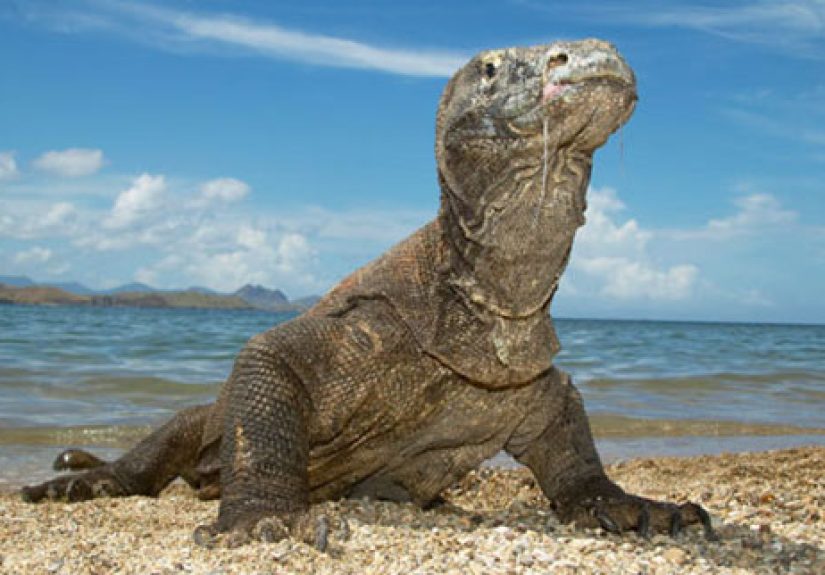
1) Komodo Dragon
If “prehistoric tank with a tongue” were a job title, the Komodo dragon would have it printed on a business card.
It’s the world’s largest lizard, built with thick skin, strong claws, and teeth designed for messy outcomes.
Add a venomous bite and you get an animal you admire from a respectful distancepreferably behind professional-grade barriers.
Why it’s dangerous
The risk isn’t just the bite itself; it’s what comes with itdeep wounds, infection risk, and the dragon’s
ability to do serious damage fast. In the wild, this is a top predator. In your imagination, it’s also the reason you
suddenly believe in cardio.
2) Nile Monitor
Nile monitors look like they were designed by someone who thought “sleek” and “intimidating” should be the same word.
They’re large, athletic lizards with serious jaws and a confident attitude. In places where they’re invasive,
they can also be a problem for native wildlifemeaning the “danger” here is both personal and ecological.
Why it’s dangerous
A big monitor lizard can bite hard, scratch with claws, and whip with its tail when threatened.
The best plan is simple: don’t corner it, don’t try to capture it, and don’t treat it like a weird dog.
3) Argentine Black and White Tegu
Tegus are the “friendly giants” of the lizard worlduntil they’re not. They’re large, strong, and smart enough
to get into trouble, especially when introduced outside their native range. In parts of the U.S., tegus have become
invasive, impacting local ecosystems by eating eggs and small animals.
Why it’s dangerous
Most tegus aren’t out looking for conflict, but a frightened or cornered large lizard can absolutely bite.
The bigger issue is that released pets can become an environmental headache that’s hard to undolike glitter, but with teeth.
4) Green Iguana
Green iguanas can look like laid-back tree ornamentsuntil one decides you’re too close to its personal space.
In areas where they’re invasive, they’ve adapted to canals, neighborhoods, and anyone with a sun-warmed fence.
Adult iguanas can defend themselves with surprising force.
Why it’s dangerous
The danger is mostly defensive: bites, scratches, and powerful tail-whips. If you’ve ever laughed at a lizard,
an iguana is the one most likely to file a complaintusing its tail.
5) Tokay Gecko
Tokay geckos are gorgeous, loud, and famously unimpressed with being handled. They’re known for a bark-like call and a
bite that can be startlingly painful for their size. If a tokay decides your finger is the enemy, it can hang on like it’s
trying to win a tiny, personal tug-of-war.
Why it’s dangerous
The bite itself is the main riskplus the classic “I panicked and made it worse” maneuver. If you’re ever bitten,
the smart move is to stay calm and avoid yanking or pulling, which can cause more injury.
6) Gila Monster
The Gila monster is one of the few venomous lizards on Earth, and it looks like it knows it. Stocky, slow-moving,
and patterned like nature’s warning label, it’s generally not aggressivebut it can bite if provoked or restrained.
And unlike a lot of scary-looking animals, this one comes with an actual chemical upgrade.
Why it’s dangerous
The venom is primarily defensive, and a bite can be extremely painful. The key word is “provoked.”
Give it space, don’t try to handle it, and you’ll almost certainly never have a problem.
7) Mexican Beaded Lizard
Close cousin to the Gila monster, the Mexican beaded lizard has an old reputation wrapped in mythologysome of it wildly exaggerated.
The reality is still serious: it’s venomous, it can bite, and the bite can be intensely painful.
The good news: it’s not a high-speed pursuer. The bad news: you shouldn’t test that fact with your ankle.
Why it’s dangerous
Most bites happen when people provoke or handle them. Treat it like a “look-only” animal, and you’re already doing it right.
(Bonus: you also avoid becoming the star of a very short, very educational news segment.)
8) Alligator Snapping Turtle
If you’ve never seen an alligator snapping turtle, imagine a turtle that looks like it lost a fight with a medieval weapon rackand won.
This is among the largest freshwater turtles in the United States, built like a living boulder with a jaw structure you don’t argue with.
It’s not a monster looking for trouble, but it will defend itself if handled.
Why it’s dangerous
The risk is the bite, plain and simple. Keep your hands away from the head, don’t pick it up unless trained,
and never assume a big turtle is “slow enough” to be safe.
9) Common Snapping Turtle
Common snapping turtles are widely distributed, surprisingly stealthy in the water, and notoriously cranky on land.
In ponds and lakes, they often want nothing to do with people. On landespecially if they’re nesting or crossing a road
they can get defensive fast.
Why it’s dangerous
A snapping turtle’s bite can cause serious injury. The most common “accident” is human curiosity:
someone tries to grab it, and the turtle responds like a strict teacher with zero patience for nonsense.
10) Eastern Spiny Softshell Turtle
Softshell turtles look like someone replaced a turtle’s armor with a rubbery pancake and said, “Good luck.”
The trade-off is speed, reach, and a defensive attitude. Spiny softshells can be fast swimmers, and when captured,
they may bite and scratch with sharp claws.
Why it’s dangerous
They lack a hard shell, so they rely on a strong bite, claws, and speed to protect themselves.
In other words: they’re not trying to be scary, but they’re excellent at it anyway.
Handling the “Danger” Without Hating the Animal
A reptile can be dangerous and still deserve respect. Most of the time, the safest move is also the kindest one:
don’t interfere. Watch from a distance, keep kids and pets back, and let wildlife do wildlife things.
If you keep pet reptiles, handle them responsibly, keep habitats clean, and treat handwashing like it’s part of the hobbynot an optional upgrade.
Real-World Experiences (An Extra of “Yep, That Happened” Energy)
If you spend enough time outdoorsor in a state where “exotic pet” sometimes becomes “free-range surprise”you start collecting
reptile stories the way some people collect fridge magnets. Not because reptiles are chasing you, but because reptiles are
masters of appearing exactly where you least expect them.
Picture a summer evening drive: headlights sweep across the road and catch a bulky shape moving with slow determination.
It’s a turtle crossing like it owns the place (because, emotionally, it does). Your first instinct might be heroic:
“I’ll help!” The smarter instinct kicks in half a second later: “I will help… with distance.” If it’s a snapper,
you notice the posturehead forward, body low, the kind of vibe that says, “Touch me and learn something permanent.”
The experience teaches a simple lesson: the turtle is not lost; it’s commuting. Your job is traffic safety, not a handshake.
Then there’s the backyard encounter. In parts of Florida and the Gulf Coast, people talk about iguanas the way people
elsewhere talk about squirrelsuntil the day an iguana drops from a tree like a scaly punctuation mark. Maybe it’s startled,
maybe it’s defending a sunny spot, maybe it’s just having a dramatic moment. Either way, you learn quickly that a large iguana
can move faster than your confidence. You also learn that “tail” is not just anatomy; it’s an opinion, delivered at speed.
If you’ve ever met a tokay gecko up close, it’s rarely because you planned a meet-and-greet. It’s more like:
“Why is the garage making dinosaur noises?” Tokays have a voice that doesn’t match their size, and that’s half the thrill.
The other half is realizing that, if handled badly, they can latch on with a bite that convinces you to reevaluate your
relationship with gloves. The most common mistake people make is trying to yank their hand awayturning a short lesson into
a longer one. Calm beats panic almost every time.
Out in desert country, the “experience” is often the opposite: you don’t see the venomous lizard until it decides you’re
close enough to deserve a warning. A Gila monster isn’t looking for a fight. It’s looking for shade, food, and peace.
When hikers do get into trouble, it’s usually because someone tried to pick one up for a photo or “move it” like it’s a toy.
The better storythe one you wantis the quiet one: you spot it, you admire it, you back off, and you go home with all your
original parts.
The funniest part? Most reptile “danger stories” end with the same moral: the animal did exactly what nature designed it to do.
The human did exactly what a curious human does. The difference is that reptiles don’t get embarrassed. We do.
Conclusion
The world’s “terrifying” turtles and lizards are rarely villains. They’re specialistsequipped with venom, muscle, jaws,
claws, and survival instincts that worked long before humans invented flip-flops. If you treat them like wildlife (not toys,
not pets, not dares), the odds are excellent that your only “danger” will be telling the story laterwith a grin instead of a bandage.