Table of Contents >> Show >> Hide
- 1. Chauvet Cave Was Discovered by Accident in 1994
- 2. The Paintings Are Around 36,000 Years Old
- 3. Chauvet Changed What Experts Thought About Prehistoric Art
- 4. The Cave Contains More Than 1,000 Images and Marks
- 5. The Artists Painted Animals With Stunning Realism
- 6. The Famous Horse Panel Is a Masterpiece of Ice Age Art
- 7. Chauvet Cave Includes Dramatic Images of Lions and Rhinos
- 8. The Artists Used Charcoal, Red Ochre, Engraving, and Blending
- 9. Cave Bears Used the Cave Before and During Human Visits
- 10. Human Footprints and Torch Marks Add to the Mystery
- 11. The Cave Was Sealed for Thousands of Years
- 12. The Original Cave Is Closed to the Public
- 13. Chauvet Cave Is a UNESCO World Heritage Site
- Why the Chauvet Cave Paintings Still Matter Today
- Experiences Inspired by the Chauvet Cave Paintings
- Conclusion
Note: This article is an original, publication-ready synthesis based on reputable archaeology, museum, heritage, and conservation sources. Source links are intentionally omitted from the visible article body as requested.
Some ancient places whisper. Chauvet Cave practically grabs a megaphone and announces, “Humans were incredible artists before anyone invented Wi-Fi, wheels, or the phrase ‘content strategy.’” Hidden in southern France, the Chauvet Cave paintings are among the most astonishing examples of prehistoric cave art ever discovered. They are old enough to make the pyramids look like recent construction projects and refined enough to make modern viewers ask, “Wait, how did they do that with charcoal, stone walls, and torchlight?”
Known officially as the Decorated Cave of Pont d’Arc, or Grotte Chauvet-Pont d’Arc, this extraordinary site contains hundreds of animal images, handprints, abstract signs, and traces of Ice Age human activity. The paintings are not crude doodles from humanity’s artistic warm-up act. They are confident, energetic, and often shockingly realistic. Lions prowl, horses gallop, rhinos clash, and cave bears appear so alive that you half expect them to complain about museum lighting.
Below are 13 fascinating facts about the Chauvet Cave paintings, from their dramatic discovery to their jaw-dropping age, advanced techniques, mysterious meanings, and modern preservation. Whether you love archaeology, art history, ancient humans, or just enjoy knowing that our ancestors were extremely good at drawing animals they probably did not want to meet in a dark hallway, Chauvet Cave is a story worth entering carefully.
1. Chauvet Cave Was Discovered by Accident in 1994
The modern story of Chauvet Cave began on December 18, 1994, when three French cave explorersJean-Marie Chauvet, Éliette Brunel, and Christian Hillairefound a small opening near Vallon-Pont-d’Arc in the Ardèche region of southern France. They were not looking for one of the greatest prehistoric art galleries on Earth. They were exploring, crawling, squeezing, and doing the sort of activity that makes claustrophobic people immediately look for an exit sign.
Once inside, the explorers realized they had stepped into something extraordinary. The walls were covered with ancient images, many of them beautifully preserved. The cave floor also held animal bones, footprints, and marks left by prehistoric visitors. Unlike some famous caves that suffered after being opened to tourism, Chauvet was quickly protected. That fast response helped preserve the fragile environment and prevented the cave from becoming the Ice Age version of an overcrowded gift shop.
2. The Paintings Are Around 36,000 Years Old
One of the most astonishing facts about the Chauvet Cave paintings is their age. Many of the charcoal drawings have been dated to roughly 36,000 years ago, placing them in the Aurignacian period, when early modern humans were living in Ice Age Europe. Some evidence suggests different phases of human activity in the cave, including later visits thousands of years after the earliest paintings were made.
To put that age in perspective, Chauvet Cave art is far older than Stonehenge, the Egyptian pyramids, and the earliest cities. It predates agriculture by tens of thousands of years. When these artists worked, Europe was home to mammoths, cave lions, woolly rhinoceroses, cave bears, and other animals that now belong to the fossil record. In other words, the artists were not painting from a cozy studio apartment. They were creating in a world where nature had teeth, tusks, claws, and no customer service department.
3. Chauvet Changed What Experts Thought About Prehistoric Art
Before Chauvet, many people assumed that prehistoric art developed slowly from simple marks to more complex images. Chauvet complicated that neat little timeline. The cave’s paintings are already sophisticated: animals overlap, bodies curve with the rock surface, shading creates volume, and repeated outlines suggest motion. The artists were not beginners fumbling through “Cave Drawing 101.” They were working with skill, planning, and visual intelligence.
This forced scholars to rethink the idea that art evolved in a straight line from primitive to advanced. Chauvet shows that early art could be technically and emotionally powerful from the start. The paintings remind us that the people of the Ice Age were not “less human” than we are. They had memory, imagination, symbolic thinking, and probably very strong opinions about which wall made the best canvas.
4. The Cave Contains More Than 1,000 Images and Marks
Chauvet Cave is not a small gallery with a few interesting sketches. It contains more than 1,000 recorded images and markings, including hundreds of animal figures. The subjects include horses, lions, rhinoceroses, mammoths, bison, aurochs, bears, deer, ibex, and other Ice Age creatures. Some are drawn in black charcoal, others in red ochre, and still others are engraved into the wall surface.
The variety matters. Many prehistoric sites emphasize animals that humans hunted, but Chauvet includes numerous powerful predators and dangerous beasts. Cave lions, cave bears, and woolly rhinos were not exactly easy dinner options. Their presence suggests that the cave paintings were about more than simple hunting records. They may have reflected myth, ritual, memory, observation, storytelling, or a worldview in which humans and animals were deeply connected.
5. The Artists Painted Animals With Stunning Realism
One reason the Chauvet Cave paintings feel so modern is their realism. The animals have weight, movement, and attitude. Horses bend their necks. Lions appear focused and alert. Rhinos seem ready to charge into a prehistoric traffic dispute. The artists carefully observed animal anatomy, posture, and behavior. Their drawings often capture not just what animals looked like, but how they moved.
This is especially impressive because the artists worked in darkness, using torchlight and possibly small lamps. The flickering light may have made the images appear to move across the uneven cave walls. A lion drawn with multiple legs or a rhino shown with repeated outlines may look like animation when seen by firelight. Before cinema, before flipbooks, before anyone said “let’s make this viral,” Chauvet’s artists may have created visual motion using stone, pigment, and shadow.
6. The Famous Horse Panel Is a Masterpiece of Ice Age Art
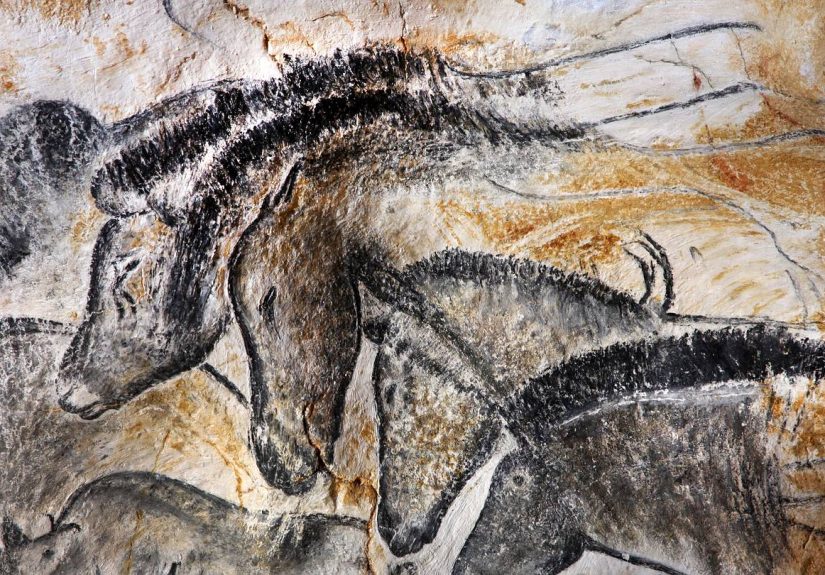
Among Chauvet’s most celebrated works is the Horse Panel, a dramatic composition featuring horses, rhinoceroses, and other animals. The horses are drawn with remarkable elegance. Their heads overlap in a way that creates depth and rhythm, almost like a carefully arranged scene rather than a random collection of figures.
The Horse Panel shows how the artists used the natural shape of the wall as part of the artwork. Cracks, curves, and bulges in the rock were not obstacles; they were opportunities. A raised surface could become an animal’s shoulder. A shadowed curve could suggest muscle. The cave wall was not simply a background. It was a collaborator, which is impressive considering most walls today contribute nothing except holding up posters slightly crooked.
7. Chauvet Cave Includes Dramatic Images of Lions and Rhinos
The lion and rhinoceros images at Chauvet are among the most dynamic in prehistoric art. The cave lions are shown without manes, which matches what researchers believe about Ice Age cave lions. This detail suggests close observation rather than fantasy. The artists knew their subjects well, probably from direct experience, careful watching, and community knowledge passed down over generations.
The rhinoceroses are equally striking. Some appear in confrontation, their horns and bodies positioned as if they are clashing. These scenes may represent real animal behavior. They also show that prehistoric artists were interested in action, tension, and storytelling. Chauvet is not just a catalog of animals. It is a world in motion.
8. The Artists Used Charcoal, Red Ochre, Engraving, and Blending
The Chauvet Cave paintings were created using several techniques. Artists used charcoal for black drawings and red ochre for red marks and images. They also engraved lines into the soft wall surface and sometimes prepared the wall by scraping it clean. In some figures, they smudged or blended pigment to create shading and volume.
This technical range is one of the reasons Chauvet feels so advanced. The artists understood contrast, line weight, perspective, and the power of negative space. They used simple materials, but they did not use them simply. A piece of charcoal in the right hands can become a galloping horse, a watchful lion, or a rhino with the personality of a tank.
9. Cave Bears Used the Cave Before and During Human Visits
Chauvet Cave was not only an art site. It was also a place used by cave bears. Researchers have found bear bones, skulls, claw marks, and bear wallows inside the cave. Some bear claw marks appear near or even over human-made images, creating an eerie overlap between animal activity and human creativity.
One of the cave’s most memorable features is a bear skull placed on a rock in the Skull Chamber. Scholars debate what this placement means. It may have been moved by humans, or natural processes may have played a role. Either way, the presence of bears adds to the cave’s strange atmosphere. Imagine entering a dark chamber filled with bones, claw marks, and painted predators. Suddenly your modern fear of a low phone battery seems less impressive.
10. Human Footprints and Torch Marks Add to the Mystery
Chauvet Cave preserves more than paintings. It also contains human footprints, charcoal remains, torch marks, and other traces of movement. Some footprints may belong to a young person, offering a rare and intimate connection to an individual who walked through the cave thousands of years ago. These traces make the cave feel less like an abstract archaeological site and more like a frozen moment in human history.
The torch marks are especially important because they help researchers understand how people moved through the cave. Visitors needed light, planning, and courage. They entered deep spaces where natural daylight could not reach. The act of painting was not casual. It required preparation, intention, and probably someone saying the Ice Age equivalent of, “Please do not drop the torch.”
11. The Cave Was Sealed for Thousands of Years
One reason Chauvet’s paintings survived so well is that the cave entrance was sealed by a rockfall thousands of years ago. This natural closure protected the cave from weather, animals, and human disturbance. For an incredibly long time, the cave remained hidden, preserving its art and floor deposits in exceptional condition.
This preservation is a gift to archaeology. In many ancient sites, later visitors, water, air changes, or modern tourism have damaged fragile evidence. Chauvet offers a rare look at a Paleolithic decorated cave where many traces remained in place. It is not just an art gallery; it is an archaeological time capsule, sealed by geology and reopened by chance.
12. The Original Cave Is Closed to the Public
The real Chauvet Cave is not open for regular public visits, and that is a very good thing. Human breath, body heat, microbes, dust, and changes in humidity can damage ancient cave art. The caution comes partly from hard lessons learned at other famous decorated caves, where tourism created conservation problems.
Instead of allowing crowds into the original cave, France created a detailed replica known as Chauvet 2. This remarkable reconstruction allows visitors to experience the scale, atmosphere, and imagery of the cave without endangering the original. It may sound disappointing not to enter the real cave, but preservation comes first. Thirty-six-thousand-year-old art deserves better than being slowly ruined by selfie traffic.
13. Chauvet Cave Is a UNESCO World Heritage Site
Chauvet Cave was inscribed as a UNESCO World Heritage Site because of its outstanding universal value. The designation recognizes not only the age of the paintings but also their artistic quality, preservation, and importance to understanding early human creativity. It is one of the most significant prehistoric art sites in the world.
The cave matters because it expands our view of what early humans were capable of. The artists of Chauvet were not merely surviving the Ice Age. They were observing, remembering, imagining, and transforming experience into images. Their work bridges a gap of tens of thousands of years. We do not know their names, languages, or stories, but when we look at their animals, we recognize a familiar human impulse: the need to make meaning visible.
Why the Chauvet Cave Paintings Still Matter Today
The Chauvet Cave paintings matter because they challenge lazy ideas about the past. It is easy to imagine prehistoric people as rough, simple, and focused only on survival. Chauvet says otherwise. These artists lived in a demanding environment, yet they invested time and skill into images hidden deep underground. That choice suggests a rich inner life and a complex culture.
The paintings also remind us that art is not a luxury added after civilization becomes comfortable. Art appears very early in the human story. It may be one of the ways humans became fully human: by sharing symbols, preserving memory, strengthening group identity, and exploring the invisible world of belief and imagination. Chauvet is not just old art. It is evidence that creativity has been part of our species for a very long time.
Experiences Inspired by the Chauvet Cave Paintings
Experiencing the Chauvet Cave paintings today usually means visiting Chauvet 2, watching high-quality documentaries, exploring virtual resources, or studying photographs and scholarly interpretations. While nothing can fully replace the original cave, these experiences can still be surprisingly powerful. A good replica does more than copy an image; it recreates a sense of space, darkness, scale, and discovery.
Visitors to Chauvet 2 often describe a feeling of stepping outside ordinary time. The reconstructed cave environment lowers the noise of the modern world. Instead of traffic, notifications, and grocery lists, you focus on curved stone walls, animal forms, and the idea that someone stood in a similar darkness tens of thousands of years ago. It is a humbling experience. The distance between “them” and “us” suddenly feels smaller.
One of the best ways to appreciate Chauvet is to look slowly. Modern viewers are trained to scroll, swipe, and move on. Chauvet rewards patience. At first, you may see only a horse or a lion. Then details appear: a softened muzzle, a tense back, a repeated line that suggests motion, a rock curve that becomes part of the body. The longer you look, the more the wall seems planned. The artists were not decorating randomly; they were composing.
Another meaningful experience is comparing Chauvet with other prehistoric sites such as Lascaux, Altamira, and later rock art traditions around the world. This comparison reveals both shared human habits and local differences. Humans repeatedly turned stone surfaces into image worlds, but each site has its own personality. Chauvet feels especially wild and dramatic because of its predators, rhinos, and deep-chamber setting.
For students, writers, artists, and travelers, Chauvet offers a lesson in creativity under constraints. The artists had no synthetic paints, no electric lights, no sketchbooks from an art store, and no online tutorials titled “How to Draw a Cave Lion in 7 Easy Steps.” Yet they produced images with grace, confidence, and emotional force. Their limitations did not stop creativity; in some ways, the cave itself helped shape it.
Artists today can learn from Chauvet’s use of surface and movement. The cave painters did not fight the wall. They worked with it. That mindset is useful far beyond archaeology. Whether someone is painting, designing, writing, or solving a problem, the lesson is clear: constraints can become part of the work. A rough surface may not be a flaw. It may be the beginning of the idea.
Chauvet also creates a powerful emotional experience because it connects viewers with anonymous individuals. We do not know who painted the horses or lions. We do not know what songs they sang, what stories they told, or what they believed happened in the dark. Yet their hands made marks that still speak. The paintings are both ancient and immediate. They prove that time can separate people, but art can still introduce them.
For anyone planning content, travel writing, museum education, or an archaeology-themed article, Chauvet is a dream topic because it combines mystery, science, beauty, and human drama. It has discovery, danger, preservation, technology, and the irresistible fact that some of humanity’s earliest known artists were already extremely good. The cave invites big questions without requiring fake answers. That is part of its magic.
Conclusion
The Chauvet Cave paintings are more than old images on stone. They are a direct encounter with early human imagination. Created around 36,000 years ago, preserved by a sealed cave environment, and rediscovered in 1994, they reveal a level of artistic skill that still feels astonishing. From the Horse Panel to the lions, rhinos, bears, handprints, and torch marks, Chauvet is one of the clearest reminders that creativity is not a modern invention.
These paintings show that Ice Age humans were careful observers, skilled artists, and symbolic thinkers. They lived in a world filled with animals that were powerful, dangerous, and deeply meaningful. Instead of merely surviving that world, they transformed it into art. That may be the most amazing fact of all: long before cities, writing, or recorded history, humans were already leaving beauty in the dark for the future to find.