Table of Contents >> Show >> Hide
- Why On-Screen Costumes Can Be So Uncomfortable
- 15 Celebrities and the Costumes They Struggled to Survive
- 1. Jim Carrey as The Grinch in How the Grinch Stole Christmas
- 2. Ryan Reynolds as Green Lantern in Green Lantern
- 3. Scarlett Johansson as Black Widow in The Avengers
- 4. Tom Holland as Spider-Man in the Marvel Films
- 5. Lily James as Cinderella in Cinderella
- 6. Robert Downey Jr. as Iron Man in Iron Man
- 7. Rebecca Romijn as Mystique in X-Men
- 8. Val Kilmer as Batman in Batman Forever
- 9. Emma Stone as Abigail in The Favourite
- 10. Ralph Fiennes as Voldemort in the Harry Potter Films
- 11. Peter Mayhew as Chewbacca in Star Wars
- 12. Paul Bettany as Vision in Avengers: Age of Ultron
- 13. Michelle Pfeiffer as Catwoman in Batman Returns
- 14. Robert John Burke as RoboCop in RoboCop 3
- 15. Simone Ashley as Kate Sharma in Bridgerton
- What These Costume Horror Stories Tell Us About Movie Magic
- Extra Experience: Watching Costume Suffering Changes How We See Movies
- Conclusion
Hollywood loves a dramatic entrance: capes swirling, armor gleaming, corsets cinched, wigs defying gravity, and superhero suits polished so perfectly they look like they were designed by a very fashionable spaceship. But behind the camera, many famous on-screen costumes are less “movie magic” and more “please send help, a fan, and maybe a snack through the eye hole.”
The truth is simple: unforgettable costumes often come with unforgettable discomfort. Some actors have spent hours under prosthetics, sweated inside rubber suits, struggled to breathe in corsets, or discovered that looking like a superhero can feel a lot like being wrapped in a hot yoga mat with branding. Below are 15 celebrities who admitted that their on-screen costumes were a torture to wear, plus what their stories reveal about the strange, sweaty science of becoming someone else on screen.
Why On-Screen Costumes Can Be So Uncomfortable
Costume design is one of the quiet superpowers of filmmaking. A great costume tells us who a character is before they say a single word. The problem? Cameras care about shape, texture, shine, silhouette, and continuity. Human bodies care about breathing, moving, hearing, drinking water, and occasionally using the bathroom like civilized mammals.
That conflict is where the trouble begins. Superhero suits are often tight and heat-trapping. Creature makeup can take half a workday to apply. Period costumes may involve restrictive corsetry. Armor can be heavy, loud, and impossible to sit in. The result is a bizarre workplace situation where an actor can be paid millions of dollars and still spend the afternoon wondering whether fame was worth losing access to their elbows.
15 Celebrities and the Costumes They Struggled to Survive
1. Jim Carrey as The Grinch in How the Grinch Stole Christmas
Jim Carrey’s Grinch transformation is one of the most famous examples of costume suffering in modern movie history. The green fur, prosthetic fingers, fake teeth, contact lenses, and heavy makeup turned him into a walking Christmas nightmare, and not just for the residents of Whoville.
Carrey reportedly found the process so overwhelming that he nearly quit early in filming. Becoming the Grinch could involve hours in the makeup chair, and the full costume limited his vision and movement. The irony is delicious: the actor playing a character who hated Christmas had to endure a holiday-themed endurance test every shooting day. The final performance is brilliant, but the behind-the-scenes reality sounds less like “You’re a Mean One” and more like “You’re a Sweaty One, Mr. Grinch.”
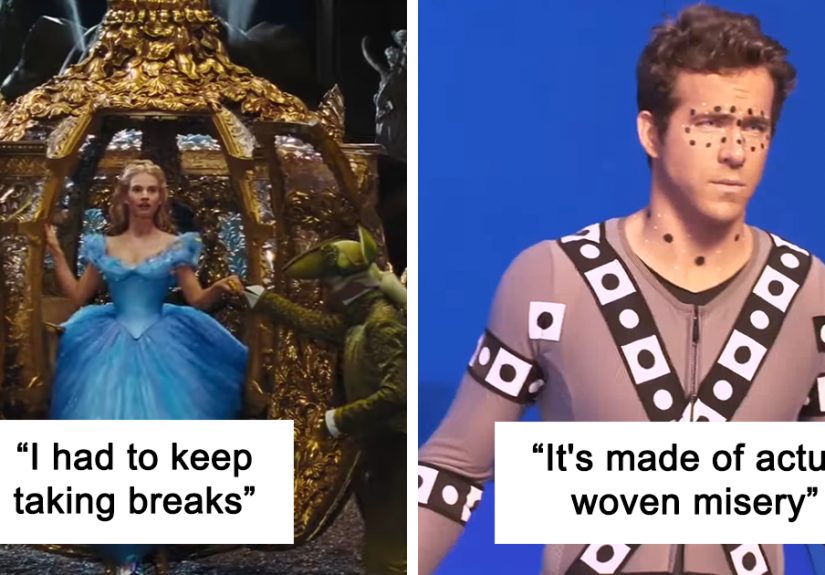
2. Ryan Reynolds as Green Lantern in Green Lantern
Ryan Reynolds has turned mocking Green Lantern into a side career, but even before the jokes became legendary, the suit itself was already giving him material. Reynolds described the motion-capture bodysuit as miserable, hot, and deeply unglamorous.
The Green Lantern costume looked sleek after digital effects worked their magic, but the real outfit was a tight one-piece suit worn during long shooting days in New Orleans heat. That means Reynolds had to perform like an intergalactic hero while feeling like leftovers wrapped in plastic. Superpower: willpower. Weakness: humidity.
3. Scarlett Johansson as Black Widow in The Avengers
Scarlett Johansson’s Black Widow costume may have looked cool, tactical, and perfectly superhero-ready, but she compared it to wearing a wetsuit. During The Avengers, the heat became so intense that she said she even hallucinated while filming a rooftop fight scene.
Action costumes have to survive kicks, flips, running, bending, and dramatic staring. Johansson’s suit took such a beating that it reportedly had to be replaced frequently. In other words, Black Widow was not only fighting aliens and villains; she was also fighting fabric fatigue, sweat, and the physics of being zipped into a tight black suit under hot lights.
4. Tom Holland as Spider-Man in the Marvel Films
Tom Holland’s Spider-Man suit gave fans the perfect superhero silhouette, but it came with one very practical problem: eating and drinking. Holland has explained that the mask’s eye pieces could be removed so he could insert a tube and drink through the eye area.
That image alone deserves its own museum exhibit. Spider-Man, friendly neighborhood hero, sipping through his face like a very athletic juice box. The costume looked effortless on screen, but behind the scenes, it required awkward solutions for basic human needs. The suit may have made Holland look like a web-slinging legend, but apparently legends also need hydration breaks.
5. Lily James as Cinderella in Cinderella
Lily James’s blue Cinderella gown looked like it floated straight out of a fairy tale, possibly carried by birds with excellent taste. But the dress and corset were not exactly a dream to wear. James has spoken about how restrictive the outfit was, especially during dancing scenes.
The gown helped create the magical transformation audiences expected from Cinderella, but it also made breathing and movement difficult. That is the strange bargain of many fantasy costumes: the more magical they look, the more likely someone behind the scenes is whispering, “Can we loosen this before I become a decorative lamp?”
6. Robert Downey Jr. as Iron Man in Iron Man
Before Marvel leaned more heavily on digital suits, Robert Downey Jr. wore practical Iron Man armor for parts of the first film. The early suit helped sell the reality of Tony Stark’s invention, but it was not built like a luxury recliner.
Downey recalled struggling with the helmet and visibility, describing how he could not properly see when the helmet closed and lights came on inside. That is a pretty big issue when your job is to act like the smartest man in the room while your costume has turned you into a very expensive traffic cone. Still, that practical armor gave the first Iron Man a grounded feel, proving that discomfort sometimes buys cinematic authenticity.
7. Rebecca Romijn as Mystique in X-Men
Rebecca Romijn’s Mystique makeup remains one of the most iconic looks in superhero movies. It was also a marathon of patience. Her transformation involved hours of body paint, prosthetics, and close-up work by makeup artists.
Romijn has described how exhausting it was to spend so much time being painted and touched up. The final result made Mystique look alien, elegant, and dangerous, but the process required a level of personal-space tolerance most people do not possess before coffee. Being blue all day may sound fun until four people are responsible for making sure every inch of you remains the correct shade of mutant.
8. Val Kilmer as Batman in Batman Forever
Val Kilmer discovered that wanting to be Batman and playing Batman are two very different hobbies. The Batman Forever suit was restrictive, isolating, and difficult to act in. Kilmer said the experience crushed his childhood excitement about the role.
The cowl limited his hearing, and the heavy suit made movement awkward. He felt cut off from the rest of the cast because people eventually stopped trying to talk to him. That is not exactly the brooding solitude Batman ordered. It is one thing to play a lonely billionaire vigilante; it is another to feel lonely because your rubber ears have turned the set into a silent film.
9. Emma Stone as Abigail in The Favourite
Emma Stone wore period corsets for The Favourite, and she did not sugarcoat the experience. She said the costume affected her breathing and even joked about how her organs shifted temporarily from the pressure.
The film’s costumes helped create the sharp, strange world of Queen Anne’s court, but Stone’s comments show how physically demanding period pieces can be. Modern audiences often admire the elegance of historical fashion, but actors wearing it for long shooting days may be thinking less about elegance and more about finding an open window and a merciful tailor.
10. Ralph Fiennes as Voldemort in the Harry Potter Films
Ralph Fiennes made Voldemort terrifying, but his costume had at least one surprisingly silly enemy: tights. Beneath the flowing robes and ghostly makeup, Fiennes dealt with costume pieces that interfered with his movement and elegance.
He has joked about the tights slipping down and needing adjustments so he could move properly. This is the kind of detail that makes movie magic even funnier. On screen, Voldemort is the Dark Lord. Off screen, he is a distinguished actor trying not to trip over fabric while negotiating with hosiery. Evil may be powerful, but wardrobe malfunctions remain undefeated.
11. Peter Mayhew as Chewbacca in Star Wars
Peter Mayhew’s Chewbacca costume gave cinema one of its most beloved characters, but the suit was heavy, hot, and physically demanding. Fur costumes are especially tricky because they trap heat, restrict airflow, and require actors to perform through layers that hide their faces.
Chewbacca needed to feel alive, expressive, and loyal without traditional facial acting. Mayhew achieved that through posture, movement, and presence, all while wearing a costume that could become brutally uncomfortable. The lesson? Sometimes the warmest character in the galaxy is also literally the warmest actor on set.
12. Paul Bettany as Vision in Avengers: Age of Ultron
Paul Bettany’s Vision costume combined makeup, prosthetics, and a tight superhero body suit. Bettany has described the process as painful and uncomfortable, especially during long days when the costume limited hearing and left only part of his face exposed.
Vision is calm, wise, and almost spiritual on screen. That makes the behind-the-scenes reality funnier: Bettany had to project cosmic serenity while internally counting the hours until someone could remove the suit. It is hard to look like an elegant synthetic being when your human body is filing complaints with management.
13. Michelle Pfeiffer as Catwoman in Batman Returns
Michelle Pfeiffer’s Catwoman suit is one of the most iconic costumes in superhero cinema. It is also one of the most famously uncomfortable. Pfeiffer has said she had to be powdered down, helped into the suit, and vacuum-packed into it before it was painted to achieve its signature shine.
The result was unforgettable: sleek, dangerous, stitched, and instantly recognizable. But the process sounds like being turned into high-fashion leftovers. The suit restricted movement, created practical problems, and required serious commitment. Pfeiffer’s performance is so magnetic that the discomfort disappears on screen, which is exactly why costume pain often goes unnoticed by audiences.
14. Robert John Burke as RoboCop in RoboCop 3
Robert John Burke took over the RoboCop role in RoboCop 3, but the armor was reportedly built with the original actor’s body in mind. That created major problems. Burke described the suit as agonizing, heavy, and extremely difficult to work in.
RoboCop is supposed to move like a mechanical law-enforcement machine, so stiffness is part of the character. Unfortunately, that does not make stiffness fun for the actor. Heavy armor can drain energy fast, especially when it must be worn through repeated takes, lighting resets, and action scenes. Looking like a futuristic cyborg may be cool, but wearing the future apparently requires a very forgiving spine.
15. Simone Ashley as Kate Sharma in Bridgerton
Simone Ashley brought intelligence, charm, and fire to Kate Sharma in Bridgerton, but the corsets were not a romantic dream. She has spoken about pain, restriction, and learning the hard way that eating a full meal before wearing a tight corset was a mistake.
Period dramas often sell elegance, but the actors inside those gowns are doing a full-body negotiation with the costume department. Ashley’s experience reminds viewers that ballroom scenes are not just graceful gliding and meaningful eye contact. Sometimes they are also breathing strategy, posture control, and quietly hoping the next take is the last one before lunch.
What These Costume Horror Stories Tell Us About Movie Magic
The funniest part of these stories is that the costumes worked. The Grinch looks unforgettable. Catwoman still dominates pop culture. Black Widow’s suit became part of Marvel history. Cinderella’s gown delivered pure fairy-tale spectacle. Chewbacca feels so real that generations of fans forget there was a very tall human being sweating inside all that fur.
That is the power and problem of great costume design. When it succeeds, the audience stops thinking about fabric, prosthetics, zippers, glue, foam, latex, lenses, and hidden tubes. We only see the character. The actor, meanwhile, may be silently battling heat, pressure, itchiness, poor visibility, and the ancient enemy known as “not being able to sit down.”
Extra Experience: Watching Costume Suffering Changes How We See Movies
Once you know what actors go through for certain roles, it becomes almost impossible to watch those scenes the same way again. A superhero landing is no longer just a cool pose. It is a person trying to bend in a suit that may have the flexibility of a refrigerator door. A royal dance is no longer merely romantic. It is a performer counting breaths inside a corset while pretending the room is not spinning. A creature performance is not only visual effects; it is patience, endurance, and probably several people holding fans just off camera.
This behind-the-scenes knowledge makes movies more impressive, not less. It reminds us that acting is physical labor. Even when a performance looks graceful, funny, or effortless, there may be hours of preparation behind it. Costume teams also deserve enormous credit because their job is nearly impossible: create something beautiful, character-specific, camera-ready, durable, and safe enough to survive filming. They are part artists, part engineers, part emergency problem-solvers, and part magicians with sewing machines.
For viewers, these stories add a new layer of appreciation. The next time you see Michelle Pfeiffer glide across the screen as Catwoman, you may remember that the suit was a vacuum-packed nightmare. When Jim Carrey leaps around as the Grinch, you may understand that his comic energy came after hours of makeup discomfort. When Tom Holland swings into action, you may picture the heroic logistics of drinking through a removable eye piece. It sounds absurd, but absurdity is often where movie history lives.
These experiences also highlight why modern productions continue to improve costume design. Actors today are more open about discomfort, safety, heat, mobility, and health. Studios increasingly use lighter materials, digital enhancements, cooling systems, and better fittings. That does not mean costume suffering has disappeared; it means the industry is learning that a miserable actor is not automatically a better actor. Pain may create a good anecdote, but comfort can create a better performance.
From an audience perspective, the best costumes are the ones that disappear into the story. We remember the character, not the zipper. We remember the emotion, not the foam padding. But the stories behind these famous outfits prove that every great look has a price. Sometimes that price is three hours in a makeup chair. Sometimes it is sweat-soaked socks. Sometimes it is a corset that turns lunch into a strategic risk. And sometimes it is simply the quiet dignity of pretending everything is fine while dressed as a space cop, spider hero, evil wizard, or fairy-tale princess.
Conclusion
On-screen costumes can transform actors into legends, but the transformation is rarely as easy as it looks. These 15 celebrities prove that movie magic often comes with heat, pressure, heavy materials, prosthetic patience, and a shocking lack of bathroom convenience. Still, the discomfort frequently pays off. Audiences remember the Grinch, Catwoman, Black Widow, Cinderella, Vision, Chewbacca, and Batman because the actors endured the physical challenge and turned costume trouble into memorable performance.
So the next time a movie costume looks flawless, spare a thought for the person inside it. They may be delivering an iconic scene while silently bargaining with their corset, sweating inside rubber, or wondering whether a superhero suit should come with cup holders. Hollywood glamour is real, but apparently, so is Hollywood chafing.