Table of Contents >> Show >> Hide
- Why Traditional Regalia Matters
- 16 Authentic Portraits and What They Teach Us
- 1. The Apsáalooke Dancer Portrait
- 2. The Diné Portrait With Silver and Turquoise
- 3. The Plains Beaded Dress Portrait
- 4. The Lakota Parade Regalia Portrait
- 5. The Tlingit Clan Crest Portrait
- 6. The Yakama Wingdress Portrait
- 7. The Fancy Shawl Dancer Portrait
- 8. The Elder Wrapped in a Blanket
- 9. The Warrior Shirt Portrait
- 10. The Pueblo Jewelry Portrait
- 11. The Hopi Portrait With Traditional Hair
- 12. The Blackfeet Portrait With Hair and Paint
- 13. The Nez Perce Leader Portrait
- 14. The Apache Portrait With Headwear
- 15. The Arctic and Subarctic Portrait
- 16. The Contemporary Native Portrait
- The Complicated Legacy of Early Native American Portrait Photography
- How to Look at Native American Regalia Respectfully
- What These 16 Portraits Reveal About Native Identity
- Experiences Related to Viewing Native American Portraits in Traditional Regalia
- Conclusion
Portraits of Native Americans in traditional regalia can stop a viewer in their tracks. A feather, a shell necklace, a woven blanket, a beaded yoke, a silver concho belt, a clan crest, or a carefully tied sash can say more than a caption ever could. But these images deserve more than a quick “wow” and a scroll. They ask us to slow down, look respectfully, and remember that regalia is not a costume. It is identity, artistry, family history, ceremonial responsibility, and community memory stitched, beaded, painted, woven, and worn.
The phrase “authentic portraits” should be handled with care. Many famous early photographs of Native Americans were made by non-Native photographers, especially during the late 19th and early 20th centuries. Some are breathtaking works of portraiture. Some are also staged, edited, romanticized, or shaped by the photographer’s idea of what Native life “should” look like. In other words, the camera may be honest about a face, a hand, or a garment, while still being complicated about context. History, like a crowded closet, contains both heirlooms and a few things we need to label properly.
This article explores 16 portrait themes that reveal the beauty, depth, and cultural significance of Native American regalia. These are not generic “Indian outfits.” They represent different Native nations, regions, ceremonies, materials, and personal stories. The best way to view them is with curiosity, humility, and a willingness to learn the difference between looking and truly seeing.
Why Traditional Regalia Matters
Traditional Native American regalia is deeply connected to community, place, kinship, and purpose. In many Native cultures, specific items are worn for ceremonies, dances, graduations, memorials, celebrations, and other meaningful occasions. Regalia may include beadwork, quillwork, feathers, shells, woven textiles, dentalium, turquoise, silver, leather, ribbons, bells, blankets, shawls, moccasins, hats, robes, and painted designs. It may be inherited, gifted, earned, commissioned, or made by the wearer’s own hands.
One of the biggest mistakes outsiders make is treating all Native regalia as one visual category. That is like looking at a tuxedo, a kimono, a military uniform, a wedding dress, and a ballet costume and saying, “Same thing, right?” Absolutely not. Native nations have distinct histories and aesthetic traditions. Plains beadwork is not the same as Pueblo jewelry, which is not the same as Tlingit clan crest regalia, which is not the same as Yakama wingdress traditions. The details matter.
16 Authentic Portraits and What They Teach Us
1. The Apsáalooke Dancer Portrait
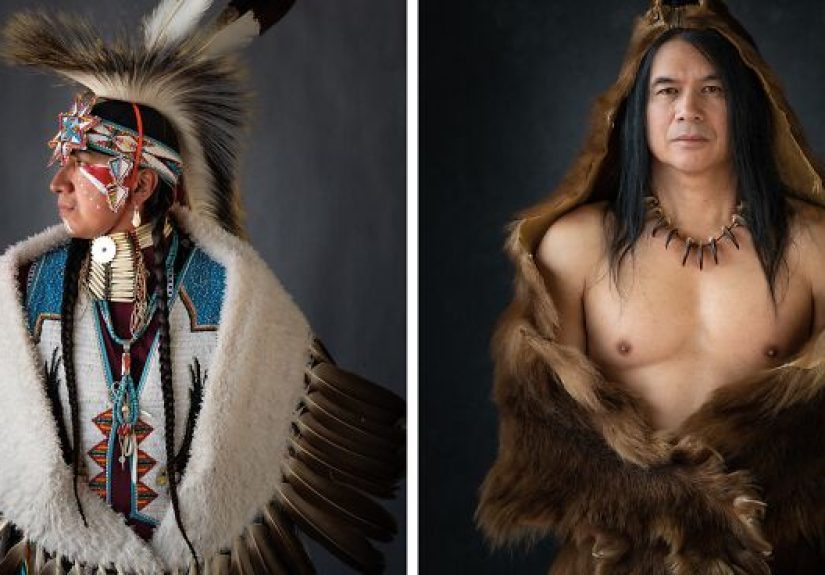
One of the most striking early portrait types shows an Apsáalooke, or Crow, dancer in traditional dress. The close framing draws attention to the face, feathers, hair, and breastplate. A portrait like this reminds us that dance regalia is not decoration for decoration’s sake. It belongs to performance, memory, public presence, and personal dignity. The dancer is not “playing a role.” He is carrying one.
2. The Diné Portrait With Silver and Turquoise
Portraits of Diné, or Navajo, people often feature silverwork, turquoise, shell necklaces, woven blankets, and velvet garments. These materials reflect trade, artistry, adaptation, and regional identity. A silver button or turquoise earring might look like a small detail to a casual viewer, but in a portrait it can become a quiet headline: craftsmanship lives here.
3. The Plains Beaded Dress Portrait
In portraits of Plains women, beadwork can function like a visual language. Geometric patterns, colors, and motifs may reflect family knowledge, personal achievement, or cultural teachings. A beaded dress is not simply “pretty,” although it often is spectacular. It is labor-intensive art. If you have ever lost patience threading a needle, imagine creating a garment that carries beauty, symbolism, and community pride bead by bead.
4. The Lakota Parade Regalia Portrait
Lakota parade regalia often connects people, horses, celebration, and public honor. Horse masks, beadwork, feathers, and decorated accessories reveal the importance of the horse in many Plains communities after its introduction reshaped travel, hunting, warfare, diplomacy, and ceremony. In portrait form, Lakota regalia can communicate movement even when the sitter is perfectly still.
5. The Tlingit Clan Crest Portrait
A Tlingit portrait featuring a robe or crest design should be read through kinship and clan identity. In Tlingit cultural contexts, crests can announce who a person is within a social system. Regalia may identify clan, house, and inherited relationships. This is a reminder that not every symbol is public property. Some designs are connected to rights, responsibilities, stories, and permissions.
6. The Yakama Wingdress Portrait
Yakama girls and women may wear the tł’píip, or wingdress, in ceremonial and powwow contexts. The dress carries ties to Plateau traditions and can be adapted for different forms of dance. A portrait of a young dancer in a wingdress captures more than clothing; it captures continuity. The garment moves between longhouse teachings, family guidance, social dance, and intertribal powwow life.
7. The Fancy Shawl Dancer Portrait
Fancy Shawl regalia is full of motion, color, fringe, and energy. Even in a still portrait, the shawl seems ready to lift. This style is often associated with grace, speed, and expressive movement. The portrait may show a young woman or girl poised between tradition and personal style, because powwow regalia often evolves with the dancer’s age, experiences, and family support.
8. The Elder Wrapped in a Blanket
Some portraits are quiet: an elder wrapped in a blanket, facing the camera with a calm expression. Blankets can carry warmth, trade history, status, gift-giving traditions, and ceremonial meaning. A blanket portrait can feel simple at first glance, but simplicity is not emptiness. It is often where the strongest presence lives.
9. The Warrior Shirt Portrait
Historic portraits featuring decorated shirts, hair ornaments, painted designs, or feather elements are sometimes described too casually as “warrior portraits.” Careful interpretation matters. Certain items may relate to bravery, leadership, honor, or specific achievements, but outsiders should avoid guessing. The most respectful reading begins with the nation, the maker, the wearer, and the documented context.
10. The Pueblo Jewelry Portrait
Portraits from Pueblo communities may include layered necklaces, shell, turquoise, silver, woven garments, and carefully arranged hair. Pueblo adornment traditions are diverse and deeply connected to place, ceremony, and family. In these portraits, jewelry is not an accessory tossed on five minutes before the camera clicks. It is part of a larger cultural vocabulary.
11. The Hopi Portrait With Traditional Hair
Historic Hopi portraits sometimes draw attention to distinctive hairstyles, woven garments, and jewelry. Hair can carry cultural, age-related, ceremonial, or community meaning. A respectful viewer does not reduce the image to “interesting hair.” Instead, the viewer asks what the hairstyle meant in its own cultural setting and how the portrait was made.
12. The Blackfeet Portrait With Hair and Paint
Blackfeet portraits may show arranged hair, face paint, blankets, beadwork, or other regalia elements. Paint and hair are not random visual drama. They may relate to identity, ceremony, mourning, protection, honor, or personal history. The portrait becomes a record of presence, but also a reminder that not everything visible is fully explainable to outsiders.
13. The Nez Perce Leader Portrait
Portraits of Nez Perce leaders often carry a powerful combination of personal dignity and political history. Regalia in such portraits can include feather elements, blankets, necklaces, or decorated garments. These images should not be separated from the larger history of Native sovereignty, treaty rights, displacement, resistance, and survival. A beautiful portrait can also be a serious document.
14. The Apache Portrait With Headwear
Apache portraits may include cloth head coverings, beaded caps, feathers, blankets, or other regional garments. Early photographers sometimes emphasized dramatic lighting and solemn poses, which could make sitters appear frozen in an imagined past. A modern viewer should admire the artistry while also asking: Who controlled the pose? Who chose the clothing? Who benefited from the image?
15. The Arctic and Subarctic Portrait
Portraits from Alaska Native communities, including Iñupiat, Yup’ik, and other peoples, may feature parkas, fur, skin sewing, boots, mitts, and weather-wise design. These garments reflect environmental knowledge as much as style. In a cold climate, beauty and survival are not enemies; they are best friends who share a sewing kit.
16. The Contemporary Native Portrait
Modern Native portraiture changes the power dynamic. Contemporary Indigenous photographers and artists often invite sitters to choose how they appear, what they wear, and how they want to be remembered. A portrait may include traditional regalia, streetwear, graduation attire, beadwork earrings, ribbon skirts, tattoos, or all of the above. Authenticity is not limited to the past. Native people are not museum shadows. They are living communities, artists, students, veterans, parents, leaders, language keepers, designers, and storytellers.
The Complicated Legacy of Early Native American Portrait Photography
Many iconic images of Native Americans in traditional regalia come from Edward S. Curtis and other early photographers. Curtis created a massive visual record of Native peoples across North America, and many of his portraits remain famous for their lighting, composition, and emotional force. However, his work is also debated because he sometimes staged scenes, removed modern objects, or emphasized a romantic idea of Native people as “vanishing.”
That matters because Native communities were not vanishing. They were surviving forced removals, broken treaties, boarding schools, bans on ceremonies, land loss, and government pressure to assimilate. A portrait of a person in regalia may look timeless, but it was often made during a very specific and difficult historical moment. If we view these images only as art, we miss the political and human reality around them.
The better approach is not to throw the photographs away or worship them uncritically. It is to read them carefully. Who is named? Who is unnamed? Was the regalia the sitter’s own? Was the image made in a studio or in the community? Was the person posing by choice, by direction, or somewhere in between? Good historical viewing asks good questions.
How to Look at Native American Regalia Respectfully
Use the Right Words
Say “regalia,” “traditional clothing,” “traditional dress,” “ceremonial attire,” or the specific garment name when known. Avoid “costume.” A costume usually implies pretending. Regalia is connected to identity, belonging, responsibility, and lived culture.
Look for Specificity
Whenever possible, identify the Native nation, community, maker, wearer, photographer, date, and occasion. “Native American” is a broad umbrella term. A portrait becomes more accurate and more respectful when it names the people and context involved.
Do Not Treat Sacred Items as Props
Some regalia elements are sacred, restricted, inherited, or earned. They should not be copied for parties, marketing campaigns, Halloween outfits, music festivals, or “boho” photo shoots. If your outfit requires an apology later, consider this your friendly warning from the internet.
Remember That Regalia Evolves
Authentic does not mean old-fashioned. Contemporary powwow regalia may include modern fabrics, bright colors, rhinestones, family heirlooms, new beadwork, athletic shoes, pins, or personal designs. Native tradition is not trapped behind glass. It grows, adapts, and keeps dancing.
What These 16 Portraits Reveal About Native Identity
Together, these portraits show that regalia is both personal and collective. It may tell a story about a dancer, a family, a clan, a ceremony, a region, a political history, or a spiritual relationship. It may be worn for joy, mourning, prayer, competition, graduation, remembrance, or public celebration. A single portrait can hold many layers at once.
They also reveal the limits of photography. A camera can preserve the curve of a shell necklace or the sparkle of beadwork, but it cannot automatically explain meaning. Meaning comes from community knowledge, oral history, language, and lived experience. The image is a doorway, not the whole house.
Experiences Related to Viewing Native American Portraits in Traditional Regalia
Encountering portraits of Native Americans in traditional regalia can feel different from viewing ordinary historical photographs. The experience often begins with visual admiration: the symmetry of beadwork, the power of a direct gaze, the softness of a blanket, the lift of feathers, the geometry of a woven pattern, or the glow of silver and turquoise. Then, if the viewer is paying attention, admiration turns into questions. Who made this? Who wore it? What did it mean? Was it chosen freely? Was it ceremonial, social, inherited, borrowed, or staged?
For many people, museum galleries and online archives are the first places where these questions come alive. A visitor may walk past a portrait expecting a simple historical image and suddenly realize that every visible detail is doing cultural work. A beaded dress is not just a dress. A clan crest is not just a design. A shawl is not just fabric. Even posture matters. Some sitters meet the lens with calm confidence; others appear guarded, tired, proud, curious, or intentionally unreadable. That unreadability is important. Viewers are not entitled to everything.
Another powerful experience is comparing older portraits with contemporary Native photography. Early images often present Native people as if they belong only to the past. Contemporary portraits challenge that idea immediately. Today’s Native artists and sitters may combine regalia with modern clothing, urban settings, graduation caps, ribbon skirts, skateboards, military medals, or handmade jewelry. The result is not less authentic. It is more complete. It says Native identity is not a sepia photograph. It is present tense.
Powwows and cultural events can deepen this understanding, especially when visitors follow local rules and listen more than they perform enthusiasm. Seeing dancers in motion changes how one reads still portraits. Fringe swings. Bells sound. Shawls open like wings. Beadwork catches the light. Families help one another adjust garments. Children learn by watching older relatives. The regalia is not isolated on a mannequin; it is part of relationships, songs, meals, jokes, protocol, and community care.
There is also an ethical experience involved: the moment a viewer realizes that appreciation has responsibilities. It is fine to admire beauty. It is better to admire beauty with context. That means not copying sacred designs, not using portraits as generic decoration, not calling regalia a costume, not assuming one tribe represents all Native peoples, and not treating old photographs as perfect truth. Respectful viewing is active. It asks the viewer to trade quick consumption for patient attention.
Perhaps the most meaningful experience is leaving a portrait with more humility than certainty. The image may teach a little, but it also points toward what we do not know. That is not a failure. It is an invitation. These portraits ask us to recognize Native peoples as diverse, living, creative, sovereign communities whose cultural expressions deserve accuracy, respect, and room to speak for themselves.
Conclusion
The 16 authentic portraits of Native Americans posing in traditional regalia are more than beautiful images. They are cultural records, artistic statements, family reflections, historical documents, and sometimes complicated products of colonial-era photography. To understand them well, we must look beyond the surface and recognize the people, nations, makers, materials, and meanings behind the regalia.
Regalia is not a costume. It is a living expression of identity, responsibility, continuity, and pride. Whether we are viewing an Apsáalooke dancer, a Diné elder, a Yakama girl in a wingdress, a Tlingit dancer with a clan crest, or a contemporary Native portrait made on the sitter’s own terms, the same rule applies: look closely, learn carefully, and respect deeply.