Table of Contents >> Show >> Hide
- Why Track Lighting Works So Well in a Kitchen
- The 3 Main Types of Kitchen Track Lighting
- How to Choose the Right Type for Your Kitchen
- Real-Life Experiences and Tips with Kitchen Track Lighting
- 1. Everyone underestimates how useful adjustability really is
- 2. Track lighting can rescue older kitchens without a full remodel
- 3. Dimmers turn your kitchen from “workspace” to “hangout”
- 4. Cleanliness matters more than you think
- 5. Mixing track with other fixtures makes the kitchen feel intentional
- 6. Don’t be afraid to start small and expand
- Conclusion
If your kitchen feels like a dim cave where recipes go to fail, track lighting might be the hero fixture you’ve been waiting for. Modern
kitchen track lighting is flexible, relatively easy to install, and surprisingly stylish. Instead of one lonely ceiling light,
you get a whole lineup of adjustable heads you can aim at islands, countertops, wall cabinets, or that one corner where everyone always ends up hanging out.
In this guide, we’ll walk through three practical types of kitchen track lighting, how they work, when to use each, and what to watch out for.
By the end, you’ll know whether your kitchen needs a simple bar, a sleek linear run, or a sculptural monorail curving over your island like a
little lighting roller coaster.
Why Track Lighting Works So Well in a Kitchen
Kitchens are multitasking spaces: you chop and cook, answer emails, help with homework, and sneak late-night snacks in the exact same room.
That means you need layered lighting: ambient lighting to brighten the whole space, task lighting for work zones, and accent lighting to show
off your backsplash or open shelves. Track lighting can do all three in one system.
Because the heads are adjustable and often repositionable along the track, you can:
- Point bright task light onto countertops and the sink area.
- Angle a few heads toward the ceiling or walls to bounce softer ambient light around the room.
- Highlight décor such as artwork, a display shelf, or a pretty range hood.
Pair that flexibility with efficient LED bulbs, dimmers, and sleek modern designs, and you get a lighting workhorse that doesn’t require gutting
your ceiling or adding a dozen recessed cans.
The 3 Main Types of Kitchen Track Lighting
There are endless variations, but most kitchen-friendly track systems fall into three big buckets:
- Fixed and swing-arm track bars.
- Standard linear track systems.
- Flexible monorail track systems.
Let’s break each one down in plain English, with real-world pros, cons, and kitchen examples.
1. Fixed and Swing-Arm Track Bars
Think of fixed and swing-arm track bars as “track lighting for people who don’t want to overthink it.” These units usually come as a single bar
with a few permanently attached heads. The heads pivot and tilt, but you can’t slide them along the bar. Swing-arm versions add one or more
articulated arms that can rotate outward, giving you more reach and movement without the complexity of a full track system.
Best for: Small to medium kitchens and quick upgrades
If you’re replacing a dated flush-mount dome over the center of the room, a fixed track bar is often a direct swap. Many fixtures use a standard
junction box and can be installed in about the same time it takes to debate what’s for dinner. This makes them perfect for:
- Galley kitchens where you want to aim heads down both countertop runs.
- Small apartments with one main ceiling outlet in the kitchen.
- Budget-conscious remodels where you want a modern look without rewiring the whole ceiling.
Pros of fixed and swing-arm track bars
- Simple, clean appearance (it looks like a slightly fancy bar light).
- Usually cheaper and easier to install than multi-piece track systems.
- Great for low ceilings where you don’t want a lot of hardware hanging down.
- Plenty of styles, from industrial cage heads to minimalist tubes and farmhouse-inspired bars.
Cons to keep in mind
- You can’t add more heads along the bar. If you realize you need more light later, you might need a whole new fixture.
- Because the layout is fixed, you’re somewhat stuck with the original spacing of the lights.
- In a large kitchen, a single bar often isn’t enough to cover all work areas, so you’ll still want under-cabinet lighting or another ceiling fixture.
Fixed and swing-arm bars are perfect when you want the look and adjustability of track lighting without committing to a modular system. They are
especially good “starter track” options for renters (with landlord approval) or first-time homeowners.
2. Standard Linear Track Systems
Standard linear track systems are what most people picture when they hear “track lighting.” You get a straight run of track, usually mounted
directly to the ceiling, plus a set of heads that slide anywhere along that track. The heads click into place and can be aimed almost any direction.
Best for: Flexible, hardworking kitchens
Linear track is ideal when your kitchen layout might change or when you want to fine-tune the lighting over time. Maybe you start with all the heads
along the island and then later move a couple toward a new coffee station or a wall of open shelving. No new wiring required; you just unlock the
head, slide, and re-angle.
You’ll often see linear track used to:
- Run along the length of a peninsula or island, with heads aimed at both prep and seating sides.
- Follow the main working side of a U-shaped kitchen.
- Line up near the wall to wash a backsplash or tall cabinets with light.
Pros of linear track
- Highly flexible: move heads as your layout or habits change.
- Easy to expand: many systems let you connect multiple track lengths or add more heads later.
- Works well with different head types, from spot-style heads to mini pendants.
- Good balance of cost, performance, and aesthetics for most homes.
Cons of linear track
- The track is visible. If you prefer an ultra-minimal ceiling, you might lean toward recessed lighting instead.
- On very low ceilings, track can feel a bit busy if it’s overdone or installed too low.
- You still need to design your layout thoughtfully so you don’t end up with bright hot spots and dark corners.
For many homeowners, a straightforward linear track with LED heads and a dimmer is the sweet spot: bright when you’re cooking, softer when you’re
enjoying a glass of wine at the island.
3. Flexible Monorail Track Systems
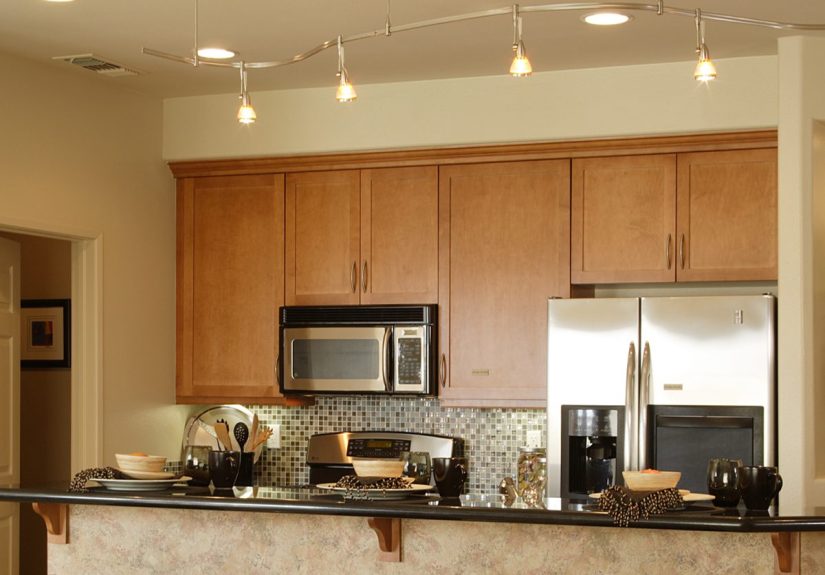
Monorail track systems are like track lighting with a designer twist. Instead of a rigid straight bar, you get a flexible rail that can be curved,
swooped, or serpentine across your ceiling. Heads and pendants can usually be attached anywhere along the rail, giving you endless layout options.
Best for: Open layouts and showpiece kitchens
Monorail really shines (pun fully intended) in kitchens that are open to living or dining spaces. You can curve the rail to follow an island,
trace the perimeter of a work zone, or visually connect the kitchen to an adjacent seating area. Because the system hangs slightly down from the
ceiling on short supports, it also works well with high or vaulted ceilings where a flush track would feel lost.
Pros of monorail track
- Highly customizable shapes that follow your kitchen layout.
- Supports both spot heads and decorative pendants on the same rail.
- Great visual statement without looking cluttered if planned well.
- Ideal for long islands, curved peninsulas, or kitchens with structural beams you need to work around.
Cons of monorail track
- Usually more expensive than basic bars or linear track, both for fixtures and installation.
- Not every style of kitchen needs or matches the “floating rail” look; it’s more modern or contemporary by default.
- Planning is crucial. Once you bend and cut the rail, it’s not as simple to reconfigure as a straight track.
If you love the idea of your lights following the natural flow of your kitchen instead of fighting it, monorail can be worth the investment. It’s
especially appealing when you want your lighting to be part of the design, not just functional background hardware.
How to Choose the Right Type for Your Kitchen
Match the track to your layout
Start by sketching your kitchen from abovecabinet lines, island, major appliancesand then draw where people stand and move. A narrow galley? A
fixed or swing-arm bar might be plenty. A big L- or U-shaped workspace? Consider linear track that runs parallel to your main counters. A large,
open-concept kitchen with a curved island? That’s monorail territory.
Think in layers: ambient, task, and accent
Even with the most flexible track system, it’s rare that track lighting alone will perfectly light every inch of your kitchen. Pair it with:
- Recessed or surface-mount fixtures for background ambient light.
- Under-cabinet lights for countertop task lighting.
- Pendants or a few angled heads to highlight focal points like shelves or artwork.
Track lighting performs best when it’s part of a team, not working solo.
Choose the right heads and bulbs
For most kitchens, small LED heads with a warm white color temperature (around 2700K–3000K) hit the sweet spot between “bright and clean” and
“not a hospital.” Narrower beams are great for spotlighting art or a bar cart, while wider beams are better for washing countertops with light.
You can also mix heads and pendants on many systemsfor example, spot heads over the prep zones and glass pendants hanging lower over the island
seating. This helps you combine function and style without adding more electrical boxes.
Plan for controls and dimming
A dimmer switch on your kitchen track lighting is almost non-negotiable. Full brightness is perfect for chopping onions or reading tiny recipe
print, but you’ll want a softer level when the kitchen is doing double duty as a hangout space. If your system supports it, two circuits (one for
the “work” heads and one for the “accent” heads) give you even more flexibility.
Common mistakes to avoid
- Installing the track too close to upper cabinets so doors cast big shadows.
- Pointing all heads straight down instead of aiming them toward work surfaces and walls.
- Using overly cool, bluish light that makes food and people look tired.
- Overloading a small kitchen with too many fixtures, making the ceiling feel cluttered.
A little planning goes a long wayonce your track is up and wired, the fine-tuning comes from where you aim the heads and how bright you run them.
Real-Life Experiences and Tips with Kitchen Track Lighting
Advice is great, but nothing beats lived experience. Here are some patterns that tend to show up once people actually live with kitchen track
lighting for a while.
1. Everyone underestimates how useful adjustability really is
At first, adjusting track heads feels like a noveltyyou’ll probably spend your first evening aiming them at everything that doesn’t move.
But once the “new toy” effect wears off, you start to appreciate the practical side. Maybe you realize your baking station gets used more than
your blender nook, so you swing an extra head over to that area. Or you rearrange your dining table and simply slide a head or two to follow it.
It’s like being able to rearrange your ceiling without opening the drywall.
2. Track lighting can rescue older kitchens without a full remodel
If you’re in an older home where “lighting plan” clearly wasn’t a phrase the builder had heard of, track systems are a smart way to cheat a better
layout. A single existing junction box can often feed a track that runs across the room, giving you light over countertops, the sink, and the
island from one connection point. Toss in some LED bulbs and a dimmer, and suddenly your 1980s kitchen feels a lot more 2025, even if the oak
cabinets are still hanging on.
3. Dimmers turn your kitchen from “workspace” to “hangout”
One common regret people share is not installing a dimmer from day one. Full-bright track lighting is excellent for heavy-duty cooking, but it’s
way too intense for a movie-night snack run or a quiet breakfast. With dimming, you can keep a few heads on at a low glow aimed at the backsplash,
creating a cozy night-light effect that still keeps you from tripping over the dog.
4. Cleanliness matters more than you think
Track heads and rails collect dust and cooking residue, especially in kitchens without strong ventilation. The good news: they’re generally easier
to wipe down than glass flush-mount fixtures or ornate chandeliers. A quick pass with a microfiber cloth every month or two keeps everything
looking sharp and prevents greasy buildup from dulling the light.
5. Mixing track with other fixtures makes the kitchen feel intentional
Some of the most successful kitchens combine a modest track with a few statement pieces. For example, a pair of oversized pendants over the island
plus a slim black linear track along the perimeter gives you that designer look you see in magazines. The track handles the serious work lighting,
while the pendants bring style and a warm glow to the seating area.
6. Don’t be afraid to start small and expand
If you’re nervous about committing, it’s totally reasonable to start with a fixed track bar or a short linear track and see how you like living
with it. Later, you can add more lengths, swap out heads for nicer ones, or upgrade to a monorail system if you fall in love with the flexibility.
Many homeowners discover that once they get used to directional lighting in the kitchen, they want similar control in hallways or over art in the
dining room.
Conclusion
Track lighting doesn’t have to scream “1990s condo remodel” anymore. Today’s kitchen track lighting is sleek, efficient, and
highly adaptable to the way you actually cook and live. Fixed and swing-arm bars offer a simple, affordable upgrade; standard linear track systems
give you serious flexibility for everyday kitchens; and flexible monorail systems turn your lighting into a design feature that follows the lines
of your space.
Choose the type that fits your layout, pair it with the right heads and LED bulbs, and layer it with under-cabinet and ambient lighting. Add a
dimmer, keep the fixtures clean, and don’t be afraid to tweak the aim of your lights as your kitchen habits evolve. You’ll end up with a bright,
functional, and inviting room where every zonefrom island prep to midnight snack patrolgets its moment in the spotlight.