Table of Contents >> Show >> Hide
- Before Anything Else: Stop the Bleeding
- Way #1: Ask for an Extension the Right Way (Fast, Specific, and Polite)
- Way #2: Negotiate a “Partial Submission” or a Two-Step Deadline
- Way #3: Build a 24–72 Hour “Catch-Up Plan” That Actually Works
- What Not to Do When You’re Overdue
- Conclusion: You Can’t Undo the Deadline, But You Can Control the Next Step
- Real-World Experiences: What “Buying Time” Actually Looks Like
You know that moment when you open your learning portal and the due date is… yesterday?
Congratulations: you’ve discovered time travel. Unfortunately, your gradebook did not come with you.
The good news: “overdue” doesn’t always mean “over.” In a lot of classes, you can still salvage pointsor
even get an extensionif you handle it like an adult who accidentally set their adulting down for a minute.
Below are three practical, respectful ways to buy more time without burning bridges (or inventing a fake
grandma’s funeralplease don’t do that).
Before Anything Else: Stop the Bleeding
When an assignment is overdue, your worst enemy isn’t the professorit’s silence. The longer you wait,
the more the story in your instructor’s head becomes: “They vanished. They gave up. They’re ignoring the class.”
Your goal is to replace that story with a better one: “They hit a snag, they communicated, and they’re making a plan.”
That plan starts with three quick checks:
- Read the syllabus and the assignment page. Many courses spell out late penalties, “grace periods,” or “late days.”
- Check whether the submission link is still open. If you can submit now, submit something now (even a partial draft).
- Decide what you’re asking for: extra time, partial credit, or a revised deliverable. Be specific.
Now, let’s talk about three ways to buy time that don’t require a DeLorean.
Way #1: Ask for an Extension the Right Way (Fast, Specific, and Polite)
If you need more time, you can absolutely ask. The key is to do it like someone who respects the instructor’s
time and the course rules. Vague messages (“I’ve had a lot going on”) tend to get vague results (“See syllabus.”).
Clear requests get clearer answers.
What to include in an extension request
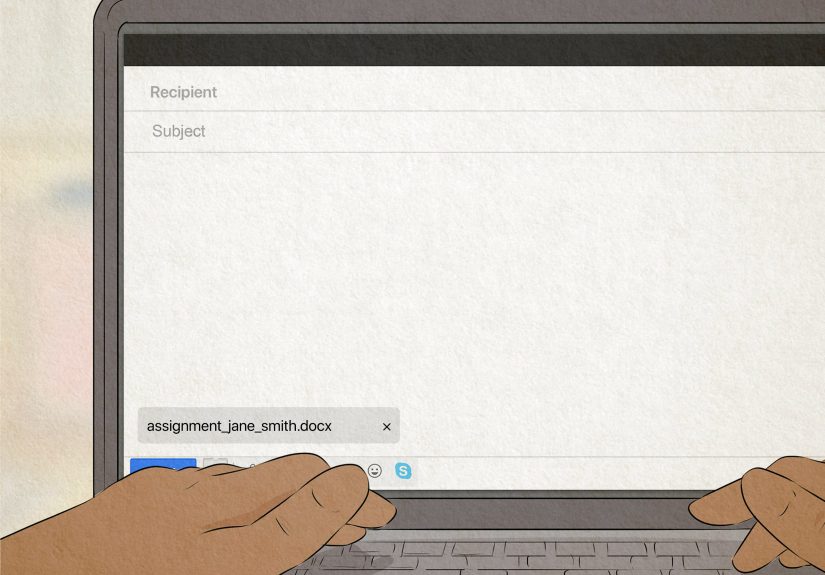
- A useful subject line: “Extension request [Course] [Assignment]”
- Who you are: your name + class section if relevant
- What you missed: the exact assignment and original due date/time
- A brief, honest reason: one or two sentencesno essay, no dramatic trilogy
- Your specific ask: how much time you need and the new deadline you’re requesting
- Your plan: what you’ll do between now and the new deadline
- Gratitude + professionalism: “Thank you for considering this.”
Be realistic about the time you request
Asking for “an extra week” when the assignment was due last night can feel like asking the dentist for “just
one more year before the root canal.” Instead, propose something realistic:
- 24–48 hours for shorter or weekly assignments
- 3–7 days for bigger papers or projects (when the course structure allows it)
Even if your instructor can’t grant the full request, proposing a reasonable timeline signals that you’re
trying to solve the problemnot auditioning for a procrastination documentary.
A copy-and-paste email template (edit it so it sounds like you)
Two common mistakes that tank extension requests
- Over-explaining. Instructors don’t need your full life story. They need clarity.
- “Can I get an extension?” with no proposed deadline. Make it easy to answer yes/no.
One more thing: if you have an approved accommodation through your school’s accessibility/disability office,
follow that process. Those systems often have guidelines for how extensions work and what documentation is (or isn’t)
required. It’s not “special treatment”it’s an established support pathway.
Way #2: Negotiate a “Partial Submission” or a Two-Step Deadline
Sometimes the clean extension isn’t availablemaybe the assignment is tied to class discussion, peer review, labs,
or graded presentations. In that case, your best move is to offer a compromise that preserves course integrity while
still giving you breathing room.
Option A: Submit what you have now, and finish the rest on a short timeline
This approach works especially well when your instructor values process: outlines, drafts, code that runs, partial
problem sets with work shown, etc. Even incomplete work can earn partial credit and show good faith.
Example: Your research paper is overdue. You can submit:
- your thesis + outline
- a preliminary bibliography with 5–8 credible sources
- 2–3 drafted paragraphs
- a short note describing what’s left and when you’ll deliver it
Option B: Ask for a narrower deliverable that still demonstrates learning
This is the “I’m not asking you to rewrite the rules of the universe, just the assignment shape” strategy. You’re
not trying to dodge the workyou’re trying to meet the learning objective under time pressure.
Examples of a narrower deliverable you can propose:
- Instead of a full lab report: submit results + discussion now, with methods later.
- Instead of a full presentation deck: submit an outline + speaker notes, then present next class.
- Instead of a complete coding project: submit the working core features plus a brief “next steps” plan.
Option C: Request a quick meeting to align on the fastest path to “acceptable”
Office hours or a 10-minute Zoom can save you hours of guessing. Your question is simple:
“What would you consider the minimum viable submission for partial credit?”
It shows you care about learning outcomes, not just damage control.
A script you can use (email or in-person)
This strategy often works because it respects the instructor’s constraints while still giving you what you need:
time to finish well.
Way #3: Build a 24–72 Hour “Catch-Up Plan” That Actually Works
Buying time is only helpful if you use it. Otherwise you’re just rescheduling the panic. The fastest way to turn
an overdue assignment into a submitted assignment is to stop thinking of it as “one big thing” and start treating
it like a checklist.
Step 1: Break the assignment into tiny, finishable chunks
If your brain keeps saying “This is huge,” it will also keep saying “Let’s scroll for just one more minute.”
Break it down until each step feels almost too easy.
- Open the rubric and copy the requirements into a checklist
- Create headings in your document (even if they’re empty)
- Collect sources (or data) for 30 minutes
- Write a messy draft for one section only
- Revise for clarity, then for formatting
Step 2: Use timeboxing (hello, Pomodoro) to force momentum
The Pomodoro Technique is simple: work in focused bursts (often 25 minutes), then take a short break (about 5 minutes).
After four rounds, take a longer break. It’s popular for a reasonit lowers the “starting” pain and helps you stay
focused without burning out.
A practical Pomodoro rule for overdue work: during the 25 minutes, you can’t do anything that future-you
would label “productive procrastination.” That means no “just reorganizing my notes” for an hour. You’re
writing, solving, coding, or building something that can be submitted.
Step 3: Choose the “grade-saving” path, not the “perfect” path
When time is tight, perfection is a luxury item. Aim for:
- Requirements first: answer every prompt, hit the rubric points
- Clarity over creativity: simple structure beats fancy wording
- Submission over polishing: a decent paper turned in beats a brilliant one trapped in your laptop
A 48-hour sample plan (steal this)
Let’s say you got a 48-hour extension (or a grace period). Here’s a plan that turns that time into a submission:
- Hour 1: Read the rubric, build your checklist, set up your document headings.
- Hours 2–4: Research/collect materials in Pomodoros; paste quotes/data with citations/notes.
- Hours 5–7: Draft the “easiest” section first to build momentum.
- Hours 8–10: Draft the core argument/problem-solving/code core.
- Hour 11: Quick pass for missing requirements (use the checklist).
- Hour 12: Format, references, and final proofread.
- Buffer time: Keep 30–60 minutes for uploading issues, file conversion, or last-minute fixes.
If you only have 24 hours, cut the research window, simplify the scope, and focus on completing every rubric item once.
What Not to Do When You’re Overdue
Overdue assignments create desperation, and desperation invites bad decisions. Avoid these:
- Ghosting. Silence makes things worse. Communicate.
- Fake excuses. Many student conduct offices explicitly warn against making up reasons to get extensions.
- Academic integrity shortcuts. Don’t copy, don’t fabricate data, don’t submit work that isn’t yours.
- Extension-shopping. Asking three different times for three different deals rarely ends well.
The professional move is simple: be honest, be specific, and show effortthen follow through.
Conclusion: You Can’t Undo the Deadline, But You Can Control the Next Step
When you’re overdue, the win isn’t “feeling less guilty.” The win is a submitted assignment and a repaired relationship
with your schedule. Start with communication (Way #1), offer a workable compromise if needed (Way #2), and use any extra
time like it’s expensive (Way #3).
And if this happens a lot, treat it as informationnot a personality flaw. Your system needs adjusting: smaller milestones,
earlier check-ins, fewer “I’ll do it tomorrow” promises made by a version of you who apparently never sleeps.
: experiences section
Real-World Experiences: What “Buying Time” Actually Looks Like
Below are a few common, real-to-life scenarios students describe when they’re trying to buy time on overdue work.
Think of these as “field notes” from the land of missed deadlinesno judgment, just patterns.
1) The Midnight Email That Worked (Because It Had a Plan)
A student realizes at 11:38 p.m. that the assignment was due at 11:59 p.m. They could sprint and submit something chaotic,
but instead they send a short message that night: course name, assignment name, a clear apology, and a specific request
for a 24-hour extensionplus a plan (“finish the last two sections tomorrow morning and revise tomorrow afternoon”).
What makes this work isn’t the drama. It’s the clarity. Instructors are more likely to say yes when the student is
concrete, respectful, and realistic about the timeline. Even when the instructor says no, the student often gets a
softer landing: permission to submit late with the standard penalty, or guidance on what’s most important to complete.
2) The “I Submitted Something” Pivot That Saved Partial Credit
Another student is behind on a multi-part project and assumes, “If it’s not perfect, it’s pointless.” That belief
quietly turns into a zero. Then they try a different approach: they submit the parts that are donemaybe the outline,
the data tables, the first half of the code, or the solved problems with steps shownalong with a short note describing
what’s missing and what they’ll add next.
This is where partial credit becomes real. In many classes, instructors can award points for correct pieces, thoughtful
work shown, or a functioning coreeven if the final polish is missing. The student’s work isn’t magically complete, but
it’s now gradable. And once something is gradable, it can earn points, feedback, and momentum.
3) The Pomodoro Comeback (AKA “I Didn’t Wait for Motivation”)
The most common experience students report is this: they kept waiting to “feel ready,” and readiness never showed up.
What finally changed things was a tiny, structured start. They set a timer for 25 minutes and promised themselves they
could stop after one round. The first round was messymaybe they just created headings and wrote bullet points. But the
second round got slightly cleaner. By the fourth round, the work had a shape.
The surprising part is how often momentum beats mood. Students who timebox their work frequently say they stop negotiating
with themselves. The timer becomes the decision-maker: “I work now, I rest later.” Over a couple of hours, that turns a
terrifying overdue assignment into a draft that can be improved.
What these experiences have in common
In every scenario, the “time” they gained wasn’t just extra hours on the clockit was reduced uncertainty. A clear email
reduced uncertainty about what the instructor would accept. A partial submission reduced uncertainty about whether any
credit was possible. A timed work sprint reduced uncertainty about whether they could even start.
If you’re overdue today, borrow the pattern: communicate clearly, submit something workable, and use structured focus to
finish. It’s not glamorous, but it’s effectiveand honestly, “effective” is the vibe we’re going for.