Table of Contents >> Show >> Hide
- Introduction: Why Catholic Symbols Speak Louder Than Décor
- What Are Catholic Religious Symbols?
- 50+ Common Catholic Symbols and Their Meanings
- 1. Crucifix
- 2. Cross
- 3. Sign of the Cross
- 4. Chi-Rho
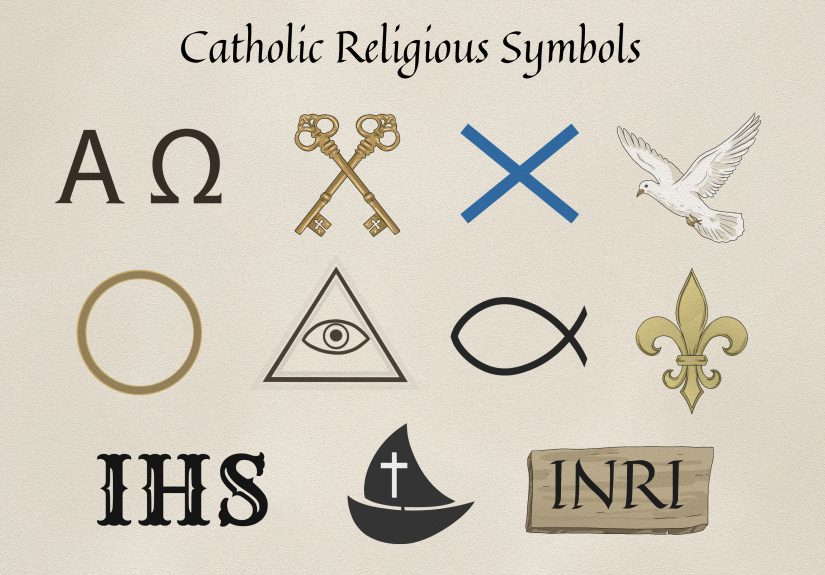
- 5. Alpha and Omega
- 6. IHS
- 7. INRI
- 8. Fish, or Ichthys
- 9. Lamb of God
- 10. Dove
- 11. Fire or Flame
- 12. Water
- 13. Shell
- 14. Bread
- 15. Wine
- 16. Chalice
- 17. Host
- 18. Grapes
- 19. Wheat
- 20. Altar
- 21. Tabernacle
- 22. Sanctuary Lamp
- 23. Monstrance
- 24. Ciborium
- 25. Paschal Candle
- 26. Candles
- 27. Incense
- 28. Thurible
- 29. Holy Oils
- 30. Sacred Chrism
- 31. Rosary
- 32. Brown Scapular
- 33. Miraculous Medal
- 34. St. Benedict Medal
- 35. Sacred Heart of Jesus
- 36. Immaculate Heart of Mary
- 37. Lily
- 38. Rose
- 39. Star
- 40. Crown
- 41. Halo
- 42. Keys
- 43. Sword
- 44. Book of the Gospels
- 45. Ambo
- 46. Palm Branches
- 47. Ashes
- 48. Violet or Purple
- 49. White and Gold
- 50. Red
- 51. Green
- 52. Rose
- 53. Triangle
- 54. Trefoil
- 55. Eye of Providence
- 56. Pelican
- 57. Anchor
- 58. Peacock
- 59. Rooster
- 60. Jerusalem Cross
- How to Understand Catholic Symbols Without Getting Lost
- Real-Life Experiences With Catholic Symbols
- Conclusion: Catholic Symbols Are Small Doors Into Big Mysteries
- SEO Tags
Editorial note: This article is written for general education and web publishing. Catholic symbols can vary slightly by culture, parish tradition, and artistic style, but their core meanings are rooted in Scripture, liturgy, devotion, and centuries of Catholic practice.
Introduction: Why Catholic Symbols Speak Louder Than Décor
Walk into a Catholic church and you may feel as if the building is quietly talking to you. The crucifix above the altar, the candles near the sanctuary, the stained-glass saints, the smell of incense, the red sanctuary lamp, the water at the entrance, and even the colors of the priest’s vestments all say something. Catholic religious symbols are not random decorations tossed around like holy confetti. They are visual theology.
For Catholics, faith is not only heard in sermons or read in books. It is seen, touched, smelled, sung, and practiced. A rosary in someone’s pocket may remind them to pray. A palm branch tucked behind a crucifix may recall Christ’s entry into Jerusalem. A white garment at Baptism points to new life. A candle at Easter announces that darkness does not get the final word.
This guide explains more than 50 common Catholic symbols and what they mean. Some are ancient, like the fish and Chi-Rho. Some appear at Mass every week, like the chalice and altar. Others live in homes, cars, school classrooms, jewelry boxes, prayer corners, and grandmothers’ pursesthe unofficial headquarters of Catholic sacramentals worldwide.
What Are Catholic Religious Symbols?
Catholic symbols are visible signs that point to invisible truths. They help believers remember God’s presence, the life of Jesus Christ, the sacraments, Mary, the saints, Scripture, and the Church’s mission. Some symbols are used in official liturgy, such as bread, wine, water, oil, candles, incense, vestments, and the altar. Others are devotional, such as medals, rosaries, holy cards, scapulars, and statues.
It is important to say this clearly: Catholics do not worship symbols. A crucifix is not God. A statue is not the saint. A medal is not a magic coin from heaven’s vending machine. Catholic symbols work like windows. They help the faithful look through ordinary things toward sacred realities.
50+ Common Catholic Symbols and Their Meanings
1. Crucifix
The crucifix is a cross bearing the body of Jesus. It is one of the most recognizable Catholic symbols because it shows Christ’s sacrifice, love, and victory through suffering. In Catholic churches, the crucifix near the altar reminds worshippers that the Mass is connected to the sacrifice of Christ.
2. Cross
The plain cross points to the death and resurrection of Jesus. While the crucifix emphasizes Christ’s suffering, the empty cross often highlights resurrection and triumph. Both express the central mystery of Christian faith.
3. Sign of the Cross
The Sign of the Cross is both a gesture and a prayer. Catholics touch the forehead, chest, and shoulders while invoking the Father, Son, and Holy Spirit. It marks prayer, blessing, and belonging to the Trinity.
4. Chi-Rho
The Chi-Rho combines the first two Greek letters of “Christ”: Chi, shaped like an X, and Rho, shaped like a P. It is an ancient symbol of Jesus Christ and appears in churches, vestments, art, and sacred objects.
5. Alpha and Omega
Alpha and Omega are the first and last letters of the Greek alphabet. Together, they symbolize Christ as the beginning and the end, the Lord of history, and the eternal Word of God.
6. IHS
IHS is a Christogram, or sacred abbreviation, associated with the name of Jesus. It often appears on altars, vestments, chalices, and hosts. In Catholic art, it reminds believers to honor the holy name of Jesus.
7. INRI
INRI appears above Jesus on many crucifixes. It abbreviates the Latin phrase meaning “Jesus of Nazareth, King of the Jews.” It recalls the inscription placed over Christ at the Crucifixion.
8. Fish, or Ichthys
The fish was an early Christian symbol. The Greek word for fish, “ichthys,” became associated with a confession of faith in Jesus Christ. Today it still represents Christian identity, discipleship, and quiet courage.
9. Lamb of God
The lamb symbolizes Jesus as the innocent sacrifice who takes away sin. It is connected to Passover, the Eucharist, and the phrase “Lamb of God” used at Mass before Communion.
10. Dove
The dove commonly represents the Holy Spirit, especially because the Spirit descends like a dove at Jesus’ Baptism in the Gospels. It also suggests peace, purity, and divine presence.
11. Fire or Flame
Fire represents the Holy Spirit, especially at Pentecost, when tongues of fire appeared over the apostles. It symbolizes transformation, courage, purification, and the warmth of divine love.
12. Water
Water is a powerful Catholic symbol of cleansing, life, and rebirth. In Baptism, water signifies dying and rising with Christ. Holy water at church entrances reminds Catholics of their baptismal identity.
13. Shell
The shell often represents Baptism because water may be poured from a shell in Christian art. It also symbolizes pilgrimage, especially the journey of faith toward God.
14. Bread
Bread symbolizes nourishment, community, and the Eucharist. At Mass, ordinary bread becomes the Body of Christ. This is why the host is treated with deep reverence.
15. Wine
Wine represents joy, covenant, sacrifice, and the Blood of Christ. In the Eucharist, wine becomes Christ’s Blood, making the chalice a major Catholic symbol.
16. Chalice
The chalice is the sacred cup used at Mass. It points to the Last Supper, Christ’s sacrifice, and the Blood of the new covenant.
17. Host
The consecrated host is the Eucharistic Body of Christ. A round white host often symbolizes unity, purity, sacrifice, and divine nourishment.
18. Grapes
Grapes represent wine, abundance, sacrifice, and the Eucharist. They may appear in church carvings, altar designs, and stained glass.
19. Wheat
Wheat symbolizes bread, harvest, sacrifice, and the Eucharist. It reminds Catholics that spiritual life is fed by Christ.
20. Altar
The altar is the central table of sacrifice and thanksgiving. It represents Christ, the place of offering, and the sacred meal of the Eucharist.
21. Tabernacle
The tabernacle is the place where the Eucharist is reserved. It is often beautifully decorated and treated with special reverence because Catholics believe Christ is truly present in the Blessed Sacrament.
22. Sanctuary Lamp
The sanctuary lamp burns near the tabernacle when the Eucharist is present. Its steady flame is a quiet reminder that Christ is there.
23. Monstrance
A monstrance is a sacred vessel used to display the Eucharistic host for adoration. Its sunburst design often symbolizes Christ as the light of the world.
24. Ciborium
The ciborium is a covered vessel used to hold consecrated hosts. It symbolizes reverence for the Eucharist and the Church’s care in distributing Communion.
25. Paschal Candle
The Paschal Candle is lit at the Easter Vigil and used during the Easter season, baptisms, and funerals. It symbolizes the risen Christ, whose light overcomes death.
26. Candles
Candles symbolize prayer, vigilance, sacrifice, and Christ’s light. A small votive candle can say what words sometimes cannot: “Lord, I am still praying.”
27. Incense
Incense represents prayer rising to God. Its fragrance and smoke add solemnity to worship and remind Catholics that prayer involves the whole person, not just the brain.
28. Thurible
The thurible is the metal vessel used to burn incense. When it swings during Mass, it marks honor, blessing, and sacredness.
29. Holy Oils
Holy oils are used in several sacraments. The Oil of Catechumens, Sacred Chrism, and Oil of the Sick symbolize healing, strengthening, consecration, and the presence of the Holy Spirit.
30. Sacred Chrism
Sacred Chrism is perfumed oil used in Baptism, Confirmation, Holy Orders, and the dedication of churches and altars. It symbolizes being sealed, strengthened, and set apart for God.
31. Rosary
The rosary is a string of beads used for meditative prayer focused on the life of Christ and Mary’s role in salvation history. It is not just “Catholic counting beads”; it is a school of prayer.
32. Brown Scapular
The Brown Scapular is a devotional sign associated with Our Lady of Mount Carmel. It represents Marian devotion, discipleship, and a desire to live under Mary’s maternal care.
33. Miraculous Medal
The Miraculous Medal is a Marian medal connected with St. Catherine Labouré. Its imagery points to Mary’s intercession, grace, and her closeness to Christ.
34. St. Benedict Medal
The St. Benedict Medal includes crosses, initials, and prayers associated with protection, conversion, and spiritual resistance to evil. It is a popular Catholic sacramental.
35. Sacred Heart of Jesus
The Sacred Heart shows Christ’s heart, often with flames, a cross, and a crown of thorns. It symbolizes Jesus’ burning love, mercy, suffering, and self-giving compassion.
36. Immaculate Heart of Mary
The Immaculate Heart of Mary usually appears with flames, roses, and a sword. It represents Mary’s love, purity, sorrow, and faithful union with her Son.
37. Lily
The lily symbolizes purity, holiness, and innocence. It is often associated with Mary, St. Joseph, and saints known for chastity or spiritual purity.
38. Rose
The rose can symbolize Mary, beauty, love, martyrdom, and heavenly grace. The rosary’s name is also linked with the image of offering a garland of roses through prayer.
39. Star
The star may represent guidance, hope, and Mary as Star of the Sea. It can also recall the star of Bethlehem that led the Magi to Christ.
40. Crown
The crown represents victory, holiness, martyrdom, and heavenly reward. In Marian art, it also points to Mary as Queen of Heaven.
41. Halo
A halo, or nimbus, is a circle of light around the head of Christ, Mary, angels, or saints. It represents holiness and participation in God’s glory.
42. Keys
Keys are associated with St. Peter and the authority given to him by Christ. They symbolize teaching authority, stewardship, and the Church’s mission.
43. Sword
In Catholic symbolism, the sword may represent martyrdom, spiritual truth, or St. Paul, who is often shown with it. It is a sign of witness, not a celebration of violence.
44. Book of the Gospels
The Book of the Gospels represents the living Word of God proclaimed in the liturgy. It may be carried in procession and honored with incense or candles.
45. Ambo
The ambo is the place where Scripture is proclaimed. It symbolizes the dignity of God’s Word and the Church’s responsibility to listen before acting.
46. Palm Branches
Palm branches recall Jesus’ entry into Jerusalem on Palm Sunday. They symbolize praise, victory, and the beginning of Holy Week.
47. Ashes
Ashes are used on Ash Wednesday as a sign of repentance and mortality. They whisper the message many people avoid: life is short, so turn toward God now.
48. Violet or Purple
Violet is used during Advent and Lent. It symbolizes penance, preparation, humility, and spiritual longing.
49. White and Gold
White and gold symbolize joy, purity, glory, and resurrection. They are used during Christmas, Easter, major feasts of Christ, Marian celebrations, and certain saints’ days.
50. Red
Red symbolizes the Holy Spirit, fire, love, sacrifice, and martyrdom. It is used on Pentecost, Palm Sunday, Good Friday, and feasts of martyrs.
51. Green
Green is the color of Ordinary Time. It symbolizes growth, hope, discipleship, and the steady spiritual work of daily Christian life.
52. Rose
Rose vestments may appear on Gaudete Sunday in Advent and Laetare Sunday in Lent. The color signals joy breaking into a season of preparation.
53. Triangle
The triangle symbolizes the Holy Trinity: Father, Son, and Holy Spirit. Three sides, one shapea simple image for a profound mystery.
54. Trefoil
The trefoil, a three-lobed design, also represents the Trinity. It appears in church architecture, stained glass, and decorative borders.
55. Eye of Providence
The Eye of Providence, often shown within a triangle, represents God’s watchful care and divine knowledge. In Catholic settings, it points to God’s providence rather than superstition.
56. Pelican
The pelican is an old Christian symbol of Christ’s sacrifice. Medieval art imagined the pelican feeding its young from its own breast, making it a symbol of self-giving love.
57. Anchor
The anchor symbolizes hope, stability, and trust in Christ. Early Christians used it as a discreet sign of faith and perseverance.
58. Peacock
The peacock is an ancient Christian symbol of immortality and resurrection. Its brilliant feathers made it a natural image of transformed life.
59. Rooster
The rooster recalls Peter’s denial of Jesus and his later repentance. It symbolizes vigilance, humility, and the grace of beginning again after failure.
60. Jerusalem Cross
The Jerusalem Cross, with one large cross and four smaller crosses, is often interpreted as Christ and the four Gospels, or the mission of the Church spreading to the four corners of the earth.
How to Understand Catholic Symbols Without Getting Lost
The best way to understand Catholic religious symbols is to ask three questions. First, where does this symbol appear? A chalice on an altar has a different role than a chalice printed on a wedding invitation. Second, what does it connect to? A dove may point to the Holy Spirit, Baptism, peace, or all three. Third, how is it used in prayer? Catholic symbols are not museum pieces. They are meant to guide worship, memory, and devotion.
Context matters. A candle at dinner is cozy. A candle beside the tabernacle is theological. Water in a bottle is hydration. Holy water at a church door reminds believers of Baptism. Colors in fashion may follow trends, but liturgical colors follow the rhythm of the Church year. Catholic symbolism takes ordinary things and gives them a sacred job description.
Real-Life Experiences With Catholic Symbols
One of the most memorable things about Catholic symbols is that they rarely stay trapped inside theology books. They move into daily life. Many Catholics first learn symbols not through formal study, but through experience. A child may not understand the full theology of the crucifix, but they know Grandma touches it before leaving the house. A teenager may not know the official term “sacramental,” but they know the St. Benedict Medal in their backpack feels like a reminder to choose courage over fear.
Imagine visiting a Catholic church for the first time. You step inside, and before anyone says a word, the symbols start teaching. The holy water font invites you to remember Baptism. The crucifix tells you that love can be costly. The candle flames suggest prayer is alive. The tabernacle lamp quietly announces that the space is not just beautiful; it is sacred. Even if you are not Catholic, you can sense that these objects are not random props. They carry memory.
In Catholic homes, symbols often become part of family storytelling. A rosary hanging from a bedroom lamp might be connected to a First Communion. A palm branch tucked behind a picture frame may be from last year’s Palm Sunday Mass. A small statue of Mary in the garden may remind a family to pray during hard seasons. These items can look simple, even ordinary, but their meaning grows through repetition. The same symbol seen every day becomes a quiet teacher.
Symbols also help during moments when words feel too small. At a funeral, the Paschal Candle stands near the coffin as a sign of resurrection hope. No one needs a long lecture to understand that light matters in grief. During Lent, ashes on the forehead say something honest about human life: we are mortal, dependent on God, and invited to change. On Easter night, the church begins in darkness, then one flame spreads from candle to candle. It is hard to miss the message: faith is not denial of darkness, but the belief that light can enter it.
For many people, Catholic symbols become anchors of identity. A student wearing a Miraculous Medal may remember Mary’s care during exams. A parent lighting a candle may pray for a child who is struggling. A parishioner seeing green vestments during Ordinary Time may be reminded that holiness grows slowly, like plants that do not panic because they are not trees yet. That is one of the underrated gifts of Catholic symbolism: it gives faith a rhythm.
There is also a touch of Catholic humor in how symbols appear everywhere. Catholics can turn a dashboard, kitchen shelf, school hallway, or refrigerator door into a miniature devotional landscape. A rosary in the car, a saint card in a wallet, a crucifix over the door, and a bottle of holy water in the cabinet can make a home feel like it has its own tiny parish supply closet. But behind the familiar clutter is a serious idea: God’s grace belongs in ordinary life, not just Sunday morning.
The best experience of Catholic symbols happens when they move from decoration to reflection. A crucifix asks, “How do I love when it costs me something?” A candle asks, “Where do I need hope?” A rosary asks, “Can I slow down and pray?” A palm branch asks, “Do I praise Christ only when it is easy?” When symbols ask questions like these, they stop being objects and become invitations.
Conclusion: Catholic Symbols Are Small Doors Into Big Mysteries
Catholic religious symbols are everywhere because Catholic faith is deeply sacramental. It believes God can work through matter, memory, beauty, ritual, and community. A symbol does not replace faith; it points faith in the right direction. The cross points to sacrifice and victory. Water points to new birth. Oil points to healing and consecration. Bread and wine point to the Eucharist. Colors point to the Church’s seasons. Medals and rosaries point to prayer, devotion, and the communion of saints.
Learning Catholic symbols is like learning the visual language of the Church. At first, the details may seem overwhelming. But once you recognize them, churches, art, feast days, and family devotions become easier to understand. The symbols were there all along, quietly doing their job. Now you know how to listen with your eyes.