Table of Contents >> Show >> Hide
Upgrading your car is supposed to feel like leveling up in a video game: better handling, better comfort, better vibes. But the aftermarket is a magical place where a “simple upgrade” can turn into stupidity on wheels in under 30 minutesusually right after you hit “Buy Now” on something described as “universal fitment”.
This isn’t an anti-mod sermon. Plenty of upgrades are smart, safe, and genuinely fun. The problem is the bad car mods that look cool for six seconds, then cause glare, noise, warranty drama, insurance confusion, or a ride quality that feels like sitting on a shopping cart during an earthquake.
Why “upgrades” go sideways so often
1) A car is a system, not a LEGO set
Modern vehicles are built around calibrated parts working together: lighting optics, suspension geometry, crash structures, airbags, and driver-assist sensors. Swap one piece without thinking through the domino effect and you’ll get a chain reaction of surprisesnone of them the fun kind.
2) “Looks fast” is not the same as “works”
A lot of popular mods are performance cosplay: fake vents, fake scoops, giant wings with zero engineering behind them, and exhaust notes that sound like a lawnmower having a midlife crisis. They’re not upgrades; they’re expensive props.
3) Legal and safe are part of the mod budget
Lighting, emissions equipment, safety systems, and even certain interior add-ons can cross legal linesor create real safety risks. Some changes can also complicate warranty claims, reduce trade-in value, and require special insurance coverage. The cheapest mod is often the one you don’t have to undo later.
50 upgrade attempts that became stupidity on wheels
Below are 50 real-world style “upgrade fails” based on common mistakes drivers makeespecially when chasing aesthetics, internet trends, or bargain-bin parts. Laugh a little, cringe a lot, and steal the safer ideas for your own build.
- LED bulbs stuffed into halogen housings: Congratsyou invented a portable sun that blinds everyone and still doesn’t light the road correctly.
- Light bar used as a daily-driver high beam: Great for off-road. In traffic? You’re basically speed-running “Get Flashed Back” mode.
- Headlights aimed “by vibes” after a lift: Now your beams point at treetops, airplanes, and the souls of oncoming drivers.
- Taillight tint so dark it’s basically stealth mode: Nothing says “rear-ended speedrun” like brake lights that whisper instead of shout.
- Strobing brake lights: You wanted attention. You got itplus a migraine for everyone behind you.
- Blue/purple “because it looks cyberpunk” lights: Cool in a garage photo. On the road? Enjoy explaining your aesthetic to a traffic stop.
- Cheap halo kits that flicker: Now your car looks like it’s buffering.
- “Smoked” headlights with reduced output: Your nighttime visibility plan is officially “hope and prayers.”
- Cloudy lenses ignored while you buy brighter bulbs: You polished nothing and replaced everything. The haze still wins.
- Headlight eyelashes: Your car now has a beauty routine and significantly less dignity.
- Stick-on fake vents: Aerodynamics: imaginary. Pride: temporary. Adhesive residue: eternal.
- Fake hood scoop on a commuter sedan: Nothing under it but regret and maybe a leaf.
- Giant wing on a front-wheel-drive grocery-getter: Downforce for the Costco parking lot, sponsored by delusion.
- Unpainted body kit installed “for now”: “For now” becomes two years of mismatched plastic and side-eye.
- DIY widebody with uneven panel gaps: The car looks like it’s trying to peel itself off the chassis.
- Fake carbon-fiber wrap bubbling in the sun: Your “race look” now resembles a poorly applied sticker on a lunchbox.
- Chrome trim overload: At some point you stop customizing and start cosplaying a kitchen appliance.
- Angry grille swap: You wanted “aggressive.” You got “cartoon villain in traffic.”
- Truck accessories purely for “tough” vibes: If it never touches dirt, it’s not off-roadit’s off-brand.
- Fake tow hooks zip-tied to a bumper: Functional? No. Dangerous? Yes. Instagrammable? Sadly, also yes.
- Monster rims with rubber-band tires: Your ride quality now communicates directly with your spine.
- Wheels with the wrong offset: Steering feel becomes a suggestion, and rubbing becomes a lifestyle.
- Cheap wheel spacers without proper hardware: You wanted “flush.” You got “loose.”
- Extreme negative camber: Your tires wear like a pencil eraser, and you handle like you’re driving on bananas.
- Stance so low you can’t clear a driveway: Every speed bump becomes a boss fight.
- Cut springs: The car bounces like a carnival ride, except the carnival didn’t ask you to sign a waiver.
- Lowering springs with stock worn shocks: You created “pogo mode” with bonus clunks.
- Lift kit installed without aligning: The steering wheel is now decorative and the tires are on a countdown timer.
- Oversized tires that rub: The sound of your “upgrade” is plastic being shaved into sadness.
- Suspension changes without thinking about sensors: Your driver-assist features now see the world like a funhouse mirror.
- Muffler delete for “presence”: It’s loud, drones at 65 mph, and makes every drive feel like a punishment.
- Fake exhaust tips that don’t connect to anything: The automotive version of drawing abs on a T-shirt.
- “Cold air intake” that sucks hot engine-bay air: You paid money to reduce performance and increase noise. Iconic.
- Pop-and-bang tune: Your car now sounds like it’s being attacked by bubble wrapand your neighbors are plotting.
- Removing emissions equipment: Enjoy the smell, the warning lights, and the conversation you’ll have at inspection time.
- “Chip” plug-in tuner that promises 60 hp: The only thing boosted is your gullibility.
- eBay turbo kit with “mystery engineering”: Short-term power. Long-term tow truck sponsorship.
- Flame decals for extra horsepower: The fastest way to add 0 hp and 100% judgment.
- Exhaust stack on a street truck: You wanted diesel-truck energy; you got “why is it pointing at the sky?” energy.
- Window sticker that says “TRACK CAR” on a stock car: The track is… the commute track.
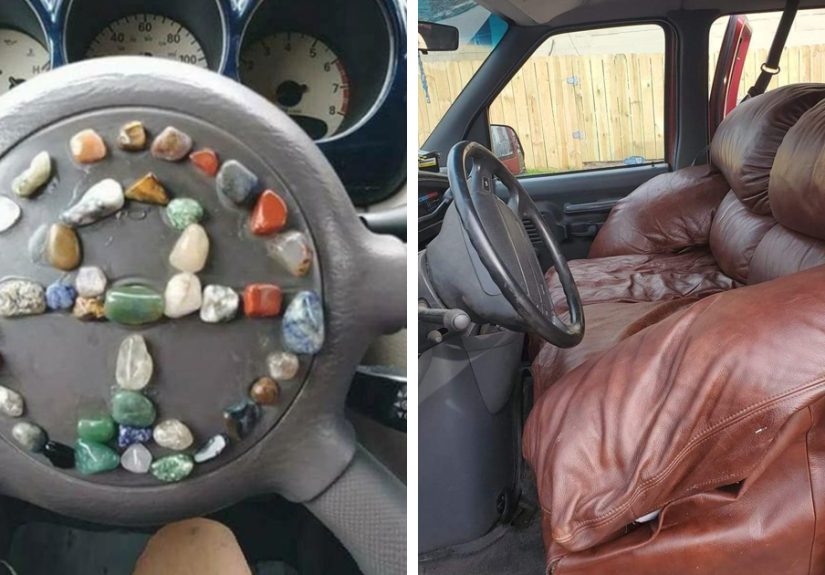
- Rhinestone steering-wheel emblem: It’s cute until an airbag deploys and turns decorations into projectiles.
- Aftermarket steering wheel that deletes the airbag: Your “upgrade” traded safety for style points you can’t cash.
- Seatbelt clip that shuts off the chime: You didn’t fix a problemyou silenced a warning.
- Pedal covers that slip: Nothing spices up a stop sign like a brake pedal that feels like a banana peel.
- Dashboard clutter that blocks airbags: If it’s in an airbag’s path, it’s not an accessoryit’s a future projectile.
- Giant tablet mount blocking visibility: You wanted “Tesla vibes.” You got “iPad in the windshield” vibes.
- Cheap interior LEDs wired poorly: Your cabin now flickers like a haunted house attraction.
- Fake “carbon” trim that peels in heat: It looks premium for one summer and then starts molting.
- Aftermarket stereo installed with a wiring mess: Surprise electrical gremlins: windows, locks, and battery drain all join the party.
- Backup camera mounted crooked: The lines say you’re centered, but reality says you just kissed the curb.
- Roof rack loaded like a moving truck: You invented wind noise, reduced mpg, and a center of gravity that hates you.
- Fake police-style lighting: Nothing says “bad decision” like mods that scream “please pull me over.”
- Cheap paint or wrap over sensors: Your car’s safety tech now has trust issues and random error messages.
- Aftermarket “performance” brakes that squeal forever: Stopping power: fine. Soundtrack: dying seagull.
- DIY “aero” that comes loose at speed: If it’s attached with household tape, it’s not aerodynamicit’s litter.
How to upgrade without becoming the meme
Spend on upgrades that actually change the drive
- Tires first: The best “performance mod” is grip. The second best is not buying the cheapest option.
- Maintenance as an upgrade: Fresh fluids, good alignment, healthy suspension bushings, and clean headlight lenses beat flashy parts every time.
- Brakes with balance: Pads, rotors, and fluid that match your driving stylewithout turning every stop into a squeal concert.
- Visibility upgrades that are sane: Restore lenses, aim headlights properly, and use legal, correctly designed components.
Keep it reversible and document everything
Want your mods to survive the “resale reality check”? Favor changes you can reverse: wheels that fit properly, quality floor mats, a good dash cam, tasteful tint that follows local rules, and upgrades that don’t permanently cut, drill, or delete safety equipment. Save receipts. Keep factory parts. Your future self will thank you when it’s time to sell or file an insurance claim.
Don’t ignore the boring paperwork
If you modify your car, your warranty and insurance don’t magically disappearbut they can get complicated. In plain English: do it right, use reputable installers when needed, and don’t hide modifications from people who need to know. If a change touches airbags, lighting, emissions, or driver-assist systems, treat it like a safety project, not a weekend craft.
Conclusion
The line between “nice upgrade” and “stupidity on wheels” is usually one bad decision: cheap parts, sloppy installation, illegal lighting, deleted safety gear, or mods chosen for internet points instead of real driving. Upgrade your carbut upgrade the parts that matter, stay legal, and keep the build something you’d proudly hand to another driver without leaving them a mystery box of problems.
Extra: of real-world modding experiences (the good, the bad, and the “why did I do that?”)
The most common “upgrade fail” experience usually starts with optimism and ends with receipts. Someone buys a part that promises a big transformation (“brighter lights,” “sportier handling,” “race sound”) and installs it quicklybecause the internet made it look like a 12-minute job. Then the first drive happens: the headlights scatter light everywhere, the exhaust drones at highway speed, or the suspension feels harsh over normal roads. That’s the moment drivers realize a car isn’t a blank canvas; it’s a calibrated machine with compromises baked in.
Lighting is the classic example. Drivers want better nighttime visibility, which is a great goal. But a “bright” bulb isn’t automatically a better beam pattern, and a better beam pattern is what actually helps you see. When the optics don’t match the light source, the result is glare, complaints, and often worse down-road illumination. People learn fast that “everyone flashed me” isn’t a flexit’s a warning from society. The better experience comes from restoring cloudy lenses, aiming lights properly, and using components designed to work together.
Suspension and wheels are the second most common rabbit hole. The first week is exciting: the stance looks sharper, the wheel gap is gone, and photos hit harder. Week two is rubbing. Week three is tire wear. Week four is realizing that offset, camber, and alignment aren’t abstract conceptsthey’re the difference between a fun car and a car that fights you. The best “grown-up modder” experience is discovering that modest changes can be dramatic: a correct alignment, quality dampers, and a wheel-and-tire setup that fits without drama can feel like a totally different vehicle without destroying daily comfort.
Then there’s the “sound phase.” Many drivers try a louder exhaust because it feels like personality. The first cold start is thrilling. The third highway trip is not. Drone turns a fun mod into background punishment, especially on long drives. A lot of people end up paying twice: once to make it louder, then again to make it livable. The best experience is learning to chase quality, not volume: a well-engineered system can sound deeper without being obnoxious, and sometimes the real upgrade is simply hearing the tires and wind again.
Finally, the most valuable experience is realizing that the smartest upgrades don’t always show up in photos. A dash cam, better tires, refreshed brakes, repaired paint protection, and a clean, functional interior aren’t “viral mods,” but they make the car better every single day. The ultimate win is when an upgrade improves safety, comfort, and confidencewithout attracting tickets, warranty headaches, or the need to explain your choices to a future buyer who just wanted a normal car.