Table of Contents >> Show >> Hide
- Why “Pre-Clovis” Is Such a Big Deal
- Quick Snapshot: 8 Pre-Clovis Sites
- 1) White Sands (New Mexico): Footprints Through the Last Ice Age
- 2) Bluefish Caves (Yukon): A Deep-Time Signal in Beringia
- 3) Cooper’s Ferry (Idaho): Early Occupation in the Inland Northwest
- 4) Gault Site (Texas, Area 15): Early Point Technology Before Clovis
- 5) Debra L. Friedkin Site (Texas): Stemmed Points Beneath Clovis
- 6) Page-Ladson (Florida): Mastodons, Tools, and Gulf Coastal Lifeways
- 7) Monte Verde II (Southern Chile): The Site That Changed the Field
- 8) Paisley Caves (Oregon): Stratigraphy, Coprolites, and Western Stemmed Traditions
- What These 8 Sites Tell Us Collectively
- Extended Experience Section: Feeling Pre-Clovis Time in the Real World (500+ Words)
- Conclusion
For a long time, the story of the first Americans sounded neat and tidy: Clovis people arrived around 13,000 years ago, spread quickly, hunted big game, and that was that. Clean timeline. Sharp points. Nice textbook chapter.
Then archaeology did what archaeology does best: it kept digging. And digging. And finding evidence that refuses to fit inside old assumptions.
Today, the “Clovis-first” model has been replaced by a richer, messier, and far more interesting picture. Across North and South America, multiple sites now suggest people were present before classic Clovis technology appeared. Some sites are widely accepted, some remain debated, and all of them force us to ask better questions about migration routes, adaptation, and human ingenuity during the late Ice Age.
In this deep-dive, we explore eight archaeological sites that pre-date Clovis, what was found at each one, why the evidence matters, and how these discoveries are rewriting the early chapters of American prehistory. You’ll also get a long-form experience section at the endbecause knowing the dates is one thing, but feeling the scale of deep time is something else entirely.
Why “Pre-Clovis” Is Such a Big Deal
Clovis refers to a distinctive archaeological complex known for fluted projectile points and a specific toolkit. Modern radiocarbon analysis places Clovis roughly between 13,050 and 12,750 calendar years before present, a relatively short and well-defined window.
If people were in the Americas before that window, then Clovis is not the beginning of the storyit is one successful chapter in a longer human saga. That shift affects nearly everything: migration timing, possible routes (interior ice-free corridor vs. Pacific coastal routes), cultural diversity, and even how we interpret interactions with Ice Age ecosystems.
In short: pre-Clovis research isn’t an academic side quest. It’s the backbone of how we understand who arrived first, when, and how they survived.
Quick Snapshot: 8 Pre-Clovis Sites
| Site | Location | Approximate Age | Core Evidence | Consensus Level |
|---|---|---|---|---|
| White Sands | New Mexico, USA | ~23,000–21,000 years ago | Human footprints in layered playa sediments | Strong and strengthening |
| Bluefish Caves | Yukon, Canada | ~24,000 years ago | Cut-marked faunal remains, radiocarbon dates | Important, still discussed |
| Cooper’s Ferry | Idaho, USA | ~16,000 years ago | Artifacts + radiocarbon sequence | Strong, with active debate on exact timing |
| Gault (Area 15) | Texas, USA | ~16,000–20,000 years ago | OSL-dated early projectile point technology | Influential, debated in details |
| Debra L. Friedkin | Texas, USA | ~15,500–13,500 years ago | Stemmed points beneath Clovis horizon | Strong for pre-Clovis occupation |
| Page-Ladson | Florida, USA | ~14,550 years ago | Stone tools + mastodon association + many dates | Widely cited, high confidence |
| Monte Verde II | Southern Chile | ~14,500 years ago | Structures, preserved organic remains, food residues | Landmark accepted pre-Clovis site |
| Paisley Caves | Oregon, USA | ≥13,200 years ago | Coprolites, human DNA signals, stratified dates, points | Important and frequently discussed |
1) White Sands (New Mexico): Footprints Through the Last Ice Age
What archaeologists found
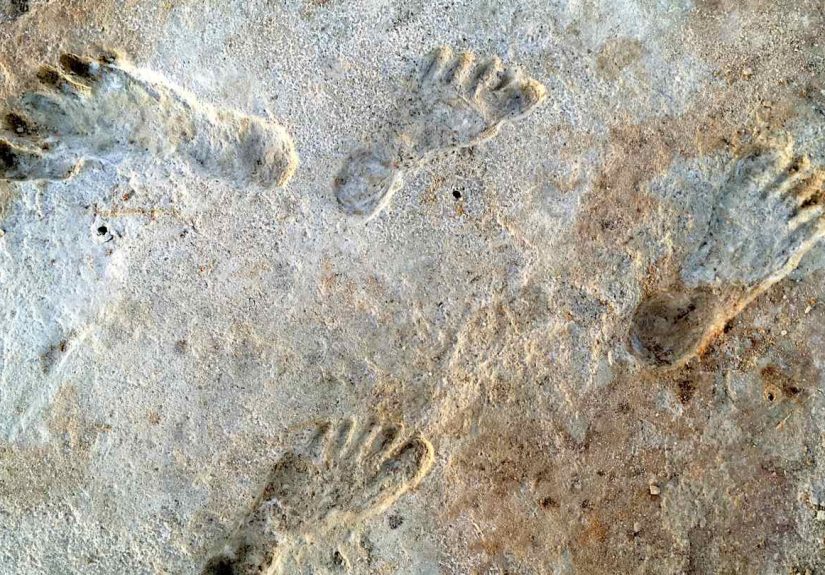
At White Sands National Park, researchers documented fossil human footprints in ancient lakebed sediments. These are not isolated impressions; they are trackways that preserve repeated movement across the landscape, sometimes alongside tracks from extinct animals.
Why it matters
The dating window around ~23,000 to ~21,000 years ago places humans in North America during the Last Glacial Maximummuch earlier than classic Clovis. That timing matters because it challenges older models that tied migration primarily to routes opening later.
The caution and the comeback
Early criticism focused on whether the first dating materials could be affected by reservoir issues. Follow-up work using independent dating approaches substantially strengthened the age model. In archaeology terms, that’s the equivalent of turning “interesting claim” into “seriously hard to ignore.”
2) Bluefish Caves (Yukon): A Deep-Time Signal in Beringia
What archaeologists found
Bluefish Caves yielded faunal bones with cut marks interpreted as human modification, plus radiocarbon dates placing activity around ~24,000 years ago.
Why it matters
If the interpretation holds, Bluefish supports a scenario in which human groups occupied high-latitude Beringian environments during glacial periods, potentially aligning with “standstill” models before broader dispersal southward.
How to read the evidence
Bluefish is important but often discussed with methodological caution. In pre-Clovis research, that’s normal: the older the claim, the more intense the scrutiny. Still, Bluefish remains one of the most cited early northern datasets in this debate.
3) Cooper’s Ferry (Idaho): Early Occupation in the Inland Northwest
What archaeologists found
Excavations at Cooper’s Ferry (known to the Nez Perce as Nipéhe) produced cultural materials in stratified contexts with radiocarbon dates indicating very early occupation, broadly around 16,000 years ago.
Why it matters
The age estimates have been interpreted as predating the full opening of interior ice-free routes, which supports the plausibility of early Pacific coastal migration scenarios. Translation: some people may have moved south before the inland corridor became the main option.
Nuance
Cooper’s Ferry also illustrates how healthy scientific disagreement works. Some scholars debate details of chronology and calibration windows, but the site remains central to pre-Clovis discussions because its data are robust and regionally significant.
4) Gault Site (Texas, Area 15): Early Point Technology Before Clovis
What archaeologists found
At Gault, especially Area 15, researchers identified an early lithic assemblage with optically stimulated luminescence (OSL) ages around ~16,000 to ~20,000 years ago.
Why it matters
The finding suggests a projectile point technology not simply derived from classic Clovis fluted points. That implies technological diversity in the Americas before the Clovis horizon becomes dominant in the archaeological record.
Big-picture impact
Gault weakens the old one-origin, one-toolkit narrative. Instead of a single “starter package,” pre-Clovis evidence increasingly points to multiple regional traditions and experimentation long before textbook Clovis points show up in full force.
5) Debra L. Friedkin Site (Texas): Stemmed Points Beneath Clovis
What archaeologists found
Beneath Folsom and Clovis layers, the Debra L. Friedkin site yielded stemmed projectile points dated roughly ~15,500 to ~13,500 years ago, with triangular-lanceolate forms appearing around ~14,000 years ago.
Why it matters
This stratigraphic sequence matters because it shows pre-Clovis technologies are not random anomalies. They form patterned, repeated evidence below later cultural horizons, which is exactly what archaeologists want to see when evaluating early occupations.
Interpretive takeaway
Friedkin supports the idea that Clovis may be one branch of a broader technological ecosystem rather than the ancestral trunk of all early American lithic traditions.
6) Page-Ladson (Florida): Mastodons, Tools, and Gulf Coastal Lifeways
What archaeologists found
Page-Ladson, a submerged sinkhole context in the Aucilla River system, produced stone artifacts associated with mastodon remains and an extensive radiocarbon record indicating human presence around ~14,550 years ago.
Why it matters
This site is a major pre-Clovis benchmark in the U.S. Southeast. It demonstrates that early populations were already exploring and exploiting Gulf coastal environments while other regions were also being settled.
Ecological relevance
Page-Ladson also contributes to the megafauna debate by showing humans and large Ice Age animals coexisted for substantial time spans, complicating simple “humans arrived and instantly caused extinctions” narratives.
7) Monte Verde II (Southern Chile): The Site That Changed the Field
What archaeologists found
Monte Verde II is famous for exceptional preservation: structural remains, organic materials, food evidence, and botanical traces in a waterlogged context. The occupation is generally placed around ~14,500 years ago.
Why it matters
Monte Verde was the turning point in shifting professional opinion away from strict Clovis-first models. If people were this far south that early, the peopling process had to begin earlier and unfold more dynamically than once believed.
Broader implications
Monte Verde gave scholars a high-quality, deeply contextual pre-Clovis datasetnot just a few stray artifacts. That quality is why it became a foundational reference in discussions of coastal movement, adaptation, and cultural variability.
8) Paisley Caves (Oregon): Stratigraphy, Coprolites, and Western Stemmed Traditions
What archaeologists found
Paisley Caves yielded human coprolites, extensive radiocarbon datasets, and Western Stemmed projectile points dated to at least ~13,200 years agoduring or before classic Clovis time in parts of North America.
Why it matters
Paisley is one of the clearest windows into non-Clovis technological traditions in the western U.S. It suggests that different cultural groups with distinct toolkits may have coexisted or developed in parallel during the terminal Pleistocene.
What this adds to the puzzle
If Clovis and Western Stemmed traditions overlap in time, then the earliest peopling of the Americas was probably not a single-wave cultural package. It was likely a mosaicregional, adaptive, and innovative.
What These 8 Sites Tell Us Collectively
- Clovis is important, but not first. It represents a major tradition, not the starting gun.
- Multiple routes are plausible. Coastal and interior dynamics likely varied through time.
- Technological diversity existed early. Stemmed, lanceolate, and region-specific traditions overlap.
- Chronology is improving fast. Better dating methods are sharpening old debates.
- The Americas were peopled in phases. Not one migration, one toolkit, one story.
Extended Experience Section: Feeling Pre-Clovis Time in the Real World (500+ Words)
Let’s move beyond lab reports for a moment. Imagine standing in one of these landscapesnot as a time traveler with a dramatic soundtrack, but as a careful observer in the present. This is where archaeology becomes emotional in the best possible way.
At White Sands, the modern dunes are dazzling and surreal, almost too bright to be real at midday. Yet below that beauty lies a hidden archive of footprints. The first time most people hear “23,000-year-old footprints,” they picture one dramatic print in a museum case. But trackways are movement made visible: walking, turning, carrying, crossing. It’s not just “a human was here.” It’s “a human had somewhere to go.” That difference changes everything.
In places like Cooper’s Ferry and Paisley Caves, experience shifts from spectacle to patience. These are not always cinematic settings; they are instructional landscapes. You begin to understand how archaeologists read a site like a layered sentence: sediment, artifact, hearth residue, faunal fragment, another sediment lens. The magic is not one dramatic objectit’s context. If you remove one line from that sentence, the meaning may collapse. Suddenly, the phrase “stratigraphic integrity” feels less like jargon and more like the spine of truth.
Texas sites such as Gault and Debra L. Friedkin offer a different kind of awe: technological continuity and innovation over long stretches of time. Looking at point forms from different layers, you can almost feel design choices in motionwhat worked, what changed, what persisted. It’s a quiet reminder that prehistoric people were not static “Stone Age characters.” They were engineers of survival. They tested ideas in stone, learned across generations, and adapted to ecological pressure with incredible precision.
Page-Ladson and Monte Verde deliver another important experience: humility about preservation. Some of the strongest evidence survives because of unusual environmental conditionswaterlogged deposits, buried contexts, lucky geologic accidents. That means our map of early human history is partly a map of where preservation was kind. How many equally old campsites vanished from coasts, floodplains, or eroded terraces? Probably a lot. The absence of evidence often means “no preservation,” not “no people.”
And then there is the human part. In educational exhibits and community interpretation, these sites are increasingly presented not as isolated scientific trophies but as places connected to Indigenous histories and living traditions. That matters. Pre-Clovis research is not just about proving a date older than another date; it is about understanding ancestors, homelands, and long continuities of knowledge across immense spans of time.
If you’re a reader, traveler, or student trying to “experience” this topic without joining an excavation, start with three habits:
- Think in landscapes, not artifacts. Ask what water, plants, game, and shelter looked like at the time.
- Think in probabilities, not absolutes. Good archaeology often weighs confidence levels, not certainty theater.
- Think in networks, not single origins. People, ideas, and technologies moved in patternssometimes overlapping, sometimes diverging.
The deepest experience of all may be this: pre-Clovis sites reveal that human curiosity is ancient. Long before roads, satellites, and search bars, people crossed unknown terrain, solved hard environmental problems, and built lifeways in places no human had lived before. That continuityof risk, adaptation, and imaginationconnects us to them more than any single point type ever could.
Also, if someone tells you archaeology is just “old rocks and bones,” you now have official permission to smile politely and hand them this article.
Conclusion
The case for pre-Clovis occupation is no longer built on one outlier site. It is built on multiple datasets across different regions, dating methods, and archaeological contexts. Some claims remain contested (as good science requires), but the cumulative evidence has changed the field: Clovis was a major cultural tradition, not the first human footprint in the Americas.
These eight sitesWhite Sands, Bluefish Caves, Cooper’s Ferry, Gault, Debra L. Friedkin, Page-Ladson, Monte Verde, and Paisley Cavesshow a peopling process that was earlier, more geographically diverse, and technologically richer than older models allowed. If there’s one takeaway, it’s this: the first Americans were not a single wave with a single toolkit. They were many stories unfolding across deep time.