Table of Contents >> Show >> Hide
There was a time when doing Donald Trump on Saturday Night Live felt like a reliable piece of American comedy machinery. You put on the suit, crank up the verbal chaos, let the guy wander from politics to steak to space lasers to whatever else was bouncing around inside his head, and the audience laughed because the absurdity felt safely boxed inside a sketch.
That box looks a lot smaller now.
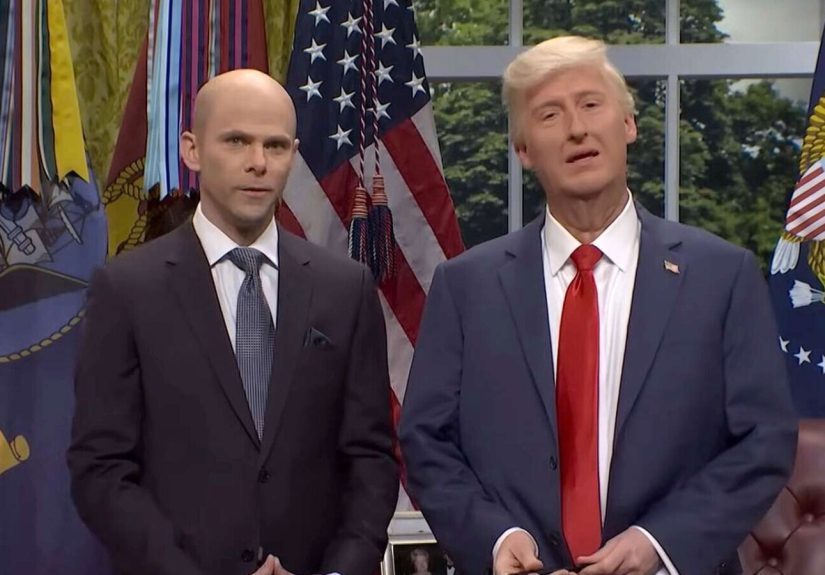
James Austin Johnson, the cast member who has become SNL’s signature Trump impersonator, recently summed up the shift with a line that lands like both a joke and a warning: impersonating Trump “used to not be as terrifying.” That statement is funny in the bleak way only modern political comedy can be funny. It is also a brutally efficient description of what has changed, not just for Johnson, but for every writer, performer, and viewer trying to figure out whether satire still works when reality keeps barging into the room wearing clown shoes and carrying executive power.
Johnson’s comment matters because it gets at the weird, exhausting puzzle at the center of modern SNL: how do you parody a man who already talks like an accidental sketch character, yet still represents very real consequences? That tension has always hovered around Trump comedy, but Johnson’s version of the impersonation has made the problem impossible to ignore. He is not just doing a voice. He is doing a kind of political jazz, a rambling, stream-of-consciousness impression that captures Trump’s speech patterns, self-mythology, and bizarre leaps of logic with unnerving precision.
And that precision is exactly why the impression can be hilarious one minute and slightly chilling the next.
From Viral Mimic to SNL MVP
Before James Austin Johnson became a featured face on network television, he was already internet-famous in a very specific niche: people watching short clips of him wandering around and talking like Trump about things Trump would never normally discuss. That was the genius of the act. Johnson was not just repeating famous lines or recycling cable-news catchphrases. He was translating Trump’s thought process into new material, letting the voice drift through pop culture, random complaints, and cosmic nonsense as if the former president had suddenly become obsessed with Scooby-Doo or prestige cinema.
That style made Johnson stand out from the crowded field of political impersonators. Plenty of comedians can imitate a voice. Far fewer can imitate a person’s mental rhythm. Johnson seemed to understand that Trump’s real comedic engine was not a single word or gesture. It was the constant sensation that a sentence was driving with one wheel in a ditch while somehow still reaching its destination.
When SNL hired Johnson in 2021, the fit was obvious. The show had long been searching for a post-Alec Baldwin approach to Trump, one that felt fresher, younger, and less like a celebrity cameo doing a victory lap. Johnson arrived with a ready-made skill set and a built-in reputation. Critics quickly noticed. His Trump debut felt less like a new cast member trying on an impression and more like the show finally plugging in the exact performer it had needed all along.
That early version of Johnson’s Trump was thrilling partly because it was so technically sharp. But it was also thrilling because it solved a problem. Baldwin’s version often leaned on scowling exaggeration and topical punch lines. Johnson’s leaned on musicality, rhythm, and verbal drift. Instead of treating Trump as a blunt-force cartoon, he treated him as a language machine.
Why Johnson’s Trump Actually Works
The secret to Johnson’s impression is that it rarely feels overbuilt. He does not merely imitate Trump’s voice; he reproduces the sensation of listening to Trump think out loud in public. The pauses are strange. The pivots are abrupt. The self-praise arrives exactly when you expect it and somehow still feels ridiculous every time. It is the comic equivalent of someone expertly recreating a crooked staircase.
That is why even people tired of Trump content often admit Johnson is hard to resist. He catches the syntax. He catches the ego. He catches the way a simple point becomes a detour, then a tangent, then a complaint, then a weird little brag about how no one has ever done anything better than he has. In other words, Johnson does not play Trump as a politician. He plays him as a never-ending sentence.
There is craft in that, and a surprising amount of discipline. Great impressions are often built on selecting the right details instead of all the details. Johnson knows when to lean into the mumbling, when to hit the grandiose note, and when to let one extra beat of silence do the work of an entire punch line. It is a performance style that looks loose from the outside but is actually packed with precision.
Why the Impression Feels Darker Now
This is where Johnson’s quote stops being just an entertaining sound bite and starts sounding like a diagnosis. He has suggested that the atmosphere around Trump is different now, and that difference changes the comedy. Earlier versions of Trump satire often relied on the idea that there were guardrails somewhere in the system. Maybe shaky guardrails, maybe laughably flimsy guardrails, but still: guardrails. That assumption gave comedians room to play. You could present Trump as chaotic because the chaos still seemed partially containable.
Johnson’s point is that the emotional math has changed. The surrounding cast of “grown-ups in the room” no longer feels like a comforting narrative device. The comedy has less cushioning. The stakes feel sharper. The jokes have to travel through more dread before they reach laughter.
That does not mean satire is dead. It means satire has to work harder. Political comedy is always most comfortable when reality still leaves a little room for exaggeration. Trump often makes that difficult because the real version of the story already sounds like a first draft from a writer who was told to make it “more insane.” Johnson seems acutely aware of this. He has talked about trying to find what is still funny inside the darkness, which is probably the most honest description of the job anyone on SNL could give.
And that honesty might be why his performance has grown more interesting. He is no longer just channeling a public figure. He is wrestling with the central problem of political comedy in the 2020s: when the news already feels like parody, what exactly is the parody supposed to do?
The Strange Burden of Being Too Accurate
Johnson’s biggest strength may also be his biggest creative problem. He is so accurate that the audience can occasionally slip from laughing at the impersonation to remembering the actual person being impersonated. That is a weird emotional pivot for a comedy show. One second you are amused by the ramble; the next you are thinking, “Oh right, this is not just an impression. This is a live-wire version of the real national mood.”
That is probably why Johnson’s best Trump material often works when it becomes slightly surreal. The more he turns the character loose in weird formats, the more breathing room the comedy gets. When Trump is placed in an unusual setting, talking about ridiculous side topics or breaking the rules of the sketch itself, Johnson can use his gift for free association without making the whole piece feel like a depressing reenactment.
How SNL Has Adjusted the Formula
To the show’s credit, SNL seems to understand that Johnson’s Trump works best when it is not trapped inside the same old lectern-and-headlines setup every week. In recent seasons, the show has experimented with broader formats: more theatrical cold opens, more self-aware framing, more moments where Trump becomes less a political stand-in and more a host of chaos who wanders through the sketch like he owns not just the country but the camera angles too.
That shift has helped. The show’s more memorable Trump pieces are often the ones that let Johnson get a little weird. Instead of just summarizing the week’s headlines, they use his impression to reveal something about Trump’s appetite for attention, performance, and narrative control. A fake awards show centered on his ego? That tracks. A fourth-wall-breaking moment where Trump addresses the audience like the room belongs to him? Also tracks. The best recent sketches understand that Trump is not only a politician in comedy terms. He is a performer who compulsively turns every setting into his own stage.
Johnson thrives in that space. He can make Trump sound boastful, petty, wounded, triumphant, confused, and weirdly poetic in a single monologue. That flexibility is what keeps the impression from calcifying. It would be easy for a long-running Trump bit to become repetitive, especially after years of national saturation. But Johnson keeps finding small updates: a different rhythm, a heavier darkness, a new verbal tic, a fresh sense that the character is both fully in command and faintly unraveling at the same time.
More Than a One-Impression Comic
Another reason Johnson’s Trump remains compelling is that he clearly does not approach it like a novelty act. He is a broad impressionist with interests beyond politics, and that range helps. It keeps him from looking trapped inside one famous voice. Profiles and interviews have repeatedly shown him as a comedy obsessive, a mimic with deep affection for oddball characters, obscure voices, and performance mechanics. That broader foundation matters because it gives his Trump an actor’s curiosity instead of a mere impersonator’s checklist.
In other words, Johnson does not seem fascinated by Trump the celebrity so much as fascinated by the challenge of rendering him accurately and usefully onstage. That distinction is important. A lesser impression can accidentally flatter its subject by turning him into a cartoon icon. Johnson’s version is funnier because it is more specific, and more specific because it is less admiring.
The Bigger Question: Can Trump Satire Still Surprise Anyone?
This is the cloud hanging over the whole enterprise. Trump has been such a permanent feature of American attention that every comedian who touches the material has to fight audience fatigue before the first punch line lands. People do not just bring political opinions to a Trump sketch. They bring memory. Exhaustion. Doomscroll residue. Family group-chat scars. At least one half-finished opinion about whether SNL should cover him less, more, or never again.
Johnson cannot solve all of that, but he can cut through it. His impression works best when it reminds viewers that comedy is not always about inventing a bigger lie; sometimes it is about making the truth legible. Trump’s speech is already absurd. Johnson’s gift is turning that absurdity into something formally recognizable. He reveals the pattern hidden inside the chaos. And once you can hear the pattern, you can laugh at it again, even if the laughter has more edge than it used to.
That may be the real meaning behind his “used to not be as terrifying” remark. The terror is not just political. It is artistic. It is the fear that reality is getting harder to transform, harder to frame, harder to make ridiculous because it is already performing its own grotesque version of comedy in public. Johnson is basically saying the job has become emotionally heavier and structurally trickier. For a sketch comedian, that is a brutal combination.
The Experience of Watching This Kind of Comedy Now
Here is the extra weird part: audiences have changed too. Watching a Trump impression in 2017 often felt like a pressure valve. Watching one now can feel like checking the weather during tornado season. You still want the update, but you are no longer pretending it is just entertainment. Johnson seems to understand that modern viewers are listening for more than punch lines. They are listening for tone. They want to know whether the show gets the moment, whether it understands the difference between mockery and normalization, whether the joke is punching upward or merely circling the spectacle again because the spectacle always gets ratings.
That is a lot to ask from one cast member in a wig. But Johnson, to his credit, has rarely seemed casual about the burden. His Trump is funny, yes, but it is also alert. It knows that the line between satire and repetition is thin. It knows audiences are tired. It knows laughter can curdle fast. And somehow, amid all that, it still finds room to be sharply, sometimes absurdly, undeniably entertaining.
That may be why his quote hit such a nerve. It did not sound like a comedian begging for sympathy. It sounded like a craftsman admitting that the material has changed shape in his hands. The job used to be difficult in a normal comedy way. Now it is difficult in a distinctly American way: morally messy, emotionally draining, and bizarrely impossible to stop watching.
Additional Reflections and Experiences Related to the Topic
One of the strangest experiences surrounding James Austin Johnson’s Trump impression is how differently it lands depending on where and how you watch it. If you catch it live on a Saturday night, half the tension comes from the fact that you already know the country has handed the show fresh material. The cold open begins, the applause starts, and there is this silent agreement in the room: yes, we are doing this again; yes, he is back; yes, we still apparently live in a nation where the first few minutes of a comedy show can feel like a national mood report.
Watching later online is a different experience. There, Johnson’s performance becomes more like a replay study. You notice the mechanics. You hear the phrasing. You watch how he lets a sentence wobble before he brings it home with a brag, a complaint, or a weird image. It is almost athletic. The joke is not always the line itself. Sometimes the joke is that he can keep the verbal plate spinning for so long without dropping the voice or the rhythm.
There is also the experience of viewers who remember earlier Trump satire and can feel the emotional drift. In the first Trump era, impressions often functioned like a giant communal eye-roll. The comedy was angry, obvious, and immediate. People laughed because they recognized the target and wanted to see him punctured. Now the response is more complicated. Viewers are still impressed, still amused, but there is often a second feeling under the laugh: fatigue. Not boredom, exactly. More like civic overexposure. Johnson is performing for an audience that has already had too much plot.
Then there is the performer’s experience, which is arguably the most fascinating part of all this. Imagine having to study a man whose public speech has been piped into American life for nearly a decade, then update your imitation as the man ages, shifts, escalates, and changes public tone. Johnson is not impersonating a static character from a movie. He is tracking a moving target in real time. That means listening carefully, adjusting constantly, and finding comic entry points without losing sight of the real-world gravity attached to the person he is portraying. That is part mimicry, part journalism, part endurance sport.
Writers and comedians who orbit this material face their own strange experience too. Trump comedy often risks becoming self-parody: the same setup, the same orange jokes, the same hand motions, the same “can you believe this guy?” exhaustion. Johnson’s success shows that the only way out is specificity. General Trump jokes are tired. Specific Trump observations can still feel alive. That is why his impression stands out. He is not doing “generic loud politician.” He is doing the weird little turns of phrase, the meandering confidence, the sticky vanity, and the constant improvisational self-defense system that makes Trump sound like he is narrating his own myth while wandering through it.
And finally, there is the experience of laughing when you are not sure you want to. That may be the most honest description of the whole thing. Johnson’s Trump can make you laugh hard, then immediately make you question what exactly you are laughing at: the performance, the accuracy, the absurdity, the despair, or the fact that American politics keeps producing material too strange to reject and too serious to enjoy innocently. That mixed reaction is not a flaw. It is probably the truest response possible. And it is exactly why Johnson’s quote about the impression being more terrifying now feels so memorable. He is not just talking about the job. He is talking about the audience’s experience too.
Conclusion
James Austin Johnson’s remark about impersonating Trump not being “as terrifying” in the past is more than a clever headline. It is a blunt explanation of how political satire has changed under pressure. Johnson remains one of the sharpest impressionists working today because he understands that a Trump impression is not merely about sounding right. It is about finding the comic shape of a public figure who keeps threatening to break the shape entirely.
That is why his performance still matters. It is technically brilliant, culturally revealing, and increasingly weighted by the fact that the joke and the danger now sit much closer together. Johnson can still make Trump funny. The real trick is that he is making audiences feel why that has become harder, stranger, and, yes, more terrifying than it used to be.