Table of Contents >> Show >> Hide
- Why Inkblots Feel So Addictive to Look At
- My 12 Inkblot Creations
- 1. The Velvet Bat
- 2. Two Foxes, Nose to Nose
- 3. The Crowned Moth
- 4. The Arguing Owls
- 5. The Dancer in Mid-Turn
- 6. The Dragon With Excellent Posture
- 7. The Laughing Mask
- 8. The Butterfly That Refuses to Behave
- 9. Two Boxers Touching Gloves
- 10. The Cathedral Window
- 11. The Sea Creature in a Silk Cape
- 12. The Twin Wolves Howling at Nothing in Particular
- What People Really See in Inkblots
- A Quick Reality Check: Inkblot Art Is Not a Personality Trapdoor
- Why I Keep Coming Back to Inkblots
- My Personal Experience Making These Inkblot Creations
- Final Thoughts
Some artwork politely introduces itself. An inkblot does not. It barges into your brain, throws open the curtains, and asks, “Well? Is this a bat, a ballroom gown, a grumpy owl, or your former boss with dramatic shoulder pads?” That is exactly why inkblot art is so much fun. It lives in the sweet spot between chaos and recognition, where the eye spots a pattern and the mind rushes in to finish the job.
This is also why inkblots are endlessly shareable. People do not just look at them. They participate in them. One person sees a moth. Another sees a masked hero. A third sees “two raccoons arguing over a croissant,” which is oddly specific and, somehow, impossible to dismiss. The beauty of the format is that there is no single correct answer. An inkblot is less like a multiple-choice test and more like a visual conversation starter with excellent dramatic timing.
That playful back-and-forth has real roots in how perception works. Human brains are wired to search for familiar shapes, especially faces, animals, motion, and symmetry. That tendency helps explain why we see castles in clouds, faces in car grilles, and suspiciously emotional expressions in kitchen appliances. Give that pattern-hungry brain a mirrored splash of ink, and it gets to work immediately. In other words, your audience is not “making things up.” Their minds are doing what minds do best: hunting for meaning.
Why Inkblots Feel So Addictive to Look At
Inkblots pull off a rare trick. They are abstract, but they do not feel distant. They invite interpretation. That matters because viewers tend to stay longer with artwork that asks something from them. Instead of simply admiring color, line, or technique, they become co-creators for a moment. The blot suggests; the viewer completes. It is the visual version of handing someone the opening line of a story and watching them sprint away with it.
There is also a long creative tradition behind this. Artists have used blotting, staining, mirrored forms, and suggestive abstraction for centuries to jump-start imagination. Later, inkblots became famous through the Rorschach test, which turned symmetrical blots into cultural icons. These days, most people know enough not to treat every blot response like a mystical personality decoder ring, and that is probably for the best. As art, though, inkblots are still undefeated. They are immediate, surprising, and wonderfully democratic. You do not need an art degree to join in. You just need eyes, a little curiosity, and perhaps the confidence to say, “I know everyone else sees a butterfly, but I am sticking with vampire rabbit.”
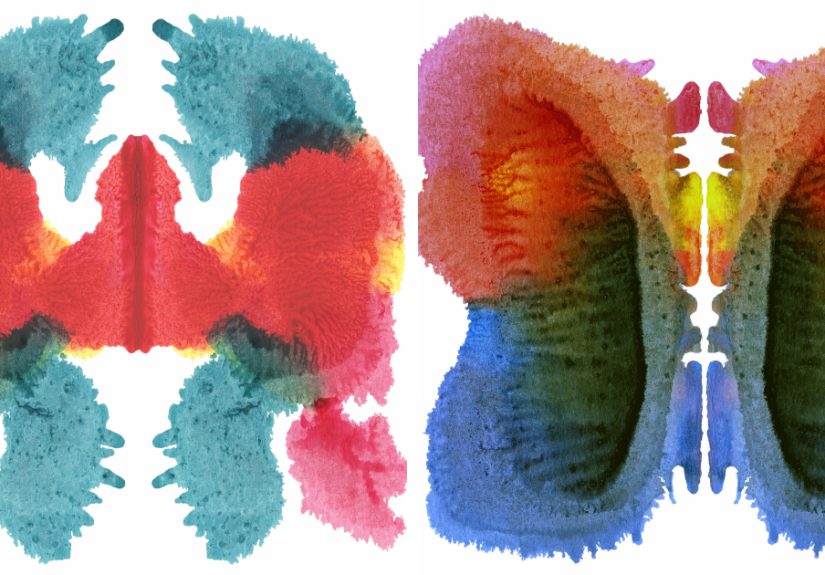
That is the spirit behind these 12 inkblot creations. They are not here to diagnose you, judge you, or reveal that deep down you are emotionally identical to a houseplant. They are here to spark imagination, conversation, and that delicious split-second when a random shape suddenly becomes something.
My 12 Inkblot Creations
1. The Velvet Bat
This one opens strong. Wide wings, a dramatic centerline, and the kind of silhouette that practically begs for Halloween music. Some people will see a bat immediately. Others will swear it is a ceremonial mask, a butterfly, or a gothic bow tie with ambition. I love how the dark outer edges give it a theatrical entrance. It does not whisper. It arrives.
2. Two Foxes, Nose to Nose
This blot has a softer symmetry, with pointed corners and a warm, almost furry shape. Viewers often gravitate toward animals when a blot offers ears, snouts, or tails, and this one has all the ingredients for a woodland showdown. Or a woodland friendship. Or a woodland gossip session. Frankly, foxes always look like they know something.
3. The Crowned Moth
Here the center rises like a tiny jeweled crown while the sides spread outward in delicate layers. This is the kind of image that makes people debate whether they are looking at an insect, a royal costume, or the world’s fanciest ink spill. The fun is in the overlap. A moth can look regal. A crown can look alive. A blot can be both at once.
4. The Arguing Owls
Round upper forms, a pinched middle, and two heavy shapes facing one another make this blot feel oddly animated. You can almost hear it. Some viewers see twin owls. Others see judges in robes, opera singers, or two elderly cats who have opinions about parking. Symmetry gives it balance; the slight unevenness gives it personality.
5. The Dancer in Mid-Turn
Not every inkblot reads as a creature. Sometimes the eye catches gesture instead of anatomy. This one feels like movement: fabric flaring, arms lifting, a body twisting through space. That is one of my favorite things about abstract symmetry. It can suggest motion with no actual figure drawn in. A good blot can make stillness look like choreography.
6. The Dragon With Excellent Posture
You know a blot is doing its job when someone instantly says “dragon” with complete confidence. This one has wings, a lifted head, and a central body line that turns random ink into pure legend. Another person might see a seahorse, a gargoyle, or a ceremonial shield. But for fantasy-minded viewers, this is where the imagination clocks in early and refuses to leave.
7. The Laughing Mask
Faces are among the first things humans look for, so a blot with eye-like spaces and a mouth-like curve tends to become a character fast. This one lands somewhere between carnival mask, trickster spirit, and “I should maybe not trust this smile.” It is playful, but it also proves how quickly we assign emotion to shapes that merely hint at a face.
8. The Butterfly That Refuses to Behave
Yes, plenty of inkblots turn into butterflies. But this one feels less like a sweet garden visitor and more like a rebellious fashion icon. The wing edges are jagged, the body is bold, and the overall shape has a punk-energy flourish. It is a reminder that even the most familiar interpretation can still have a distinct mood.
9. Two Boxers Touching Gloves
Here the mirrored sides create the impression of two figures leaning inward. Shoulders, gloves, helmets, raised arms; the mind can build bodies from almost nothing. One viewer sees athletes. Another sees statues. Another sees robots preparing for a very emotional reunion. That is what makes comment sections under inkblot art so entertaining: everyone is technically improvising, but nobody feels like they are guessing.
10. The Cathedral Window
Some blots stop reading as living things and become architecture. This one has a vertical authority to it, like stained glass, a vaulted arch, or some mysterious ancient door you are definitely not supposed to open but absolutely will. Symmetry naturally supports this kind of interpretation because buildings, like faces, often rely on balance and repeated forms.
11. The Sea Creature in a Silk Cape
There is always one blot that refuses to choose a genre. This is mine. It looks aquatic and theatrical at the same time, as if a squid attended a costume gala. The flowing lower forms suggest tentacles or fabric, depending on where your imagination prefers to vacation. Either way, it feels alive in the most delightfully uncooperative way.
12. The Twin Wolves Howling at Nothing in Particular
I saved a dramatic one for last. Sharp angles, upward thrust, and mirrored tension make this blot feel almost cinematic. Some people see wolves. Some see flames. Some see two armored figures back to back. Strong contrast tends to create strong opinions, and strong opinions are gold when the goal is to get readers to jump into the comments and say what they saw first.
What People Really See in Inkblots
When viewers respond to art like this, they are usually not revealing a secret hidden identity. They are showing how perception, memory, emotion, and association work together in real time. That is much more interesting anyway. One person notices faces first. Another always spots animals. Someone else gravitates toward clothing, architecture, or fantasy creatures. Our brains are constantly matching what we see against what we already know. Inkblots simply make that matching process visible.
This is where the internet turns an old visual trick into a surprisingly effective engagement format. Ask people what they see, and you are not just asking for an answer. You are inviting them to compare, defend, revise, laugh, and reconsider. Suddenly the image becomes social. A viewer who first saw a butterfly might never unsee the “two squirrels in formalwear” after reading someone else’s comment. The artwork keeps changing because the conversation around it changes.
That makes inkblot content especially strong for web publishing. It is easy to scan, fun to react to, and naturally built for dwell time. Readers pause. They look again. They scroll back up. They compare their answer to yours. In the age of disposable content, that kind of active attention is a minor miracle.
A Quick Reality Check: Inkblot Art Is Not a Personality Trapdoor
Because inkblots are tied to pop psychology in the public imagination, it helps to be clear: enjoying or interpreting an inkblot is not the same thing as taking a formal psychological assessment. Modern readers are smart, and many are allergic to grand claims dressed up as certainty. So the strongest approach is honesty. Frame the blots as artworks, perception prompts, and conversation pieces. That keeps the tone playful, informed, and credible.
In fact, that honesty improves the article. It lets the piece celebrate what inkblots actually do well: trigger imagination, expose the flexibility of perception, and remind us that the human mind is gloriously eager to find meaning. Not every mystery needs to be “solved.” Some just need to be enjoyed from three different angles while your friend insists the dragon is obviously a lobster.
Why I Keep Coming Back to Inkblots
There is something refreshing about making art that starts with surrender. You drip, fold, press, open, and then react. The process contains control, but not too much. That balance is addictive. A perfectly planned artwork can be satisfying, but an inkblot has the thrill of collaboration with chance. It gives you a surprise first and asks for structure second.
It also strips creativity down to one of its purest forms: noticing. Before you can refine a blot into a character, creature, or mood, you have to see what is there. Or more accurately, you have to see what could be there. That tiny leap from mark to meaning is where imagination does its best work. It is messy, funny, surprising, and sometimes oddly emotional. Not bad for a puddle with symmetry.
My Personal Experience Making These Inkblot Creations
Making inkblots has taught me that creativity is often less about forcing an idea onto the page and more about recognizing the moment an accident becomes interesting. That sounds poetic, which is a dangerous hobby for any writer, but it is true. When I start an inkblot, I never fully know what I am going to get. I know the colors. I know the paper. I know the basic motion. After that, I am negotiating with chaos like a very underqualified diplomat.
The first few times I made them, I expected instant masterpieces. Naturally, the paper responded by producing shapes that looked like spilled coffee and one deeply suspicious potato. That turned out to be useful. Inkblot art rewards patience, but it also rewards humor. If you need every attempt to look profound, this medium will humble you before lunch. But once I stopped trying to control every outcome, the process became much more exciting. I started noticing little things: a wing shape in a smear, a mask hidden in the center, a dramatic curve that turned a random stain into a creature with attitude.
What surprised me most was how emotional the viewing process became. Not dramatic-violin emotional, but personal in a quiet way. Some days I would open a folded sheet and instantly see something playful, like a butterfly wearing a cape. On another day, the exact same shape might feel heavier, stranger, or more mysterious. That made me realize how much mood affects interpretation. The blot was the same. I was the variable. That is part of what makes sharing inkblots with other people so satisfying. Their answers do not just expand the image; they expand the moment. Suddenly one object holds twelve possibilities, then twenty, then fifty.
I also love the way audiences respond to inkblot art online. People who might scroll past a more traditional piece will stop for an image that asks a question. “What do you see?” is a deceptively simple prompt. It invites curiosity without demanding expertise. Nobody feels excluded. Kids can answer. Artists can answer. People who have never voluntarily entered a museum gift shop can answer. The comments become part critique, part comedy club, part group imagination exercise. One person says “owl,” another says “alien king,” and a third says “my aunt when someone underseasons the mashed potatoes.” The result is delightfully human.
On a practical level, inkblot making has improved the way I look at all kinds of visual art. I pay more attention to symmetry, negative space, and silhouette now. I notice how quickly the brain tries to organize ambiguity. I also trust first impressions more, even when they are weird. Especially when they are weird. Weird first impressions are often the doorway to memorable art. A clean, obvious image can be satisfying, but an image that keeps changing every time you look at it has staying power.
That is why these 12 creations matter to me beyond the novelty factor. They remind me that imagination is not always a lightning bolt. Sometimes it is a slow reveal. Sometimes it is a joke. Sometimes it is a pattern the brain grabs because it cannot resist turning randomness into story. Every blot feels like a tiny collaboration between material, memory, and mood. And honestly, that feels like a pretty accurate description of creativity in general.
So when I say, “Share what you see,” I do not mean it as a trick question. I mean it literally. I want the dragons, the dancers, the masks, the moths, the wildly incorrect seafood interpretations, all of it. The best part of inkblot art is that the image is never quite finished until someone else looks at it. That may be the most charming thing about the whole medium. It begins as ink, but it only becomes a full experience once a second imagination enters the room.
Final Thoughts
Inkblot creations work because they combine mystery with participation. They give viewers enough structure to spark recognition, but enough ambiguity to keep the mind playing. That is a powerful mix for art lovers, curious readers, and anyone who enjoys the thrill of saying, “Wait, now I see something else.” These 12 pieces are not just images. They are invitations. And in a crowded online world, an invitation is sometimes stronger than an explanation.
Note: This article explores inkblots as creative, visual, and cultural experiences. It is not intended as a psychological diagnosis or a substitute for professional assessment.