Table of Contents >> Show >> Hide
- What Is NASA’s SLS Rocket?
- How Big Is the SLS?
- The Main Parts of the SLS Rocket
- SLS and the Artemis Program
- Why Is SLS So Powerful?
- Why Not Just Use Commercial Rockets?
- The Cost and Controversy Around SLS
- What Makes SLS Different From Saturn V?
- What Happens During an SLS Launch?
- Why SLS Matters for the Moon and Mars
- Quick Facts About NASA’s SLS Rocket
- Experience-Based Reflections: What Watching SLS Teaches Us
- Conclusion
If rockets had a heavyweight division, NASA’s Space Launch System would walk into the ring wearing moon boots and carrying a lunchbox full of liquid hydrogen. Better known as the SLS rocket, this mammoth machine is NASA’s super heavy-lift launch vehicle built for one very big job: sending astronauts, the Orion spacecraft, and major exploration hardware beyond Earth orbit and toward the Moon.
The title promises “less than 3 minutes,” so here is the fast version before we fire the engines: SLS is the backbone of NASA’s Artemis program, the campaign designed to return humans to deep space, build a sustained presence around and on the Moon, and prepare for future missions to Mars. It is huge, powerful, expensive, controversial, technically impressive, and about as subtle as a thunderstorm in a library.
But the SLS is not just a big rocket for big rocket fans. It represents a major shift in American human spaceflight. After decades of operating mainly in low Earth orbit with the Space Shuttle and International Space Station, NASA is using SLS and Orion to push crews back toward the Moon. Artemis I proved the rocket could launch Orion without astronauts in 2022. Artemis II sent astronauts around the Moon in 2026. The next steps are more complex: docking demonstrations, lunar landings, commercial landers, surface systems, and eventually a Moon-to-Mars pathway.
What Is NASA’s SLS Rocket?
The Space Launch System is a NASA-built super heavy-lift expendable rocket. “Super heavy-lift” means it can send extremely large payloads into space, especially beyond low Earth orbit. “Expendable” means the main rocket hardware is not reused after flight. In plain English: SLS is built to throw very heavy things very far, then say goodbye forever.
NASA designed SLS to launch the Orion spacecraft and cargo directly toward the Moon in a single mission. That direct-to-the-Moon capability is one of the rocket’s biggest selling points. Instead of launching the crew capsule on one rocket and the departure stage on another, SLS can send Orion, astronauts, and large mission hardware together on a powerful trajectory toward lunar space.
The rocket is also part nostalgia, part engineering upgrade. It borrows heritage from the Space Shuttle era, including RS-25 engines and solid rocket booster technology, but adapts those systems for deep-space missions. Think of it as NASA opening the shuttle toolbox, keeping the best wrenches, and building a moon-bound skyscraper with flames.
How Big Is the SLS?
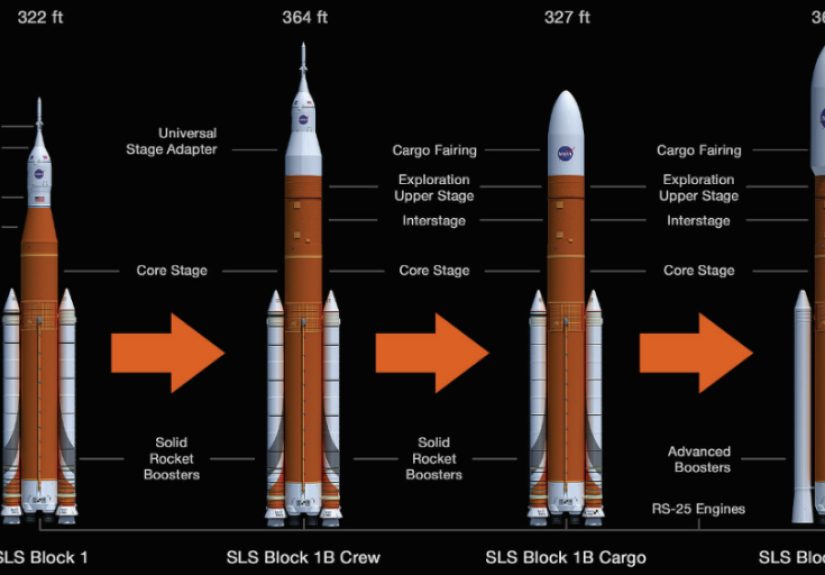
The Block 1 SLS configuration stands about 322 feet tall with Orion on top, making it taller than the Statue of Liberty. Fully fueled, it weighs roughly 5.75 million pounds. At liftoff, it produces about 8.8 million pounds of thrust, which is more than the Saturn V rocket that launched Apollo astronauts to the Moon.
That size is not for show. Escaping Earth’s gravity is brutally difficult. Sending people to the Moon requires far more energy than reaching the International Space Station. The Moon is nearly 1,000 times farther away than low Earth orbit, so SLS must give Orion the speed needed for a translunar injection burn, the maneuver that sends the spacecraft out of Earth orbit and toward lunar space.
The Main Parts of the SLS Rocket
1. The Core Stage
The core stage is the orange central body of the rocket and the largest newly developed part of SLS. It is more than 212 feet tall and about 27.6 feet in diameter. Inside are tanks holding hundreds of thousands of gallons of super-cold liquid hydrogen and liquid oxygen. These propellants feed the four RS-25 engines at the base of the rocket.
Boeing is the lead contractor for the SLS core stage, and NASA’s Michoud Assembly Facility in New Orleans plays a major role in manufacturing. This facility has a long spaceflight history, and now it builds the towering structure that makes SLS look like a skyscraper that decided to major in physics.
2. Four RS-25 Engines
The RS-25 engines are veteran performers. They were originally developed for the Space Shuttle, but NASA upgraded them for SLS. Each engine burns liquid hydrogen and liquid oxygen, producing enormous thrust with high efficiency. Together, the four RS-25 engines provide about 2 million pounds of thrust during ascent.
On the Shuttle, these engines were reusable. On SLS, they are not recovered. That has drawn criticism from cost-conscious observers, because RS-25 engines are engineering masterpieces, not bargain-bin lawnmower parts. Still, their reliability and performance are major reasons NASA selected them for deep-space crew missions.
3. Twin Solid Rocket Boosters
On either side of the core stage are two five-segment solid rocket boosters. These are also derived from Space Shuttle booster technology, but they are larger and more powerful. Each booster is about 177 feet tall and produces millions of pounds of thrust.
The boosters provide more than 75% of the rocket’s thrust during the first two minutes of flight. That short window is spectacularly important. At liftoff, SLS must fight gravity, atmospheric drag, and the inconvenient fact that Earth does not like letting go of things.
4. The Upper Stage
For the first Artemis flights, SLS uses the Interim Cryogenic Propulsion Stage, or ICPS. This upper stage performs the key burn that sends Orion toward the Moon. It uses an RL10 engine powered by liquid hydrogen and liquid oxygen.
NASA previously planned to upgrade SLS with the Exploration Upper Stage for later missions, creating the Block 1B version with greater payload capacity. However, in 2026 NASA refined its Artemis architecture and announced that it was no longer planning to use the Exploration Upper Stage or Mobile Launcher 2 because of development delays. Instead, NASA said it would standardize the SLS configuration and evaluate alternative second-stage options for future missions.
SLS and the Artemis Program
SLS exists because of Artemis. The Artemis program is NASA’s plan to return astronauts to lunar space, land crews near the Moon’s south polar region, build a lasting exploration presence, and use lunar missions as preparation for Mars. SLS is the launch vehicle. Orion is the crew spacecraft. Ground systems at Kennedy Space Center prepare, fuel, and launch the stack. Commercial landers, spacesuits, rovers, surface habitats, and future infrastructure complete the larger picture.
Artemis I launched on November 16, 2022, without astronauts. The mission sent Orion on a 25-day journey around the Moon and back, covering about 1.4 million miles. The flight tested SLS, Orion, ground systems, navigation, communications, and reentry performance.
Artemis II launched in April 2026 with four astronauts: Reid Wiseman, Victor Glover, Christina Koch, and Canadian Space Agency astronaut Jeremy Hansen. The mission flew around the Moon and returned safely to Earth after nearly 10 days. It marked the first crewed flight of Orion and the first crewed lunar voyage since the Apollo era. At its farthest point, the crew traveled more than 252,000 miles from Earth, setting a new human spaceflight distance record.
Why Is SLS So Powerful?
SLS is powerful because lunar missions demand speed, mass, and reliability. To send Orion toward the Moon, the rocket must accelerate the spacecraft to roughly 24,500 mph. That is not just “fast” in a sports-car sense. That is “your GPS has given up and is now quietly praying” fast.
The Block 1 SLS can send more than 27 metric tons to the Moon. Future standardized or upgraded configurations are intended to support more ambitious Artemis missions, including larger payloads and more complex mission profiles. The main idea is simple: the more mass NASA can send in one launch, the fewer launches and in-space assembly steps are required.
Why Not Just Use Commercial Rockets?
This is one of the most common questions in modern spaceflight. Commercial rockets, especially reusable launch systems, have changed the economics of getting to orbit. SpaceX’s Falcon Heavy, Starship development, Blue Origin’s New Glenn, and other vehicles are reshaping expectations. So why does SLS still matter?
The answer depends on mission needs, schedule, risk tolerance, and politics. SLS is designed specifically to launch Orion and crew safely on deep-space trajectories. It is integrated into NASA’s Artemis architecture and certified around NASA’s human exploration requirements. Commercial systems play a huge role too, especially lunar landers, cargo services, communications, and future infrastructure. Artemis is not an either-or program. It is more like a group project where every participant brings a different rocket-shaped casserole.
Still, critics argue that SLS is too expensive, launches too infrequently, and uses expendable hardware in an era moving toward reusability. Supporters counter that SLS provides unique heavy-lift capability, proven performance, and a national deep-space transportation system under NASA control. Both sides have a point, which is why SLS debates can get spicy enough to reheat leftovers.
The Cost and Controversy Around SLS
No honest overview of SLS can skip the cost. The rocket has faced years of schedule delays, budget scrutiny, and watchdog criticism. U.S. government reviews have raised concerns about long-term affordability and cost transparency. NASA’s Artemis program includes many expensive parts, and SLS is one of the biggest.
Part of the cost comes from the rocket’s complexity. SLS relies on major contractors, specialized facilities, human-rating requirements, heritage hardware, new manufacturing, and a nationwide supply chain. NASA says more than 1,100 companies across the United States support SLS development and production.
That national footprint is a strength and a complication. It supports jobs and technical expertise across many states, but it can also make the program politically difficult to change quickly. Space policy is never just engineering. It is engineering wearing a suit, carrying a budget binder, and trying not to trip over congressional priorities.
What Makes SLS Different From Saturn V?
Saturn V was the legendary Apollo rocket that carried astronauts to the Moon between 1968 and 1972. SLS is often compared to Saturn V because both are giant Moon rockets. SLS produces more liftoff thrust than Saturn V, but Saturn V carried astronauts all the way to lunar orbit with the Apollo spacecraft and lunar module in a different mission architecture.
SLS is built for the Artemis era, where Orion, commercial lunar landers, Gateway-related concepts, surface systems, and international partnerships all fit into a broader plan. Apollo was a race to land. Artemis is intended to become a repeatable exploration system. Whether it succeeds at that scale depends not only on SLS, but on budget stability, lander readiness, spacesuit progress, mission cadence, and NASA’s ability to manage a very complicated orchestra without anyone dropping the tuba.
What Happens During an SLS Launch?
An SLS launch begins long before the countdown clock gets dramatic. The rocket is assembled inside the Vehicle Assembly Building at Kennedy Space Center, rolled to Launch Complex 39B on a mobile launcher, tested, fueled, and checked repeatedly. The fueling alone is a major operation because liquid hydrogen and liquid oxygen must be stored at extremely cold temperatures.
At liftoff, the RS-25 engines ignite first, followed by the solid rocket boosters. Once the boosters light, the rocket is committed. There is no polite pause button. The boosters burn for roughly two minutes, then separate. The core stage continues firing its RS-25 engines for about eight minutes before shutting down. After stage separation, the upper stage takes over, placing Orion into the proper orbit and then performing the burn toward the Moon.
For crewed Artemis missions, Orion separates and begins its journey. The spacecraft uses its service module for power, propulsion, thermal control, and life support support functions. After the lunar mission, Orion returns to Earth at high speed, survives extreme heating during reentry, deploys parachutes, and splashes down in the ocean.
Why SLS Matters for the Moon and Mars
SLS matters because NASA’s deep-space ambitions require a transportation system that can move crews and major hardware beyond Earth orbit. The Moon is the first destination, but Mars is the long-term horizon. Before sending astronauts to Mars, NASA needs to learn how to operate far from Earth, manage life support, handle radiation risks, use lunar resources, coordinate complex spacecraft, and keep humans alive when the nearest hardware store is 240,000 miles away.
The Moon offers a proving ground. It is close enough for missions to be practical, but distant enough to expose the hard problems of deep-space exploration. SLS launches the people and spacecraft that begin that chain of learning.
Quick Facts About NASA’s SLS Rocket
- Full name: Space Launch System
- Type: Super heavy-lift expendable rocket
- Main mission: Launch Orion and Artemis crews toward the Moon
- Block 1 height: About 322 feet with Orion
- Liftoff thrust: About 8.8 million pounds
- Core engines: Four RS-25 engines
- Boosters: Two five-segment solid rocket boosters
- First launch: Artemis I, November 16, 2022
- First crewed launch: Artemis II, April 2026
- Primary destination: Lunar space, with Mars preparation as the long-term goal
Experience-Based Reflections: What Watching SLS Teaches Us
Experiencing the story of NASA’s SLS rocket is not only about memorizing thrust numbers or comparing payload charts. It is about watching a nation relearn how to send people into deep space. For anyone who follows space exploration closely, SLS feels like a mix of old-school ambition and modern tension. It carries echoes of Apollo, but it also launches in a world where private space companies livestream booster landings and the public expects faster, cheaper progress.
One of the most powerful experiences connected with SLS is the feeling of scale. Seeing the rocket on the pad at Kennedy Space Center is different from reading a specification sheet. A 322-foot launch vehicle is not just tall; it dominates the landscape. The mobile launcher, the flame trench, the water deluge system, and the Vehicle Assembly Building all remind viewers that deep-space exploration is not a laptop project. It is physical, industrial, loud, and almost absurdly difficult.
Another lesson is patience. Spaceflight fans often want every mission to move quickly, but rockets like SLS do not respond well to impatience. Hydrogen leaks, valve issues, software checks, weather constraints, and safety reviews can delay a launch. That can frustrate viewers, especially when a mission has been advertised for years. But crewed spaceflight has a brutal rule: boring caution is better than exciting disaster. If a rocket carrying astronauts needs more checks, the right answer is to check it again, even if the internet groans dramatically into its coffee.
SLS also teaches the difference between engineering success and program success. Artemis I proved that the rocket could perform beautifully on its first flight. Artemis II showed that SLS and Orion could carry astronauts around the Moon and bring them home. Those are enormous achievements. Yet the program still faces questions about cost, launch frequency, and long-term sustainability. A rocket can work technically while still being debated economically. That tension is not a flaw in the conversation; it is the conversation.
For students, writers, and everyday space fans, SLS is a useful reminder that exploration is never clean and simple. It is not a movie montage where engineers tighten three bolts, someone says “go,” and the Moon politely moves closer. Real exploration is paperwork, welding, testing, politics, weather, budgets, human courage, and thousands of people doing jobs most viewers will never see.
The most inspiring part of SLS may be what it represents for the next generation. Children who watched Artemis II saw humans travel around the Moon for the first time in their lives. They saw Christina Koch, Victor Glover, Reid Wiseman, and Jeremy Hansen make lunar space feel current again, not like a black-and-white chapter from a history textbook. That matters. Big rockets do more than move spacecraft; they move imagination.
At the same time, SLS invites healthy skepticism. Admiring the rocket does not require ignoring its cost. Criticizing its price does not require dismissing the skill of the people who built it. The best way to understand SLS is to hold both truths at once: it is a magnificent machine, and it is an expensive one. It is a bridge back to the Moon, and bridges are judged not just by whether they stand, but by how often people can cross them.
In the end, the experience of SLS is the experience of watching humanity attempt something hard in public. Every countdown carries hope. Every delay carries frustration. Every launch carries the reminder that leaving Earth is still one of the most difficult things our species does. And when that giant orange-and-white rocket finally rises, shaking the Florida coast like thunder with paperwork, it becomes clear why people still look up.
Conclusion
NASA’s Space Launch System is not merely a rocket; it is a statement of intent. It says the United States wants to send astronauts beyond low Earth orbit, return to lunar exploration, and prepare for human missions deeper into the solar system. SLS combines shuttle-era heritage, modern upgrades, enormous thrust, and a mission architecture built around Artemis and Orion.
It is also a rocket surrounded by serious questions. Its power is undeniable. Its cost is controversial. Its role in the future will depend on NASA’s evolving Artemis plans, commercial partnerships, and the ability to create a mission cadence that feels sustainable rather than ceremonial. Still, SLS has already done something historic: it launched Artemis I, carried Artemis II astronauts around the Moon, and helped reopen the human pathway to deep space.
So, all you need to know in less than three minutes? SLS is NASA’s giant Moon rocket, built to launch Orion and Artemis crews beyond Earth. It is powerful, complex, expensive, inspiring, and very, very loud. In other words, it is exactly the kind of machine humanity builds when the destination is no longer the sky, but the worlds beyond it.
Note: This article is based on current public information from NASA, U.S. government space program oversight materials, aerospace contractors, and reputable American space reporting. It has been fully rewritten in original editorial style for web publication.