Table of Contents >> Show >> Hide
- Who Is the Artist Behind These “Resurrected” Roman Emperors?
- How AI, Facial Reconstruction, and Photoshop Work Together
- Meet the Emperors: From Augustus to Nero and Beyond
- How Accurate Are These AI Reconstructions, Really?
- Why the Internet Loves Historical AI “Glow-Ups”
- What Projects Like This Mean for Art, History, and Education
- Experiences and Reactions: Living With Lifelike Roman Emperors (Extra Deep Dive)
- Conclusion: From Marble Busts to Up-Close Encounters
If you’ve ever wandered through a museum, stared at a marble bust of a Roman emperor, and thought, “Okay, but what did this guy actually look like?”, you’re not alone. Those blank stone eyes and perfectly chiseled noses leave a lot to the imagination. Thanks to modern techand one very dedicated artistwe don’t have to imagine quite as hard anymore.
In a wildly popular project featured on Bored Panda, artist Haroun Binous used artificial intelligence, facial reconstruction techniques, and Photoshop to “resurrect” around 30 Roman emperors, turning ancient statues into startlingly lifelike portraits. The result feels like scrolling through a very intense historical LinkedIn feed: Augustus looks like your serious coworker from finance, Nero could be a moody musician, and Hadrian has total “bearded hipster architect” energy.
Beyond the initial wow factor, this project sits at the crossroads of history, technology, and internet culture. It raises fascinating questions: How close can AI really get to the truth? What happens when we give ancient power brokers modern faces? And is it okay that some emperors now look suspiciously like your ex?
Who Is the Artist Behind These “Resurrected” Roman Emperors?
The mastermind behind these portraits is Tunisian-born artist Haroun Binous, who started the project while studying pharmacy in Lausanne, Switzerland. According to interviews and write-ups, the whole thing began when he went looking for realistic reconstructions of Roman emperors and came up empty. So, in true internet era fashion, he decided to make them himself.
Binous gathered reference images of busts and statues from museums and online collections, then used AI tools plus painstaking manual work in Photoshop to transform them into full-color portraits. His series spans emperors from Augustusthe first emperor of Rometo later, less famous rulers like Licinius and Titus, giving online audiences a visual timeline of Rome’s leadership in striking detail.
The project quickly spread beyond Bored Panda, being picked up by art and pop-culture sites like Demilked and Pleated Jeans, where the portraits were shared in gallery-style posts and meme-ready formats. That virality helped introduce Roman history to people who might normally scroll right past anything with the word “emperor” in it.
How AI, Facial Reconstruction, and Photoshop Work Together
At first glance, it might look like magic: feed in a stone bust, press “enhance,” andboomperfectly realistic Roman dude appears. In reality, the process is more layered and more creative than that.
Step 1: Collecting and Cleaning the Reference Sculptures
The starting point for each emperor is a high-quality image of a bust or statue. Binous and similar artists often compare multiple sculptures of the same person to correct for missing noses, chipped ears, or overly flattering artistic choices.
In Photoshop, those images are cleaned uplighting adjusted, contrast improved, and details sharpenedso the AI can better “understand” the facial structure. This is similar to what professional photo restorers do when they prep old photos for AI-assisted enhancement.
Step 2: AI-Powered Facial Reconstruction
Next comes AI. Artists like Binous and others working on Roman-emperor projects have used machine-learning tools that generate photorealistic faces based on reference imagery. For one comparable project on 54 emperors, the artist combined hundreds of statue images per emperor, using AI to average them into a consistent, lifelike face.
AI models can infer skin texture, realistic lighting, and even subtle asymmetries that we don’t see in marble. In some reconstructions, creators have admitted to feeding in modern celebrity faces as texture or style referencesthink “give Augustus a hint of Daniel Craig jawline” energywhile still respecting the overall structure of the bust.
Step 3: Human Touch in Photoshop
AI doesn’t get the final say. Once a plausible face exists, the artist goes back into Photoshop to tweak eye color, skin tone, hair, and age markers so the portrait lines up with what historians know about each emperor’s origin, era, and lifestyle. That might mean making a battle-hardened emperor look a bit more weathered, or softening the features of a ruler who came to power young.
Modern Photoshop and AI-powered toolslike neural filters and generative restoration featurescan refine skin, reduce noise, and colorize grayscale sources quickly, but the artist still decides what “feels right” for each face. The result is a hybrid: part science, part digital painting, part educated guesswork.
Meet the Emperors: From Augustus to Nero and Beyond
The Bored Panda gallery showcases around 30 emperors, and each one looks like someone you could plausibly sit next to on public transitif your subway line ran from the Colosseum to modern-day TikTok. Let’s zoom in on a few standouts.
Augustus: The Reluctant Influencer
Augustus, Rome’s first emperor, is often depicted in marble as calm, idealized, and eternally youthful. In Binous’s reconstruction, he becomes a believable thirtysomething with clear eyes, light hair, and a resolute expressionmore “startup founder who somehow also conquered Gaul” than untouchable myth.
Seeing Augustus with modern skin tone and detail makes it easier to remember that he was a living person navigating messy politics, family drama, and the very real risk of being stabbed by someone he’d had over for dinner.
Hadrian: Bearded, Bookish, and a Little Intimidating
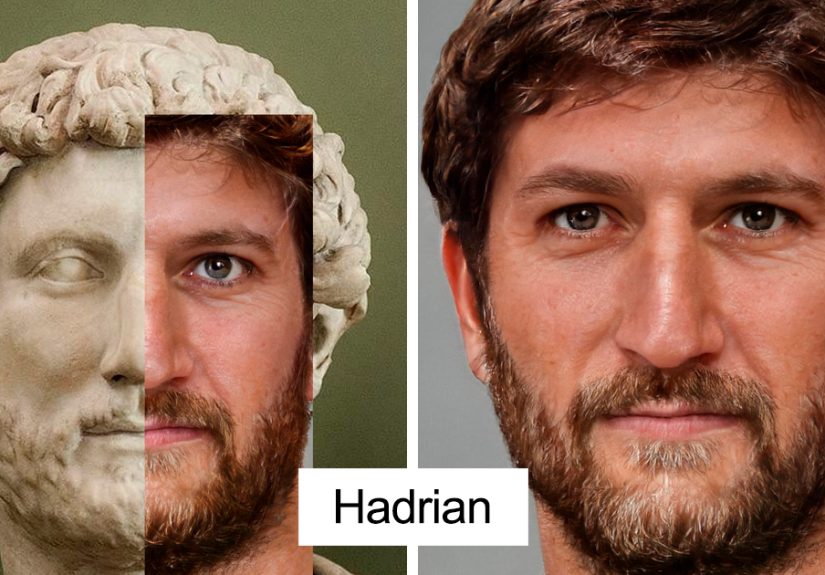
Hadrian’s portrait may be the poster child for this project. His marble busts already have a distinctive beard and intense gaze; translated into a modern face, he looks like a stylish professor who could either explain Stoic philosophy or give you a terrifying performance review.
The reconstruction highlights his curls, deep-set eyes, and strong cheekbones, making it easier to imagine the man who ordered the construction of Hadrian’s Wall and traveled extensively throughout the empire.
Caracalla: The Don’t-Mess-With-Me Glare
Caracalla is famous for his scowl in ancient sculpture, and the AI-enhanced version doubles down on it. The modernized portrait shows a man with furrowed brows, intense eyes, and the vibe of someone who absolutely would not enjoy your stand-up routine.
It’s a powerful example of how emotional expression carved centuries ago can still translate through layers of marble, pixels, and algorithms.
Nero and Constantine: History’s Headliners
Nero’s reconstructed face manages to be both familiar and unsettling. His slightly soft features and direct gaze contrast sharply with his chaotic reputationfiddling legends, questionable leadership, and all. Seeing a more human Nero can complicate the usual “cartoon villain” narrative and invite viewers to ask what’s legend and what’s propaganda.
Constantine the Great, on the other hand, looks every bit the imposing statesman. In AI reconstructions, his face appears mature, focused, and weatheredfitting for the emperor who embraced Christianity and reshaped the Roman world.
How Accurate Are These AI Reconstructions, Really?
As stunning as these images are, they’re not time-travel photographs. They’re interpretations based on incomplete evidence, shaped by artistic choices and algorithmic guesses.
Even traditional facial reconstructionused in forensics and archaeologyrelies on standardized tissue-depth measurements, educated guesses about features like lips and ears, and assumptions about age, health, and ancestry. AI adds another layer, filling in texture and color based on patterns it has learned from modern faces, which may or may not match what people looked like 2,000 years ago.
Experts in AI photo restoration have also raised concerns that these tools, while powerful, can quietly “rewrite” history by smoothing out imperfections, changing facial proportions, or imposing contemporary beauty standards on old images. When we see Nero or Hadrian rendered in HD with perfect lighting, it’s easy to forget that we’re looking at a digital interpretation, not a verified snapshot.
That doesn’t make the work less valuablebut it does mean we should treat it as a visually informed hypothesis rather than gospel truth. Think: “Netflix historical drama,” not “security camera footage from 117 CE.”
Why the Internet Loves Historical AI “Glow-Ups”
The success of the Bored Panda article and similar posts on Demilked, Pleated Jeans, and other sites isn’t just about cool techit’s about how people relate to the past.
History Feels More Real When Faces Feel Familiar
Most of us remember faces better than dates or dynasties. Turning emperors from cold marble into believable people taps into that instinct. Suddenly, the guy whose name you skimmed in a textbook looks like someone who might buy overpriced coffee or argue about sports.
AI Art Is Perfectly Built for Social Media
These reconstructions arrive as image carousels30 portraits you can swipe through in seconds. They’re meme-ready (“Tell me this isn’t your gym bro,” “Caracalla looks like he runs a crypto startup”), easy to share, and endlessly remixable. That’s catnip for platforms like Instagram, X, and Reddit.
Bored Panda’s formatshort intros, image galleries, light commentaryhelps too. It gives just enough context for history fans while staying accessible for casual scrollers who just came for “cool AI stuff.”
What Projects Like This Mean for Art, History, and Education
On the serious side, AI reconstructions are starting to influence how we teach and display history. Teachers can drop these images into slideshows; museums can use similar techniques to show visitors what a partially damaged statue might once have looked like. Researchers are even proposing multi-modal 2D and 3D methods to reconstruct full portraits of emperors from coins and reliefs.
At the same time, historians and archivists warn that AI “improvements” can oversimplify or distort complex realities. AI-powered restoration of vintage photos, paintings, and historical faces can unintentionally erase evidence of aging, damage, or artistic style that carries important context.
The sweet spot is responsible use: clearly labeling reconstructions as artistic interpretations, sharing the original sources (busts, coins, mosaics), and talking openly about what’s known, what’s likely, and what’s pure imagination.
Experiences and Reactions: Living With Lifelike Roman Emperors (Extra Deep Dive)
Spend a little time with “Artist Recreates What Roman Emperors Looked Like Using AI, Facial Reconstruction, And Photoshop (30 Pics)” and you start to notice how differently people react to the same set of faces.
Scrolling Through History on Your Phone
Imagine discovering the article on a lazy evening scroll. At first it’s simple curiosity: “Cool, Roman emperors in color.” Then the side-by-side images hit youstone on the left, human on the rightand it’s oddly emotional. The AI-enhanced faces don’t just add color; they add personality. You notice crow’s feet, uneven eyelids, a crooked nose that somehow survived two millennia through stone copies and digital reconstruction.
By the time you reach the end of the 30 portraits, you may find that you’re unintentionally assigning vibes to each emperor. Augustus feels calm and calculated, Caracalla looks like he’d start a bar fight, Marcus Aurelius has the quiet introspection of someone who writes Stoic quotes in his Notes app. It turns the empire from a vague concept into a messy cast of characters.
In the Classroom: From Marble to “I Know This Guy”
Educators who incorporate these images into lessons report that students pay more attention when they see realistic faces instead of just columns of dates and battles. A timeline of emperors is one thing; a slideshow of 30 distinct-looking people is another. It invites questions like:
- “Why does this emperor look so young if he ruled such a huge empire?”
- “How did someone who looks this tired end up in charge of everything?”
- “Why do so many of them have that ‘I-slept-2-hours’ expression?”
That curiosity opens the door to deeper discussions about propaganda, portraiture, and how leaders have always cared very deeply about their public imagewhether carved in marble or filtered through AI.
Museum Visits, Upgraded
Now picture walking through a gallery of Roman sculptures after seeing the Bored Panda article. The bust of Hadrian no longer feels anonymous. You mentally overlay the AI-generated face on the stone, almost like AR in your imagination. The fractured nose and blank eyes become easier to interpret, because you’ve already seen a possible “completed version.”
Some visitors have described feeling a strange sense of empathy when they connect the reconstructed faces with the real marble pieces. Emperors who once felt impossibly distant now seem uncomfortably humanambitious, flawed, mortal. It doesn’t excuse what they did in life, but it changes how we think about them: not symbols, but people making choices with enormous consequences.
Online Comment Sections: Humor Meets Critical Thinking
Of course, this is still the internet. Under posts sharing the project, you’ll find jokes comparing emperors to celebrities, coworkers, or politiciansalongside thoughtful comments about historical accuracy and ethics. Some people are amazed at how “modern” the faces look; others wonder if that’s exactly the problem.
That mix of memes and critical thinking is kind of perfect for this project. It reflects the double nature of AI reconstructions: they’re fun and shareable, but they also push us to ask who controls our visual imagination of the past, and how tools like AI and Photoshop shape that imagination in ways we don’t always notice.
In the end, that might be the best outcome of all. Whether you come for the “30 Pics” or the deep-dive discussion afterward, you leave with a sharper sense that history isn’t just old stones and dusty names. It’s a long line of real human beingsand thanks to AI, some of them are suddenly staring back at us.
Conclusion: From Marble Busts to Up-Close Encounters
“Artist Recreates What Roman Emperors Looked Like Using AI, Facial Reconstruction, And Photoshop (30 Pics)” is more than a viral galleryit’s a miniature case study in how technology can refresh our relationship with history. By combining ancient sculptures, machine learning, and digital artistry, Haroun Binous and similar creators give Roman emperors new faces that feel uncannily present.
These portraits aren’t perfect reconstructions, and they’re not meant to be. They live in that fascinating middle ground between scholarship and speculation, where art invites us to imagine the past more vividly while also reminding us to stay skeptical about what we see on our screens.
But if a single swipe through 30 AI-enhanced emperors makes one more person care about how Rome rose, ruled, and fellmission accomplished. The emperors are long gone, but thanks to AI and Photoshop, their faces might just be entering a whole new era of internet fame.