Table of Contents >> Show >> Hide
- Quick Answer: Can You Freeze Apples?
- Why Freeze Apples in the First Place?
- Best Apples for Freezing
- How to Freeze Apples Step by Step
- Step 1: Wash, sort, and prep your workspace
- Step 2: Peel, core, and slice for your future recipe
- Step 3: Prevent browning (this is not optional if you care about looks)
- Step 4: Pick your pack style
- Step 5: Tray-freeze for loose, scoopable apples
- Step 6: Package correctly to prevent freezer burn
- Step 7: Freeze fast, store smart
- How Long Do Frozen Apples Last?
- Can You Freeze Whole Apples?
- How to Thaw Frozen Apples (Without Turning Them to Mush)
- Common Mistakes and How to Avoid Them
- Mini FAQ
- Experience Section: Real Kitchen Notes on Freezing Apples (Extended)
- Final Takeaway
You absolutely can freeze applesand if you’ve ever bought a giant bag at the orchard because your “future self” seemed ambitious, this is excellent news.
Freezing apples is one of the easiest ways to cut food waste, save prep time, and keep homemade desserts within arm’s reach when life gets busy.
The trick is knowing how to freeze them so they stay useful, flavorful, and not weirdly brown and glued together like one giant apple meteor.
This guide walks you through exactly what works: the best apple prep methods, how to prevent browning, whether to use sugar or skip it, how long frozen apples
keep quality, and what to cook once they’re thawed. You’ll also get a practical “what I learned the hard way” experience section at the end so you can avoid common mistakes.
If your goal is meal prep, easy pie nights, or just rescuing apples before they get soft in the fruit bowl, you’re in the right place.
Quick Answer: Can You Freeze Apples?
Yes. Apples freeze very well when peeled, cored, sliced, and treated to slow browning before freezing. You can freeze them in several styles:
dry pack (no sugar), sugar pack, or syrup pack. Frozen apples are best for cooked usespies, crisps, muffins, sauces, oatmeal, and smoothies
because thawed apples are softer than fresh ones.
If you only remember one thing, remember this: freeze in recipe-ready portions. Future you does not want to chip frozen apples out of a giant mystery block at 9:42 p.m.
Why Freeze Apples in the First Place?
1) Reduce waste without eating apples three meals a day
Apples are sturdy, but not immortal. Freezing lets you preserve a bumper crop from the market, orchard, or your own backyard before texture drops.
It’s one of the most practical ways to extend the useful life of ripe fruit.
2) Save serious time on baking days
Pre-sliced frozen apples mean no peeling marathon when you want pie, crisp, cobbler, or apple-cinnamon muffins.
You can often cook or bake from frozen, which turns “project dessert” into “weekday dessert.”
3) Keep quality high with less effort than canning
Freezing is straightforward and beginner-friendly. You don’t need pressure canning equipment, and your flavor stays clean and fresh when packaging and
anti-browning steps are done correctly.
Best Apples for Freezing
For best results, choose apples that are crisp, firm, and flavorfulnever mealy. Firm varieties hold shape better in pies and crisps.
Tart-sweet balance also helps because freezing slightly softens flavor edges over time.
Good practical choices for freezing and baking include classic firm varieties such as Granny Smith, Golden Delicious, Rome Beauty, Jonathan, Stayman,
Honeycrisp, and similar crisp apples available in U.S. markets. If in doubt, buy two varieties and blend them for better flavor and texture depth.
How to Freeze Apples Step by Step
Step 1: Wash, sort, and prep your workspace
Rinse apples under running water, then dry them well. Trim bruised or damaged spots. Use a clean cutting board and knife.
If you’re freezing a large batch, set up an assembly line: peel/core station, anti-browning station, tray station, bagging station.
It feels extra, but it prevents chaos and saves time.
Step 2: Peel, core, and slice for your future recipe
Slice size matters. Thin slices are better for quick stovetop uses; medium slices are ideal for pies and crisps.
If your main goal is apple pie, keep slices fairly consistent so everything cooks evenly.
Uniform pieces are the difference between “beautiful filling” and “some slices are applesauce while others are still crunchy.”
Step 3: Prevent browning (this is not optional if you care about looks)
As soon as apples are cut, they start browning from oxygen exposure. To slow this, use an ascorbic-acid treatment (vitamin C),
which is a standard recommendation for freezing fruit.
- Classic ratio: Dissolve 1/2 teaspoon (about 1500 mg) ascorbic acid in 3 tablespoons of water; coat apple slices.
- Alternative: A brief steam blanch can also reduce darkening for firm fruits like apples.
If you prefer lower-sugar prep, anti-browning is still important. Color protection is about quality and appearance, not sweetness.
Step 4: Pick your pack style
You’ve got three main options. Choose based on how you’ll use the fruit:
- Dry pack (no sugar): Best for savory uses, lower-sugar recipes, and flexible meal prep.
- Sugar pack: Good for pie filling and desserts; helps texture and flavor retention. Common guide: about 1/2 cup sugar per quart of fruit.
- Syrup pack: Ideal for uncooked desserts and fruit cocktails; often uses chilled syrup and a little ascorbic acid for color.
Important note: sugar improves texture/flavor, but it is not required for safe freezing.
Step 5: Tray-freeze for loose, scoopable apples
Spread treated slices in a single layer on a sheet pan and freeze until firm (often around a couple of hours, depending on thickness and freezer load).
This “flash freeze” step prevents clumping so you can pour out exactly what you need later.
Step 6: Package correctly to prevent freezer burn
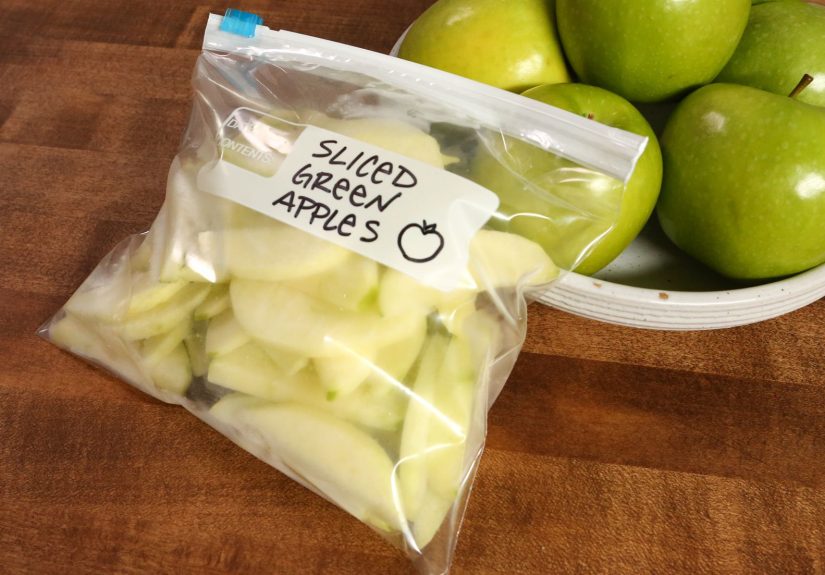
Transfer frozen slices to freezer-safe bags or rigid freezer containers. Press out excess air.
Label with:
- Apple variety (optional but helpful)
- Pack type (dry/sugar/syrup)
- Date frozen
- Portion size (e.g., “4 cups for pie”)
Leave proper headspace for expansionespecially with syrup packs. A practical rule: dry packs often use about 1/2 inch;
liquid/syrup packs need more.
Step 7: Freeze fast, store smart
Freeze apples quickly at 0°F (-18°C) or below. Don’t overload your freezer with too much unfrozen fruit at once.
Small batches freeze faster and preserve better texture.
How Long Do Frozen Apples Last?
From a food safety standpoint, frozen food held continuously at 0°F stays safe for a very long time.
From a quality standpoint, frozen apples are best within about 8 to 12 months.
Some guidance allows longer under ideal conditions, but flavor and texture are usually best in that first year.
If you open a bag and notice dry, pale patches, that’s freezer burnquality loss, not automatically a safety issue.
Trim affected spots and use in cooked recipes where texture is less critical.
Can You Freeze Whole Apples?
Technically yes, but it’s usually not the best strategy. Whole frozen apples are harder to portion, slower to thaw, and softer after thawing.
In practice, sliced apples are far more useful and give better recipe results.
If you do freeze whole apples anyway, think “future applesauce” rather than “future lunchbox crunch.”
How to Thaw Frozen Apples (Without Turning Them to Mush)
For pies, crisps, and cobblers
Use partially thawed or straight-from-frozen slices, depending on your recipe. Toss with thickener and spices and bake.
You may need a little extra bake time if fruit is fully frozen at start.
For muffins, quick breads, and pancakes
Thaw briefly just enough to separate pieces, then fold in. Too much thawing can release extra liquid and thin your batter.
For smoothies and sauces
No thawing needed for smoothies. For sauce, cook from frozen with a splash of water until tender, then mash.
Cinnamon, nutmeg, and a tiny pinch of salt make the flavor pop.
Common Mistakes and How to Avoid Them
- Skipping anti-browning treatment: You’ll get darker slices and flatter flavor appearance.
- No tray freeze: Bag turns into one giant apple glacier.
- Too much air in packaging: Faster freezer burn and stale flavor.
- No label/date: Future mystery fruit situation.
- Overloading freezer: Slow freezing = weaker texture.
- Wrong expectations: Thawed apples are for cooking, not crisp raw snacking.
Mini FAQ
Do I have to peel apples before freezing?
Not always. Peeling gives smoother texture in pies and sauces. Skin-on works for rustic crisps, smoothies, and some quick breads.
Do frozen apples lose nutrition?
Freezing generally preserves nutrients well. Quality changes are usually more about texture and flavor over time.
Can I freeze apples without sugar?
Yes. Sugar is optional for freezing safety. It mainly helps with color, flavor, and texture quality.
What’s the best portion size to freeze?
Freeze in recipe-specific amounts: 2 cups for muffins, 4 to 6 cups for pies, 1-cup packs for oatmeal or smoothies.
Portioning once saves time forever.
Experience Section: Real Kitchen Notes on Freezing Apples (Extended)
My first season freezing apples started with confidence and ended with a freezer bag the size of a bowling ball. I skipped tray freezing,
tossed fresh slices straight into a bag, and congratulated myself for being “efficient.” Three weeks later, I needed two cups for muffins.
I got zero cups and one frozen apple brick. I chipped at it with a butter knife like I was excavating an archaeological site. Lesson learned:
a 10-minute tray-freeze setup saves an hour of future frustration.
The second mistake was pretending browning “doesn’t matter.” It’s true that browned apples are still usable, but visual quality affects how motivated
you are to cook with them. When I started using the ascorbic acid method, the difference was obvious: brighter slices, cleaner flavor perception, and
better-looking pies. It also made batch prep less stressful because I wasn’t racing oxidation. I could prep calmly, bag properly, and label everything.
Tiny system, big payoff.
I also tested dry pack versus sugar pack with the same apple variety. Dry pack won for flexible weeknight cooking: oatmeal, savory pan sauces, quick compote,
and smoothies. Sugar pack won for dessert textureespecially crisps and hand piesbecause the fruit held flavor and body a little better after freezing.
Now I split each batch: 70% dry pack, 30% sugar pack. That one tweak gave me options without needing two separate grocery runs.
Portioning changed everything. I used to freeze “one big bag per mood,” which is not a real measurement. Now I freeze:
one-cup bags for breakfast bowls, two-cup bags for muffins, and five-cup bags for pie night. Each bag gets a label with date, variety, and intended use.
Sounds nerdy, but it means I can open the freezer and grab exactly what I need. Decision fatigue drops. Cooking frequency goes up.
Another practical note: mixing varieties gives better flavor complexity than single-variety batches. A tart apple plus a sweeter, aromatic apple makes
a more balanced filling and less one-dimensional sauce. If I’m baking, I want structure and brightness. If I’m making applesauce, I want deeper sweetness.
Freezing by intended useand not just by what’s on saleimproved results more than any spice trick I tried.
I once overloaded the freezer with too many warm containers at once, assuming “cold air will figure it out.” It did not.
Items froze slowly, and texture suffered. Since then I freeze in smaller waves, leaving space around packages for airflow.
It feels slower in the moment but produces better fruit quality later. This is one of those invisible habits you only appreciate
when you bite into a cobbler that tastes like actual apples instead of sweet mush.
The biggest mindset shift: frozen apples are not a backup plan; they are a cooking strategy. On busy weekdays, I can make spiced oatmeal with fruit,
quick skillet compote for yogurt, or a weeknight crumble without starting from scratch. During holidays, prepped frozen slices turn a multi-hour dessert
into a manageable evening project. My freezer became less “cold storage” and more “future convenience.”
If I had to give one practical blueprint to beginners, it would be this: start with eight apples, do one method perfectly, and write down what you liked.
Next batch, improve one thingslice thickness, pack type, or portion size. Keep the process boring and repeatable. Fancy hacks are optional; clean prep,
anti-browning treatment, proper packaging, and clear labels are not. Do that consistently and you’ll always have apples ready for real life.
Final Takeaway
So, can you freeze apples? Definitelyand once you do it well, you’ll wonder why you ever let extra apples soften in the crisper drawer.
Choose firm fruit, treat slices to reduce browning, pick the right pack style for your recipes, and freeze in labeled portions.
Keep temperatures at 0°F or lower and aim to use your stash within 8 to 12 months for peak quality.
That’s the whole strategy: smart prep now, easier meals and better desserts later.