Table of Contents >> Show >> Hide
- Why Cold Spring Harbor Became So Important
- From Human Heredity to Social Engineering
- How the Lab Popularized Eugenics in America
- From Research Desk to Operating Table
- Buck v. Bell and the Legal Blessing of Eugenics
- Why the Science Failed
- Cold Spring Harbor’s Legacy Today
- Experiences of Living with This History
- Conclusion
Cold Spring Harbor, New York, sounds like the sort of place where you’d expect sailboats, shore birds, and very expensive coffee. What many people do not expect is that this quiet Long Island community also housed one of the most influential engines of American eugenics. In the early 20th century, the Eugenics Record Office at Cold Spring Harbor helped turn prejudice into paperwork, bias into charts, and social fear into public policy. That is not a poetic exaggeration. It is the unnerving truth.
To be precise, Cold Spring Harbor did not invent eugenics in America. The idea had already arrived from Europe, and American reformers, academics, and lawmakers were already flirting with it. But Cold Spring Harbor did something arguably more dangerous: it gave eugenics an institutional home, a scientific-looking vocabulary, and a filing system. It made the movement look orderly, rational, and modern. Put bluntly, it dressed ideology in a lab coat and called it research.
This history matters because it reveals how bad science becomes powerful science. Eugenics was not merely a fringe belief whispered in smoky back rooms. It was promoted by respected men, backed by wealthy institutions, and translated into laws that harmed tens of thousands of people. The story of Cold Spring Harbor shows how easily a research center can become a cultural amplifier when science stops asking hard questions and starts flattering the prejudices of its age.
Why Cold Spring Harbor Became So Important
The key institution in this story was the Eugenics Record Office, or ERO, founded in 1910 at Cold Spring Harbor by biologist Charles Benedict Davenport. Harry H. Laughlin soon became its most famous administrator and public advocate. Together, Davenport and Laughlin helped make the site a hub for collecting family records, publishing studies, lobbying lawmakers, and broadcasting the idea that poverty, disability, criminality, and “social failure” were mostly hereditary.
That was the pitch: society was not failing people; people were supposedly failing society because of their bloodlines. It was a tidy theory, and like many tidy theories, it was wildly wrong.
The ERO worked under the broader umbrella of the Carnegie Institution of Washington, which gave it prestige and resources. That mattered. Once an idea moves from crank pamphlet to institutionally sponsored research, the public often stops asking whether the idea is humane, rigorous, or even true. It simply looks official. Cold Spring Harbor became influential not just because of what it claimed, but because of where it claimed it from.
From Human Heredity to Social Engineering
Charles Davenport and the dream of “better breeding”
Charles Davenport was trained as a scientist, but he was also a man of his era’s anxieties. He embraced hereditarian thinking with almost missionary zeal. In his view, a vast range of human conditions could be traced to inheritance: intellectual disability, mental illness, alcoholism, criminality, promiscuity, poverty, and even what he considered laziness or “shiftlessness.” The result was a worldview in which social problems were reimagined as breeding problems.
That shift was central to American eugenics. Instead of asking why people were poor, reformers could declare them biologically inferior. Instead of addressing unequal schools, bad housing, labor exploitation, racism, or lack of healthcare, eugenicists could point to family trees and say, “There, that’s the problem.” It was social analysis with all the inconvenience removed.
Harry Laughlin and the policy machine
If Davenport supplied the theory, Harry Laughlin supplied the megaphone. Laughlin was not just a record keeper. He became one of the most visible advocates for turning eugenics into law. He promoted sterilization statutes, helped shape immigration restriction arguments, and pushed the notion that the nation should protect itself from “bad heredity.”
Cold Spring Harbor under Laughlin did not behave like a neutral observatory. It behaved like an ideas factory with legislative ambitions. The ERO gathered data, yes, but it also interpreted that data in ways that supported outcomes Laughlin already favored. This was not science carefully following evidence. It was evidence selected to flatter ideology.
How the Lab Popularized Eugenics in America
Pedigrees, questionnaires, and the illusion of certainty
One of the ERO’s signature tools was the family pedigree. Workers collected information on relatives, habits, health conditions, supposed character traits, and social outcomes. These records were then used to argue that traits such as “feeblemindedness,” “pauperism,” and criminal behavior ran in families in clear hereditary lines.
That sounds technical. It also sounds deeply unreliable, because it was. Many of these categories were vague, moralistic, class-biased, and shaped by the prejudices of the researchers. When a system treats poverty as inherited weakness rather than structural hardship, the resulting chart may look scientific, but it is really a prejudice diagram with better penmanship.
The ERO’s methods often confused environment with heredity, relied on flimsy field observations, and assumed complex human traits followed simple genetic patterns. Modern genetics does not support those assumptions. But in the early 1900s, these pedigrees created a dangerous illusion of certainty. Once messy human lives were reduced to lines and symbols, lawmakers and the public could imagine they were seeing objective truth.
Education, exhibits, and public persuasion
Cold Spring Harbor’s influence did not stay inside filing cabinets. Eugenic ideas spread through pamphlets, journal articles, congresses, fairs, and public exhibits. The movement loved charts, slogans, and visual propaganda because they simplified ugly ideas into easy moral lessons. “Better breeding” was sold as efficiency. Restriction was sold as prudence. Exclusion was sold as progress.
This mattered because eugenics succeeded not only as a scientific claim but also as a branding campaign. The movement wrapped itself in modernity, statistics, and public health language. By the 1920s, it had become familiar enough that many Americans encountered it not as an extremist ideology, but as a sensible reform movement. That is one of the darkest lessons of the period: harmful ideas often become mainstream by sounding practical.
Immigration restriction and the politics of exclusion
Cold Spring Harbor also influenced debates over immigration. Davenport and Laughlin argued that newer immigrants from southern and eastern Europe threatened the nation’s hereditary stock. Their rhetoric merged racism, nativism, and pseudo-genetics into a single package. In that package, national identity became something to be guarded biologically, not merely politically.
The result was not academic chatter floating harmlessly in the breeze. Eugenic arguments helped support the logic behind restrictive immigration policy in the 1920s. In other words, the Long Island lab was not just classifying people. It was helping decide who belonged in America at all.
From Research Desk to Operating Table
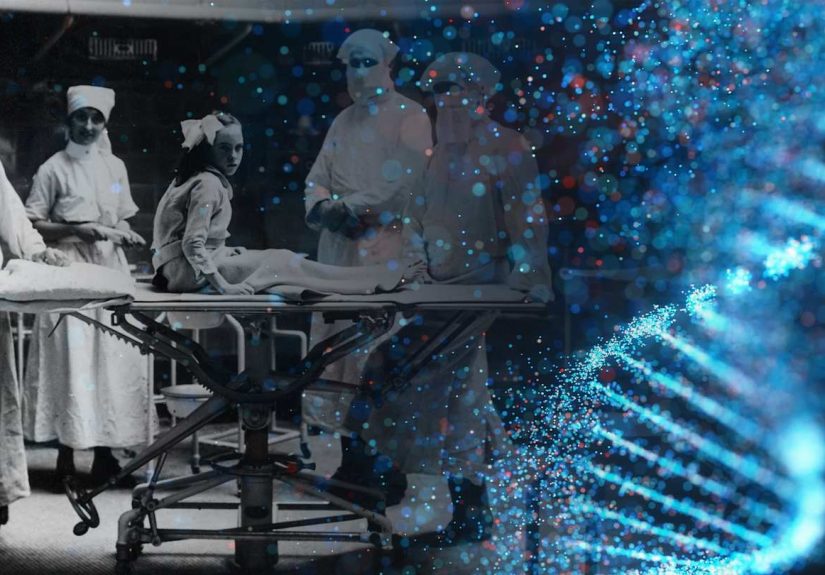
The most devastating legacy of American eugenics was forced sterilization. Once eugenicists convinced lawmakers that some people were biologically unfit, sterilization was framed as a public good. It was presented as humane, efficient, and protective of society. Those are the kinds of adjectives history teaches us to fear.
Across the United States, more than 30 states enacted sterilization laws. Victims were often people living in institutions, people with disabilities, poor women, incarcerated people, and members of marginalized racial and ethnic groups. California became the nation’s most aggressive sterilizer, accounting for roughly one-third of all officially reported operations. Overall, more than 60,000 people in the United States were sterilized under these policies.
Cold Spring Harbor did not carry out every operation, of course. But it helped furnish the intellectual justification. It supplied the categories, the confidence, and the policy arguments. That is how institutional harm often works. One place writes the theory. Another passes the law. Another performs the procedure. Responsibility gets distributed, but the damage stays painfully concentrated in human bodies.
Buck v. Bell and the Legal Blessing of Eugenics
No discussion of this history is complete without Buck v. Bell, the 1927 Supreme Court case that upheld Virginia’s sterilization law. Carrie Buck, a young woman wrongly labeled “feebleminded,” became the human face of a legal system willing to sacrifice individual rights to eugenic ideology. The Court’s ruling gave sterilization advocates new momentum and lent the movement the sort of legitimacy that only a Supreme Court decision can provide.
This was not a minor footnote. It was a national green light. After Buck v. Bell, sterilization rates climbed. The law had effectively announced that reproductive control in the name of heredity could coexist with American constitutionalism. That should unsettle anyone who assumes that injustice always arrives wearing obvious villain makeup. Sometimes it arrives in a judicial opinion with a neat citation format.
For Cold Spring Harbor’s advocates, the ruling validated years of lobbying and propaganda. For the people targeted by these policies, it meant deeper vulnerability. The distance between theory and harm had collapsed.
Why the Science Failed
Even on its own terms, the science of eugenics was badly flawed. It relied on simplistic ideas about heredity, treated complex traits as though they were controlled by single genes, and ignored the massive influence of environment, culture, discrimination, nutrition, schooling, trauma, and opportunity. It also confused moral judgment with biological fact. A person was poor, therefore their genes were poor. That is not genetics. That is circular logic with a microscope nearby.
Many scientists eventually criticized eugenic claims, and by the late 1930s the movement’s scientific credibility was fraying. The ERO closed in 1939. World War II and the exposure of Nazi racial policy further discredited eugenics in public life, especially once Americans could no longer ignore where racial “improvement” theories could lead.
But the collapse of prestige did not erase the damage. Sterilization programs persisted in some places long after elite opinion shifted. The lesson here is brutal but useful: discredited science does not instantly stop harming people. Institutions can continue running on old assumptions long after the theory has begun to rot.
Cold Spring Harbor’s Legacy Today
Today, Cold Spring Harbor Laboratory is a major center for biomedical research, not a eugenics headquarters. It also preserves and shares records of the ERO, acknowledging the institution’s role in promoting a harmful and discredited movement. That act of preservation matters. Archives cannot undo the past, but they can prevent convenient forgetting.
The site now occupies an uneasy place in American scientific memory. It is both a landmark of research and a reminder that scientific institutions are never morally self-cleaning. The presence of a laboratory does not guarantee wisdom. The presence of data does not guarantee justice. And the presence of prestige absolutely does not guarantee truth.
That is why this history remains urgent in the age of genomics, reproductive technology, and predictive data. Most modern genetics is not eugenics, and it is important not to flatten those distinctions. But the history of Cold Spring Harbor warns us what happens when scientific language is used to rank human worth, sort populations into “desirable” and “undesirable” categories, or turn social inequality into biological destiny.
Experiences of Living with This History
To understand why this story still hits hard, it helps to think about the experience of encountering it now. Imagine arriving in Cold Spring Harbor on a bright day. The water is calm. The campus is beautiful. Trees move in the breeze. Nothing about the landscape announces what was once organized there. That contrast is part of the experience. Evil, in public memory, is often expected to look dramatic. But many of the systems that harmed people in the 20th century were housed in ordinary offices, pleasant campuses, and respectable institutions.
For students learning this history for the first time, the experience can be jarring. They often expect eugenics to belong entirely to Nazi Germany, to some distant place where extremism wore a swastika and shouted more loudly than Americans ever did. Cold Spring Harbor ruins that comforting illusion. It reveals that American eugenics was domestic, organized, and often polite. It advanced through conferences, committee work, family studies, and recommendations typed on official letterhead. That can be more chilling than open fanaticism because it feels so familiar.
For descendants of people harmed by sterilization laws, the experience is different again. This history is not abstract. It lives in broken family lines, missing children, withheld consent, institutional trauma, and the knowledge that respectable professionals once argued your relatives should not exist. There is no clever historical phrasing that makes that lighter. The damage was intimate. It affected bodies, marriages, futures, and the shape of entire families.
For disabled communities, communities of color, immigrants, and poor families, the legacy of eugenics can also feel uncomfortably modern. The language changes over time, but suspicion toward certain groups’ fertility, parenting, intelligence, or worth has never fully disappeared. The experience of reading this history today is often less about discovering something dead than recognizing something unfinished. Not identical, not unchanged, but disturbingly recognizable.
There is also the experience of confronting the archive itself. Old pedigree charts, institutional reports, and conference materials can look dry at first glance. Then the labels start landing with force. A person becomes a symbol. A family becomes a case. A life becomes a defect category. That is when the archive stops feeling like paper and starts feeling like machinery. The forms are calm. The ideology behind them is not.
Teachers, museum workers, and historians who present this material often describe another challenge: how to tell the truth without accidentally reproducing the cruelty of the original sources. That takes care. The documents are full of racist, ableist, sexist, and classist assumptions. Yet avoiding the material entirely would leave the public with a cleaner history than the country deserves. The experience of teaching Cold Spring Harbor’s eugenics past is therefore a balancing act between exposure and responsibility.
And then there is the civic experience, which may be the most important one. Once people learn what happened, they start asking different questions about science in the present. Who defines “risk”? Who gets categorized? Who benefits from a supposedly objective system, and who gets monitored, excluded, or corrected by it? Those are healthy questions. In fact, they are the opposite of eugenics. Eugenics thrived on certainty. Democratic accountability begins with skepticism.
That is why Cold Spring Harbor still matters. Not because it is a frozen relic of a bygone embarrassment, but because it offers a living lesson in how institutions can confuse authority with wisdom. The most useful experience this history can produce is not guilt alone, and certainly not morbid fascination. It is vigilance. If a beautiful campus, a stack of charts, and a few famous scientists once helped sell the nation a cruel fantasy of human hierarchy, then the responsibility now is clear: admire science, yes, but never worship it blindly.
Conclusion
Cold Spring Harbor’s role in American eugenics is a story about prestige without humility, data without ethics, and policy without compassion. The Eugenics Record Office helped make eugenics look scientific, modern, and administratively tidy at the very moment it was stripping people of dignity and autonomy. That is why the lab’s history matters far beyond Long Island. It shows how dangerous institutions become when they stop studying humanity and start grading it.
If there is one lesson to carry forward, it is this: science is powerful, but power is not the same thing as wisdom. The history of Cold Spring Harbor reminds us that when research aligns too neatly with fear, hierarchy, and political convenience, the right response is not admiration. It is scrutiny.