Table of Contents >> Show >> Hide
- How to Choose the Right Room Divider for Your Space
- 19 Creative Room Divider Ideas to Partition Your Space
- 1. Ceiling-Mounted Curtains
- 2. Open Bookshelves
- 3. Folding Screens
- 4. Slatted Wood Partitions
- 5. Glass and Metal Partitions
- 6. Half Walls
- 7. Storage Cabinets as Dividers
- 8. Sliding Barn Doors
- 9. Plant Walls and Tall Greenery
- 10. Pegboard Dividers
- 11. Upholstered Panels
- 12. Beaded or Rope Dividers
- 13. Vintage Doors or Window Frames
- 14. Sofa-Back Dividers
- 15. Wardrobes and Armoires
- 16. Acoustic Panel Dividers
- 17. Freestanding Screens with Shelves
- 18. Partial Raised Platforms
- 19. Custom Built-In Partitions
- Design Tips for Making a Divider Look Intentional
- Common Mistakes to Avoid
- Real-Life Experiences With Room Dividers
- Final Thoughts
Open layouts are wonderful until your sofa is also your office, your dining table is also your homework station, and your bed is somehow part of the living room conversation. That is where smart room divider ideas come in. A good divider does more than slice one room into two. It can create privacy, improve flow, add storage, soften noise, and make your home feel intentional instead of accidental.
The best part is that you do not need to build a full wall and start acting like your own contractor on a reality show. Some of the most effective space partitions are simple, stylish, and surprisingly flexible. Whether you live in a studio apartment, share a bedroom, need a work zone in the living room, or want to make a giant room feel less like an airplane hangar, these creative room divider ideas can help.
How to Choose the Right Room Divider for Your Space
Before you start dragging a bookcase across the floor and calling it design, think about what you actually need. Are you trying to block sight lines, create privacy, add storage, let light pass through, or reduce visual clutter? Your answer will point you toward the right type of partition.
For example, curtains and folding screens are ideal when you want flexibility. Bookshelves and storage units are great when every square foot has to earn its keep. Slatted wood, glass, and half walls work best when you want definition without making the room feel boxed in. In other words, the divider should solve a problem, not create a new one.
19 Creative Room Divider Ideas to Partition Your Space
1. Ceiling-Mounted Curtains
If you want the easiest way to divide a room without making permanent changes, curtains are the MVP. A ceiling-mounted track draws the eye upward, which makes the space feel taller while also creating a soft barrier. Use sheer panels if you want filtered light, or heavier drapes if privacy is the goal. This option works especially well for studio bedrooms, shared kids’ rooms, and home office corners.
2. Open Bookshelves
An open bookcase is the overachiever of room dividers. It separates zones, gives you storage, and still lets light travel through the room. Style it with books, baskets, plants, and a few decorative objects, but do not stuff every shelf like it is trying to win a storage contest. Leaving some breathing room keeps the divider feeling airy and modern.
3. Folding Screens
The classic folding screen is still popular for a reason. It is portable, renter-friendly, and available in everything from rattan to upholstered panels to sleek modern finishes. If your needs change often, this is one of the smartest space partition ideas. Pull it out when you need privacy, fold it away when you want openness, and enjoy the fact that commitment issues are finally working in your favor.
4. Slatted Wood Partitions
Wood slat dividers are one of the chicest ways to define space without killing natural light. Vertical slats create rhythm and architecture, making even a basic apartment feel more custom. They are ideal for separating an entry from a living room or carving out a sleeping area in a loft. They also add warmth, texture, and a little designer drama without shouting for attention.
5. Glass and Metal Partitions
If you want separation with a polished, architectural feel, consider a glass partition with black metal framing. It gives you structure and visual division while preserving light. Frosted or ribbed glass can add more privacy if you do not want your workspace or bedroom fully on display. This option is especially effective in modern homes, converted lofts, and spaces that need a little definition without feeling closed off.
6. Half Walls
A half wall creates a subtle division while keeping the room connected. It can separate a dining area from a living room, define an office nook, or create an entry zone in an open layout. The beauty of a half wall is that it can also become a design feature. Add trim, paneling, a ledge for decor, or even a slim shelf on top, and suddenly your practical divider is pulling style duty too.
7. Storage Cabinets as Dividers
If you need to hide clutter and divide space at the same time, closed storage cabinets are a brilliant choice. Place a low credenza behind a sofa to define the living area, or use a tall cabinet to create a bedroom boundary in a studio. This works beautifully in homes where visual calm matters because nothing ruins a serene room faster than seeing your printer, cords, and random mystery drawer contents from the couch.
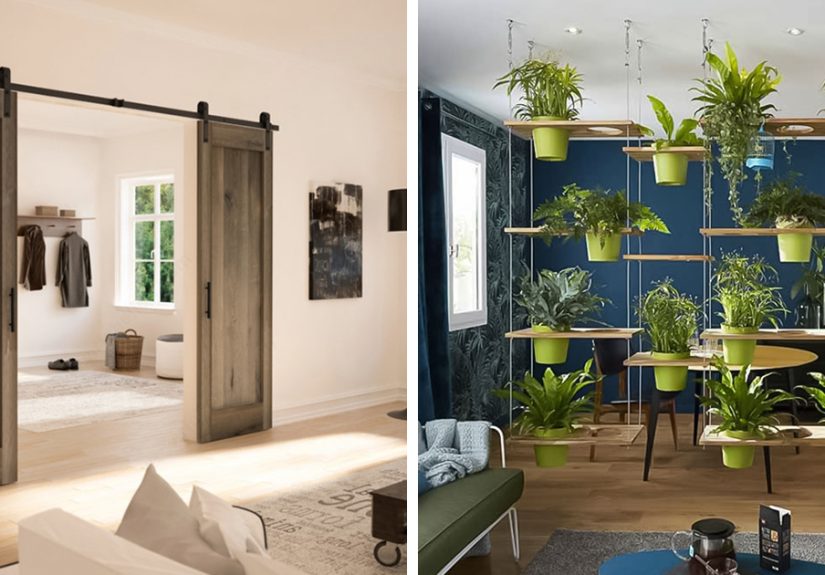
8. Sliding Barn Doors
Sliding barn doors bring a stronger sense of separation than curtains, but they still feel lighter than a standard wall and swing door. They are useful for home offices, laundry areas, or bonus spaces that occasionally need privacy. Choose a clean-lined version for a modern home or a reclaimed wood style for something more rustic. Either way, they make a statement.
9. Plant Walls and Tall Greenery
A living divider adds softness in a way that hard materials never can. A row of tall plants, a freestanding planter system, or a shelf filled with greenery can define a zone while making the room feel fresh and layered. Plants are especially good for separating relaxation areas from work areas because they visually calm the space. Just choose varieties suited to your light conditions unless your design plan includes performing a memorial service for ferns every other month.
10. Pegboard Dividers
Pegboard dividers are practical, customizable, and great for creative spaces. You can hang office supplies, baskets, hooks, or decor directly on the surface, making the divider both functional and flexible. This is a strong option for craft rooms, work-from-home setups, or family spaces where you want organization built into the partition itself.
11. Upholstered Panels
Upholstered dividers bring softness, color, and even a bit of sound absorption to a room. They are useful in bedrooms, home offices, or multipurpose spaces where you want the divider to feel cozy rather than stark. Choose a textured neutral for a sophisticated look or a bold pattern if the divider is meant to act like statement decor.
12. Beaded or Rope Dividers
For a playful, artistic vibe, consider beaded strands, rope curtains, or hanging textile dividers. These options are more decorative than private, but they can still create a visual threshold between zones. They work best in eclectic interiors, bohemian spaces, or rooms that need movement and texture more than full separation.
13. Vintage Doors or Window Frames
Repurposed architectural pieces can become unforgettable room dividers. Old doors, salvaged shutters, or vintage window frames add character and history while dividing space in a creative way. They are perfect for cottage, farmhouse, or collected-style interiors. Even one dramatic piece can make the room feel more layered and personal.
14. Sofa-Back Dividers
Sometimes the divider is already in your house pretending to be furniture. Positioning a sofa with a console table behind it can establish a clear boundary between living and dining zones. Add a lamp, a tray, and a few books on the console, and suddenly the room has order. It is simple, affordable, and refreshingly low-drama.
15. Wardrobes and Armoires
A wardrobe is one of the most practical room partition ideas for studios and bedrooms because it creates privacy and adds serious storage. Place it perpendicular to the wall to divide a sleeping area from the rest of the room. Unlike a flimsy divider, a wardrobe gives the setup substance and makes the room feel like it has distinct destinations.
16. Acoustic Panel Dividers
If your biggest problem is noise rather than sight lines, acoustic dividers are worth considering. These are especially helpful in shared bedrooms, work zones, or large family spaces where everyone is doing something different at once. They can be freestanding, wall-mounted, or suspended, and they help make a room feel calmer and more focused.
17. Freestanding Screens with Shelves
Some dividers combine display space with a lightweight frame, giving you the best of both worlds. These are great when you want a little storage and a little openness. Use them to display pottery, books, candles, or plants, but keep the styling curated. The goal is “thoughtful” rather than “yard sale in progress.”
18. Partial Raised Platforms
A small platform or change in floor level can create a strong sense of zoning even without a tall divider. Pair it with a low shelf or curtain, and the effect becomes even stronger. This approach works best in larger rooms where you want to visually distinguish a reading nook, office, or sleeping area in a more architectural way.
19. Custom Built-In Partitions
If you are ready for a longer-term solution, a custom built-in partition can be tailored exactly to your needs. Think integrated shelves, lower cabinets, open cubbies, or a slatted top section that preserves light. This is ideal when you want the space to look truly intentional and polished. Yes, it costs more than buying a folding screen, but it can completely transform how your home functions day to day.
Design Tips for Making a Divider Look Intentional
The secret to a successful room divider is making it feel like part of the design, not an emergency fix. Match materials or colors to existing furniture so the partition blends with the room. Use lighting on both sides so one zone does not feel forgotten. Leave enough circulation space so the new layout feels natural. And do not underestimate the power of styling. A divider looks better when it has company, whether that means a rug, a lamp, art, or a nearby chair that helps the new zone feel complete.
It also helps to think in layers. A curtain divider becomes more convincing with a rug beneath the bed. A bookshelf divider works better when the shelves are styled from both sides. A glass partition looks more intentional when it aligns with nearby trim, furniture lines, or other architectural elements. The goal is not simply to divide a room. It is to create two purposeful spaces that still feel connected to the same home.
Common Mistakes to Avoid
One of the biggest mistakes is choosing a divider that is too bulky for the room. A massive cabinet in a small apartment can make the space feel cramped instead of organized. Another mistake is blocking all light, especially in homes that already struggle with dim corners. This is why open shelving, slats, glass, and sheer fabrics are so useful. They provide separation without turning half the room into a cave.
You should also avoid creating zones with no clear purpose. If the divided area has no job, it will quickly become a holding pen for laundry, bags, and life’s miscellaneous chaos. Give each section a role. Reading nook. Office corner. Sleeping space. Entry zone. Mini library. Once a space has a purpose, it is much easier to keep it functional and attractive.
Real-Life Experiences With Room Dividers
One of the most surprising things about using a room divider is how much it changes the feeling of a home, not just the floor plan. In small apartments, even a simple curtain can create emotional relief. When the bed is hidden, the room feels calmer. When a desk is tucked behind a shelf, work feels less like it has invaded the entire house. People often think room dividers are just visual tools, but they also help create routine. You can mentally “arrive” in a workspace, then leave it behind at the end of the day, even if you only walked six feet.
In family homes, dividers can reduce friction in subtle ways. A bookshelf between two activity zones can make one person feel less interrupted while another watches television or takes a call. A slatted partition in an entry can stop shoes, bags, and daily clutter from visually taking over the living room. Even a low cabinet behind a sofa can make the room feel more structured and more comfortable. The space starts making sense, and that tends to make life inside it run more smoothly too.
There is also a confidence boost that comes from solving an awkward layout creatively. Plenty of people live in homes that were not designed for modern life. Bedrooms become offices. Dining rooms become homework stations. Living rooms become everything rooms. A well-chosen divider does not just hide the mess. It helps you claim the room in a smarter way. Suddenly, instead of apologizing for the layout, you are working with it.
Some of the best experiences come from flexible dividers. A folding screen can turn a guest corner into a private sleeping zone for the weekend. Curtains can open wide when you want the room to breathe and close when you want coziness. Plant dividers can soften the edge between one area and another so the room feels peaceful instead of chopped up. These small changes can make a home feel more personal, more adaptable, and more forgiving of real life.
And then there is the simple joy of visual order. It is hard to relax when every function of your home is visible at once. A room divider lets you edit what you see. That sounds minor until you experience it. Hide the workstation, and the evening feels more restful. Screen the laundry area, and the room feels cleaner. Create a reading nook behind a shelf, and suddenly that corner becomes a place you actually want to sit. Good dividers do not just partition space. They improve the experience of living in it.
Final Thoughts
The best room divider ideas balance style and function. They help define how a room works while making it look better at the same time. Whether you go for a curtain, a bookshelf, a half wall, a plant display, or a custom built-in, the right choice can make your home feel larger, calmer, and more intentional.
So if your space currently feels like one giant multiuse shrug, take heart. A creative room divider can turn that chaos into zones with purpose, privacy, and personality. No full renovation required. No drywall dust in your coffee. Just smarter design and a room that finally understands the assignment.