Table of Contents >> Show >> Hide
- What an ectopic pregnancy is, in plain English
- Can you detect an ectopic pregnancy at home?
- Early warning signs surgeons never ignore
- When symptoms usually show up
- Risk factors that raise suspicion
- How doctors actually diagnose an ectopic pregnancy
- Advice from a surgeon: when to seek care immediately
- What treatment may look like
- What about future fertility?
- Common mistakes that delay diagnosis
- The bottom line
- Extended Experience Section: What Real-World Ectopic Pregnancy Experiences Teach Us
Note: This article is for educational purposes only and is not a substitute for emergency medical care. If you have a positive pregnancy test and severe abdominal or pelvic pain, shoulder pain, heavy bleeding, dizziness, or fainting, seek urgent medical help right away.
Early pregnancy can feel like one long guessing game. Is that cramp normal? Is spotting okay? Is your body being dramatic, or is it trying to wave a giant red flag? When the concern is an ectopic pregnancy, the answer is simple: this is not the time to play detective alone.
An ectopic pregnancy happens when a fertilized egg implants outside the uterus, most often in a fallopian tube. Because that location cannot safely support a growing pregnancy, the condition can become dangerous fast. From a surgeon’s perspective, the goal is not just to confirm what is happening. The goal is to catch it early enough to protect your health, reduce the risk of internal bleeding, and preserve fertility whenever possible.
The good news is that ectopic pregnancy often leaves clues. The tricky part is that those clues can overlap with normal early-pregnancy symptoms, miscarriage symptoms, stomach bugs, or even “maybe I slept weird” discomfort. That is why the smartest advice is also the least glamorous: take symptoms seriously, test early, and get checked before the situation turns into an emergency room plot twist.
What an ectopic pregnancy is, in plain English
In a typical pregnancy, the fertilized egg travels into the uterus and implants there. In an ectopic pregnancy, that journey goes off course. The pregnancy may implant in a fallopian tube, but it can also occur in places like the cervix, ovary, or abdominal cavity. None of those locations are designed to stretch and safely hold a developing pregnancy.
That is why ectopic pregnancy is never something to “wait out” on your own. It cannot continue normally, and if the surrounding tissue ruptures, it can cause serious internal bleeding. Surgeons worry about timing because the difference between “caught early” and “caught late” can mean the difference between medication and emergency surgery.
Can you detect an ectopic pregnancy at home?
Not fully. A home pregnancy test can tell you that you are pregnant, but it cannot tell you where the pregnancy is located. That is the key problem. Some people assume a positive test plus light bleeding means a normal pregnancy with spotting. Others assume pain means a miscarriage. In reality, ectopic pregnancy can look like both.
So here is the surgeon-style version of the rule: if you have a positive pregnancy test and symptoms that do not feel routine, especially pain on one side, vaginal bleeding, shoulder pain, or dizziness, you need a medical evaluation. Home testing starts the conversation. It does not finish it.
Early warning signs surgeons never ignore
One-sided pelvic or lower abdominal pain
This is one of the classic clues. The pain may feel sharp, stabbing, aching, or crampy. It may come and go, or it may steadily worsen. Many people describe it as pain that seems oddly specific, almost like the body has picked a side and committed to it.
Light vaginal bleeding or spotting
Spotting in early pregnancy is not always dangerous, but when it shows up with pain, it gets much more important. Ectopic bleeding may be lighter or different from a usual period, which is exactly why it can fool people into waiting longer than they should.
Shoulder pain
This one surprises people. Shoulder pain can happen when internal bleeding irritates nerves near the diaphragm. In other words, shoulder pain during early pregnancy is not always a random coincidence. Sometimes it is the body sending a very strange but very real alarm.
Dizziness, weakness, or fainting
If an ectopic pregnancy ruptures, blood loss can cause lightheadedness, weakness, or fainting. At that point, the concern is no longer “Could this be ectopic?” but “This may already be an emergency.”
Pressure in the rectum or pain with bowel movement urges
Not everyone gets this symptom, but it can happen. Because the pelvis is a crowded neighborhood, pressure or irritation in one structure can show up as discomfort somewhere unexpected.
When symptoms usually show up
Ectopic pregnancy symptoms often appear in the first several weeks of pregnancy, commonly after a missed period and often around six to eight weeks after the last normal period. That said, bodies do not read scripts. Some people have symptoms earlier, while others feel almost nothing at first.
That is why the absence of dramatic symptoms does not automatically mean everything is fine. Many ectopic pregnancies start quietly. In surgery and emergency care, “quiet at first” is not comforting. It is exactly why early follow-up matters.
Risk factors that raise suspicion
Anyone who can become pregnant can have an ectopic pregnancy, and sometimes it happens with no obvious risk factors at all. Still, doctors pay closer attention when certain factors are present.
These include a previous ectopic pregnancy, a history of pelvic inflammatory disease or sexually transmitted infections, prior tubal or pelvic surgery, endometriosis, infertility treatment, smoking, becoming pregnant while an IUD is in place, and age over 35. If you have one or more of these risk factors, that does not mean you will have an ectopic pregnancy. It does mean you should have a lower threshold for getting checked early.
How doctors actually diagnose an ectopic pregnancy
This is where medical reality beats internet guessing.
Step 1: Confirm the pregnancy
A urine or blood pregnancy test confirms pregnancy hormones are present. Useful? Absolutely. Enough on its own? Not even close.
Step 2: Measure quantitative hCG levels
Doctors often order blood tests to measure human chorionic gonadotropin, or hCG. In a typical early pregnancy, hCG rises in a predictable pattern. With ectopic pregnancy, that rise may be slower or abnormal. It is not a perfect standalone test, but it is an important piece of the puzzle.
Step 3: Do a transvaginal ultrasound
This is one of the most important tools in early diagnosis. A transvaginal ultrasound helps the clinician look for a pregnancy inside the uterus and assess the ovaries, tubes, and pelvis. If no intrauterine pregnancy is seen when it should be visible, concern rises.
Step 4: Repeat tests if the picture is still unclear
Sometimes the first scan does not give a final answer. That does not mean nothing is wrong. It may simply be too early to see the full picture. In those cases, doctors may repeat hCG testing and ultrasound over time. This phase is sometimes called a pregnancy of unknown location. Annoying name, important concept.
In other words, ectopic pregnancy is often diagnosed by combining symptoms, hormone trends, and imaging, not by one dramatic “aha” moment. Medicine loves patterns. Ectopic pregnancy usually reveals itself through a pattern that needs to be watched carefully.
Advice from a surgeon: when to seek care immediately
If you are pregnant or might be pregnant, do not brush off these signs:
- Severe abdominal or pelvic pain
- Vaginal bleeding with significant pain
- Shoulder pain
- Dizziness, weakness, or fainting
- Pain that is rapidly worsening
Those symptoms deserve urgent evaluation. Not tomorrow. Not after three more internet searches and a cup of tea. Urgent.
If your symptoms are milder, such as light spotting with one-sided pain, call your OB-GYN, reproductive health clinic, or emergency line the same day. A surgeon would rather evaluate ten false alarms than one missed rupture.
What treatment may look like
Treatment depends on how early the ectopic pregnancy is found, your symptoms, your hCG levels, and whether there are signs of rupture or internal bleeding.
Medication
If the ectopic pregnancy is caught early and you are stable, a medication called methotrexate may be used. It stops the pregnancy tissue from growing and allows the body to absorb it over time. This option often avoids surgery, but it requires close follow-up with repeat blood tests.
Surgery
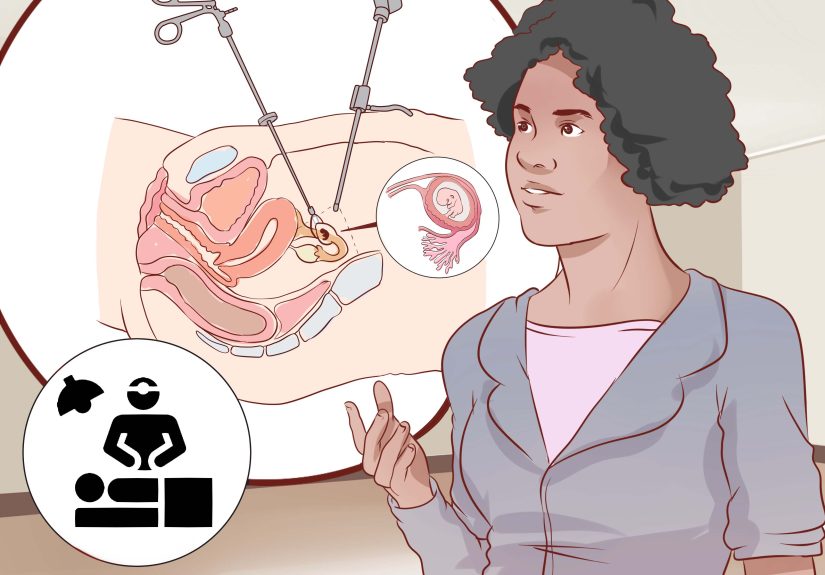
If the pregnancy is larger, causing significant pain, or suspected to have ruptured, surgery may be needed. Surgeons commonly use laparoscopy, which involves small incisions and a camera. Depending on the situation, the pregnancy may be removed while preserving the tube, or the affected tube may need to be removed.
Emergency surgery is sometimes necessary when there is heavy internal bleeding. No one loves hearing the phrase “emergency surgery,” but catching the problem early can help prevent getting to that point.
What about future fertility?
An ectopic pregnancy can be emotionally brutal. It is not just a medical event. It is also a loss, often mixed with fear about future fertility. The reassuring truth is that many people go on to have healthy pregnancies afterward.
The exact outlook depends on the health of the remaining tube or tubes, the cause of the ectopic pregnancy, and whether there has been significant damage. Having one ectopic pregnancy does raise the risk of another, which is why early monitoring matters so much in future pregnancies.
If you have had an ectopic pregnancy before, tell your clinician as soon as you get a positive pregnancy test in the future. Early blood work and ultrasound can help confirm that the next pregnancy is in the right place.
Common mistakes that delay diagnosis
Assuming spotting is always normal
Sometimes it is. Sometimes it is not. Bleeding becomes more concerning when it is paired with pain.
Waiting for symptoms to become “bad enough”
That is risky because rupture can happen quickly. Early ectopic pregnancy may feel mild until it very much does not.
Trusting a home pregnancy test to tell the whole story
A positive test confirms pregnancy, not location. Think of it as chapter one, not the entire book.
Ignoring symptoms because there are no risk factors
This is a big one. Plenty of ectopic pregnancies happen in people with no known warning history at all.
The bottom line
If you want the shortest possible version of a surgeon’s advice, here it is: detect ectopic pregnancy by respecting the pattern. A missed period or positive pregnancy test plus one-sided pain, unusual bleeding, shoulder pain, dizziness, or fainting should trigger medical evaluation fast. Diagnosis usually requires blood work and a transvaginal ultrasound. The earlier it is found, the safer and simpler treatment may be.
There is no prize for being the toughest person in the room when it comes to early-pregnancy pain. The smart move is the early move. If something feels off, get checked. In ectopic pregnancy, timing is not a detail. It is the whole game.
Extended Experience Section: What Real-World Ectopic Pregnancy Experiences Teach Us
The following are composite, educational scenarios based on common clinical patterns, not individual patient records.
One of the most common experiences starts with uncertainty, not panic. A person misses a period, takes a home pregnancy test, and gets a faint positive. Then comes spotting. Then a little cramping. Nothing dramatic, nothing movie-worthy, just enough discomfort to raise an eyebrow. Because early pregnancy can be messy and unpredictable, many people tell themselves they will “wait and see.” In some cases, that delay is where the real danger begins. Surgeons often say the body whispers before it screams. Ectopic pregnancy is a perfect example. The earliest clues may be subtle, but the pattern matters more than the intensity.
Another common experience is the one-sided pain story. A patient may describe a nagging ache low on the right or left side, sometimes with spotting that seems too light for a normal period and too odd to ignore. When that person gets evaluated early, doctors can often begin tracking hCG levels and perform an ultrasound before a rupture occurs. That early timing can make a huge difference. Instead of an emergency operation in the middle of the night, the person may qualify for medication treatment or a planned minimally invasive procedure. In plain English: getting checked early can change the entire tone of the experience from crisis management to controlled medical care.
Then there is the experience that catches people completely off guard: no risk factors, no dramatic history, no reason to think they would be the one dealing with this. This matters because many people assume ectopic pregnancy mainly happens to someone else, someone with a long fertility history or prior surgery or a known tubal problem. But real clinical practice does not always work that neatly. Some patients have no obvious risk factors at all. That is why symptoms deserve respect even when a person’s medical history looks boring in the best possible way.
There is also the emergency presentation, which tends to leave a lasting emotional mark. Someone may think they are dealing with a rough start to pregnancy, then suddenly develop severe pain, shoulder discomfort, dizziness, or fainting. In that moment, the experience changes from confusing to urgent. Surgeons and emergency teams move quickly because internal bleeding can escalate fast. Patients who go through this often say the scariest part was how rapidly things changed. That is one of the most important lessons tied to ectopic pregnancy: the condition may smolder quietly before it becomes a true emergency.
Finally, there is the experience after treatment, and this part deserves more attention than it usually gets. Many patients are relieved to be physically safe but emotionally shaken. They may grieve the pregnancy, worry about future fertility, or feel anxious during the next pregnancy. That reaction is normal. In fact, many clinicians encourage earlier follow-up in future pregnancies for exactly this reason. Seeing that a pregnancy is inside the uterus early on can bring enormous reassurance. So if there is one practical lesson woven through these experiences, it is this: pay attention early, act sooner than feels necessary, and let medicine answer the location question before your body is forced to answer it the hard way.