Table of Contents >> Show >> Hide
- What MLA Wants When You Quote Dialogue (The Big Idea)
- Quotation Marks vs. Block Quotes: Choosing the Right Format
- MLA In-Text Citations for Dialogue: The “Where Exactly Is This?” Part
- How to Cite Dialogue from Novels and Short Stories in MLA
- How to Cite Dialogue from Plays and Drama in MLA
- How to Cite Dialogue from Film, TV, and Video in MLA
- How to Cite Dialogue from Interviews, Conversations, and Q&As
- Tricky Dialogue-Citation Situations (And How to Not Panic)
- Works Cited: Common Dialogue-Heavy Sources (Quick Templates)
- MLA Dialogue Citation Checklist (Print This in Your Brain)
- Conclusion: Cite Dialogue Like a Pro (Not Like a Gremlin With Quotation Marks)
- Experiences from the Real World of MLA Dialogue Citations (Plus a Few Hard-Learned Lessons)
Dialogue is the glitter cannon of writing: it makes everything more vivid, more human, andif you’re not carefulmore citation-prone. In MLA style, quoting dialogue isn’t just about dropping quotation marks like confetti. You also need the right in-text citation, the right punctuation placement, and (sometimes) the right layout so your reader can tell who said what without playing detective.
This guide walks you through how to cite dialogue in MLA (9th edition conventions), with practical formats for novels, short stories, plays, scripts, interviews, and film/TV dialogue. You’ll get clear rules, specific examples, and a checklist you can use before you hit “Submit” (or “Publish,” if you’re living dangerously).
What MLA Wants When You Quote Dialogue (The Big Idea)
MLA documentation does two main jobs: (1) it gives credit to the source, and (2) it helps your reader find the exact passage you used. When you cite dialogue, MLA typically expects:
- The quote formatted correctly (short quote vs. block quote; drama layout when needed).
- An in-text citation that points to where the dialogue appears (usually author + page, or another locator like act/scene/line or a timestamp).
- A matching Works Cited entry so the source can be found and verified.
Quotation Marks vs. Block Quotes: Choosing the Right Format
Before you worry about citations, you need the right quote format. In MLA, long quotations are set off as block quotes; shorter ones are integrated into your sentence with quotation marks.
Short quotations (most dialogue from novels and stories)
If your quotation fits within four typed lines of prose or fewer, keep it in your paragraph and wrap it in double quotation marks. Then add an MLA in-text citation (usually author + page).
Block quotes (long dialogue or multi-speaker excerpts)
If your quotation runs more than four lines of prose in your document, format it as a block quote: start on a new line, indent the whole quote 0.5 inches, keep it double-spaced, and omit quotation marks. The parenthetical citation comes after the quote’s closing punctuation.
Dialogue from plays, scripts, and screen scenes often uses block-style formatting even when it’s not “long,” because clarity matters more than length when multiple speakers enter the chat.
MLA In-Text Citations for Dialogue: The “Where Exactly Is This?” Part
MLA in-text citations usually follow the author-page pattern: last name + page number in parentheses. If you name the author in your sentence, you typically put only the page number in parentheses.
Author named in the sentence
Author not named in the sentence
Punctuation placement (the part that trips everyone)
In MLA, periods and commas usually appear after the parenthetical citation when the quote ends the sentence. Think of the citation as the last “word” in the sentence.
For block quotes, the rule flips: end the quote with punctuation first, then add the parenthetical citation.
Question marks and exclamation points depend on meaning. If the punctuation belongs to the quoted dialogue, keep it inside the quotation marks. If it belongs to your sentence, it goes outside.
How to Cite Dialogue from Novels and Short Stories in MLA
Most dialogue you quote from fiction is treated like any other short prose quotation: double quotation marks + author-page in-text citation. The special twist is what happens when the quoted passage already contains speech in quotation marks.
Quote within a quote (double quotes outside, single quotes inside)
When your quotation includes a character’s spoken words inside it, MLA uses single quotation marks for the inner quote.
Multiple speakers in a prose source
If you quote a back-and-forth conversation from a novel, you can often keep it inline if it’s short and readable. If it gets crowdedor the speaker changes matteruse a block quote for clarity and then cite as usual with author + page.
Tip: Don’t “dump” dialogue. MLA style isn’t just citation rules; it’s also about good academic writing. Introduce the quote, present it, then explain what it shows.
How to Cite Dialogue from Plays and Drama in MLA
Plays are dialogue-heavy, so MLA gives drama its own formatting approach. When you quote dialogue from a play, you typically identify speakers and cite the location using what the text providesoften act.scene.lines (or page numbers if that’s all you have).
Short quote from a play (in the flow of your sentence)
If you quote a short line from a play in your sentence, use quotation marks and cite the act/scene/line numbers if available.
Block-format dialogue with speakers (best for two or more speakers)
For dialogue that includes multiple speakers, set it as a block quote and start each speaker’s line with the character’s name in all caps, followed by a period. Indent consistently so it’s easy to scan.
If you omit lines within a dramatic quotation and that omission includes a shift in speakers, MLA expects you to show the gap clearly (often with an ellipsis line) so you’re not “editing” the conversation into something it isn’t.
How to Cite Dialogue from Film, TV, and Video in MLA
If you quote dialogue from a film or TV show, MLA recommends using a locator that functions like a page number. Since screens do not come with pages (rude), writers commonly use a timestamp.
In-text citations for film/TV dialogue (title + timestamp)
A practical MLA approach is to cite the title (or a shortened title) plus the relevant time range. Format timestamps using hours:minutes:seconds when possible (or minutes:seconds if the video is under an hour, depending on your instructor’s preference and your media player display).
Formatting multi-speaker screen dialogue
If you’re presenting the dialogue like a script (especially with multiple speakers), you can format it similarly to drama: each speaker label in caps, a period, then the line. Keep it readable.
How to Cite Dialogue from Interviews, Conversations, and Q&As
Interviews are dialogue by design, but how you cite them depends on how you accessed them.
Published interviews (print or online)
If the interview is published (in a magazine, on a news site, in a podcast transcript, etc.), treat it like a standard source. In-text citation usually uses the interviewee’s last name plus a page number if availableor another locator (like a timestamp for audio/video).
Video/audio interviews (use timestamps)
Personal conversations (unpublished)
If you’re citing an unpublished personal interview or a private conversation (email, text message, direct message), your instructor may treat it as “personal communication.” Often, these are cited in-text but not always included in Works Cited (requirements vary by class). When in doubt, ask your instructor or follow your department’s guidance.
Tricky Dialogue-Citation Situations (And How to Not Panic)
1) Omitting words: ellipses
If you remove words from a line of dialogue, use ellipses to show the omissionwithout changing the meaning. The safest habit is to omit only what you must and keep the grammar honest.
2) Adding clarity: brackets
If you need to clarify a pronoun or add context inside a quote, use brackets.
3) Emphasis added (use sparingly)
If you add italics or emphasis to a quoted line, label it so readers know you didn’t alter the original.
4) Dialogue that’s quoted inside another source (indirect sources)
If you’re quoting dialogue that you found quoted in a different source (for example, a critic quoting a character’s line), MLA typically wants you to cite the source you actually used and mark it as indirect (often with “qtd. in”). Best practice: track down the original whenever possible.
5) Poetry or verse dialogue: showing line breaks
If the dialogue is in verse (poetry or a verse play) and you quote fewer than three lines in your sentence, MLA commonly uses a forward slash with spaces on both sides to mark line breaks, and a double slash for stanza breaks.
Works Cited: Common Dialogue-Heavy Sources (Quick Templates)
Your Works Cited entry depends on the source type. Below are simplified MLA-style templates you can adapt. (Exact details vary based on what information your version provideseditor, performers, platform, etc.)
Novel or short story in a book
Play (printed)
Film or TV episode
Online video (if that’s how you accessed the dialogue)
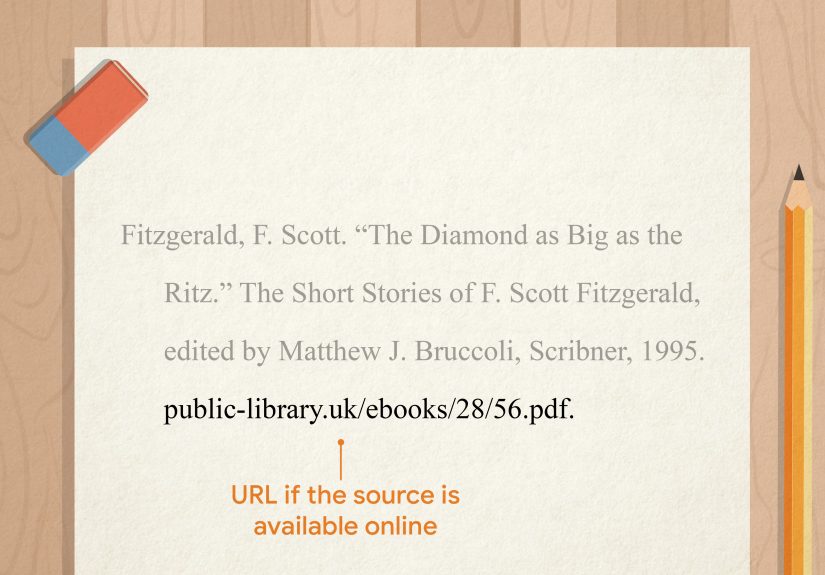
Interview (published online)
Note: Some instructors require URLs; others prefer you omit them. MLA allows flexibility, so follow your course requirements first.
MLA Dialogue Citation Checklist (Print This in Your Brain)
- Did you choose the right format? Short quote in-text vs. block quote for long or multi-speaker excerpts.
- Did you identify speakers clearly? Especially for plays, scripts, and screen dialogue.
- Did you include the right locator? Page number, act.scene.lines, chapter/section (if needed), or timestamp.
- Is punctuation placed correctly? Periods usually go after the parenthetical citation; block quotes put citation after the quote’s punctuation.
- Did you keep the quote accurate? Use brackets/ellipses to show changes, not to “rewrite” the source.
- Does every in-text citation match a Works Cited entry? No orphan citations. No mystery sources.
- Did you explain the dialogue? A quote is evidence, not a mic drop. Add your analysis.
Conclusion: Cite Dialogue Like a Pro (Not Like a Gremlin With Quotation Marks)
Properly citing dialogue in MLA comes down to three things: formatting (short vs. block vs. drama layout), locating (page numbers, act/scene/line numbers, or timestamps), and punctuation (citations don’t “float”they land in specific places). Once you get those right, the rest is just consistency and good judgment.
If you take one habit from this guide, make it this: treat dialogue as evidence. Introduce it, cite it, and then explain what it proves. Your reader shouldn’t have to guess why the quote mattersand your teacher shouldn’t have to guess where it came from.
Experiences from the Real World of MLA Dialogue Citations (Plus a Few Hard-Learned Lessons)
If MLA dialogue citations had a theme song, it would be “Why Is Everyone Yelling About Punctuation?” because the most common “experience” students have isn’t confusion about the quote itselfit’s confusion about where everything goes around it. Here are a few realistic scenarios people run into, and what tends to fix them fast.
Experience #1: The “My quote looks fine… why did I lose points?” moment.
A student writes: “I can’t believe you did that.” (Rivera 52) It feels correct, because the citation is present. But MLA usually places the period after the citation, not before it. The correction is tinyalmost annoying in its tininessbut it matters because MLA wants the citation to be part of the sentence’s ending. The fixed version becomes: “I can’t believe you did that” (Rivera 52). The weird part is how quickly this becomes muscle memory once you’ve been corrected exactly twice (which is, historically, the number of times most humans need).
Experience #2: The “This dialogue is turning into spaghetti” problem.
Someone tries to quote a whole argument from a novel inside one paragraph. It starts fine. Then new speakers appear. Then more lines. Then the quote becomes a paragraph-long tangle of he said/she said. The reader can’t track who’s speaking, and the writer can’t explain the quote because the quote ate the paragraph. The fix is usually to switch to a block quote for the exchange, keep each new line clearly separated, and then trim to only the lines that actually support the point. In practice, students often discover that they needed two lines, not twelve. (Dialogue is delicious, but your paper is not a screenplay.)
Experience #3: The “How do I cite a movie quotepage 3 of Netflix?” panic.
This one is common in literature and media classes. A student quotes a line from a film and then freezes because there’s no page number. The quickest way out is to use a timestamp (or time range) from the media player and cite the title. Once writers try it, they usually feel relieved because it’s actually more precise than a page numberyour reader can jump directly to the moment. The new challenge becomes consistency: pick a timestamp format (often hh:mm:ss) and keep it the same throughout the paper. Also: write down the timestamp when you find the quote. “I’ll remember where it is” is a lie everyone tells themselves once.
Experience #4: The “quote within a quote” optical illusion.
A student quotes narration that includes dialogue, and suddenly the quotation marks look like a fence made of punctuation. The best trick here is to slow down and name the layers: your paper uses double quotes for the main quotation, and inside that quotation you switch the character’s speech to single quotes. When students practice this once with a simple example, it stops being scary. When they don’t practice it, they invent brand-new punctuation systems (which is bold, but not MLA).
Experience #5: The “I cited the line, but I didn’t do anything with it” regret.
The last experience is the most important: quoting dialogue without analysis. Students often include a juicy line and assume it speaks for itself. Teachers, unfortunately, do not share this assumption. A reliable habit is to add one or two sentences after the quote answering: What does this line reveal (character, conflict, theme, power, tone)? Why this line and not another? That move turns dialogue from decoration into evidenceand it makes your citations feel purposeful rather than perfunctory.
If you’ve had any of these experiences, congratulations: you’re doing academic writing like a real human. MLA dialogue citation is mostly about learning where the pieces go and repeating the pattern until it’s automatic. The good news is that once it clicks, it stays clickedand future-you will cite dialogue with the calm confidence of someone who has survived the punctuation wars.