Table of Contents >> Show >> Hide
- Why Teaching Your Child to Swim Matters
- When Should You Start Swim Lessons?
- Safety First, Then Strokes
- Start With Water Comfort
- Teach the Core Survival Skills First
- How to Teach Basic Swimming Skills
- Keep Lessons Short and Positive
- What Not to Do
- Should You Teach Your Child Yourself or Use Swim Lessons?
- How to Build Confidence in Nervous Children
- Open Water Is Different From Pool Water
- Experience and Real-Life Lessons From Parents
- Final Thoughts
Teaching your child to swim is one of those parenting jobs that feels equal parts adorable and terrifying. On one hand, you get cute goggles, tiny splashes, and the dream of a future family beach trip that does not end with you sprinting like a panicked lifeguard. On the other hand, water is serious business. That is why teaching a child to swim is never just about making it from one side of the pool to the other. It is about building confidence, water safety, body awareness, and smart habits that can last for life.
The good news is that children can absolutely learn to love the water and become stronger, safer swimmers over time. The even better news? You do not have to turn your backyard or community pool into Navy SEAL training camp. The best approach is gradual, playful, consistent, and focused on safety first. If you want to know how to teach your child to swim without turning every lesson into a dramatic splash opera, this guide will walk you through it.
Why Teaching Your Child to Swim Matters
Swimming is not just another extracurricular activity you can squeeze between piano lessons and soccer snacks. It is a life skill. Children who learn basic swimming and water safety skills are better prepared around pools, lakes, beaches, and water parks. That does not mean a child who can swim is ever fully safe without adult supervision. It means they are more capable, more aware, and better equipped if something unexpected happens.
Swimming also brings a long list of side benefits. It helps improve coordination, endurance, balance, and confidence. For many children, water can become a place where they feel powerful instead of cautious. For shy kids, it can be a quiet confidence builder. For high-energy kids, it is the rare activity that actually uses all that chaos for good.
When Should You Start Swim Lessons?
There is no magical birthday when a child suddenly transforms into a tiny Michael Phelps. The best age to start depends on your child’s emotional maturity, physical development, health needs, comfort in the water, and how often they are around water. Some children can begin learning basic swim skills and water adjustment very young, while others need more time to warm up to the idea that a pool is fun and not a giant wet betrayal.
For toddlers and preschoolers, the goal is usually not perfect freestyle. It is comfort, breath control, floating, kicking, reaching the wall, and learning how to respond calmly in water. For older children, lessons can move faster because they often have better listening skills, stronger coordination, and more patience for repetition. In other words, a 6-year-old may grasp the mechanics more quickly than a 2-year-old, but both can still make meaningful progress.
Signs Your Child Is Ready
Your child may be ready for swim instruction if they can follow simple directions, separate from you without total emotional collapse, tolerate getting wet, and show curiosity rather than panic around water. Nervousness is normal. Full-scale octopus-level clinging is also normal. Readiness does not mean fearless. It means your child can participate with support.
If your child has developmental differences, sensory sensitivities, or a medical condition, it may help to talk with your pediatrician and choose an instructor experienced in adaptive or individualized swim teaching.
Safety First, Then Strokes
Before you teach a single kick, set the family rule that swim skills do not replace supervision. Ever. Not after one lesson, not after ten lessons, not after your child manages a heroic dog paddle that makes grandma cry happy tears. Children need close, constant supervision in and around water, even when they are improving.
Create layers of protection:
- Always use active adult supervision.
- Stay within arm’s reach of young or weak swimmers.
- Use a properly fitted U.S. Coast Guard-approved life jacket for boating and open water.
- Choose pools with barriers, gates, and clear rules.
- Learn CPR if possible.
- Teach your child that swimming only happens with an adult’s permission.
If you have access to a home pool, secure it with four-sided fencing and a self-closing, self-latching gate. That is not overprotective. That is smart. Children are fast, curious, and blessed with the exact kind of confidence that makes them think, “I can definitely do this,” right before proving they definitely cannot.
Start With Water Comfort
The first step in teaching your child to swim is helping them feel relaxed in the water. A child who is tense, frightened, or bracing for doom will struggle to learn even simple skills. So begin with play.
Sit on the pool steps together. Splash gently. Pour a little water over shoulders and arms. Sing songs. Blow bubbles. Practice putting the chin, mouth, and then nose in the water. Let your child feel successful early. The more fun they have, the more their brain starts filing water under “interesting challenge” instead of “liquid chaos.”
Easy Beginner Activities
- Blow bubbles on the surface of the water
- Practice holding the wall and kicking
- Walk through shallow water
- Pick up sinking toys in shallow areas
- Practice getting in and out safely
- Sing while splashing to build comfort and rhythm
Do not rush submersion. Some children are fine putting their face in the water on day one. Others act like you suggested taxes. Both reactions are normal. Keep the tone calm and light.
Teach the Core Survival Skills First
When parents think of swimming, they often picture strokes. But for children, the first priorities should be practical water survival skills. These are the building blocks that make a child safer and more competent.
1. Enter and Return to the Surface
Your child should learn what it feels like to go into water and come back up calmly. This can begin with gentle supported entries from the steps or edge. The goal is no panic, no flailing, and no swallowing half the pool like it is a sports drink.
2. Float on the Back
Back floating is one of the most valuable early skills. A child who can roll onto their back and float is buying time, saving energy, and staying calmer. Support their head and back at first. Encourage “belly up, ears in, eyes to the sky.” Some children resist because back floating feels strange. Stay patient and use short repetitions.
3. Kick With Support
Hold your child under the arms or let them hold the wall while practicing straight-leg flutter kicks. The kicks do not need to be powerful at first. They just need to move water and build body awareness.
4. Reach for the Wall and Climb Out
One of the smartest skills you can teach is how to move to the wall and get out. Practice having your child hold the edge, travel sideways along the wall, and climb out safely. This is especially helpful for younger children.
5. Turn, Find the Exit, and Move Toward It
As your child gains confidence, teach them to turn around in the water, look for the wall or steps, and move toward safety. This helps them understand that swimming is not random splashing. It is controlled movement with a purpose.
How to Teach Basic Swimming Skills
Once your child is comfortable in the water and has some survival basics, you can start connecting those skills into real swimming.
Front Glide
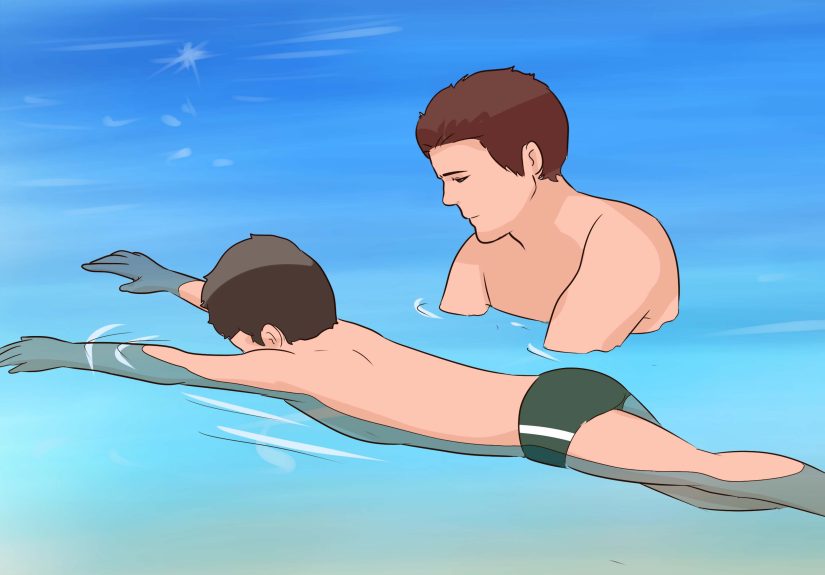
Support your child under the chest and belly as they stretch long in the water with their face down briefly. This teaches body position. Think “long like a pencil,” not “flop like wet spaghetti.”
Kick and Reach
Have your child push off the wall and kick toward you from a short distance. Keep the distance tiny at first. Success builds confidence. Confidence builds willingness. Willingness keeps the lesson from turning into a poolside negotiation.
Breath Control
Teach your child to exhale in the water and inhale when their face comes up. Blowing bubbles is a great introduction. Breath control is often what separates calm swimmers from frantic ones.
Arm Movement
Once kicking is steady, introduce simple arm actions. For young beginners, the goal is movement and rhythm, not textbook-perfect stroke mechanics. Fancy technique can come later. Right now, you want coordinated, purposeful motion.
Keep Lessons Short and Positive
Children learn best when lessons are short enough to end before fatigue, frustration, or popsicle-brain misery sets in. For young kids, 15 to 30 minutes may be plenty. Stop while your child is still feeling successful. That way, they will want to come back.
Use praise that is specific:
- “You kept your face calm in the water.”
- “You found the wall all by yourself.”
- “That back float was much longer this time.”
Specific praise teaches children what worked. Generic praise is nice. Specific praise is useful.
What Not to Do
Sometimes parents accidentally make swim learning harder by moving too fast or leaning on outdated ideas. Avoid these common mistakes:
- Do not assume floaties or water wings teach real swimming skills.
- Do not force a terrified child underwater.
- Do not compare siblings or friends.
- Do not treat one good swim day as proof your child is fully safe.
- Do not replace supervision with confidence.
Inflatable arm floaties and pool toys can create a false sense of security and unnatural body position. They are fun toys, not safety plans.
Should You Teach Your Child Yourself or Use Swim Lessons?
You can absolutely help your child learn to swim, especially with water comfort, floating, kicking, and wall skills. But formal lessons with a qualified instructor can be a huge advantage. Good instructors know how to break skills into steps, adapt to fear, and spot problems you may miss. They also bring structure, consistency, and the magical authority all children reserve for adults who are not their parents.
The ideal setup is often both: professional swim lessons plus regular parent-supported practice. Lessons introduce the skills. Practice makes them stick.
How to Build Confidence in Nervous Children
If your child is fearful, the answer is not to push harder. It is to slow down and make success easier. Let them watch other children. Keep routines predictable. Use the same warm-up every time. Bring a favorite toy for shallow-water games. Celebrate tiny wins.
You can also use simple scripts like:
- “We are just practicing, not performing.”
- “You do not have to love it today. You just have to try one step.”
- “I will stay with you while you learn.”
Confidence in the water is usually built, not born. Even children who eventually swim like little torpedoes often begin by refusing to get their ears wet.
Open Water Is Different From Pool Water
If your child swims well in a pool, that does not automatically mean they are ready for lakes, rivers, oceans, or boating. Open water adds waves, currents, murky visibility, cold temperatures, uneven bottoms, and distractions. Teach children that different water environments require extra caution. In open water, life jackets matter, swimming with a buddy matters, and adult judgment matters a lot.
Experience and Real-Life Lessons From Parents
One of the most surprising things parents discover is that teaching a child to swim is rarely a straight line. It looks more like two great days, one meltdown, a random breakthrough, and then a week where your child forgets that kicking uses legs and not pure optimism. That is normal.
Many parents say the first big breakthrough is not a stroke at all. It is the moment their child relaxes. Maybe it happens when they blow bubbles without wiping their face in outrage. Maybe it happens when they float for three seconds and realize the water is helping, not attacking. Those tiny moments matter because they change the child’s relationship with the pool.
Another common experience is that children often perform better with routines. One family might begin every lesson by sitting on the steps, splashing shoulders, singing a short song, then practicing wall kicks. Another might always start with a toy retrieval game, followed by back floats and a jump to parent. Repetition creates predictability, and predictability helps nervous children feel safe enough to try.
Parents also learn quickly that mood matters. A child who skipped a nap, missed lunch, or arrived at the pool already grumpy may respond as if swim practice is a personal insult. On those days, lowering expectations can save everyone’s sanity. A shorter lesson with one small success is far better than a long lesson that ends with tears and dramatic declarations of never swimming again, ever, in this lifetime.
Some parents discover their child loves games more than drills. Asking a child to “practice flutter kicks for two minutes” may go nowhere fast. Asking them to “kick like they are powering a rocket to the wall” can suddenly produce Olympic enthusiasm. Pretend play works. So do races to the steps, treasure hunts for dive toys in shallow water, and “starfish float” contests on the back.
There is also the humbling reality that children do not always separate skill from bravery. A child may physically be able to float, but emotionally resist because floating feels weird. Parents often need to support confidence and skill at the same time. That is why patience matters so much. Teaching swimming is not just coaching a body. It is coaching a nervous system.
Families who stick with it often notice something wonderful after a few weeks or months: the child begins to take ownership. They remember to hold the wall. They ask to practice kicking. They proudly show grandparents how they can float like a pancake. That sense of competence is huge. It spills beyond the pool into other parts of life too.
And then there is the parent side of the experience. Teaching your child to swim can be unexpectedly emotional. Watching them learn to trust the water, trust their body, and trust your guidance can feel like watching independence happen in real time. It is messy, splashy, and sometimes exhausting, but it is also one of those deeply practical parenting gifts. You are not just teaching an activity. You are teaching a lifelong survival skill wrapped in fun.
Final Thoughts
If you want to teach your child to swim, start with patience, play, and safety. Focus on comfort in the water first, then build survival skills, then swimming skills. Keep lessons short, positive, and consistent. Use formal lessons when possible, practice often, and never let improving swim ability replace close supervision.
Most of all, remember that progress is progress. Whether your child is blowing bubbles, floating for five seconds, or finally swimming to the wall without help, each step counts. One day you will look up and realize the child who once treated a splash like a betrayal is now confidently moving through the water. And yes, you will probably still hover nearby like a protective poolside hawk. That part is called parenting.