Table of Contents >> Show >> Hide
- Why Add Ceiling Texture?
- Choose Your Ceiling Texture Style
- Safety Check: Old Popcorn Ceilings and Dust
- Tools and Materials (Keep It Simple)
- Prep the Room and Ceiling (Because Gravity Is Petty)
- Mix Drywall Mud for Ceiling Texture
- How to Texture a Ceiling: Step-by-Step Methods
- How to Match Existing Ceiling Texture
- Drying and Painting a Textured Ceiling
- Common Problems (and Quick Fixes)
- Real-World Experiences: Lessons People Learn the Hard Way
- Conclusion
Texturing a ceiling is a classic DIY flex: you walk in with confidence, you walk out with joint compound in your hair (and somehow on the cat). The good news is that ceiling texture is more technique than talent. If you prep the room, mix your drywall mud consistently, and practice on scrap first, you can get a clean, even finish that hides flaws and looks intentionally “designer,” not “oops.”
Below you’ll learn how to texture a ceiling using the most common styles in American homesorange peel, knockdown, stomp/slap brush, and skip trowelplus how to match existing texture, paint it, and fix the mistakes that usually show up right when you start feeling proud.
Why Add Ceiling Texture?
- It disguises imperfections like patched seams, hairline cracks, and small waves.
- It softens harsh lighting by breaking up glare.
- It helps repairs blend because “perfectly flat” is harder than it sounds.
Choose Your Ceiling Texture Style
Orange Peel Texture
A light, dimpled spray texture. It’s subtle, popular in newer builds, and forgiving. Orange peel texture is usually sprayed with a hopper gun or repaired with aerosol texture products for small areas.
Knockdown Texture
Knockdown starts as sprayed droplets, then you flatten the peaks with a wide drywall knife to create a mottled, marbled look. It’s one of the most common “modern” ceiling textures because it hides flaws without looking heavy.
Stomp or Slap Brush Texture
These are brush-made patterns created by rolling on thinned joint compound, then pressing a stomp (often crows-foot) or slap brush into it. If you want maximum disguise with a handcrafted vibe, this is your lane.
Skip Trowel Texture
A hand-troweled texture with random crests and shallow valleysoften associated with a Mediterranean or stucco look. It’s beautiful in raking light and also the quickest way to learn that trowel control is a real skill.
Safety Check: Old Popcorn Ceilings and Dust
If you’re working on an older textured ceilingespecially popcornavoid scraping or sanding without understanding what you’re dealing with. Some older building materials may contain asbestos, and disturbing them can release hazardous fibers. If you suspect asbestos, get professional guidance and testing rather than “just seeing what happens.” (Spoiler: what happens is dust.)
Tools and Materials (Keep It Simple)
- Protection: drop cloths, plastic sheeting, painter’s tape, safety glasses, and a good dust mask/respirator.
- Prep: patching compound, sanding sponge, shop vacuum, and primer (plus stain-blocking primer for water marks).
- Texture material: premixed joint compound (thinned with water) or bagged spray texture product; a bucket; drill + mixing paddle.
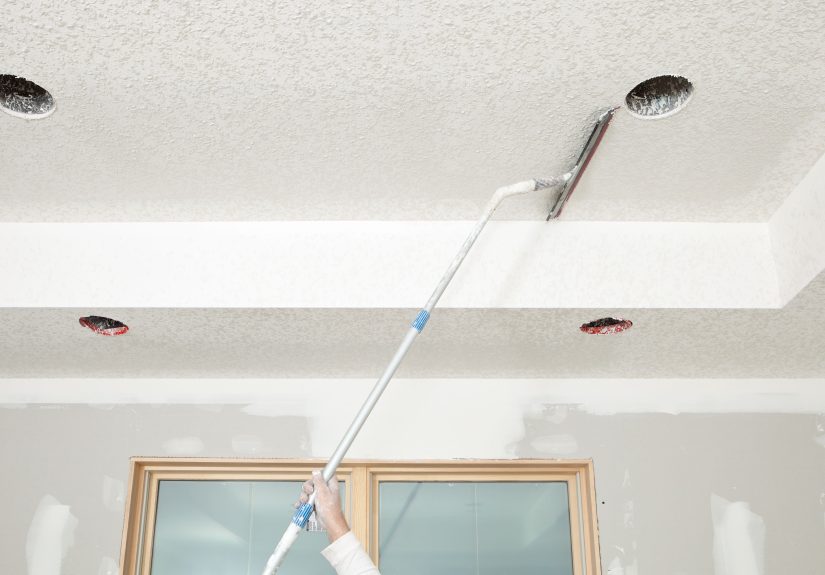
- Application: roller + extension pole, stomp/slap brush or trowel (as needed), and/or hopper gun + air compressor for spray textures.
- Finishing: 10–18 inch drywall knife (for knockdown), mud pan, damp rag, and a sanding sponge for touch-ups.
Prep the Room and Ceiling (Because Gravity Is Petty)
- Clear or cover everything. Floors and furniture get drop cloths; walls get plastic if you’re spraying.
- Protect fixtures. Remove what you can; tape off what you can’t. Turn off power if you’re removing lights/fans.
- Tape the edges. A clean tape line is the difference between “crisp” and “why is the ceiling wavy?”
- Clean and repair. Dust, cobwebs, and grease reduce adhesion. Patch cracks/holes, then sand smooth.
- Prime. Priming evens out porosity so texture doesn’t dry blotchy or peel later.
Mix Drywall Mud for Ceiling Texture
For most ceiling texture projects, you’ll thin joint compound with water until it flows easily but still holds shape. Mix with a paddle at low speed so you don’t whip air into it (air bubbles = pockmarks). The exact thickness depends on the method:
- Roller + brush: thicker than spray; it should cling to the roller without dripping like soup.
- Hopper gun spray: thinner so it sprays evenly and doesn’t clog. Follow your sprayer and product instructions.
Consistency matters. If you mix multiple buckets, keep them the sameor combine portionsso the texture doesn’t change across the ceiling.
How to Texture a Ceiling: Step-by-Step Methods
Method 1: Subtle Roller Texture (Stipple)
Best for: a light ceiling texture that quietly hides minor repairs.
- Cut in around edges and fixtures with a brush.
- Roll the textured mix onto the ceiling using a thicker nap roller (commonly around 3/4 inch).
- Work in small sections and overlap passes to keep an even pattern.
- If you want more texture, apply a second light coat rather than globbing on one heavy coat.
Method 2: Stomp or Slap Brush Texture
Best for: ceilings with lots of flaws, or rooms where you want a bold, handmade look.
- Roll thinned joint compound onto a 3×3 foot area.
- Press (stomp) or slap the brush into the wet mud and pull straight down.
- Overlap randomly so the pattern doesn’t look stamped.
Optional knockdown twist: after stomping, let the mud set until it loses its wet shine, then lightly flatten the high points with a wide knife.
Method 3: Spray Orange Peel or Knockdown (Hopper Gun)
Best for: fast coverage and the most “builder-standard” results.
- Practice on scrap drywall first. Adjust water, nozzle size, and air flow until the droplet size matches your goal.
- Spray with steady, overlapping passes, keeping distance and speed consistent. (Inconsistent distance = inconsistent dots.)
- For orange peel, stop when coverage looks even and let it dry.
- For knockdown, wait until the texture firms up (duller sheen, peaks holding shape), then “knock down” with a wide drywall knife held nearly parallel to the ceiling.
Aerosol shortcut for small areas: many spray texture cans recommend spraying from roughly 12–18 inches away and practicing first. For knockdown repairs, you may knock down very quicklysometimes within a couple of minutesso read the can and work in small patches.
Method 4: Skip Trowel Texture
Best for: a high-end, custom ceiling texture.
- Apply a thin layer of mud with a trowel over a small area.
- Skim back over with the trowel at varied pressure so it “skips” and leaves random crests.
- Keep it irregular and lightskip trowel looks best when it’s not trying too hard.
How to Match Existing Ceiling Texture
Matching is easier when you focus on what’s visible from the floor: pattern type, dot/peak size, and density. Use these habits:
- Feather the edges so the repair blends outward instead of ending abruptly.
- Build in layers (especially with spray) rather than aiming for full depth in one pass.
- Use the same tools as the original texture whenever possible: same brush type, same knife width, similar nozzle.
If your first attempt is off and the material is still wet, scrape it and redo it immediately. Redoing wet texture is annoying. Redoing dry texture is a lifestyle choice.
Drying and Painting a Textured Ceiling
Dry time depends on thickness, humidity, and the product. As a rule, texture should feel dry and firm before paint. When painting:
- Prime stains first (water marks, smoke) with a stain-blocking primer.
- Use a thicker nap roller (often 3/4 to 1 inch) so paint reaches into the texture.
- Textured ceilings absorb more paintplan for extra.
- Keep a wet edge and don’t “massage” paint that’s starting to dry.
Common Problems (and Quick Fixes)
- Uneven texture: Let it dry, sand high spots lightly, then re-texture low spots and blend.
- Clogging sprayer: Mud is too thick or has debris. Thin slightly, clean often, and keep mix smooth.
- Smearing knockdown: You knocked down too early or pressed too hard. Wait longer, use lighter pressure, keep the knife clean.
Real-World Experiences: Lessons People Learn the Hard Way
Ceiling texturing is famous for teaching the same lessons to everyone, regardless of confidence level. Here are the “field notes” that come up again and againespecially on first-timers’ projects.
Prep is the real project. The actual texturing step might take an hour. The protection step can take two. DIYers who treat masking like optional end up spending the rest of the weekend scraping dried specks off trim while muttering unprintable things about gravity.
Write down your mix. People add water until “it looks right,” then forget what “right” was. If you need a second bucket, the texture can change mid-ceiling and become visible after painting. A quick notebrand, water amount, nozzle setting, and rough air pressurekeeps your finish consistent and your future self sane.
Practice boards save ceilings. Spraying or stomping onto scrap drywall is not overkill; it’s insurance. Up close, ceiling texture looks dramatic. From the floor, it looks calmer. A practice board lets you check that “floor view” before you commit to 200 square feet of permanent dots.
Knockdown timing is a Goldilocks situation. Too soon and your knife drags through wet mud, making smears and bald spots. Too late and it won’t flatten cleanly. The sweet spot is when the wet shine dulls and peaks hold shape. Most DIYers find it by testing one small area firstthen repeating that timing for the rest of the ceiling.
Your shoulders will file a complaint. Overhead work is tiring, and fatigue makes patterns inconsistent. Smaller sections, planned breaks, and an extension pole usually produce better results than “powering through” until your arms turn into spaghetti.
Matching old texture is about camouflage, not perfection. The goal isn’t to replicate every bump; it’s to disappear from normal viewing distance. Feather edges, match density, and let paint unify the sheen. When in doubt, slightly under-texture and add a second light passsubtle fixes blend better than chunky patches.
Painting is where the finish becomes believable. Textured ceilings drink paint. The DIYers who buy “just enough” often end up with thin spots and lap marks that show in angled light. A thicker nap roller helps coverage, and the biggest trick is stopping yourself from re-rolling areas that are already drying. That’s how streaks are born.
Lighting will betray you (and that’s actually helpful). Before you declare victory, turn on the brightest light in the room or shine a work light across the ceiling at a low angle. That “raking light” exaggerates high spots and thin areas so you can touch up while it’s still easy. It may bruise your ego, but it saves you from discovering the problem later at 9 p.m. when you’re trying to relax.
Dry time isn’t a suggestion. In humid weather, texture that feels dry on the surface can still be soft underneath. If you paint too soon, rollers can pull or smear peaks, and knockdown can lose its crisp edges. When in doubt, wait longer (or run a fan and dehumidifier) and do a quick fingernail test in an inconspicuous spot.
Most “disasters” are fixable. If you hate the pattern, you can often scrape and redo while it’s wet. If it’s dry, you can sand high spots and reapply texture to low spots. The real disaster is rushing: uneven pressure, inconsistent distance, and changing mix thickness are the three fastest ways to get a ceiling that looks like multiple ceilings.
Conclusion
Texturing a ceiling comes down to three things: prep (protect the room and prime), consistency (mix and apply the same way across the whole surface), and patience (practice first and don’t rush drying). Choose the ceiling texture that fits your roomsubtle orange peel, classic knockdown, bold stomp, or artisan skip troweland you can turn an imperfect ceiling into a finish that looks purposely designed.