Table of Contents >> Show >> Hide
- What Does the Remembrance Day Poppy Mean?
- How to Wear a Remembrance Day Poppy in the UK: 12 Steps
- 1. Choose the Type of Poppy You Want to Wear
- 2. Get Your Poppy from a Trusted Source
- 3. Decide When to Start Wearing It
- 4. Place It on the Left Side If You Want the Traditional Look
- 5. Pin It Securely Without Damaging Your Clothes
- 6. Keep It Visible but Not Flashy
- 7. Wear It Respectfully with Formal Clothing
- 8. Adapt the Poppy for Coats, Scarves, and Bags
- 9. Understand the Leaf Question
- 10. Respect Different Poppy Choices
- 11. Remove It Thoughtfully After Remembrance Events
- 12. Wear It with Meaning, Not Pressure
- Common Mistakes to Avoid When Wearing a Remembrance Poppy
- Practical Examples for Different Outfits
- Why the Poppy Still Matters Today
- Personal Experiences and Reflections on Wearing a Remembrance Day Poppy
- Conclusion
Wearing a Remembrance Day poppy in the UK looks simple: pin flower to coat, walk out the door, try not to stab your finger. Easy, right? Well, almost. The little red poppy carries more meaning than its lightweight paper petals suggest. It is a symbol of remembrance, gratitude, reflection, and support for the Armed Forces community. It is also one of those British traditions that somehow inspires questions every November: Which side does it go on? When should you start wearing it? Is the leaf supposed to point somewhere? Can you wear a poppy on a backpack? And what happens if your poppy spins around like a tiny red helicopter in the wind?
The good news is that wearing a Remembrance Day poppy is not about passing an etiquette exam. The Royal British Legion has made the most important point clear: there is no single correct way to wear a poppy. It is a personal choice. Still, if you want to wear one respectfully, comfortably, and confidently during the UK Remembrance season, these 12 steps will help you get it right without overthinking it into a national crisis.
What Does the Remembrance Day Poppy Mean?
The red poppy became closely associated with remembrance after the First World War. Poppies grew across parts of the Western Front, and their striking color became linked with memory, loss, and hope. In the UK, the poppy is now widely worn in the weeks leading up to Remembrance Sunday and Armistice Day. It honors those who lost their lives in service and shows support for veterans, serving personnel, and their families.
The tradition in Britain began in 1921, when the newly formed British Legion adopted the poppy as a symbol of remembrance and fundraising. Today, poppies are distributed through the Royal British Legion’s annual Poppy Appeal, usually held in October and November. Donations help fund practical support for the Armed Forces community, including help with housing, employment, recovery, financial concerns, and family needs.
How to Wear a Remembrance Day Poppy in the UK: 12 Steps
1. Choose the Type of Poppy You Want to Wear
Start by choosing a poppy that suits your clothing and lifestyle. The classic UK paper poppy is lightweight, recognizable, and easy to pin to a coat or jacket. Since 2023, the Royal British Legion has introduced a plastic-free paper poppy design, making it easier to recycle. You can also choose enamel pins, brooches, fabric poppies, knitted poppies, or reusable poppy badges.
For everyday wear, a paper poppy works perfectly. For formal events, an enamel pin or brooch may sit more neatly on a suit, coat, blazer, or dress. If you commute, travel, or spend a lot of time outdoors, a sturdier pin may save you from the classic “where did my poppy go?” mystery by lunchtime.
2. Get Your Poppy from a Trusted Source
In the UK, poppies are commonly available through Royal British Legion volunteers, supermarkets, train stations, high street shops, workplaces, schools, and official online poppy shops. Getting your poppy through an official or recognized fundraiser helps ensure your donation supports the intended cause.
You do not need to make a grand financial gesture. Even a small donation is part of the tradition. The point is not to turn remembrance into a receipt competition. It is about joining a collective act of respect.
3. Decide When to Start Wearing It
Many people in the UK begin wearing a poppy from late October, when the Poppy Appeal launches, or from the beginning of November. Others wait until the week before Remembrance Sunday or Armistice Day on November 11. There is no strict rule.
A simple approach is to wear your poppy during the main remembrance period: from the Poppy Appeal launch through Remembrance Sunday and Armistice Day. If Remembrance Sunday falls before November 11, many people continue wearing the poppy until Armistice Day. If Armistice Day comes first, some wear it until Remembrance Sunday. Either choice is fine.
4. Place It on the Left Side If You Want the Traditional Look
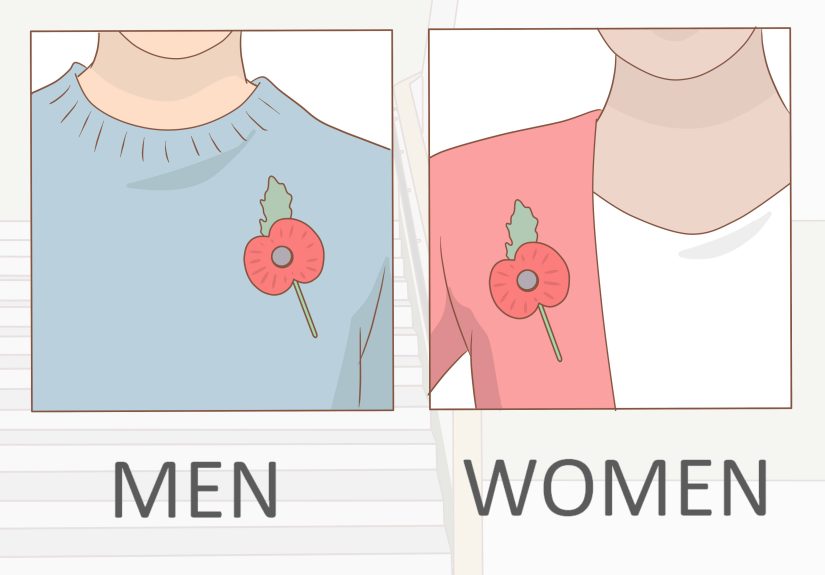
Many people wear the poppy on the left side of the chest, near the heart. This is probably the most familiar and traditional-looking placement in the UK. You will often see poppies pinned to the left lapel of coats, jackets, blazers, and suits.
That said, the left side is a custom, not a law carved into a stone monument. The Royal British Legion says there is no correct way to wear a poppy. So if your outfit, mobility needs, uniform rules, or personal preference make another placement better, choose what works respectfully.
5. Pin It Securely Without Damaging Your Clothes
If you are using a paper poppy with a pin, slide the pin carefully through the stem or center and then through your coat or jacket fabric. Try to choose a stable area such as a lapel, collar edge, or chest panel. Avoid thin, delicate fabrics that could tear or snag.
For expensive coats, silk, knitwear, or delicate dresses, consider a magnetic poppy badge, brooch backing, or reusable enamel pin. Your poppy should honor remembrance, not leave your favorite coat looking like it lost a fight with a sewing kit.
6. Keep It Visible but Not Flashy
A Remembrance Day poppy is meant to be seen, but it does not need to be displayed like a neon sign. Place it where it can sit naturally on your outfit. On coats and blazers, the lapel is ideal. On a jumper or shirt, the upper chest works well. On a scarf, place it where it will not be hidden by folds.
If you wear a name badge, work pass, or school lanyard, position the poppy so it does not get covered. The aim is simple visibility, not fashion runway drama. Respectful and neat beats oversized and chaotic.
7. Wear It Respectfully with Formal Clothing
For formal events such as Remembrance Sunday services, church ceremonies, workplace commemorations, or civic events, wear the poppy neatly on the left lapel or upper left chest. If you are wearing a suit, place it on the lapel. If you are wearing a dress or blouse, place it where it lies flat and does not pull the fabric.
Keep other accessories simple. A poppy can be worn with medals, but medals usually have their own rules and traditions. If you are attending a military, veterans’ association, or official ceremony, follow the organizer’s guidance.
8. Adapt the Poppy for Coats, Scarves, and Bags
November in the UK is not exactly famous for gentle breezes and warm sunshine. It is more “bring a coat, then bring another coat just in case.” If your outerwear covers your shirt or dress, wear the poppy on your coat so it remains visible outdoors.
You can also attach a poppy to a scarf, hat, or bag if that is the most practical option. A backpack or handbag placement is especially useful for students, commuters, or anyone whose coat fabric does not hold pins well. Just make sure it is secure and not likely to fall off during the morning rush.
9. Understand the Leaf Question
Some people say the poppy leaf should point to 11 o’clock to symbolize the eleventh hour of the eleventh day of the eleventh month, when the First World War armistice took effect. Others do not follow this custom at all. The Royal British Legion does not require a specific leaf direction.
If pointing the leaf to 11 o’clock feels meaningful to you, do it. If your poppy does not have a leaf, or if the leaf spends the day rotating like it has its own plans, do not panic. The meaning of the poppy is not ruined by botany behaving badly.
10. Respect Different Poppy Choices
In the UK, most people associate remembrance with the red poppy. However, other poppies exist. White poppies, distributed by the Peace Pledge Union, are worn by some people as a symbol of remembrance for all victims of war and as a statement of peace. Purple poppies are sometimes associated with animals affected by war, though they are not part of the Royal British Legion’s official campaign.
People may wear a red poppy, a white poppy, both, or none. Remembrance can be deeply personal. Some families connect it with military service. Others connect it with loss, migration, pacifism, or complicated historical memories. Respectful conversation is better than poppy policing.
11. Remove It Thoughtfully After Remembrance Events
Many people stop wearing their poppy after Armistice Day or after Remembrance Sunday, depending on which date comes later. There is no universal deadline. If you want a simple rule, wear it through the main remembrance events, then remove it and store or recycle it appropriately.
If you have a reusable enamel pin or brooch, keep it somewhere safe for next year. If you have a paper poppy, check whether it can be recycled. The newer plastic-free design makes this easier. Treating the poppy carefully after wearing it is part of showing respect.
12. Wear It with Meaning, Not Pressure
The most important step is to wear the poppy with sincerity. It should not be a forced badge, a social media performance, or a test of patriotism. At its best, the poppy is a quiet sign that you remember service, sacrifice, grief, courage, and the human cost of conflict.
If someone asks why you wear it, you can say something simple: “I wear it to remember those who served and those who lost their lives.” If you have a personal family connection, you can share it. If not, that is fine too. Respect does not require a dramatic backstory.
Common Mistakes to Avoid When Wearing a Remembrance Poppy
Do Not Turn It into a Costume
A poppy should feel thoughtful, not theatrical. Large decorative displays can be beautiful in public memorials, but for personal wear, simple is usually best. A neat poppy on a coat or lapel says enough.
Do Not Shame Others for Their Choice
Some people wear poppies proudly. Some choose not to. Some wear different colors. Some have personal, political, religious, or family reasons for their choice. Remembrance loses its dignity when it becomes a shouting match.
Do Not Forget the Silence
Wearing the poppy is meaningful, but it is only one part of remembrance. The two-minute silence at 11 a.m. on Armistice Day remains a powerful tradition. Standing quietly, even for a short moment, can say more than any accessory.
Practical Examples for Different Outfits
With a Suit or Blazer
Pin the poppy to the left lapel. Keep it level and secure. If you are wearing a tie and pocket square, avoid overcrowding the area. The poppy should be visible but not competing for attention like it is auditioning for a musical.
With a Winter Coat
Place the poppy on the upper left chest or lapel. Choose a spot where thick fabric can hold the pin. If the coat is padded, use a brooch-style poppy or badge for better stability.
With School or Work Clothing
Follow any school or workplace guidance. If pins are not allowed for safety reasons, use a sticker, wristband, lanyard poppy, or approved badge. The intention matters more than the exact format.
With Delicate Clothing
Avoid pushing pins through silk, lace, fine knitwear, or expensive fabric. Use a magnetic clasp, brooch converter, or attach the poppy to a coat, cardigan, scarf, or bag instead.
Why the Poppy Still Matters Today
The remembrance poppy has lasted for more than a century because it is simple and emotionally powerful. It connects public history with private memory. It appears at national ceremonies, local memorials, schools, shops, football matches, churches, train stations, and family gatherings. One small flower can carry many meanings at once.
For some, it is about remembering a grandparent or great-grandparent. For others, it is about supporting veterans today. For many, it is a reminder that war affects real people long after headlines fade. The poppy is not meant to glorify conflict. At its most thoughtful, it asks people to pause, remember, and hope for a more peaceful future.
Personal Experiences and Reflections on Wearing a Remembrance Day Poppy
One of the most memorable things about wearing a poppy in the UK is how ordinary and extraordinary it feels at the same time. You may pick one up outside a supermarket from a volunteer with a collection tin, pin it to your coat in a hurry, and continue with your day. Then, later, you notice poppies everywhere: on bus drivers, teachers, office workers, news presenters, shop staff, grandparents, teenagers, and people rushing for trains with coffee in one hand and Monday morning in their soul.
That shared visibility creates a quiet connection. Nobody has to give a speech. Nobody needs to recite a history book. The poppy does the small, symbolic work. It says, “I remember,” even when the person wearing it is just trying to find their umbrella or remember where they parked.
A common experience is the annual battle of keeping the paper poppy attached. The first time you wear one on a thick winter coat, you may feel confident. Five minutes later, the wind flips it upside down. Ten minutes later, the stem is leaning sideways. By lunch, it has migrated somewhere near your shoulder like a tiny red explorer. This is why many people eventually switch to enamel pins or brooch-style poppies. They are practical, reusable, and less likely to abandon ship on the Underground.
Another experience is the conversation it can start. Someone might mention a relative who served. A teacher might explain Armistice Day to a class. A colleague might ask why some poppies are white. A child might ask why everyone is wearing a red flower in November, which is a fair question because flowers in cold weather do seem suspiciously cheerful. These conversations are part of the tradition. They keep remembrance from becoming automatic.
Wearing a poppy can also feel different depending on where you are. At a local memorial service, it may feel solemn and formal. At work, it may feel like a quiet sign of respect. On a busy shopping street, it may blend into the movement of everyday life. At 11 a.m. during the two-minute silence, however, the meaning often becomes clearer. Traffic slows. People pause. The small flower on your coat suddenly feels less like an accessory and more like a reminder that history is not as far away as it sometimes seems.
For visitors to the UK, wearing a poppy can be a respectful way to participate in a national tradition, as long as it is done sincerely. You do not need to know every historical detail before wearing one. You only need to understand the basic meaning: remembrance, respect, and support. It is also perfectly acceptable to ask questions. Most people would rather explain the tradition kindly than watch someone panic over lapel placement like they are defusing a very patriotic device.
The best experience of wearing a Remembrance Day poppy comes when you stop worrying about perfection. The poppy does not have to sit at an exact angle. The leaf does not have to behave. Your coat does not need to look like it belongs in a royal procession. What matters is the intention behind it. Wear it neatly, wear it respectfully, and wear it because you understand that remembrance is about people.
In that sense, the poppy is powerful because it is small. It does not shout. It does not explain everything. It simply asks for a moment of attention. In a world where everyone is busy, distracted, and possibly arguing with a self-checkout machine, that small pause still matters.
Conclusion
Wearing a Remembrance Day poppy in the UK is simple, but its meaning runs deep. Choose a poppy from a trusted source, wear it where it is visible and secure, and remember that there is no single official placement rule. The left side near the heart is traditional, but personal choice is respected. Whether you wear a paper poppy, enamel pin, brooch, or another thoughtful version, the real purpose is remembrance.
The poppy is not about perfect etiquette. It is about honoring lives lost in service, supporting the Armed Forces community, and taking time to reflect on the cost of conflict. Wear it with care, humility, and pride. And if your poppy spins sideways in the November wind, fix it gently and carry on. Remembrance has room for humanity, and humanity occasionally loses a fight with outerwear.