Table of Contents >> Show >> Hide
- What Happened at the “Gold’s Gym” Locker Room?
- Why Joey Swoll’s Involvement Changed the Temperature
- Why People Got Furious So Fast
- The Real Reason This Story Blew Up
- What Gyms Should Learn From This Mess
- The Bigger Lesson About Joey Swoll
- Experiences That Explain Why This Topic Hits So Hard
- Conclusion
- SEO Tags
When a locker-room dispute becomes internet content, nuance usually gets benched before the warm-up even starts. That is basically what happened when fitness influencer Joey Swoll jumped into the viral Gold’s Gym locker-room controversy involving singer Tish Hyman, a transgender woman at a Los Angeles gym, and a flood of online outrage that turned one messy confrontation into a full-blown culture-war circus.
The headline version is simple enough: Hyman said she felt violated after encountering a transgender woman in the women’s locker room, Joey Swoll publicly backed her, and critics blasted him for taking what they saw as an anti-trans position. But the fuller story is much messier, more emotional, and way more revealing about how internet outrage works in 2025 and 2026. This was not just about one gym, one influencer, or one argument near the lockers. It became a flashpoint about privacy, gender identity, gym etiquette, public shaming, and whether online personalities can talk about sensitive issues without pouring gasoline on them.
If you are wondering why people got so furious, the answer is not just that Joey Swoll “picked a side.” It is that he picked a side on one of the most combustible debates online, then did it in a way many people believed flattened the facts, inflamed the rhetoric, and contradicted the judgment-free gym values that built his brand in the first place.
What Happened at the “Gold’s Gym” Locker Room?
The controversy began after Tish Hyman posted videos describing a confrontation inside the women’s locker room at the Beverly Center gym in Los Angeles. She said she felt unsafe and later said her membership was revoked after the incident. Local reporting framed the encounter as a dispute between Hyman and a transgender woman, with Hyman arguing that the issue was about boundaries and privacy, not hatred. That distinction mattered to her supporters, who saw her as someone speaking up in a moment of discomfort that many women would also find deeply unsettling.
But there was an immediate complication that made the story even hotter: according to local reporting, there was no public indication that a crime had occurred in the locker room itself, and the gym said its locker-room approach was consistent with state and local law. In California, that legal backdrop is a big deal. State protections broadly bar discrimination on the basis of gender identity, and advocacy materials specific to gyms and spas say transgender people have the right to use facilities that match their gender identity. In other words, this was never going to be a straightforward “one person broke the rules” story. It was always going to collide with a larger legal and cultural debate.
And to make things even more internet-perfect in the worst possible way, the gym branding itself was muddy. People kept calling it Gold’s Gym, but the Beverly Center location had just recently shifted to EōS Fitness. Online outrage does not care much about corporate paperwork, though. Gold’s was the famous name, so Gold’s became the lightning rod.
Why Joey Swoll’s Involvement Changed the Temperature
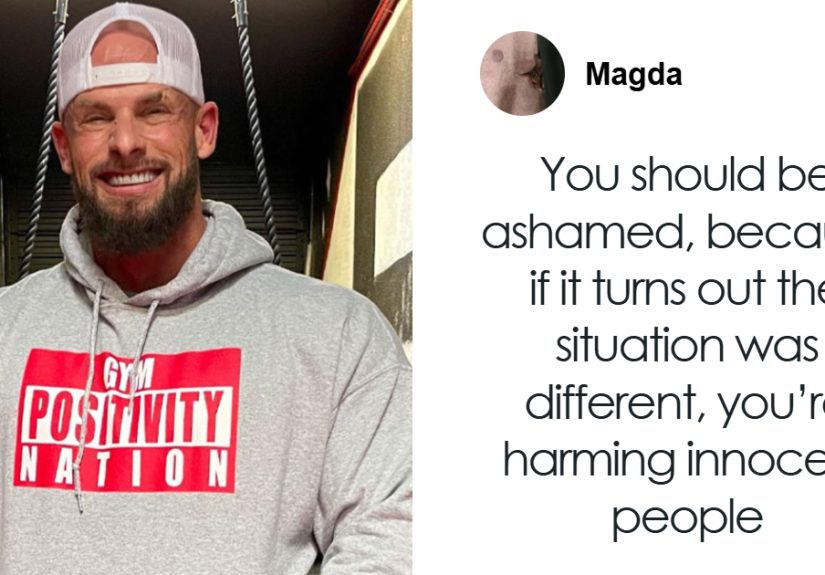
Joey Swoll is not just another commentator with a ring light and a strong opinion. He built a huge following by styling himself as the “CEO of gym positivity,” a guy who calls out rude, mocking, or invasive behavior in fitness spaces. His brand works because it taps into a real feeling many gym-goers have: that public workouts are stressful enough without being secretly filmed, shamed, or turned into somebody else’s content.
That image is why his intervention mattered. When Swoll publicly backed Hyman, he was not speaking as a random bystander. He was speaking as someone whose whole online identity is built around fairness, respect, and protecting people in vulnerable gym moments. He argued that women should be able to feel safe and comfortable in locker rooms and later insisted that supporting that idea was not transphobic.
To his supporters, that was the end of the conversation. They saw Swoll as doing what he always says he does: standing up for a person who felt exposed, ignored, and steamrolled. They believed he was defending privacy, not attacking transgender people.
His critics saw something very different. To them, Swoll was not merely defending one upset gym member. He was endorsing a larger political framing that paints trans women as threats in women’s spaces. That is where the backlash really detonated.
Why People Got Furious So Fast
1. Critics believed he turned one conflict into a broad anti-trans message
The anger was not just about his sympathy for Hyman. It was about the language and framing around that sympathy. Many critics argued that Swoll treated a single disputed encounter as proof of a larger ideological point. Once that happened, the conversation stopped being about one locker-room confrontation and started sounding, to many people, like a referendum on whether trans women belong in women’s spaces at all.
That matters because the legal and research context is more complicated than social-media slogans make it sound. California protections recognize access based on gender identity, and recent research from the Williams Institute says there is no evidence that allowing transgender people to use facilities aligned with their gender identity increases safety or privacy violations in those spaces. So when Swoll’s commentary leaned hard into a women’s-safety narrative, critics felt he was pushing a fear-based conclusion that the evidence does not neatly support.
2. His usual anti-filming principles suddenly looked selective
This part especially irritated people familiar with Swoll’s old content. He became famous by condemning people who film others in gyms, invade their privacy, or create viral pile-ons over awkward moments. That is the heartbeat of his platform. He has even publicly celebrated consequences for people who filmed and mocked others in fitness settings.
So when he backed Hyman in a controversy that itself exploded through videos, reposts, and mass online commentary, critics saw a double standard. In their view, Swoll was outrageously strict about filming and public shaming when it fit his usual gym-etiquette lane, but suddenly more forgiving when the target was a transgender woman in a politically charged story. That perceived inconsistency made the backlash much harsher than it otherwise might have been.
3. People already worry about what happens after he “calls someone out”
There is another layer here that often gets lost: Joey Swoll’s content has long generated debate about what happens after he posts. Past reporting has described people receiving hate, threats, and harassment after being featured in his callout videos. Whether he intends that or not, critics argue that his platform does not just comment on behavior. It mobilizes mobs.
That history made this moment more combustible. Critics were not only upset by what he said. They were worried about what his audience might do with it. In a controversy involving gender identity, locker rooms, and viral clips, the stakes were already sky-high. Adding a major fitness influencer with a loyal and highly reactive audience was like tossing pre-workout powder into a bonfire.
The Real Reason This Story Blew Up
Stories like this go nuclear because they allow everybody to bring their own fears into the room. Some women see locker-room privacy as non-negotiable and believe institutions dismiss those concerns too quickly. Some transgender people hear these debates and think, “Here we go again, another moment where my existence gets treated like a public emergency.” Gym owners hear legal risk. Influencers hear engagement. Politicians hear opportunity. The internet hears blood in the water.
That is why the Joey Swoll angle made the whole thing bigger. He is a bridge figure between mainstream gym culture and online outrage culture. He is not a policy expert, not a civil-rights lawyer, not a local reporter, and not a neutral investigator. He is an influencer with a powerful brand and a built-in moral script: somebody was wrong, somebody was right, and somebody needs to do better. That format works great for rude tripod behavior on the gym floor. It works a lot less cleanly when the topic is transgender rights, public accommodations law, and a conflict where the facts are emotionally charged and socially explosive.
What Gyms Should Learn From This Mess
There is a practical takeaway buried under all the noise. Gyms need clear policies, clear staff training, and de-escalation procedures that do not leave members feeling abandoned or publicly humiliated. If a member reports feeling unsafe, staff cannot shrug. If a trans member is being harassed, staff cannot shrug then either. “Everybody calm down” is not a policy. It is a panic response wearing a name tag.
The smartest gyms will do three things. First, they will make their policies explicit and legally compliant. Second, they will train staff to handle conflicts without turning the front desk into amateur crisis theater. Third, they will create privacy options that help everyone, including private changing stalls, better signage, and zero tolerance for filming in sensitive spaces. That last point should not be controversial. A locker room is not content. It should never become a viral set.
The Bigger Lesson About Joey Swoll
Joey Swoll did not become controversial because he had an opinion. Influencers have opinions the way gyms have mirrors. He became controversial because this particular opinion collided with his public identity. His brand says he protects dignity in the gym. His critics believe that in this case, he protected one person’s dignity by endangering someone else’s and by feeding a broader anti-trans panic. His supporters think that reading is unfair and that he simply defended a woman who felt exposed in a vulnerable moment.
That gap is why the outrage has lasted. People were not arguing about one post. They were arguing about what Joey Swoll actually represents. Is he a fairness-first gym watchdog? A selective moralist? A genuinely well-meaning creator who wandered into a policy fight far bigger than his usual lane? Depending on who you ask, he is all three before breakfast.
Experiences That Explain Why This Topic Hits So Hard
If you want to understand why this controversy exploded, spend five minutes thinking about the everyday experience of a locker room. It is one of the few public places where people are expected to be physically vulnerable while pretending not to notice anyone else’s vulnerability. That is already awkward before politics enters the building.
For many women, the locker room is supposed to be one of the rare places where they can change clothes, shower, or simply exist without feeling watched. If that expectation gets shaken, even for a second, the emotional response can be intense and immediate. People do not react to those moments like they react to a dispute over a treadmill. They react from the gut. That helps explain why so many women online instantly related to the emotional force of Hyman’s story, even if they did not know every detail.
For transgender women, however, public conversations like this can feel like a permanent cross-examination. They go to the gym to work out, not to become symbols in somebody else’s national argument. Every viral controversy carries the same message: your right to change clothes in peace is apparently still up for debate. That creates its own kind of fear, especially when online rhetoric turns one encounter into a sweeping moral panic.
Then there are the employees, the people nobody writes dramatic captions about. The front-desk worker, the manager, the staff member getting yelled at by three people at once while trying not to violate company policy or state law. Those workers are often thrown into impossible moments with very little training and a very high chance of ending up in someone’s video. In internet terms, they are one bad angle away from becoming “the villain” of a clip they never asked to star in.
And of course there are the bystanders. The person finishing leg day who suddenly becomes an unwilling witness to a screaming match. The member who sees the clip later and realizes the gym they joined for stress relief is now trending for the exact opposite reason. The ordinary gym-goer does not want a manifesto. They want a place to work out, shower, and go home without ending up in a nationwide argument about identity and rights.
That is the part commentators often miss. Viral stories flatten lived experience. They turn discomfort into ideology, fear into content, and confusion into teams. One side says privacy. The other says dignity. One side says safety. The other says discrimination. Meanwhile, regular people are stuck inside an environment where all of those concerns can feel real at once. That complexity does not fit neatly inside a rage-filled caption, which is exactly why the internet keeps fumbling it.
So yes, Joey Swoll picked a side. But the deeper problem is that online culture keeps rewarding everyone for picking sides before they understand the full human mess in front of them. That is why people were furious, and why this story did not stay a local gym dispute for more than five minutes.
Conclusion
The Joey Swoll-Gold’s Gym locker-room controversy became far bigger than one influencer’s opinion because it pressed on several raw nerves at the same time: women’s privacy, transgender rights, gym etiquette, internet pile-ons, and the strange power of influencer morality plays. Swoll likely believed he was defending a woman who felt unsafe. His critics believed he amplified a harmful anti-trans narrative and abandoned the consistency that made his brand credible.
Both reactions tell you something important about the modern internet. People are not just judging facts anymore. They are judging framing, audience impact, and who benefits when a story gets turned into a public spectacle. And in a controversy this charged, once the framing hardens, nobody is really talking about lockers anymore. They are talking about what kind of society they think those lockers represent.