Table of Contents >> Show >> Hide
- Meet the “Biker Dogs” Who Made the Road Their Happy Place
- Why a Motorcycle Dog Birthday Hits Different
- The Reality Check: “Motorcycle Dog” Should Mean “Trained and Protected Dog”
- The Birthday Playbook: How to Celebrate On the Road Without Chaos
- What These Stories Really Teach: The Road Is About Connection
- Extra: of On-the-Road Birthday Experiences (The Stuff You’ll Remember Forever)
- Conclusion
If you’ve ever felt like birthdays are getting a little… predictable (another candle, another “Happy Birthday,” another slice of cake that mysteriously disappears),
allow me to introduce you to a far superior party theme: an 11th birthday on the open road, complete with a tiny biker jacket vibe and a crowd of humans
who are absolutely willing to honk for the guest of honor.
“Motorcycle dog” sounds like something a kid blurts out when they’re inventing their dream life (“I’m going to be a dragon dentist!”), but it’s real. In the U.S.,
more than a few dogs have become famous for riding along with their humanssometimes in sidecars, sometimes in special carriers, and sometimes (when it’s done carefully and
with serious training) as a steady passenger wearing protective gear. And for one beloved Boston terrier named Chopper, the road didn’t just mean attention
it meant a mission: showing up for people who needed comfort, laughs, and a little hope.
Meet the “Biker Dogs” Who Made the Road Their Happy Place
Chopper: The therapy dog who turned an 11th birthday into a rolling love fest
In Southern California, Chopper the Biker Dog became a local celebrity not because he was loud (he wasn’t), but because he was joyful. Chopper was known for his
biker-style outfit and his mini motorcycle appearances at community eventsthen he’d pivot to the most meaningful work imaginable: visiting people in hospitals, veterans’ homes,
and care facilities to bring comfort and smiles.
When Chopper’s health became fragile as he got older, his 11th birthday landed with extra weight. Instead of a packed indoor party, supporters rallied in a way that fit the moment:
a drive-by/drive-thru style celebration where people could show love without putting him at risk. It was part birthday, part parade, and part “thank you for being you.”
Not every dog gets a birthday line-up of humans waving signs and cheering like it’s a championship game, but then again… not every dog is a motorcycle dog.
Sox: The long-haul passenger who helped normalize “dogs + motorcycles”
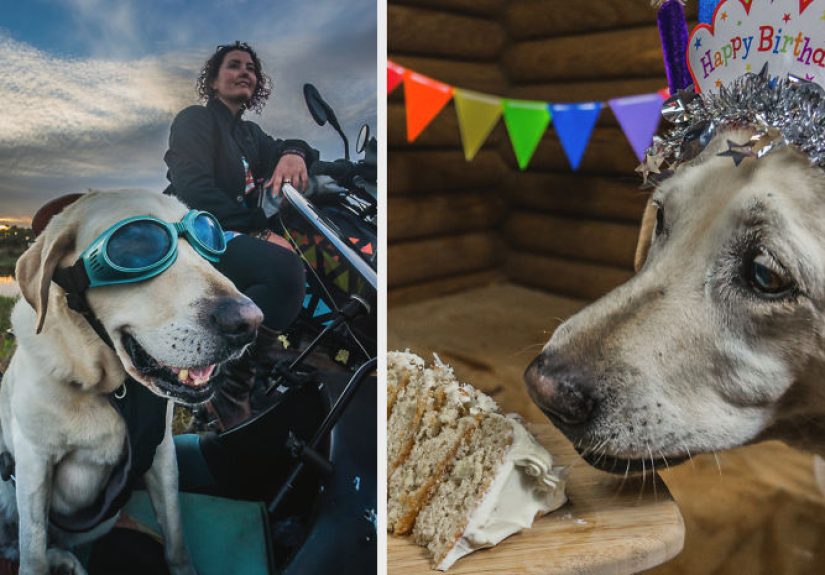
Another famous rider-dog story comes from a husky named Sox, who traveled across the U.S. with his human, Michael Fiala. Their adventures got attention because
Sox wasn’t just “posed” for photoshe was a real passenger, trained over time, and geared up with items like goggles and a small helmet. Their story also highlights something
important for anyone inspired by these viral moments:
the internet shows the cute part first, but the safe part has to come before everything.
Why a Motorcycle Dog Birthday Hits Different
Dogs don’t care about balloons. They care about ritual: your voice, your routine, the route to the park, the familiar stop where someone always says,
“Is that the good boy?” A birthday on the road works because it turns celebration into what dogs love mosttime together, new smells, and attention from friendly strangers
(aka the unofficial currency of canine happiness).
But there’s also something deeper going on with an older dogespecially an 11-year-old. Senior dogs are living libraries. They’ve watched your life change, learned your moods,
and forgiven you for leaving the house without them that one time in 2017 (they remember). A road birthday says, “You still get to have adventures. You still matter. You still get
the front-page version of love.”
The Reality Check: “Motorcycle Dog” Should Mean “Trained and Protected Dog”
Start with the non-negotiables: health, temperament, and consent
Not every dog should ride, and that’s not a vibe-killit’s responsible love. Before you even consider anything motorcycle-related, the basics matter:
- Vet readiness: Especially for senior dogs, check mobility, breathing, heart health, and comfort levels.
- Temperament: A dog that panics with loud sounds or sudden movement is not a candidate for riding.
- Body type and heat risk: Short-nosed breeds can overheat more easily and may struggle in hot weather.
- “Consent” signals: If your dog freezes, trembles, tries to escape gear, or shuts down, that’s a “no.” Respect it.
Secure transport is the whole game
In cars, safety experts emphasize restraining pets to reduce injury risk and driver distraction. On a motorcycle, the principle is the same, but the stakes are higher.
A dog should never be “free-range” on a bike. That means no balancing acts, no “he just sits there,” and no improvising with unsafe setups.
Safer approaches typically involve purpose-built carriers (for small dogs), secure harness systems designed to prevent jumping or falling,
and slow acclimation that prioritizes calm, steady behavior. Think of it like teaching a dog to enjoy a crate or a car ride:
you don’t start with the highway. You start with comfort, confidence, and tiny wins.
Eye, ear, and wind protection: cute is optional, protection isn’t
The classic biker-dog look (goggles, helmet) gets laughs, surebut it also points to real hazards. Wind, dust, insects, and debris can irritate or injure eyes.
Loud noise can trigger fear and stress, and dogs hear sounds differently than humans, often detecting higher frequencies and quieter sounds we might not notice.
Practical gear choices depend on the dog and the setup, but the logic stays the same:
protect what the ride exposes. Goggles can help reduce eye irritation from wind and particles. A properly designed helmet can help with head protection in certain situations,
but fit and comfort matter enormouslyif gear causes stress, it defeats the goal.
Heat, hydration, and “senior pace” rules
Birthdays happen in every season. The road doesn’t care. Your dog’s body does.
Dogs can overheat quickly, and older dogs may handle temperature swings less gracefully than they did at age threekind of like how adults used to pull all-nighters and now need a nap
after reading one email.
Plan for:
- Frequent water breaks (more than you think you need).
- Shorter segments and more sniff stopssniffing is dog sightseeing.
- Shade and rest during the hottest hours.
- Paw comfort (hot pavement is not a birthday treat).
The Birthday Playbook: How to Celebrate On the Road Without Chaos
Build the route around the dog, not the photo
The best “birthday ride” route is boring in the right ways: smoother roads, predictable stops, and minimal surprises. Choose pet-friendly locations, quiet scenic pullouts, and
places where your dog can safely stretch, sniff, and relax.
If your dog is a community favorite (like Chopper), consider a celebration style that lets people participate safelythink a controlled meet-and-greet window, a parking-lot “parade line,”
or a quick wave-and-honk moment. The goal isn’t to overwhelm the dog; it’s to let the dog feel the love without stress.
Pack a “birthday kit” that’s actually useful
- Water + collapsible bowl
- Leash and backup leash
- Wipes (because life happens)
- Basic first-aid items approved by your vet
- A cooling towel in hot weather
- A warm layer in cool weather
- ID tags and up-to-date microchip info
- Small, dog-safe treats
Birthday food: keep it celebratory, not dangerous
Dogs do not need frosted cake. They need you to not accidentally feed them something toxic. Common people-food hazards include chocolate, grapes/raisins, and products sweetened with xylitol.
If you want a special snack, keep it simple: a vet-approved treat, a small portion of dog-safe food, or a dog-friendly “pup cup” style treat that doesn’t include risky ingredients.
Bonus tip: if your dog is older, go easy on rich foods. An upset stomach is a terrible souvenir.
What These Stories Really Teach: The Road Is About Connection
The viral clip of a dog on a motorcycle isn’t what sticks with people long-term. What sticks is the relationship: trust, training, and the way an animal can become a walking reminder that
kindness still exists.
Chopper’s public personavest, goggles, mini-bike energywas only half the story. The other half was quiet and powerful:
showing up for strangers in hospitals, senior centers, and veterans’ spaces, bringing laughter into rooms that needed it.
That’s why an 11th birthday celebration on the road felt meaningful. It wasn’t just “happy birthday.” It was “thank you.”
And if you’re the kind of person who sees these stories and thinks, “I want that joy in my life,” you don’t need a motorcycle to start.
You can take your dog on safe adventures. You can volunteer. You can create small moments of delight for people who are having a rough day.
That’s the real biker-dog legacy: showing up with lovewherever the road goes.
Extra: of On-the-Road Birthday Experiences (The Stuff You’ll Remember Forever)
A road birthday with a motorcycle dog has a rhythm that feels different from a regular day, even if the route is short. It starts with the pre-ride routine: your dog watching you like a
tiny supervisor while you gather gear, water, and treats. The moment the harness comes out, the tail tells the trutheither “YES, we’re doing the fun thing” or “I’m not sure about this
whole outfit situation.” The best experiences happen when you listen to that tail and adjust the plan before the engine ever turns over.
Then comes the first “celebrity moment.” It might be at a gas station, a parking lot, or a stoplight where someone leans out of their car window and says,
“Is that a dog?” like they’ve just discovered a new species. You’ll nod, your dog will look extremely pleased with the attention, and suddenly the world feels friendlier than it did
five minutes ago. That’s the secret magic of traveling with a dogyour pup becomes a bridge between strangers.
The best birthday rides include small, meaningful stops: a shady place where your dog can drink water and sniff everything like an investigator; a quiet overlook where the wind feels
gentle instead of harsh; a pet-friendly patio where your dog can receive birthday compliments as if they’re collecting badges. If the celebration includes supporters, you’ll notice how
quickly the vibe can turn emotional. People don’t just wave at the dogthey wave at the story. They wave at the hope that something wholesome still exists.
On the road, you also learn your dog’s “comfort language.” Some dogs like to keep their eyes forward, calm and focused, almost professionallike they’re clocking in for a shift as your
co-pilot. Others relax most when you keep speeds modest and stops frequent. Senior dogs, especially, have a way of teaching patience: they don’t want ten miles of hustle, they want ten
minutes of peace. The birthday lesson becomes obvious: make the day about what your dog enjoys, not what looks impressive.
And when you get home, the sweetest part often isn’t the photosit’s the after. Your dog settles into their favorite spot with the relaxed body language of an animal that feels safe and
included. You’ll take off the gear, offer a final birthday treat, and realize the road wasn’t the point. The point was that your dog got a day that said,
“You’re loved. You’re celebrated. You’re still my favorite adventure.”
Conclusion
“Motorcycle Dog Celebrates 11th Birthday On The Road!” isn’t just a headlineit’s a reminder that joy can be simple, weird, and wildly memorable. Whether you’re inspired by Chopper’s
community-driven celebration or Sox’s long-haul travel story, the takeaway is the same: adventure is better when it’s safe, and birthdays are better when they’re built
around what your dog actually loves.
Plan smart, protect your pup, keep the route dog-friendly, and remember: your dog doesn’t need a perfect party. Your dog needs youpresent, prepared, and willing to make their world
a little bigger for a day.