Table of Contents >> Show >> Hide
Every so often, the art world rediscovers someone who makes you wonder how on earth they were ever overlooked in the first place. Burt Shonberg is one of those names. Long before psychedelic art became a poster-shop category, a dorm-room cliché, or a catchall for anything with swirls and weird eyeballs, Shonberg was already there, painting visions that looked as if they had wandered in from a dream, a séance, and a midnight monster movie all at once.
That is what made the Los Angeles exhibition of his rare early works such a genuine event. More than a nostalgic revival, it felt like a correction. For the first time in over half a century, Los Angeles got a serious chance to look again at a painter who once helped define the city’s bohemian underground, then somehow slipped through the official story of California art. The show gathered rarely seen pieces, early paintings, and formative works that revealed not just a “psychedelic artist,” but a painter building a private visual universe years before the wider culture caught up.
If you only know Burt Shonberg as the artist linked to Roger Corman, Café Frankenstein, Marjorie Cameron, or the era’s more deliciously strange corners, the exhibition offered a bigger picture. It showed how his art grew from Surrealist and Cubist influences into something far more mystical, theatrical, and personal. And if you had never heard of him before, well, congratulations: you just inherited one of Los Angeles’ best overdue introductions.
Why the Los Angeles Show Mattered So Much
Exhibitions get called “important” all the time, often for reasons that feel suspiciously related to gift-shop traffic. This one actually earned the word. The Los Angeles presentation marked the city’s first major Shonberg exhibition in more than 55 years, and it featured many works that had never been publicly shown before. That alone gave the event historical weight. But the deeper value came from what those paintings revealed: Shonberg was not merely a footnote to the psychedelic era. He was one of its earliest visual architects.
That distinction matters because Shonberg’s career never followed the clean, museum-approved script. He was admired by people in the know, connected to influential writers, filmmakers, musicians, and collectors, and visible across Los Angeles coffeehouses and countercultural spaces. Yet his paintings remained scattered, his murals were tied to transient venues, and his reputation never hardened into canon. In other words, he had the myth, the talent, and the scene, but not the institutional safety net.
The LA exhibition changed the mood around him. Instead of treating Shonberg like a colorful side character from bohemian lore, it centered the work itself. That shift is huge. It let viewers ask better questions: not “Who famous knew him?” but “What exactly was he seeing?” and “Why does this painting still feel so unruly?”
Who Was Burt Shonberg, Really?
The Artist Before the Legend
Burt Shonberg was born in Revere, Massachusetts, in 1933, studied art in the 1950s, served in the Army, and eventually made his way to California, where his creative life really took off. In Los Angeles and Laguna Beach, he became part of a scene that mixed beat culture, occult curiosity, science fiction, underground film, and coffeehouse experimentation. That combination sounds impossibly niche until you remember this was mid-century Southern California, where niche subcultures practically grew on palm trees.
Shonberg painted murals for clubs, restaurants, and coffeehouses. He helped found Café Frankenstein in Laguna Beach, a beatnik hangout whose very name tells you this was not a place serving timid cups of decaf. He moved through a social world that included George Clayton Johnson and Hampton Fancher, and he formed a relationship with artist and occult figure Marjorie Cameron, whose influence pushed him deeper into mystical and esoteric territory.
He also worked in orbit around film and music. Roger Corman commissioned him to create ancestral portraits for The Fall of the House of Usher, and Shonberg’s imagery later appeared on album art connected to California rock culture. So yes, he was part painter, part muralist, part underground myth-maker, and part accidental ghost in the machine of American pop culture.
More Than a “Psychedelic Artist”
Calling Shonberg a psychedelic art pioneer is accurate, but it is also incomplete. The label gets the headline right while flattening the experience. His paintings were not just colorful hallucinations. They were structured, symbolic, and often surprisingly controlled. He was interested in altered consciousness, mystical revelation, hidden worlds, extraterrestrial possibilities, ancient archetypes, and horror imagery, but he filtered all of that through a disciplined painterly intelligence.
That is why his best work does not feel like visual noise. Even when the imagery gets strange, and it often does, there is always a compositional logic underneath it. Shonberg was not tossing paint at transcendence and hoping the universe handled the rest. He was trying to invent a visual language for states of awareness that ordinary realism could not hold.
What the Rare Early Works Reveal
The early paintings are where the exhibition really came alive. They showed Shonberg before the legend fully crystallized, while already hinting at the artist he would become. One early watercolor from the mid-1950s reportedly balances a soldier-like bust, bleak landscape space, Cubist fracture, and surreal symbolism in a way that suggests he was already building toward something uncategorizable. You can see traditional modernist ingredients in those works, but you can also see him quietly sabotaging them from the inside.
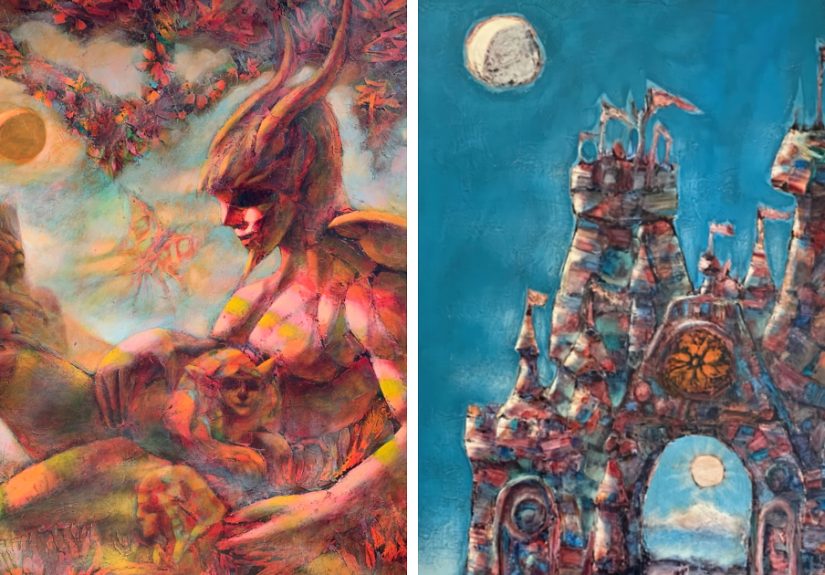
That is what makes early Shonberg so exciting. He does not look derivative, even when the influences are visible. You catch traces of Surrealism, a little metaphysical painting, maybe some Cubist spatial tension, but then suddenly a third eye appears, a sphinx emerges from the dust, a moon hangs over a psychic desert, or a face seems to split between earthly form and some incoming transmission from elsewhere. It is as if the painting starts in art history class and ends in another dimension.
Several motifs define these formative works. There are monsters and mask-like faces, but not the easy kind meant to merely spook you. There are mythic creatures, lunar presences, desert vistas, occult symbols, and hybrid beings that seem half ancient relic, half space traveler. His Frankenstein-inspired imagery also matters here. Shonberg had a longtime fascination with the monster, seeing in it something personal, almost autobiographical: the outsider, the misunderstood creation, the figure assembled from incompatible parts and forced to live anyway. That emotional charge gives even his stranger paintings an oddly human center.
Another striking feature of the early works is how they bridge two worlds at once. On one side, they carry remnants of 1950s modernism. On the other, they lean toward the visionary painting language that would later define his reputation. You can practically watch the transformation happen: structure loosens, symbolism deepens, and ordinary space becomes unstable. A painting is no longer just a picture. It becomes a threshold.
Roger Corman, LSD, and the Counterculture Connection
No serious discussion of Burt Shonberg can ignore the way his art intersected with the era’s experimental culture. Roger Corman saw something in his paintings that fit the haunted, Gothic mood of House of Usher and later The Premature Burial. That was not random hiring. Corman responded to the mystical and eerie force in Shonberg’s imagery, the sense that his pictures already belonged to a world where psychology, horror, and myth bled into one another.
Then there is the matter of psychedelics. Shonberg participated in the LSD-related creative experiments associated with Dr. Oscar Janiger, and that experience became part of his lifelong attempt to paint altered consciousness. It would be easy to turn that into tired mythology, as if a tab of acid plus a paintbrush automatically produces genius. Shonberg’s work tells a more interesting story. Psychedelic experience did not replace his artistic thinking. It sharpened a direction he was already moving toward.
That is important because his paintings are not valuable simply because they are “drug art.” They matter because he pursued the nearly impossible challenge of translating expanded perception into coherent visual form. He wanted to paint revelation without reducing it to decoration. Plenty of artists have aimed for that. Very few made it look this haunted, this funny, this solemn, and this gloriously peculiar all at once.
Why He Was Overlooked for So Long
Here is the frustrating part: none of this should have taken so long. Shonberg was respected by peers, connected to influential people, and active in a moment that later became heavily mythologized. So why did he remain on the margins?
Part of the answer is structural. He did not fit neatly into the dominant art-historical boxes. He was too mystical for one camp, too weird for another, too tied to coffeehouse murals and occult side streets for the polished gallery establishment, and too painterly to be reduced to a novelty of the psychedelic underground. He was also not a careerist in the conventional sense. That may sound romantic, but art history tends to reward visibility, archiving, and institutional persistence. Shonberg’s work often lived in private hands, vanished sets, demolished venues, and half-remembered stories.
Timing also worked against him. His one major solo exhibition in Los Angeles came in 1967, right before the broader culture fully canonized psychedelia. Being early is glamorous in hindsight and terrible in real time. If you arrive before the market has built a shelf for your work, you can spend decades being admired and ignored simultaneously.
Then there is the plain fact that Los Angeles history loves glamorous rebels but often forgets the artists who made the city’s inner weather. Shonberg was one of those weather-makers. His art helped shape the mood of a scene that others later became famous for inhabiting.
Why Burt Shonberg Feels Timely Again
Today, Shonberg feels less like a relic and more like a correction to the modern appetite for overexplained art. Viewers are once again interested in visionary art, occult imagery, spiritual symbolism, outsider aesthetics, and paintings that refuse to stay politely on message. Shonberg fits that moment beautifully, but he also exceeds it. He does not feel trendy. He feels discovered.
What makes the rare early works especially powerful is that they show his originality before the term “psychedelic” became a style package. These paintings are rawer, riskier, and in some cases more revealing than the later works because they let you watch a worldview forming in public. You see him reaching for a language big enough to contain mythology, monster movies, altered states, and metaphysical longing without collapsing into parody.
That balancing act is harder than it sounds. Plenty of art can be strange. Much less can be strange and convincing. Shonberg managed both. He painted like someone trying to report back from the edge of the visible world, while still caring whether the picture worked as a picture. That is why the Los Angeles exhibition mattered: it reminded viewers that visionary art is not an escape from form. In the right hands, it is form under pressure.
The Experience of Seeing Burt Shonberg in Person
There is also a difference, a big one, between reading about Burt Shonberg and standing in front of his work in a gallery. On a screen, the paintings can look like fascinating artifacts from a gloriously strange subculture. In person, they feel more intimate and more unsettling. You notice how the surfaces breathe. You notice how the faces do not quite sit still. You notice that the color is not merely “psychedelic” in the poster sense. It is bruised, glowing, dusty, theatrical, and oddly tender.
Walking through a room of Shonbergs must have felt a little like wandering into a private cosmology where every image knows more than it is willing to tell you. A sphinx is never just a sphinx. A moon is never just a moon. A monster may be tragic, comic, autobiographical, and cosmic all at once. And because the early works still carry traces of their making, their searching, and their uncertainty, they do not feel embalmed by art history. They feel alive, like thoughts still in the act of arriving.
That matters for viewers who are tired of exhibitions that explain themselves to death. Shonberg’s paintings do not slam the door on interpretation, but they do make you work. You stand there, staring at a face that is also a landscape, or a landscape that feels like a vision report, and your brain starts doing a funny little dance between recognition and confusion. That is part of the pleasure. The work does not just ask to be seen. It asks to be entered.
And then there is Los Angeles itself, which gives the whole experience an extra charge. Shonberg belongs to a version of the city that was messy, mystical, literary, cinematic, and deeply nocturnal. He painted for coffeehouses and clubs, for underground personalities and half-lit conversations, for places where people argued about poetry, UFOs, peyote, film, philosophy, and whether the world was secretly a coded illusion. Seeing his art in Los Angeles after all these years is not just a comeback. It is a homecoming with very weird luggage.
For younger viewers, the experience is probably different but no less sharp. Shonberg can feel startlingly contemporary because we now live in a culture saturated with surreal imagery, apocalypse aesthetics, conspiracy symbolism, retro horror, esoteric memes, and digital dream-logic. Yet his paintings still stand apart from all that visual static because they are handmade encounters, not algorithmic mashups. They came from a singular mind trying to organize mystery rather than market it.
There is something moving about that. Even when the paintings are eccentric, they never feel cynical. They are searching for transcendence the hard way, through image, symbol, and repeated formal invention. They are weird, yes, but they are weird with conviction. In an age when irony often arrives before sincerity has even parked the car, that conviction lands hard.
By the time you leave a room of Shonberg’s work, you may not feel that you have “understood” everything, and that is probably the point. What lingers is not a neat lesson but a mood: wonder, unease, curiosity, a slight shift in atmospheric pressure. The best visionary art does that. It does not simply show you another world. It makes this one feel less settled. Shonberg’s rare early works seem to do exactly that, which is why their return to Los Angeles was more than a historical event. It was an invitation to look again, and maybe to look less politely.
Conclusion
The rediscovery of Burt Shonberg’s rare early works proves that art history is never as finished as it pretends to be. Long before psychedelic art became a familiar label, Shonberg was building a visual language out of myth, monsters, occult symbols, altered consciousness, and pure painterly nerve. The Los Angeles exhibition did more than revive interest in a forgotten name. It restored depth to a figure too often reduced to legend, gossip, or supporting-role status in other people’s biographies.
What emerges from these paintings is not just a counterculture curiosity, but a serious artist who saw the world sideways and painted it that way on purpose. His early works reveal a mind in formation, but also an originality that was already hard to miss. That they returned to Los Angeles after more than 50 years feels both thrilling and a little overdue. Then again, perhaps Shonberg was always going to arrive late to the official party. Artists this strange rarely come through the front door.