Table of Contents >> Show >> Hide
- Why Asking for Your Old Job Back Is Not as Weird as It Sounds
- Should You Ask for Your Old Job Back?
- What a Strong Rehire Letter Should Accomplish
- How to Structure a Letter Asking for Your Old Job Back
- Sample Letter Asking for Your Old Job Back
- More Sample Letters for Different Situations
- What to Include in Your Letter
- What Not to Say
- Tips to Improve Your Chances of Getting Rehired
- A Quick Example of a Strong Answer to “Why Do You Want to Come Back?”
- Final Thoughts
- Real-World Experiences and Lessons From People Who Wanted Their Old Job Back
- SEO Tags
Sometimes the “next big opportunity” turns out to be more like the “next mildly chaotic spreadsheet with trust issues.” It happens. A new role looks shiny, the salary sounds nice, and then three Mondays later you realize your old job had better leadership, better culture, better coffee, or at least fewer surprise meetings that could have been an email. That is exactly why a sample letter asking for your old job back can be surprisingly useful.
Asking a former employer to take you back is no longer a career taboo. In many industries, returning workers are so common they even have a nickname: boomerang employees. The key is not to sound desperate, dramatic, or like you just texted your career ex at 2:00 a.m. with “u up?” A smart rehire letter should sound thoughtful, mature, and valuable to the company.
This guide breaks down when returning to a former employer makes sense, how to write an effective ask for old job back email, what to avoid, and several practical examples you can adapt. If you want your return to feel strategic instead of awkward, you are in exactly the right place.
Why Asking for Your Old Job Back Is Not as Weird as It Sounds
Careers are messier than they used to be. People leave for pay, promotions, relocation, caregiving, school, burnout, curiosity, or because they genuinely believed another role would be a better fit. Then life happens. Sometimes the new company is unstable. Sometimes the culture is off. Sometimes the old employer improved in all the places that once drove you nuts.
That means returning is not automatically a step backward. In some cases, it is a smart move forward with better information. You know the company. The company knows you. The learning curve is shorter. The relationship can restart on stronger footing if both sides are honest about what changed.
Still, familiarity alone is not a good enough reason. You should not chase your old job just because the new one is annoying and the printer at your last office made a comforting little beep. You need a real case for why coming back makes business sense for them and career sense for you.
Should You Ask for Your Old Job Back?
Before writing any letter to a former employer asking for your job back, pause for a brutally honest gut check. Returning can work beautifully, but only when the basics are right.
Good signs
You left on professional terms. Your past performance was solid. Your old manager respected your work. You gained new skills, perspective, or industry knowledge while away. You can clearly explain why you left and why you want to return now. Even better, there is an actual opening or a realistic need you can fill.
Warning signs
You burned bridges, skipped notice, trashed the company publicly, or left because of problems that still exist. If the culture was toxic before and nothing has changed, going back may just be reheating old problems. Nostalgia is not strategy.
The best question to ask yourself
What is different now? If your answer is only, “I miss my old team,” that is not enough. A stronger answer sounds like this: “I left to grow into a client-facing leadership role, and after gaining that experience, I can now return with skills that directly support the department’s current goals.” That is the language of a mature rehire candidate, not a panicked regret spiral.
What a Strong Rehire Letter Should Accomplish
A good sample letter asking for your old job back does four jobs at once.
1. It acknowledges the past without getting stuck there
You do not need a dramatic confession scene. You do need clarity. Briefly explain why you left and why reaching out now makes sense.
2. It shows growth
If you come back sounding exactly the same as when you left, you are missing the point. Mention what you learned, built, improved, or achieved since leaving.
3. It makes your return easy to imagine
Employers respond well when they can quickly picture how you would add value. Remind them of your track record and connect it to current needs.
4. It sounds confident, not entitled
You are expressing interest, not demanding a reunion tour. Professional warmth works. Begging does not.
How to Structure a Letter Asking for Your Old Job Back
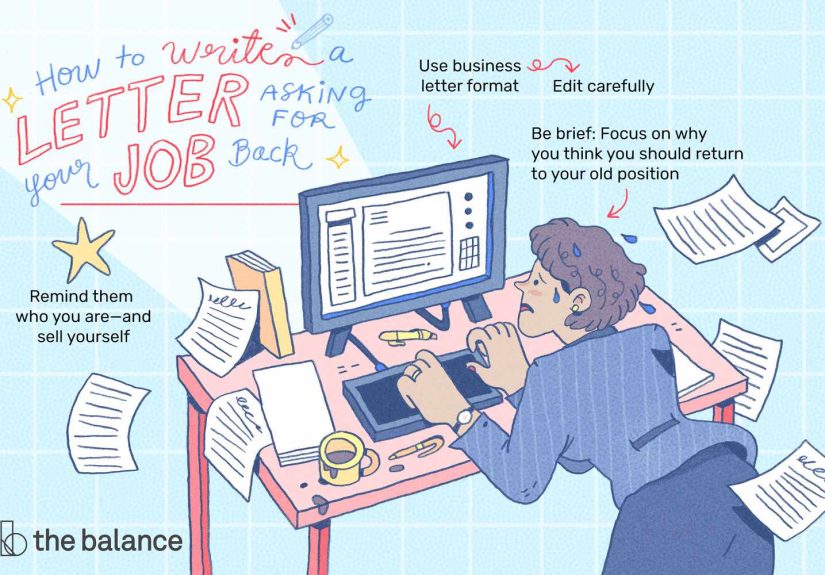
The best return to former employer letter is simple and direct. Think of it as a professional note with enough detail to open the door, not a five-page memoir called Why I Was Wrong, Susan.
Opening
Start warmly and state your purpose. Mention the role or team if relevant.
Middle
Explain why you left, what you have done since, and why you are interested in returning now. Keep the tone positive. No blame, no bitterness, no “my current boss is a chaos goblin.”
Value statement
Show how your experience can help the company. This is where you shift from emotion to business logic.
Closing
Invite a conversation. Thank them for their time. Keep it polished and brief.
Sample Letter Asking for Your Old Job Back
Here is a classic version you can customize for most situations.
Sample Letter #1: Professional and Direct
Subject: Interest in Rejoining [Company Name]
Dear [Manager’s Name],
I hope you have been well. I am reaching out to express my interest in returning to [Company Name] if there is an appropriate opportunity on your team or within the organization.
When I left [Company Name], I did so to pursue an opportunity that I believed would help me grow professionally. During my time away, I gained valuable experience in [specific skill, industry, leadership, project management, client relations, etc.], and I have come to appreciate even more the strengths of the culture, leadership, and collaboration I experienced while working with your team.
My time at [Company Name] remains an important part of my career. I am especially proud of [specific achievement], and I believe the additional experience I have gained since then would allow me to contribute at an even higher level if the chance to return becomes available.
If you are open to it, I would be grateful for the opportunity to reconnect and discuss whether there may be a fit for my background and experience. Thank you for your time and consideration.
Sincerely,
[Your Name]
[Phone Number]
[Email Address]
More Sample Letters for Different Situations
Sample Letter #2: When You Left for Growth and Want to Return Stronger
Subject: Reconnecting About Opportunities at [Company Name]
Dear [Manager’s Name],
I wanted to reach out and let you know how much I valued my time at [Company Name]. Since leaving, I have had the opportunity to expand my experience in [area], particularly through [brief example]. Those experiences have helped me grow professionally and sharpen skills that I believe would be especially valuable in a role with your team.
I have been following the company’s progress and was excited to see [specific development, initiative, or growth area]. It made me realize how interested I would be in contributing again if there is an opening that aligns with my background.
If you would be open to a conversation, I would love the chance to reconnect and learn whether there may be a fit now or in the near future.
Best regards,
[Your Name]
Sample Letter #3: When You Left for Personal Reasons
Subject: Interest in Returning to [Company Name]
Dear [Manager’s Name],
I hope you are doing well. I am writing because I would be very interested in returning to [Company Name] if an appropriate role becomes available. When I left, it was due to personal circumstances that required my full attention. Those circumstances have now stabilized, and I am in a strong position to fully recommit to my career.
I always appreciated the professionalism, support, and team environment at [Company Name]. Looking back, I continue to value the experience I gained there and the relationships I built. I would welcome the opportunity to bring both my previous experience with the organization and my renewed focus back to the team.
Please let me know if there is a suitable opening or if you would be willing to connect for a brief conversation. Thank you for your consideration.
Sincerely,
[Your Name]
What to Include in Your Letter
If you want your sample email asking for old job back to actually work, include these elements naturally:
A clear reason for returning
Maybe the new role was not the right fit. Maybe you moved and have now returned. Maybe you left to gain experience and now you can bring that value back. Keep it honest and compact.
Specific achievements
Do not say you are hardworking and passionate and excellent at teamwork and also probably nice to dogs. Give proof. Mention a project you led, revenue you influenced, systems you improved, retention you increased, or clients you supported.
Evidence of growth
New certifications, larger responsibilities, leadership experience, technical skills, or industry exposure all strengthen your case.
Respect for their process
You are interested in rejoining, but you understand they may have a formal hiring process. That maturity matters.
What Not to Say
This part matters a lot. Even a strong candidate can wreck a return with one bad paragraph.
Do not insult your current or recent employer
Complaining makes you sound reactive. Employers want perspective, not a live episode of workplace reality TV.
Do not sound entitled
Even if you were a star performer, do not assume the company owes you a seat. Ask professionally.
Do not over-explain
You do not need to narrate every bad meeting, every office feud, or the exact moment you realized your new boss uses “circle back” as a personality trait.
Do not ignore the reason you left
If you left because of pay, growth, management, or flexibility, be prepared to discuss whether that issue has changed.
Tips to Improve Your Chances of Getting Rehired
Reconnect before you formally apply
If possible, reach out to a former manager or trusted colleague first. A warm conversation can tell you whether the timing is good and whether your return would be welcome.
Update your resume
Your old company does not need a time capsule version of you. Show how you have grown since leaving.
Be ready to negotiate
Returning does not mean accepting the exact same arrangement. If salary, title, remote flexibility, or growth path mattered before, discuss them professionally.
Prepare for the “Why now?” question
You will almost certainly be asked. A strong answer is calm, honest, and future-focused.
A Quick Example of a Strong Answer to “Why Do You Want to Come Back?”
“I valued my time here and left to gain broader experience in a faster-growth environment. That experience helped me strengthen my client management and cross-functional leadership skills. As I look at where I can contribute most effectively long term, I believe I could bring those skills back here in a way that benefits the team immediately.”
That answer works because it is honest, specific, and not soaked in regret. It also focuses on value, which is where hiring conversations should live.
Final Thoughts
A well-written sample letter asking for your old job back is not about begging for a second chance. It is about making a compelling, professional case for a smarter second chapter. Employers understand that careers are not always linear. What they want to see is self-awareness, growth, and evidence that your return would solve problems instead of create new ones.
If you left on good terms, gained useful experience, and can explain why returning makes sense now, then reaching out is absolutely reasonable. Keep the tone respectful. Keep the message clear. And keep the focus on what you can contribute today, not just what you miss from yesterday.
Because sometimes the grass is greener on the other side. And sometimes it is just painted concrete with a sign that says “synergy.”
Real-World Experiences and Lessons From People Who Wanted Their Old Job Back
One of the most common experiences people have after leaving a good company is discovering that the old job was better than they realized. A marketing coordinator might leave for a bigger title, only to find that the new role comes with less support, weaker leadership, and goals that change every other Tuesday. In that situation, the desire to go back is not childish. It is informed. The person has seen the contrast and can now describe the value of the old role with much more clarity.
Another common situation involves leaving for practical reasons rather than emotional ones. Someone may move to a new city, pause work to care for family, or accept a role with better short-term pay. Months later, the personal situation changes. They are ready to work again, and the former employer still represents stability, familiarity, and a strong cultural fit. In cases like this, the best letters are usually calm and straightforward. The writer does not over-apologize. They simply explain the change in circumstances and show readiness to return with full commitment.
There are also people who come back after intentionally leaving to grow. This is often the strongest return story. Imagine a project manager who left a mid-sized company to gain enterprise-level experience. After two years, they have led more complex rollouts, handled larger budgets, and learned new systems. When they contact their former employer, they are not saying, “Please take me back because I made a mistake.” They are saying, “I have leveled up, and I can now bring that value to a place where I already understand the team and mission.” That is a powerful shift.
Of course, not every return story is a happy reunion with dramatic office music playing in the background. Sometimes people want to go back for the wrong reasons. They are lonely, frustrated, or simply tired of change. Those feelings are real, but they are not enough on their own. The strongest candidates usually take a few days to think before reaching out. They talk to a former colleague, review why they left, and ask whether the company has changed in the areas that matter most. That pause can save a lot of trouble.
The biggest lesson from real experiences is simple: honesty wins. Not oversharing. Not groveling. Just honest, mature clarity. If you can explain why you left, what you learned, and why returning makes sense now, you have a real chance. And even if the answer is no, a well-written letter protects your reputation, preserves the relationship, and reminds people that you handled the moment like a professional.