Table of Contents >> Show >> Hide
- What counts as a “smart mattress” in 2025?
- Smart vs. traditional: The differences at a glance
- 1) Comfort & support: “Smart” doesn’t automatically mean “better”
- 2) Sleep tracking: helpful trends, not a medical diagnosis
- 3) Temperature control: the feature that can feel like magic
- 4) Adjustability: firmness, elevation, snore features, and “set it and forget it”
- 5) Cost in 2025: upfront price vs. “forever fees”
- 6) Reliability: when your bed depends on Wi-Fi, life gets interesting
- 7) Privacy & security: your mattress can learn a lot about you
- So, which should you choose in 2025?
- How to shop smarter (without overcomplicating it)
- Bottom line
- Real-life experiences: what it feels like living with a smart bed (and without one)
Once upon a time, a “smart” bed meant you didn’t fall off it. In 2025, it can mean your mattress tracks your sleep, warms your feet, cools your torso, nudges you out of snoring mode, and sends you a report card the next morning. (Finallysomeone is grading you for lying down.)
But do you actually need a smart mattress… or is a well-made traditional mattress still the MVP of good sleep? Let’s break down the real differencesfeatures, comfort, cost, privacy, reliability, and who each option fits bestso you can choose the right bed without getting bamboozled by buzzwords.
What counts as a “smart mattress” in 2025?
A smart mattress (or smart bed system) uses built-in sensors, connectivity (usually Wi-Fi + an app), and sometimes motors or active climate hardware to track and/or adjust your sleep environment. That can include:
- Sleep tracking (movement, heart rate trends, breathing patterns, time in bed)
- Automatic adjustments (firmness, elevation, temperature, snore responses)
- Personalized insights (sleep scores, trends, coaching prompts)
- Dual-zone control for couples (because love is patient… but not always the same temperature)
A traditional mattress focuses on the core job: support + pressure relief + durability. It may be memory foam, innerspring, latex, or hybrid. You can still pair it with an adjustable base or cooling beddingbut the mattress itself usually doesn’t collect data or require an app.
Smart vs. traditional: The differences at a glance
| Category | Smart Mattress / Smart Bed System | Traditional Mattress |
|---|---|---|
| Primary value | Personalization + data + automation | Comfort + support + simplicity |
| Sleep tracking | Yes (varies by brand) | No (unless you add a separate tracker) |
| Temperature control | Often active cooling/heating (not just “cooling foam”) | Typically passive cooling materials only |
| Adjustability | May auto-adjust firmness/elevation; dual-zone common | Fixed feel (unless you buy a flippable or modular design) |
| Price | Higher upfront; may include subscriptions | Wide range; usually lower total cost |
| Privacy / security | Collects personal data; depends on policy and protections | Almost none (unless your mattress is secretly a spy… it’s not) |
| Reliability | More parts that can break; some features depend on internet/app | Fewer failure points |
1) Comfort & support: “Smart” doesn’t automatically mean “better”
Here’s the truth that mattress marketing doesn’t always love: comfort still comes from materials and construction. A smart mattress can be amazingor mediocredepending on its foam density, coil quality, zoning, edge support, and how well it matches your body type and sleep position.
Traditional mattresses: great sleep without the tech tax
A high-quality traditional mattress can deliver excellent spinal alignment, pressure relief, and motion isolation without ever asking you to update firmware. If your main goal is “wake up without aches,” you’ll often get more value by prioritizing:
- Correct firmness for your sleep position (side sleepers usually need more pressure relief)
- Good support layers (durable coils or high-density foam)
- Cooling features that match your needs (breathable covers, latex, coils, airflow design)
Smart systems: personalization can helpespecially for couples
Smart beds shine when two sleepers want two different experiencesdifferent firmness, different temperature, different elevation. If you’ve ever negotiated bedtime like a peace treaty (“I’m freezing.” “I’m melting.”), smart dual-zone features can be a legit quality-of-life upgrade.
2) Sleep tracking: helpful trends, not a medical diagnosis
Many smart mattresses track sleep through sensors embedded in the bed (sometimes called “nearables”). They can estimate:
- Total time in bed and approximate sleep time
- Restlessness / movement
- Heart rate trends and breathing rate (model-dependent)
- Sleep “scores” and patterns over days/weeks
The upside: you may notice patterns you missedlike late caffeine, alcohol, hot room temps, or inconsistent bedtime showing up as worse nights.
The reality check: even the sleep experts say consumer sleep tech has limitations, especially for sleep stages and diagnosing disorders. If you’re worried about sleep apnea, insomnia, or ongoing daytime fatigue, treat your sleep data as a conversation starternot a verdict.
Beware the “sleep score spiral”
Some people sleep worse when they start tracking sleepbecause they become anxious about metrics. If your morning mood depends on a number your mattress made up while you drooled, it might be time to use the data less often (or not at all).
3) Temperature control: the feature that can feel like magic
If there’s one area where smart sleep tech can create a night-and-day difference, it’s temperature control. In 2025, many systems go beyond “cooling gel” and use active cooling and heating:
- Airflow-based cooling inside the bed
- Water-based systems that circulate cooled/heated water through a cover
- Automatic programs that adjust temperature across the night
Why it matters: sleep tends to be easier when your environment supports your body’s natural temperature drop at night. Bedroom temperature recommendations often land around the mid-60s °F for many adults, but comfort varies person to person.
Who benefits most from smart temperature control?
- Hot sleepers who wake up sweaty at 2 a.m.
- Couples with different temperature needs (one wants “Arctic,” the other wants “Toasty Cinnamon Bun”)
- People dealing with night sweats who want more stable sleep conditions
- Athletes or highly active folks who feel overheated at night
Traditional option: you can still improve temperaturejust differently
Traditional mattresses can be “cooler” with breathable builds (like coils or latex), moisture-wicking covers, and lighter bedding. That helpsbut it usually won’t match the impact of active cooling if overheating is your #1 sleep disruptor.
4) Adjustability: firmness, elevation, snore features, and “set it and forget it”
A key difference in 2025: many smart beds aren’t just mattressesthey’re systems. Depending on the model, you might get:
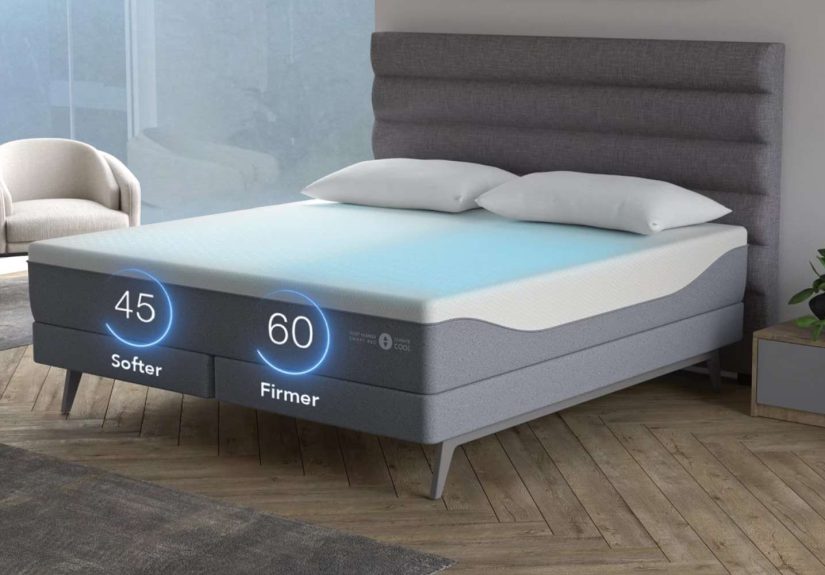
- Adjustable firmness (sometimes per side)
- Adjustable base for head/feet elevation
- Snore response features that slightly elevate your head when snoring is detected
- Gentle wake alarms (warming or vibration instead of a panic siren)
Traditional mattresses can still use adjustable bases, but the mattress won’t usually integrate tracking + automatic responses in the same way.
5) Cost in 2025: upfront price vs. “forever fees”
This is where smart vs. traditional becomes extremely… math-y.
Smart mattresses: higher cost, sometimes subscriptions
Many smart beds cost more upfront because you’re paying for sensors, electronics, climate hardware, and/or a smart base. Some brands also charge subscriptions for advanced features like automated temperature programs, deeper analytics, or ongoing software services.
When comparing prices, make sure you’re comparing the same thing:
- Full smart bed (mattress + integrated base)
- Smart cover system (you keep your mattress and add the tech)
- Required membership vs. “nice-to-have” subscription
- Trial period, warranty, and return costs
Traditional mattresses: simpler pricing, predictable ownership
Traditional mattresses range widely in price, but the total cost is usually easier to predict: buy the mattress, rotate it if needed, replace it when it’s worn out. No app. No login. No “Your bed needs a security patch.”
6) Reliability: when your bed depends on Wi-Fi, life gets interesting
A traditional mattress fails in only a few ways: sagging, worn foam, broken coils. A smart mattress can also deal with:
- Sensor glitches
- App bugs
- Connectivity issues
- Mechanical problems in an adjustable base
- Cloud outages (yes, really)
In fairness, brands have improved offline controls and outage modesbut the core point remains: more technology = more potential failure points. If you’re the type who still owns a “dumb” toaster because it never asks you to agree to Terms & Conditions, you may prefer traditional.
7) Privacy & security: your mattress can learn a lot about you
Smart mattresses collect personal data. Depending on the system, that can include sleep schedules, heart rate trends, movement patterns, and other information that may be considered health-related. Companies differ in what they collect, how they use it, and what choices you have.
Questions to ask before buying a smart mattress
- What data is collected? (Sleep time? Biometrics? Location? Usage patterns?)
- Where is data stored? (On-device vs. cloud)
- Can I delete my data? (And how easy is it?)
- Is there a privacy mode? (And does it actually do what it says?)
- Do core features work offline? (Temperature, elevation, basic controls)
Traditional mattresses win this round by doing the radical, privacy-forward thing of… not collecting data at all.
So, which should you choose in 2025?
Choose a smart mattress (or smart bed system) if you…
- Overheat or get cold easily and want active temperature control
- Share a bed with someone whose comfort preferences differ from yours
- Want sleep insights to spot patterns (not to self-diagnose)
- Like adjustability: firmness, elevation, snore features, scheduled routines
- Don’t mind paying more for personalizationand can tolerate occasional tech quirks
Choose a traditional mattress if you…
- Want the best comfort-per-dollar and fewer things that can break
- Prefer “set it and forget it” sleep with no apps or subscriptions
- Are privacy-focused (or just tired of everything being connected)
- Sleep fine already and mainly need better support or pressure relief
How to shop smarter (without overcomplicating it)
- Start with comfort basics: sleep position, firmness preference, pressure relief needs.
- Identify your #1 sleep problem: overheating, pain, snoring, restlessness, partner mismatch.
- Only pay for tech that solves that problem: tracking is nice; temperature control is often the real game-changer.
- Check ongoing costs: subscriptions, replacement parts, warranty limitations.
- Read privacy policies like you’re adopting a robot: because you kind of are.
- Use the trial period: your spine’s opinion matters more than marketing copy.
Bottom line
In 2025, smart mattresses can be genuinely impressiveespecially if you struggle with temperature swings, share a bed with a human space heater, or want adjustable comfort and automated routines. But a traditional mattress still delivers what most people need: solid support, comfort, and reliability without subscriptions, updates, or privacy trade-offs.
The best choice comes down to your sleep pain points. If tech solves a real problem, it may be worth it. If not, you can spend less, sleep great, and keep your mattress blissfully unaware of your bedtime snack choices.
Real-life experiences: what it feels like living with a smart bed (and without one)
Let’s talk about the part reviews can’t fully capture: the day-to-day reality. Not the spec sheet. Not the “AI-powered sleep optimization ecosystem.” Just: what happens when you’re tired, cranky, and trying to pass out like a normal person.
Experience #1: The hot sleeper who stops fighting the sheets
If you’re a hot sleeper, a smart temperature-controlled system can feel like discovering fireexcept in reverse. The first few nights, the biggest surprise isn’t the cooling itself. It’s the fact that you don’t wake up to fix things.
On a traditional mattress, overheating often triggers a familiar routine: one leg out, flip the pillow, kick off the comforter, wake up again because now you’re chilly, rebuild the blanket fort, repeat until sunrise. With active cooling, the bed stays closer to your comfort zone through the night, so your body doesn’t drag you into “thermostat management” at 3:07 a.m.
The weird part? You may realize how often you were waking up beforebecause you stop doing it. It’s like living next to a train track your whole life and only noticing the silence when you move away.
Experience #2: Couples stop negotiating bedtime like diplomats
Dual-zone control is the quiet relationship counselor of sleep tech. One person runs cold and wants a warm bed. The other sleeps like a portable furnace. A traditional setup turns this into a nightly compromise featuring “fine, I’ll just use another blanket” and passive-aggressive window cracking.
Smart systems can make it simple: each side gets its own setting. That alone can reduce resentmentbecause nobody wants to be the villain who ruined bedtime by existing at the wrong temperature.
The funniest side effect is how quickly couples adapt. After a week, “your side is too warm” becomes “your side is your side,” and peace returns to the kingdom.
Experience #3: The sleep-data enthusiast… and the “sleep score hangover”
If you love data, a smart mattress can feel like getting a fitness tracker for your nights. You’ll check trends. You’ll experiment. “What if I stop caffeine after 1 p.m.?” “What if I take a walk after dinner?” It can be motivating when you treat it like a long-term pattern finder.
But some people hit a wall: the sleep score hangover. That’s when you wake up feeling okay, check the app, see a number you don’t like, and instantly feel personally attacked by your own mattress. (“It says I got 72. Am I… a failure?”)
The healthiest way to use sleep tracking is surprisingly boring: check weekly trends, not nightly drama. Use it to guide habitsnot to grade your character.
Experience #4: When tech goes sideways
Smart beds are still technology, which means they occasionally do technology things. Apps update. Wi-Fi stutters. Sensors misread. You may have a night where you think, “I just want to sleep,” and your bed replies, “Have you tried turning it off and on again?”
That’s the trade: you’re buying convenience and personalization, but you’re also accepting that a bed can sometimes behave like a gadget. Some people are totally fine with that. Others want their mattress to be as emotionally present as a brick.
Experience #5: The traditional mattress loyalty club
On the flip side, living with a great traditional mattress can be gloriously uneventful. You go to bed. You sleep. You wake up. No graphs. No firmware. No subscription. Just comfort and support doing their job quietlylike a good librarian.
Plenty of people prefer this, especially if their main sleep issues are solved by choosing the right firmness, materials, and pillow setup. If your biggest problem is pressure points or back support, a well-matched traditional mattress can outperform a fancy smart system that’s the wrong feel.
In other words: you don’t need a “smart” bed to have smart sleep. You just need a bed that fits your body and a routine your brain can live with.