Table of Contents >> Show >> Hide
- Why “Board Girls” Keeps Popping Back Up
- A Quick Refresher: What Happens in “Board Girls”
- So Why Do People Call It Transphobic?
- The Real-World Flashpoint That Dragged It Back Into the Spotlight
- How a South Park Clip Becomes “Evidence” on Social Media
- South Park’s Track Record on Trans Topics (Context Matters)
- What Would a Smarter Version of This Episode Look Like?
- Why This Conversation Isn’t Going Away
- Conclusion: A Cartoon Isn’t a Policy Argument
- Experiences: What It Feels Like When “Board Girls” Becomes a Conversation Starter (and a Conversation Ender)
Every few years, the internet digs up an old TV clip like it’s an archaeological artifact that will finally “settle the debate.” This time, the artifact is
South Park’s Season 23 episode “Board Girls,” the one that tried to lampoon the trans-athlete conversation and instead became a reusable meme for people
who don’t actually want a conversation. If you’ve seen it trending again, you’ve also seen the same predictable cycle: a screenshot, a caption, a pile-on, and
a thousand hot takes sprinting past the part where real people have to live with the fallout.
The episode’s return to the spotlight isn’t just about South Park being edgy. It’s about how cultural “evidence” gets manufactured: a cartoon joke is
treated as a documentary, an athlete’s body becomes a public referendum, and the internet’s appetite for certainty bulldozes nuance. Meanwhile, the actual
issuessports governance, eligibility rules, misinformation, and the human cost of online harassmentget flattened into a single punchline.
Why “Board Girls” Keeps Popping Back Up
“Board Girls” is the kind of episode that was built to be clipped. It has a loud premise, an instantly recognizable parody, and a simple “gotcha” structure:
introduce a trans woman athlete, show her dominating, then reveal she’s “actually” a man gaming the system. It’s tidy, meme-friendly storytellingand that’s
exactly the problem. When a story is engineered to end with a twist that invalidates the character’s identity, it doesn’t just “satirize a debate.” It teaches
the audience what to suspect, who to doubt, and what counts as “common sense.”
When the real world runs into a complicated eligibility disputeespecially one involving women athletes, international federations, and confusing headlinesthis
episode becomes a shortcut for people who want a one-line explanation. It’s not that everyone sharing the clip is malicious. It’s that the clip is a
prepackaged narrative: “See? This is what’s happening.” And the internet loves prepackaged narratives because they save you from reading anything longer than a
tweet.
A Quick Refresher: What Happens in “Board Girls”
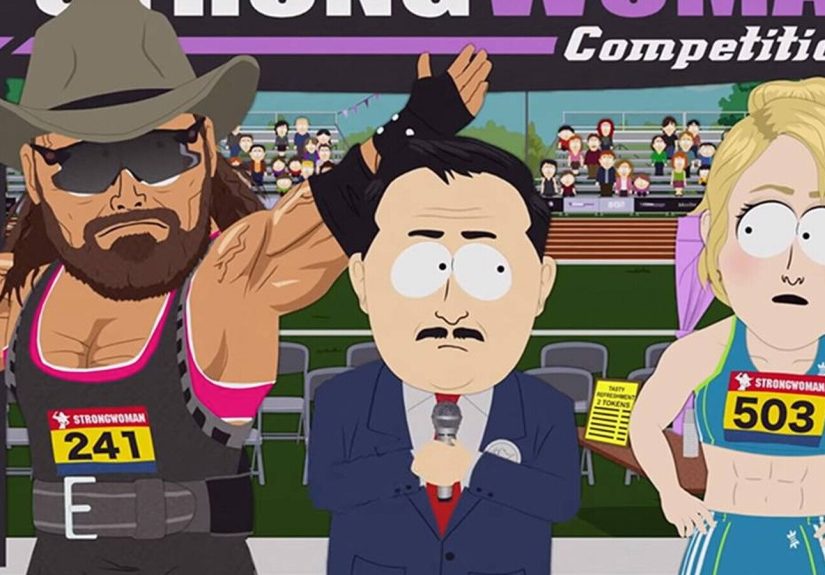
The episode centers on the “Strong Woman” competition, where Vice Principal Strong Woman is the local herountil a new competitor shows up: Heather Swanson, a
trans woman athlete presented as an unstoppable force. The joke is not subtle. Heather looks and sounds like a pro-wrestling throwback, and the show plays her
as a swaggering caricature designed to overwhelm everyone’s ability to respond.
The Heather Swanson “Satire” Setup
The episode frames Heather as someone who began identifying as female very recently and is competing in women’s events as a kind of revenge plot. That framing
matters, because it leans into a specific trope: the idea that trans women are “really men” using transition as a loophole to dominate women’s spaces. Even if
you personally believe sports categories are complicated (they are), the episode doesn’t explore complexityit builds its comedy around suspicion.
The Board-Game B-Plot (and Why It’s the Better Story)
Ironically, the episode’s other storylinegirls joining the boys’ board-gaming clubdoes a much cleaner job of showing how gender panic works. The boys assume
the girls don’t belong, the girls learn the rules, and suddenly the boys want to change the rules. That plotline is classic South Park: petty,
recognizable, and actually observational. It’s also the one that accidentally exposes how “fairness” arguments can be weaponized when someone starts losing.
So Why Do People Call It Transphobic?
A lot of comedy survives by exaggeration, but “Board Girls” isn’t just exaggerating. It’s choosing a target and a premise. And the premise is basically: the
trans athlete at the center of this story is illegitimate. That’s not “nuance.” That’s a conclusion dressed up as a joke.
The Trope: “Men in Disguise, Up to No Good”
Critics argue the episode recycles one of the oldest anti-trans ideas: trans women as deceptive threats. That stereotype has consequences far outside TV. It
feeds suspicion in everyday life (“Are you really who you say you are?”), it gets recycled in politics (“We must protect women and girls”), and it creates a
cultural permission structure for harassment (“I’m just asking questions”).
Satire Isn’t a Free PassIt Depends on the Punchline
People often defend the episode by saying South Park “makes fun of everyone.” But satire isn’t a participation trophy. The question is: who gets
framed as absurd, and what “truth” is the audience supposed to walk away with? If the audience leaves thinking “trans women in sports are obviously scammers,”
then the satire didn’t challenge biasit reinforced it.
Even reviews that found the episode funny still noted the awkwardness of what it was trying to say. Some critics described it as clumsy, rushed, or unwilling
to engage with the real-world gray areas it gestures at. In other words: it lit the match, then walked away from the fire.
The Real-World Flashpoint That Dragged It Back Into the Spotlight
The episode’s latest resurgence has been linked to ongoing public arguments about gender eligibility in sportsespecially when a women’s competition becomes a
lightning rod for rumor, vague “testing” claims, or insinuations that spread faster than official explanations. When the news cycle is messy, memes become
“clarity.” And “Board Girls” is meme-clarity: loud, wrong, and confident.
When “Eligibility” Turns Into a Conspiracy Word
Here’s the reality: sports eligibility rules are not universal. They vary by sport, federation, and level of competition. They can involve documentation,
medical criteria, hormone-related standards, or newer “sex testing” proposalsoften justified with safety language. The governance gets even messier when
different organizations are fighting over legitimacy, recognition, and authority.
In that chaos, athletes become symbols. Instead of “a competitor who met the published criteria for this event,” they get reframed as “proof” of whatever
someone already believed. The episode clip becomes a weapon in that reframingbecause it provides a ready-made villain archetype.
How a South Park Clip Becomes “Evidence” on Social Media
If you want to understand why this episode keeps resurfacing, you don’t need a media studies degree. You just need to watch how a viral post behaves:
- Step 1: Share the clip with a caption that implies it’s a documentary (“They predicted this!”).
- Step 2: Replace context with vibes (“Look at the size difference!”).
- Step 3: Treat uncertainty as guilt (“If it’s complicated, it must be a cover-up.”).
- Step 4: Let the comments do the radicalizing (“Just asking questions” becomes “Everyone knows.”).
And because comedy clips are emotionally efficientfunny, shocking, shareablethey outcompete any boring statement from a sports official. Bureaucracy speaks in
paragraphs; memes speak in punchlines.
South Park’s Track Record on Trans Topics (Context Matters)
“Board Girls” didn’t land in a vacuum. South Park has touched trans themes before, sometimes claiming it’s critiquing “PC culture,” sometimes aiming at
celebrity controversies, and sometimes just going for the cheapest shock laugh. The show’s long-running brand is boundary-pushing irreverencebut boundary
pushing can easily become “pushing down” when the target is a marginalized group already dealing with real-world discrimination and violence.
Put differently: it hits different when the joke arrives in a world where trans people are routinely treated as public problems to be solved, rather than
people to be respected. A show can insist it’s “equal opportunity,” but the social consequences are not equally distributed.
What Would a Smarter Version of This Episode Look Like?
Comedy can tackle sports fairness debates without defaulting to trans panic. A sharper version of “Board Girls” might have:
- Made the target the bureaucracy and bad-faith politics, not trans identity.
- Shown how rules get written by committees and then weaponized by mobs.
- Let trans characters be peopleflawed, funny, humanwithout hinging the joke on “gotcha, not really trans.”
- Explored how online outrage turns athletes into villains overnight.
In other words, the funniest target is often the machine: the institutions that can’t explain themselves, the influencers who monetize confusion, and the
spectators who confuse a TikTok clip with a medical degree.
Why This Conversation Isn’t Going Away
Even if “Board Girls” disappeared from the internet tomorrow (it won’t), the underlying fights would remain. Sports organizations are still struggling to write
eligibility policies that balance inclusion, competitive equity, privacy, safety, and public trust. Those goals can collide. When they do, the loudest voices
often aren’t coaches, doctors, or athletesthey’re people chasing engagement.
Meanwhile, trans people and gender-nonconforming women keep paying the price for a culture that treats their bodies as public property. Research consistently
finds transgender people face elevated levels of discrimination and victimization compared with cisgender peers. That’s the context internet “jokes” plug into,
whether the person sharing the clip acknowledges it or not.
Conclusion: A Cartoon Isn’t a Policy Argument
“Board Girls” is back in the news because it’s a convenient story for an inconvenient reality: sex, gender, and athletic categories don’t fit neatly into
memes. But convenience is not the same as truth. If your take on women’s sports can be fully captured by a South Park gag, your take is probably
missing the part where actual athletes existalong with federations, medical privacy, due process, and the very real harm of public suspicion.
The best rule of thumb is simple: treat cartoons like cartoons, treat people like people, and treat “viral certainty” like what it usually isconfidence
without homework.
Experiences: What It Feels Like When “Board Girls” Becomes a Conversation Starter (and a Conversation Ender)
Watching “Board Girls” in a vacuum can feel like you’re seeing a show do what it always does: pick a cultural argument, turn the volume to eleven, and dare
you to laugh. The experience changes when you watch it knowing the clip has been used like a cudgel online. Suddenly, the episode stops being “a controversial
half-hour of TV” and starts feeling like a reusable templateone that strangers apply to real people they’ve never met.
If you’ve ever tried to discuss it in a group chat, you know the vibe. Someone drops the clip like it’s a mic drop. Someone else replies with a paragraph.
The paragraph loses, because paragraphs always lose to a clip. Then you get the classic internet two-step: “I’m not transphobic, I’m just concerned about
fairness,” followed by a suspicious amount of enthusiasm for humiliating women athletes who don’t fit a narrow beauty standard. It’s like watching a magic
trick where the rabbit is always “reasonable questions” and the hat is always “public shaming.”
There’s also the weird emotional whiplash of the episode’s structure. The board-game plot is genuinely relatableanyone who’s been in a hobby space where the
“default” audience gets defensive can recognize the pattern. The girls learn the rules, the boys rage, everyone suddenly cares deeply about “tradition.” It’s
funny because it’s true. Then the Heather Swanson plot lands, and the episode asks you to laugh at a caricature that’s built out of suspicion. One minute
you’re watching a satire about gatekeeping; the next minute you’re watching gatekeeping.
The most common “experience” people describe afterward is a kind of social sorting. If you say the episode is transphobic, someone will insist you “don’t get
satire.” If you say it raises real questions, someone else will hear “I’m comfortable with stereotypes.” It’s a fast way to learn who in your orbit treats
trans people as neighbors versus talking points. And yes, that can be uncomfortable. But it’s also clarifying in the way a fire alarm is clarifying: loud,
inconvenient, and hard to ignore.
For trans viewers (and for plenty of cis viewers too), the lingering feeling isn’t just offenseit’s exhaustion. The episode’s punchline has been used in the
wild to justify suspicion toward anyone who looks “too strong,” “too tall,” “too muscular,” “too something.” That doesn’t just hit trans women; it splashes
onto gender-nonconforming women, intersex athletes, and women of color who’ve been policed for their bodies forever. The experience of seeing those dynamics
turned into entertainment can feel like being reminded that your humanity is negotiable when the crowd wants a spectacle.
And yetbecause humans are complicatedsome people still laugh at parts of it while hating what it’s become. They’ll tell you the wrestling parody is absurd.
They’ll admit the episode is clumsy. They’ll also admit they’ve seen it posted by accounts that clearly aren’t joking, accounts that use the clip as an excuse
to go hunting for targets. That’s the strange aftertaste of “Board Girls” in 2026: not just “Was it funny?” but “What did it give people permission to do?”
If you’re stuck navigating this episode in real life, a practical tip: shift the conversation away from the cartoon and toward the actual policy questions.
Ask what rule someone thinks should exist, who should write it, what evidence they’re using, and how they’d protect athletes’ privacy and due process. People
who came for a meme usually won’t stay for a policy discussionand that tells you everything you need to know. The goal isn’t to “win” an argument about a TV
show. The goal is to refuse to let a TV show be the argument.