Table of Contents >> Show >> Hide
If you grew up on a steady diet of James Bond, satellite dishes the size of small countries, and villains who seemed suspiciously confident around catwalks, you already know the telescope in question. It is Arecibo Observatory in Puerto Rico, the giant radio telescope featured in GoldenEye and burned into pop culture memory as the kind of place where the final showdown absolutely has to involve a fall from a great height.
But Arecibo was never just a gorgeous movie set with “do not lean over the rail” energy. It was one of the most important scientific instruments ever built in the United States. It helped scientists study pulsars, detect near-Earth asteroids, probe planets, search for signals from deep space, and send humanity’s famously nerdy hello into the cosmos with the Arecibo Message. That is why the phrase “the telescope from GoldenEye is in trouble” lands with more force than a Bond one-liner. The trouble is real, the stakes are bigger than nostalgia, and the story is part science tragedy, part infrastructure warning, part question mark about what America values after the cameras leave.
A Pop-Culture Icon That Was Also a Scientific Beast
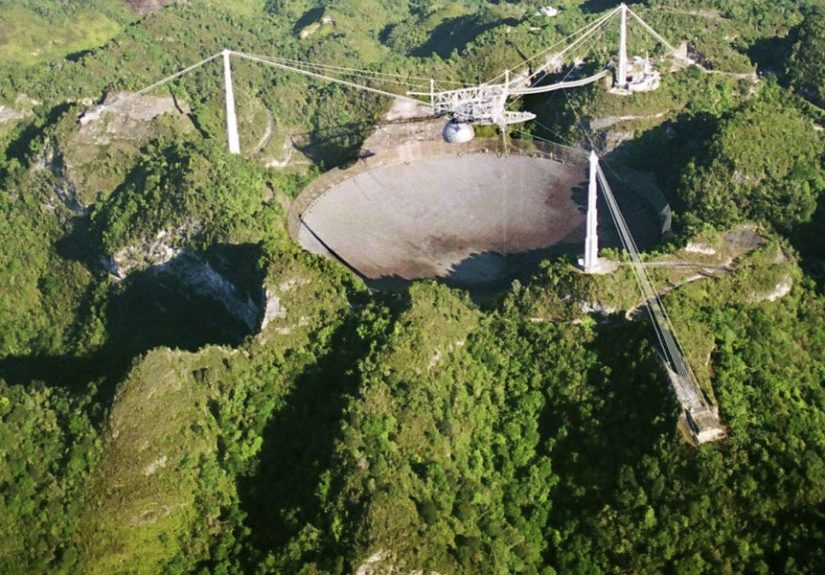
Arecibo looked like science fiction because, frankly, science fiction has been borrowing from real science for decades. Built into a natural sinkhole, the 305-meter dish was one of the most recognizable observatories on Earth. It appeared in GoldenEye and Contact, which is a pretty good résumé for a telescope. One film made it a Bond battleground. The other turned it into a cathedral for cosmic curiosity. Somehow, both were right.
Behind the Hollywood glow, Arecibo did serious work. It was instrumental in radio astronomy, atmospheric science, and planetary radar. It helped support research linked to Nobel Prize-winning work on binary pulsars. It was part of the story of the first confirmed planets found beyond our solar system. It contributed to fast radio burst research long before that phrase became science-news catnip. And for planetary defense, Arecibo was not just useful. It was a heavyweight. When scientists needed sharp radar observations of asteroids coming near Earth, Arecibo was often the place that turned fuzzy concern into measurable fact.
So yes, it was the telescope from GoldenEye. It was also the telescope that helped humanity keep tabs on the sky without panicking every time a space rock drifted by like it owned the neighborhood.
What Actually Happened to Arecibo?
The short version: gravity won
Arecibo’s most famous structure collapsed in December 2020 after catastrophic cable failures. That sentence is short. The heartbreak behind it is not. Earlier in 2020, a cable slipped out of a socket and tore into the dish. Then a main cable snapped. Engineers assessed the danger, and the situation became so unstable that a controlled decommissioning was planned because getting workers onto the structure had become too risky. Before that controlled process could happen, the suspended platform crashed down and destroyed the dish below.
In plain English, a structure that had towered over generations of scientists, students, and moviegoers failed in spectacular fashion. In engineering English, the story got even more unsettling. Later analyses found that the root cause involved long-term failure in the telescope’s cable-socket system, including accelerated zinc creep in spelter sockets. That sounds like the kind of phrase designed specifically to empty a party, but it matters. It means the collapse was not simply the result of one dramatic snap in one bad week. It reflected a deeper structural problem that developed over time and was difficult to anticipate in exactly the way it unfolded.
The scarier lesson: old infrastructure does not send polite warnings
The 2024 failure analysis from the National Academies did more than explain a mechanical disaster. It delivered a wider warning about aging scientific facilities. Glamorous discoveries tend to get headlines. Inspection logs, monitoring systems, maintenance budgets, and contract compliance do not. Unfortunately, steel and zinc are not moved by romance. A telescope can have legendary status, a glorious past, and a starring role in Bond history, then still lose a fight with physics if long-term monitoring and upkeep fall short.
That is one reason Arecibo’s collapse still stings. It did not feel like the normal end of a proud instrument after a graceful retirement. It felt abrupt, avoidable in spirit if not in every detail, and symbolic of a bigger American habit: cheering breakthrough science while acting weirdly shy about paying for boring maintenance.
Why the Trouble Matters Beyond Puerto Rico
Planetary defense took a hit
When an asteroid makes the news, the coverage usually has two modes: “cool space potato” and “should we start apologizing to the dinosaurs?” Arecibo helped keep those modes separate. Its radar capability was crucial for refining the orbits, shapes, and surface characteristics of near-Earth objects. That kind of data matters because the difference between “close pass” and “problem” can come down to precision.
Without Arecibo’s 305-meter dish, the United States lost a uniquely powerful tool in planetary radar. Other facilities still do important work, but Arecibo filled a particular niche. Losing it was not like replacing your favorite coffee mug. It was more like losing a specialized emergency instrument and realizing halfway through the day that the backup is not quite the same.
Radio astronomy lost a legend
Arecibo was one of those rare facilities that became part of the emotional architecture of science. Researchers used it for pulsar timing, atmospheric studies, mapping gas in galaxies, radar studies of planets and asteroids, and investigations that crossed disciplinary borders. Its data archive will keep supporting science for years, maybe decades, because good observations do not stop being useful just because the hardware is gone. But archived brilliance is not the same thing as a living instrument.
The absence is practical and cultural at the same time. Scientists lost capability. Puerto Rico lost a landmark. Students lost a pilgrimage site where the abstract suddenly felt huge and real. And the broader public lost one of the easiest ways to picture what large-scale science can look like when ambition is allowed to become physical.
The loss hit identity as much as research
Arecibo was not just an observatory in Puerto Rico. It was part of Puerto Rico’s scientific identity and global profile. For many people, it represented proof that world-class science does not belong only to the mainland, the Ivy League, or the usual zip codes. It belonged in the hills of Puerto Rico too, with all the pride, jobs, education, and community meaning that came with it.
That is why debates about Arecibo have never been only about metal, funding, or engineering. They are also about respect, memory, and whether institutions know how to preserve scientific legacy without flattening the communities that gave that legacy a home.
So What Kind of Trouble Is It In Now?
Here is the complicated part: the original telescope is gone, but the story is not over. The “trouble” today is no longer about whether the 305-meter dish can be saved. It cannot. The trouble now is about what replaces a scientific giant after the giant is gone.
The National Science Foundation decided not to rebuild the famous telescope. Instead, the site has been moving toward a new future centered on science education, workforce development, and community engagement through the NSF Arecibo C3 initiative. That shift is understandable. It is also controversial, because an education center is not the same as a flagship research instrument. One keeps the spark alive. The other used to light the room.
That tension sits at the heart of the current conversation. Is Arecibo being honored, transformed, or downsized? Depending on who you ask, the answer is “yes.”
Supporters of the new approach argue that Arecibo’s legacy should continue through education, inclusion, and a broader scientific mission that serves local communities directly. Critics worry that the decision leaves a major gap in U.S. observational capability and effectively asks the public to celebrate a memorial where a powerhouse once stood. Both views have merit. One is forward-looking. The other is grieving with receipts.
What Arecibo Still Represents
Even in ruin, Arecibo remains one of the most meaningful places in modern astronomy. The telescope’s history includes the 1974 Arecibo Message, which turned the facility into a symbol of humanity’s attempt to speak into the dark with something more sophisticated than waving. It also includes generations of students who saw science not as a textbook chapter but as a structure so enormous it seemed to bend the landscape around it.
There is also a reason Arecibo keeps resurfacing in public conversation. It sits at the intersection of three irresistible ideas: science, cinema, and fragility. We love giant machines because they make intelligence visible. We mourn them because they remind us intelligence is not the same thing as invincibility.
In that way, Arecibo has become more than an observatory. It is now a cautionary tale about what happens when world-changing instruments age inside systems that are better at applauding discovery than sustaining it.
Experiences Around Arecibo: What the Place Felt Like
To understand why people still talk about Arecibo with the tone usually reserved for cathedrals, ballparks, and grandparents who gave excellent advice, you have to picture the experience of being there. Long before anyone reached the dish, there was the approach: winding roads, thick green hills, and the feeling that something improbably large was hiding just beyond the next turn. Then the structure revealed itself, and the reaction was often the same whether the visitor was a scientist, a student, or a tourist who originally came because of James Bond: silence first, then a laugh, then a sentence that usually amounted to, “That thing is absurdly huge.”
Arecibo gave people scale shock. Not the bad kind, like seeing the price of concert tickets, but the exhilarating kind. The dish looked less like a human-made object than a deliberate dent in the Earth, as if the island had decided to help astronomy by becoming part of the instrument. Above it, the suspended platform seemed to float in a way that was both majestic and mildly alarming. It was beautiful, yes, but also just dangerous-looking enough to remind you that serious science is often one part elegance and one part engineering dare.
For students, the site could change the emotional temperature of science. A classroom can tell you that radio waves carry information from distant objects. Arecibo made that idea physical. It said: we built this because the universe is talking and we were stubborn enough to listen. That is a powerful message for a kid standing on a viewing platform, especially in Puerto Rico, where the observatory represented not borrowed prestige but homegrown scientific significance.
For researchers, Arecibo was never only scenery. It was a workplace with quirks, routines, local memory, and the kind of institutional culture that forms when brilliant people and difficult hardware spend decades teaching each other humility. There is a special bond that grows around instruments like that. Scientists do not usually write sonnets to equipment, but they come surprisingly close when the equipment helped define their careers.
And for the public, Arecibo offered one of the rare places where advanced science felt cinematic without becoming fake. The movies borrowed its visual drama, but the real thrill was better: the knowledge that the place actually mattered. It was not pretending to guard Earth, study cosmic mysteries, or symbolize humanity’s curiosity. It was doing those things for real.
That is why the loss still feels personal to so many people who never touched a cable, calibrated a receiver, or published a paper. Arecibo made science feel big, public, and collective. It invited ordinary people into a story that usually happens behind closed doors or deep inside journals. When it collapsed, the damage was structural, but the grief was social. The giant dish had taught people how wonder sounds when it echoes off steel. Once you have experienced that, even secondhand, you do not forget it.
Conclusion
The telescope from GoldenEye is indeed in trouble, but not in the tidy, action-movie way the title suggests. The real trouble is heavier and more human. Arecibo’s famous dish is gone. Its scientific role was not fully replaced. Its collapse exposed the risks of neglecting aging research infrastructure. And its future now depends on whether the next chapter can honor more than the memory of a spectacular machine.
Still, this is not just a story about loss. It is a story about legacy, responsibility, and the odd durability of places that mattered enough to change how people think. Arecibo may no longer scan the sky the way it once did, but it still asks a live question: when a nation lets a world-famous instrument fade, what exactly is it willing to build in its place?
If the answer is smart, ambitious, and rooted in the community that carried Arecibo for decades, then the telescope’s last act may not be collapse. It may be a challenge. And honestly, that would be a very Bond ending after allless explosion, more reckoning.