Table of Contents >> Show >> Hide
- Automation Is Bigger Than Auto-Leveling
- From One Print at a Time to Continuous Production
- The Real Brains of the Operation: Software
- Sensors, Cameras, and the End of Wishful Thinking
- Post-Processing: The Awkward Middle School Phase of Automation
- Why Humans Still Matter
- What Still Needs Work
- The Road Ahead for More Automated Printers
- Experiences From the Semi-Automated Frontier
For years, desktop 3D printers were marketed like magical countertop factories. Press a button, wait a while, and voilà: a bracket, a vase, a tiny dragon with suspiciously sharp elbows. Reality, of course, had other plans. Someone still had to level the bed, start the job, remove the finished part, reload material, check for spaghetti disasters, and clean up the aftermath. In other words, the printer was doing the printing, but humans were doing the babysitting.
That is finally starting to change. The latest push in additive manufacturing is not just about printing faster or hotter or in five colors at once. It is about making printers more automated in a meaningful, workflow-level way. The new goal is simple: reduce idle time, reduce operator touches, and make 3D printing behave less like a hobby that demands snacks and attention and more like a reliable production process.
That shift matters because automation changes the economics of printing. A fast machine is nice. A fast machine that can keep working while the operator is asleep, in a meeting, or trying to remember where they left their coffee is much more valuable. “Towards more automated printers” is really a story about turning isolated machines into connected systems that can queue jobs, verify conditions, recover from minor issues, and hand off finished parts with far less human intervention.
Automation Is Bigger Than Auto-Leveling
When many people hear the phrase automated printer, they think of familiar convenience features: auto bed leveling, filament sensors, power-loss recovery, or onboard cameras. Those are helpful, but they are only the appetizer. True printer automation goes further. It includes automated job scheduling, remote monitoring, intelligent routing across multiple machines, automatic part removal, build-plate swapping, material handling, post-processing, and quality verification.
In that sense, automation is not one feature. It is a stack. Hardware handles the physical work. Software handles the decisions. Sensors handle the truth. Put those three together, and a printer starts acting less like a one-off tool and more like a manufacturing node.
This is why the conversation around additive manufacturing has matured. The exciting question is no longer, “Can this printer make a part?” The better question is, “Can this printer make parts consistently, repeatedly, and with minimal supervision?” That is where automation earns its keep.
From One Print at a Time to Continuous Production
One of the biggest bottlenecks in FDM printing has always been painfully ordinary: a finished part sitting on the bed like a theater guest who refuses to leave after the credits. The next print cannot start until the previous part is removed. That sounds small, but on a print farm, it adds up to hours of lost capacity every week.
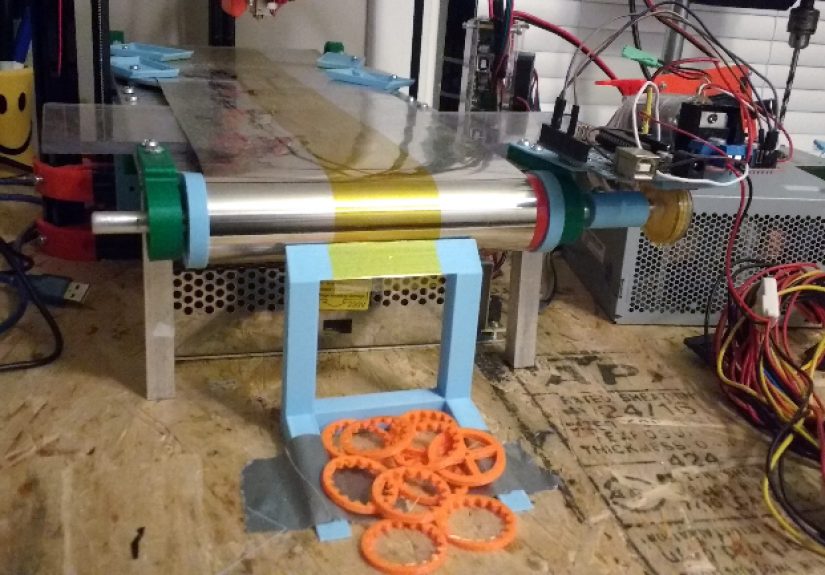
Engineers and tinkerers have attacked that problem from several angles. Belt printers tried to solve it with moving conveyor surfaces that eject finished parts automatically. They are clever, but they come with compromises in adhesion, geometry, and part consistency. Another approach is auto-ejection, where the printer flexes, tilts, sweeps, or otherwise nudges completed parts off the build area. This is often simpler, cheaper, and surprisingly effective for the right shapes and materials.
Then there is the more elegant, factory-minded solution: build-plate swapping. Instead of waiting for a human to clear the bed, the machine removes the used plate and loads a fresh one. That keeps the printer in motion and shifts the human task away from the hot zone. The operator is no longer interrupting every cycle; they are servicing a batch of completed plates when convenient. It is a small design change with a very big personality.
This is why automated plate systems are getting so much attention. They preserve the benefits of rigid build surfaces while enabling back-to-back production. For small businesses, makerspaces, and production labs, that can mean the difference between a printer that looks productive and a printer that actually is.
Why This Matters for Print Farms
In a one-printer setup, a few minutes of downtime between jobs is annoying. In a ten-printer setup, it becomes a management problem. In a hundred-printer setup, it becomes a business model problem. Continuous operation is where automation moves from “nice upgrade” to “please, for the love of throughput, yes.”
Automated farm systems reflect that reality. They are designed for 24/7 operation, traceability, lower downtime, and easier scaling. That is the language of production, not hobbyism. It also shows why a more automated printer is not necessarily a single miracle machine. Often, it is a well-orchestrated combination of printer hardware, swappable beds, queue software, monitoring tools, and finishing equipment.
The Real Brains of the Operation: Software
If hardware is the muscle of printer automation, software is the traffic cop, shift manager, and slightly obsessive spreadsheet person who somehow keeps the whole thing running. Smart scheduling systems now do far more than send a file to a printer. They can match jobs to compatible machines, queue prints in advance, reroute tasks when a printer goes offline, track progress remotely, and flag blocked jobs that need operator attention.
That matters because a modern print workflow is full of variables. Different materials need different temperatures. Different printers have different build volumes. Some parts need a particular surface finish. Some jobs are urgent, some are cheap, and some are the kind of thing that makes everyone whisper, “Please do not fail at 98 percent.”
Good automation software handles that complexity quietly. It is the invisible layer that converts a room full of machines into something closer to a coordinated production cell. In the best setups, operators do not micromanage each printer. They manage policy, priorities, compatibility, and output. That is a major leap in labor efficiency.
This is also where additive manufacturing starts to resemble the rest of digital manufacturing. The printer becomes part of a connected workflow that includes planning, dispatch, monitoring, reporting, and traceability. Once software enters the chat in a serious way, the printer is no longer working alone.
Sensors, Cameras, and the End of Wishful Thinking
Old-school 3D printing often ran on hope. You loaded the file, listened for suspicious noises from the next room, and hoped the machine was creating a part rather than inventing a plastic bird’s nest. More automated printers aim to replace hope with feedback.
Cameras, thermal sensors, machine-vision systems, and in-situ inspection tools are becoming central to that mission. They can detect print failures earlier, monitor layer quality, and support better process control. In high-value applications, they can also reduce waste by identifying problems before a bad build consumes more time and material.
This is a crucial step in making additive manufacturing more production-ready. You cannot automate confidently if the system has no reliable way to observe itself. Real-time monitoring gives the printer a kind of situational awareness. It is not quite self-awareness, which is probably for the best, but it is enough to improve quality, repeatability, and operator trust.
The next frontier is tighter feedback loops. Instead of merely spotting defects, more systems will adjust conditions in response to what sensors see. When that becomes more common, automated printers will stop being passive machines that execute instructions and become active systems that manage process quality in real time.
Post-Processing: The Awkward Middle School Phase of Automation
Printing the part is only part of the job. In many workflows, the real time sink comes afterward: resin removal, powder handling, support removal, washing, curing, cleaning, and finishing. Post-processing has long been the not-so-glamorous step where automation dreams go to wait in line.
That is changing, too. Automated resin removal, automated powder-handling systems, and integrated finishing tools are shrinking one of the biggest labor bottlenecks in additive manufacturing. This matters because the most expensive part of a 3D print is not always the machine time. Sometimes it is the human time that comes afterward with gloves, brushes, patience, and a look that says, “Who designed this support structure?”
More automated printers, then, are really part of a more automated ecosystem. A printer that produces parts nonstop is only truly productive if the downstream workflow can keep up. Otherwise, you have not solved the bottleneck. You have merely moved it to a sink, a powder station, or a table covered in half-cleaned parts.
Why Humans Still Matter
None of this means people disappear from the process. Quite the opposite. As printers become more automated, human work becomes more valuable because it shifts upward. Operators spend less time pushing buttons and peeling parts off beds, and more time validating jobs, managing exceptions, optimizing designs, maintaining equipment, and improving throughput.
In other words, automation does not make people irrelevant. It makes low-value repetition less central. The human role becomes supervisory, analytical, and strategic. That is a better use of talent and, frankly, a better use of everyone’s knees and wrists.
The smartest view of automation is not “replace the operator.” It is “stop wasting the operator.” That distinction matters. A truly effective printer workflow is one where people intervene where judgment matters and machines handle what is predictable, repetitive, and time-sensitive.
What Still Needs Work
For all the progress, more automated printers are not magic. Part geometry still matters. Material behavior still matters. Auto-ejection does not love every shape. Bed swapping adds mechanical complexity. Vision systems can miss subtle issues. Queue software only works as well as the rules behind it. And once multiple vendors, printers, materials, and post-processing systems enter the same workflow, integration can become the world’s least fun puzzle.
Standardization is still a major challenge. So is interoperability. Manufacturers want data to move cleanly from design to scheduling to machine control to inspection to reporting. That sounds great on a slide deck. In practice, it requires shared formats, better software handshakes, and less of the classic industrial strategy known as “our ecosystem, our rules.”
But the direction is unmistakable. Additive manufacturing is moving toward connected, auditable, semi-autonomous production. The printer of the future is not just a machine with better specs. It is a machine that participates in a smarter workflow.
The Road Ahead for More Automated Printers
The most exciting thing about printer automation is that it is no longer theoretical. We can already see the building blocks in real systems: automated bed swapping, auto-ejection kits, smart queues, remote fleet management, real-time monitoring, post-processing automation, and data integration across production stages. Each one removes a little friction. Together, they change the category.
That is why the phrase towards more automated printers feels exactly right. We are not at full autonomy across every machine and process. Not yet. But the trend line is clear. Printers are gaining more independence, more awareness, and more connection to the wider manufacturing environment.
And that is good news for everyone who wants 3D printing to become more than a cool machine in the corner. Because the future of printing is not just faster nozzles and shinier marketing. It is fewer idle hours, fewer manual touches, fewer preventable failures, and more systems that can get the job done while humans move on to work that deserves a human brain.
Or, to put it less formally: the dream is no longer “look what this printer can make.” The dream is “look what this printer can keep making without needing me every five minutes.” That is when a printer starts to feel less like a gadget and more like a teammate.
Experiences From the Semi-Automated Frontier
Spend enough time around print labs, maker businesses, or small manufacturing teams, and you notice the emotional side of automation almost as quickly as the technical side. The first change is not always speed. It is stress. In a manual workflow, every print job carries a tiny tax on attention. Someone has to remember when a job will finish, whether the bed is free, whether the right material is loaded, and whether that overnight print will become a successful part or a tragic pile of modern art. More automation softens that anxiety.
Operators often describe the experience in the same way: instead of hovering, they start trusting. A queue system means they can prepare several jobs at once. Auto-ejection or plate swapping means they do not have to sprint back to the machine the minute a print finishes. Remote dashboards mean they can check status without physically standing in front of every printer like an exhausted air-traffic controller in a room full of tiny plastic aircraft.
There is also a psychological shift when printers become more automated. People stop thinking in single jobs and start thinking in flow. They ask different questions. Not “Can this part print?” but “Can this part fit into tonight’s queue?” Not “Is Printer 4 free?” but “Which machine can handle this material most efficiently?” It sounds subtle, but it is the difference between using a tool and running a process.
Small business owners feel this especially hard. In a side-hustle print farm, the operator is usually also the designer, customer-service department, shipping clerk, photographer, and emergency janitor. Automation gives those people back time that is actually useful. Time can go into product design, quoting, packaging, maintenance, or sleep, which remains a wildly underrated productivity tool.
Even imperfect automation changes the rhythm of work. Maybe the printer still needs a human for part collection. Maybe the monitoring system is good, not genius. Maybe the smart queue still occasionally needs manual intervention because one machine is being dramatic. Even then, the difference is noticeable. The workday becomes less reactive. Fewer interruptions. Fewer dead minutes between prints. Fewer moments of realizing a machine has been sitting idle for two hours because nobody noticed a job ended.
The funny part is that more automation does not necessarily make the workshop feel colder or less hands-on. In many cases, it does the opposite. It frees people to focus on the fun, skilled, and creative parts of the job. They spend less time scraping beds and more time improving part design, dialing in tolerances, testing new materials, or building a better customer experience. The machine takes over the repetitive chores, and the human gets promoted back into being the human.
That is probably the clearest real-world lesson from the push toward more automated printers: the best automation does not remove people from the story. It removes friction from the story. And once that friction starts disappearing, 3D printing becomes more sustainable not just technically, but practically. The workflow feels lighter. The output feels steadier. The business feels more scalable. And the operator, at long last, feels like they can leave the room without the printer immediately plotting chaos.