Table of Contents >> Show >> Hide
- What a Party Food Calculator Really Does (Spoiler: It Prevents Panic)
- The Core Formula: Total Bites = Guests × Time × Party Style
- Portion Shortcuts for the Biggest Appetizer Categories
- Build a Balanced Appetizer Menu (So It Doesn’t Feel Like “Beige on Beige”)
- How to Use the Calculator: A Real Example (With Numbers You Can Steal)
- Timing Trick: Serve in Waves to Keep Food Fresh and Guests Happy
- Food Safety for Appetizer Parties (Because Nobody Wants a “Party Favor” Like Food Poisoning)
- Make Your Calculator Even Smarter: Common “Oops” Factors
- Quick-Start Party Food Calculator Checklist
- FAQ: The Questions Everyone Googles While Holding a Cart in the Snack Aisle
- of Real-Life Party Experiences (So You Can Feel Seen)
Planning appetizers feels like trying to estimate how many jellybeans fit in a suitcase: you can guess, but you’ll either run out at the worst possible moment or end up eating leftover spinach dip for breakfast until you develop chlorophyll. The good news? Appetizers are one of the easiest party menus to “math” your way intowithout draining the fun out of hosting.
This guide walks you through a simple, practical party food calculator mindset: figure out how many bites you need, choose the right mix of options, and scale portions so guests stay happily snacky (not hangry), while you avoid a fridge full of regret.
What a Party Food Calculator Really Does (Spoiler: It Prevents Panic)
A good appetizer menu planner answers three questions:
- How many total bites should I plan for?
- What kinds of bites should those be (hot vs. cold, light vs. hearty, dietary needs)?
- How do I portion each item so people can sample variety without demolishing the first tray in seven minutes?
The calculator approach isn’t about being rigid. It’s about being confidently flexiblelike wearing stretchy jeans to a buffet.
The Core Formula: Total Bites = Guests × Time × Party Style
Start with the number that matters most: total appetizer “bites”. A bite can be one slider, one stuffed mushroom, one wing, one deviled egg half, one skewer, one small cup of soupwhatever you’d reasonably count as a single serving unit.
Step 1: Pick a baseline bites-per-person target
Use this quick guide based on how the event is structured:
- Appetizers before a full meal (short): 4–6 bites per person total
- Appetizers + drinks (cocktail-style, 2–3 hours): 8–10 bites per person total
- Appetizers are the meal (heavy hors d’oeuvres): 12–15 bites per person total
If you prefer an hourly method (especially for passed apps), a common rule is about 4–6 pieces per person per hour for passed itemsthen add stationary foods (dips, boards) separately.
Step 2: Apply “real life” multipliers
Parties aren’t robots. Adjust your total bites using these reality checks:
- Hungry crowd: +10–20% (teenagers, post-hike friends, people who “forgot lunch”)
- Lots of alcohol: +10% (snacking tends to keep pace with sipping)
- Mostly kids: -10% bites, but increase familiar options (chips, fruit, simple sliders)
- Late-night event: +10% (people graze longer)
Step 3: Add a safety buffer (without building a food museum)
Add 5–10% as a buffer for unexpected plus-ones, tray “shrinkage,” and the guest who treats shrimp cocktail like a sport. If budget is tight, buffer with inexpensive fillers (popcorn, pretzels, crudités, chips + salsa) rather than doubling the pricey stuff.
Portion Shortcuts for the Biggest Appetizer Categories
Once you know your total bites, you still need to portion the “stationary” itemsbecause no one counts hummus in “bites” unless they’re using a tortilla chip like a measuring spoon.
| Category | Quick Portion Rule | When to Increase |
|---|---|---|
| Dips & spreads | 2–3 Tbsp per person (or ~1/3 cup per person for dip-heavy parties) | Game day, mostly snack foods, long hangouts |
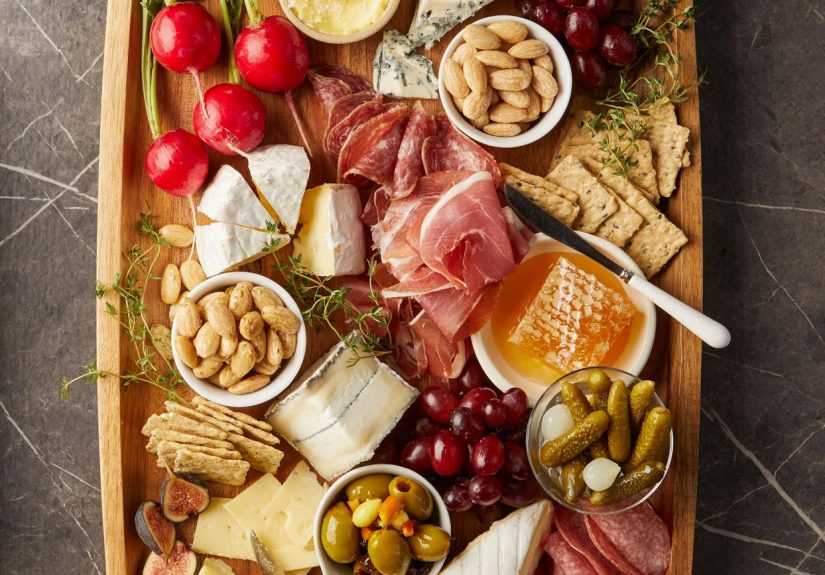
| Cheese/charcuterie-style boards | About 2–3 oz per person as a light appetizer element | Board is the “main event” or no hot food planned |
| Sliders / mini sandwiches | 1–2 per person if there’s other food; 2–3 if apps are the meal | Late-night, big appetites, limited variety |
| Crudités & fruit | Plan “plenty,” because it’s the cleanup crew for dips | When you need gluten-free, vegetarian-friendly volume |
| Chips, crackers, bread | Enough to support dips/boards; restock in small batches | If dips/boards are featured or meal is light |
The big takeaway: count bites for hand-held items and use portion rules for bowls/boards. That combo is the backbone of a reliable party food calculator.
Build a Balanced Appetizer Menu (So It Doesn’t Feel Like “Beige on Beige”)
Great appetizer spreads have rhythm: a crunchy thing, a creamy thing, a spicy thing, a fresh thing, a hearty thing. Your goal is to make the table feel abundant even if you’re not serving 47 different recipes.
The “Simple Mix” Blueprint
- 1–2 hearty anchors: sliders, meatballs, wings, skewers, or a warm dip
- 1–2 fresh/light options: crudités, fruit, a bright salad bite, or veggie-forward apps
- 1 crowd-pleasing carb: crostini, chips + salsa, crackers + spread
- 1 “wow” item: something with a fun twist (mini tacos, fancy deviled eggs, baked brie)
Dietary Coverage Without Overcomplicating Your Life
You don’t need a separate menu for every eating style. You just need at least a few options where guests can confidently say, “Yep, I can eat that.”
- Vegetarian: Aim for ~25–35% of offerings to be meat-free.
- Gluten-free-friendly: Include at least one sturdy option (e.g., wings, skewers, deviled eggs, crudités + dip), plus a GF “vehicle” like rice crackers or tortilla chips.
- Nut awareness: If using nuts, keep them clearly separated and labeled.
Labeling can be charmingly low-tech: a sticky note that says “GF” has saved more parties than you’d think.
How to Use the Calculator: A Real Example (With Numbers You Can Steal)
Let’s say you’re hosting 24 guests for a 2.5-hour cocktail-style party where appetizers are the main food. You expect moderate drinking, and the crowd is mostly adults.
1) Choose a target
For appetizer-as-the-meal, plan roughly 12 bites per person.
2) Do the math
Total bites = 24 × 12 = 288 bites
Add a modest 10% buffer: 288 × 1.10 = 317 bites (round to 320 because trays don’t love odd numbers).
3) Distribute bites across categories
Here’s an easy split that feels abundant:
- 40% hearty/protein: ~128 bites
- 30% veggie/fruit/light: ~96 bites
- 20% carbs/cheesy/crunchy: ~64 bites
- 10% “fun” wildcard: ~32 bites
4) Turn that into an actual menu
- Mini meatballs: 80 (hearty anchor)
- Chicken wings: 48 (second hearty anchor)
- Caprese skewers: 60 (fresh/light)
- Stuffed mushrooms: 36 (veg-forward + savory)
- Chips + salsa + guac: portioned for 24 (carb + dip category)
- Deviled eggs: 32 halves (wildcard crowd-pleaser)
- Crudités + hummus: portioned for 24 (backup for everyone)
Notice what’s happening: you’re not serving “everything.” You’re serving a smart mix with enough volume where it counts.
Timing Trick: Serve in Waves to Keep Food Fresh and Guests Happy
One of the biggest hosting hacks is not putting everything out at once. When you do that, the early crowd eats like they’re defending a title, and the late arrivals stare at the crumbs like, “So… was there a party here?”
The Three-Wave Method
- Arrival (first 30 minutes): easy grabsnuts/pretzels, crudités, chips + salsa
- Main grazing (middle): your best hot items + most impressive bites
- Late-party save: a second batch of the hearty anchor (or a warm dip refresh) so the energy stays up
This also helps with food safety and keeps textures crisp and appealing. Soggy crostini are a tragedy in three acts.
Food Safety for Appetizer Parties (Because Nobody Wants a “Party Favor” Like Food Poisoning)
Appetizers sit out. That’s their whole personality. So you’ll want a simple safety plan:
- Keep cold foods cold and hot foods hot. Avoid the temperature “danger zone.”
- Use small platters and replenish often instead of leaving a mountain of food out for hours.
- Watch the clock: don’t leave perishable foods at room temp for more than about two hours (less if it’s very hot out).
- Use clean utensils and swap serving spoons/tongs if they hit the floor (the floor always wins).
If you’re hosting outdoors or in warm conditions, lean more heavily on stable snacks (pretzels, popcorn, chips, whole fruit) and keep the perishable items in a rotation: out for a bit, back into the fridge/cooler, then refreshed.
Make Your Calculator Even Smarter: Common “Oops” Factors
1) The “Everyone Loves This” Problem
If there’s one superstar item (wings, sliders, queso), make extra. People don’t “sample” queso. They enter into a long-term relationship with it. A good rule: increase your top 1–2 items by 15–25% and reduce the less popular items slightly.
2) The “Too Many Fussy Bites” Trap
Toothpick-heavy items can be gorgeous, but if every bite requires precision engineering, guests slow down and food backs up on platters. Balance fussy with simple: one fancy, two easy.
3) The “No One Eats the Healthy Thing” Myth
People absolutely eat the healthy thingif it’s easy and flavorful. Put the crudités in cups, add a dip with personality, and suddenly carrots are cool again.
Quick-Start Party Food Calculator Checklist
- Enter guest count: adults + kids
- Enter duration: total party time (and how long food will be available)
- Select party style: pre-meal apps, cocktail snacks, or apps-as-the-meal
- Pick your bites-per-person target (then add buffer)
- Choose 5–7 menu items that cover hearty + fresh + crunchy + dietary-friendly
- Plan serving waves (don’t dump everything out at once)
- Use safety strategy: small platters + hot/cold holding
FAQ: The Questions Everyone Googles While Holding a Cart in the Snack Aisle
How many different appetizers should I serve?
For most home parties: 5–7 options is plenty. More guests doesn’t always mean more recipessometimes it just means bigger batches.
Is it better to do passed appetizers or a buffet table?
Buffet tables are easier for most hosts. Passed apps feel fancy but require more coordination (or very obedient friends). A hybrid works great: set out snacks, then “pass” one hot item occasionally from the kitchen.
What’s the easiest way to reduce leftovers?
Scale expensive items precisely, and pad the menu with cheap, flexible extras (chips, popcorn, fruit, veggies). Also: serve in waves. Leftovers often happen because everything comes out at once and half of it sits untouched.
of Real-Life Party Experiences (So You Can Feel Seen)
The first time I hosted an appetizer-only party, I learned a lesson that should be embroidered onto a throw pillow: guests will absolutely eat more than you think when there’s no “official meal.” I had planned a tasteful spread a cute cheese board, two dips, and some elegant little crostini that made me feel like I belonged in a magazine. What I actually created was a competitive sport where everyone politely waited five minutes, then collectively decided the crostini were a limited-edition release. The tray disappeared so fast I wondered if I’d accidentally invited a group of professional magicians.
That night taught me why a party food calculator is basically emotional support with math. When you set a bites-per-person target, you stop guessing based on vibes and start planning based on reality: people snack while they talk, snack while they laugh, snack while they hover near the kitchen pretending to “help.” (They are not helping. They are monitoring the meatballs.)
Another time, I overcorrected and made “just in case” quantities of everythingthree dips, two hot apps, a fruit platter the size of a coffee table, and enough chips to insulate an attic. The party was fun, but the next day my refrigerator looked like it was running a small deli. I ate leftovers for so long that my social media memories started showing me “On this day: still eating spinach dip.”
The sweet spot came later, once I learned the magic of serving in waves. Now I put out an easy arrival snack (chips + salsa, a bowl of olives, crudités in cups), then hold back the “main attraction” hot item until everyone’s settled. Not only does it make the party feel like it has momentum, it also keeps the food looking and tasting better. Guests don’t feel like they missed the good stuff, and I don’t feel like I’m constantly sprinting to refill a platter that’s being treated like a free sample station.
My favorite “calculator win” happened at a game-day hangout. I planned 10 bites per person for a 3-ish hour window, added a 10% buffer, and made one superstar item extra (wings). I also built in two “budget stabilizers”: popcorn and a big veggie tray with a bold dip. The wings were still the celebrity, but the popcorn became the surprise heropeople grabbed handfuls without thinking, which took pressure off the pricier foods. At the end of the night, I had a normal, reasonable amount of leftoversenough for a happy lunch, not enough to open a restaurant.
If you take one thing from these experiences, let it be this: planning is freedom. When you know your numbers, you can relax, enjoy your guests, and stop doing frantic mental math next to the refrigerator like you’re defusing a bomb made of tortilla chips.