Table of Contents >> Show >> Hide
- 1. Flogging with the Cat-o’-Nine-Tails
- 2. Running the Gauntlet
- 3. Keelhauling: The Horror Under the Hull
- 4. Hanging from the Yardarm
- 5. Irons, Bilboes, and the Miseries of Confinement
- 6. Bread-and-Water Diet and Dark Confinement
- 7. Extra Watches and Back-Breaking Drudgery
- 8. Stoppage of Grog and Docking of Pay
- 9. Branding and Marking Deserters
- 10. Impressment: Punishment Before You Even Served
- What These Punishments Reveal About the Royal Navy
- Experiences and Reflections on Royal Navy Punishments
- Conclusion
When people picture the Royal Navy during the Age of Sail, they usually imagine billowing canvas,
roaring broadsides, and heroic captains shouting orders through the smoke. What they don’t always
picture is the other side of life at sea: brutal discipline designed to keep hundreds of cramped,
tired, and occasionally mutinous men in line on a creaking wooden warship thousands of miles from home.
Between the late 17th and early 19th centuries, the Royal Navy was one of the most powerfuland most
fearedinstitutions on Earth. That power wasn’t built on fancy uniforms alone. It relied on a system
of punishments that ranged from mildly humiliating to flat-out lethal. Many came from long European
maritime traditions; others were codified by naval regulations, Admiralty orders, and the infamous
Articles of War. Together, they created a culture where disobedience could literally cost you your skin.
Below are 10 of the harshest punishments associated with the Royal Navy during the Age of Sail,
along with how they worked, what crimes “earned” them, and what they reveal about life aboard
His Majesty’s ships.
1. Flogging with the Cat-o’-Nine-Tails
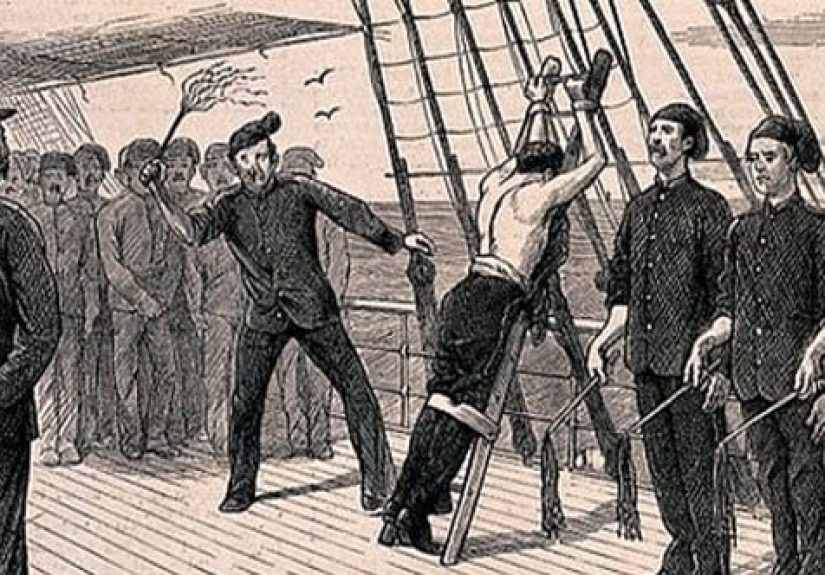
If there was one punishment that defined naval discipline, it was flogging. Sailors dreaded the cat-o’-nine-tailsa short wooden handle attached to nine knotted cords designed to turn a man’s back into raw, bleeding flesh.
Naval records and later analyses show that by the late 18th century, an “average” flogging might involve around
12–20 lashes, with more severe offenses drawing higher counts.
Floggings were public. The entire crew was mustered to watch as the offender was tied to a grating or mast,
shirt stripped off, and a designated boatswain’s mate swung the whip. Blood wasn’t a side effectit was the
point. The spectacle reminded every sailor what could happen if they stole, disobeyed an officer, or
showed up drunk on watch.
Not all captains used the lash equally. Some were notorious for giving out flogging sentences for minor
offenses, while others reserved it for more serious crimes when they felt the crew needed “a lesson.”
But as long as the Articles of War demanded “death or such other punishment as the court martial shall
think fit,” the cat-o’-nine-tails remained the go-to tool of naval justice.
2. Running the Gauntlet
Running the gauntlet was a special kind of nightmare. Instead of one man with a whip, you got an entire
line of your crewmates armed with ropes, knotted cords, or small sticks. The condemned sailor was forced
to walk (or be dragged) between them while they struck him on the back and sides.
This punishment was often reserved for more serious offenses such as theft or certain sexual crimes, and it
could easily turn fatal if the blows were too hard or the sailor collapsed before reaching the end of the line.
Accounts from the period suggest that it caused so many severe injuries and deaths that naval authorities
eventually abolished the practice by the early 19th century.
Apart from the obvious physical damage, running the gauntlet weaponized social pressure. Your own messmates
became part of the punishmentrefusing to strike could be seen as defiance of the officers. It was
humiliation, pain, and psychological warfare wrapped into one ugly package.
3. Keelhauling: The Horror Under the Hull
Keelhauling is one of the most infamous naval punishments ever imagined, and it’s often associated with
both pirates and navies. The victim was tied to a rope that ran underneath the ship’s keel, thrown overboard
on one side, and dragged under the hull to emergeif he was luckyon the other.
In theory, this was “only” a punishment; in practice, it was closer to a slow-motion execution. The sailor
risked drowning, head trauma from smashing into the hull, or being shredded by barnacles clinging to the wood.
If he survived, he would often be left covered in deep cuts and at risk of lethal infection.
Modern historians point out that keelhauling was far more common and better documented in the Dutch Navy than
in the British Royal Navy, and that British references to it are relatively rare and often second-hand. Still,
the fact that Parliament had to deny rumors of keelhauling on a Royal Navy ship in the late 19th century shows
how strongly this punishment haunted the naval imagination.
Even if it was rare, the very idea of being dragged under the ship you served on was enough to terrify sailors
into obedience. Sometimes, a punishment doesn’t have to be used often to do its job.
4. Hanging from the Yardarm
For the most serious naval crimesespecially mutiny, desertion, and violent offensespunishment could end
at the gallows. Hanging from the yardarm (a horizontal spar on a mast) was the classic seagoing execution.
Desertion was a constant problem. During conflicts like the American Revolutionary War, tens of thousands of
Royal Navy sailors deserted over a few years, often fleeing to merchant ships that paid better and treated
crews less harshly. Those who were unlucky enough to be caught could face
hangingsometimes in front of assembled crews from multiple ships as a very clear warning.
Mutiny, of course, was treated with even more severity. Naval leaders knew that a single successful mutiny could
cost them a ship, a battle, or even a war. To them, a hanging was not just justice; it was insurance.
5. Irons, Bilboes, and the Miseries of Confinement
Not every offense led straight to blood and rope. Sometimes, the punishment was slow, cold, and cramped.
Sailors could be confined in ironsheavy shackles fastened to ankles or wristsor locked into bilboes,
a kind of bar with rings that clamped around the legs.
The prisoner might be chained to the deck, pinned in a tiny space below, or isolated in a makeshift cell.
On a damp wooden ship, that meant sleeping in your own sweat and saltwater, with poor ventilation and
almost no chance to stretch or move. Add the constant motion of the sea and the smell of the lower decks,
and a few days in irons started to look worse than a short flogging.
Irons were often combined with other penaltieslike reduced rations, loss of grog (rum), or public shamingto
make the experience even more miserable.
6. Bread-and-Water Diet and Dark Confinement
Bread and water may sound like a diet trend gone wrong, but at sea it was a very real punishment. A sailor
sentenced to “bread and water” would be confined, usually below decks or in a small cell, and fed only plain
bread and water for a set number of days.
This punishment was widely associated with British naval practice and later adoptedand eventually bannedby
the U.S. Navy, which once allowed captains to confine sailors on bread and water for certain offenses.
While the Royal Navy gradually moved away from extreme corporal punishments in the 19th century, restrictive
diets and confinement remained tools for enforcing discipline.
The point wasn’t starvation so much as discomfort and monotony. Imagine hard labor, no privacy, stale air, and
the same boring piece of bread over and over. Punishment by food is still punishment.
7. Extra Watches and Back-Breaking Drudgery
Not every punishment had to draw blood to be effective. One of the simplest penalties available to officers
was the assignment of extra duty. Sailors might be ordered to stand additional watches, scrub decks repeatedly,
haul lines until their hands blistered, or work the pumps for hours on end.
Holystoning the deckscrubbing it with blocks of sandstone and seawaterwas a classic form of “punishment work.”
Add a few extra hours of that under a blazing sun or freezing rain, and you had a very persuasive reminder
to follow orders next time.
Extra watches also meant less sleep. On a ship where men already lived with chronic fatigue, losing precious
rest could be as dreaded as the lash. It hurt less, but it lingered longer.
8. Stoppage of Grog and Docking of Pay
The Royal Navy didn’t just control sailors’ bodies; it controlled their wallets and rum rations too.
Stoppage of paytemporarily withholding wagescould be imposed for damage to ship’s property, loss of gear,
or disciplinary violations.
Even more dreaded was stoppage of grog. Sailors’ daily rum ration was one of the few guaranteed comforts in
their bleak, exhausting routine. Take that away and morale dropped fast. Officers knew this and used grog
as a powerful behavioral lever. Good conduct might bring steady rum; bad conduct might dry up the barrel.
If you really wanted a sailor’s attention, you didn’t always need whipsyou just needed to take away his rum
and his hard-earned coin.
9. Branding and Marking Deserters
Desertion wasn’t just a crime; it was a long-term stain on a sailor’s identity. In some periods, British
military authorities used physical markings to identify deserters, including branding with letters like “D”
or tattoo-like marks made with ink and needles. While branding was more systematically used in the army,
naval deserters could also be visibly marked to make escape and reenlistment under a false name more difficult.
The logic was simple and harsh: once marked, always suspected. A deserter who was caught might face a brutal
flogging, imprisonment, or executionand even if he survived, the mark on his skin could follow him for life.
In an era without digital records, the human body became the filing system. If you had the wrong letters burned
into yours, doors closed quickly.
10. Impressment: Punishment Before You Even Served
Impressmentbeing seized by a press gang and forced into naval servicewas technically a form of recruitment,
not a punishment. But for many sailors and dockside workers, it felt like a sentence handed down without trial.
Press gangs roamed British ports and sometimes even boarded merchant ships, grabbing “eligible seafaring men”
and delivering themoften in ironsto Royal Navy vessels. Those who resisted could be beaten
or prosecuted, and refusing impressment was itself a crime.
Once aboard, men might go years without shore leave, enduring harsh discipline, disease, and the constant risk
of death in battle. Wages were often paid months or years in arrears, and the Navy intentionally withheld part
of a sailor’s pay to discourage desertion. If that doesn’t sound like punishment, you might be
a naval recruiter.
Impressment blurred the line between criminal justice and manpower policy. Instead of punishing crimes already
committed, it pre-punished men for the “crime” of being good at sailing.
What These Punishments Reveal About the Royal Navy
Together, these punishments show how fragile order could be on a wooden warship. The Royal Navy relied on
conscripted labor, long voyages, and cramped quarters where boredom, fear, and resentment were constant
companions. In that environment, officers believed that discipline had to be immediate, visible, and often
terrifying.
Yet the story isn’t just one of cruelty. Many captains understood that too much punishment could backfire,
pushing crews toward mutiny or deliberate sabotage. Debates over flogging, impressment, and corporal
punishment raged in Parliament and the press, and over the 19th century the Royal Navy gradually reformed
its disciplinary system, curbing the lash and emphasizing courts-martial and imprisonment instead.
Still, the legacy of those punishments lingers in our language“keelhaul,” “run the gauntlet,” “press-ganged”and
in the scars recorded in sailors’ diaries, court-martial records, and medical reports. The Age of Sail didn’t
just produce naval heroes; it produced survivors of a disciplinary regime that modern sailors can barely imagine.
Experiences and Reflections on Royal Navy Punishments
It’s one thing to read about naval punishments on paper; it’s another to imagine how they felt to the people
living under them. Today, visitors to preserved warships such as HMS Victory or similar museum ships step
onto the lower gun decks and are struck by how little space there is. Hammocks hang inches apart. The ceiling
is low enough that taller adults have to stoop. Now imagine standing there while a flogging is carried out in
front of the entire ship’s company.
Historical accounts describe sailors going pale, sweating, or looking away as the first blows landed. Others
forced themselves to watch, either from grim fascination or from the belief that knowing “how bad it could be”
would keep them on the right side of the Articles of War. The sound alonerope hitting flesh, the involuntary
gasp or cry, the boatswain’s mate counting out the lashesmust have been hard to forget.
Modern reenactors and naval historians sometimes stage carefully controlled demonstrations using replica
whips and padded dummies to show how flogging worked. Even in this sanitized form, onlookers often flinch.
That reaction helps bridge the gap between the numbers in a ledger“twelve lashes”and the human reality of
what those twelve lashes meant to a real person with family, friends, and fears.
Written testimonies from sailors also reveal how punishments shaped shipboard culture. Some men described
brutal captains as “tyrants” and blamed excessive flogging for low morale, desertion, or even mutiny. Others
accepted punishment as part of the job, arguing that on a crowded warship with loaded cannons and gunpowder
everywhere, strict discipline was the only thing standing between order and chaos.
Imagine being a young seaman pressed into service, barely in your late teens, suddenly subject to rules you
don’t fully understand and officers you’ve never met. A careless word, a missed signal, or an argument with a
superior could land you in irons or under the lash. Over time, many sailors developed their own coping strategies:
sticking close to experienced hands, keeping their heads down around volatile officers, and fiercely protecting
the small pockets of freedom they did havesharing jokes, singing, gambling, or writing letters whenever possible.
There’s also the lingering emotional impact. Punishments such as branding, execution for desertion, or impressment
tore families apart. Some men never came home. Others returned bearing scars that raised uncomfortable questions
in dockside taverns or around the dinner table. For communities that depended on the sea, Royal Navy discipline
was not an abstract policy; it was a daily risk.
Looking back, it’s tempting to dismiss these punishments as just another example of a “more brutal time.” But
the debates that took place in the 18th and 19th centuries over flogging, impressment, and capital punishment
sound surprisingly modern. Politicians, reformers, and even some naval officers worried about excessive cruelty,
wrongful convictions, and the long-term effect of fear-based systems on the people who served under them.
In that sense, studying the punishments of the Royal Navy during the Age of Sail isn’t just a tour of historical
horror. It’s a reminder that whenever societies rely on extreme discipline to maintain orderwhether in a fleet,
a prison, or a workplacethey eventually have to ask the same questions: How much is too much? What does “effective”
really mean? And how do you balance security with basic human dignity?
Conclusion
The Age of Sail gave the Royal Navy unmatched global reach, but it came at a human cost paid in scars, broken
bones, and lives cut short by rope and iron. Flogging, running the gauntlet, keelhauling, hanging, irons,
bread-and-water confinement, exhausting extra duty, pay and grog stoppages, branding, and impressment all worked
together to enforce obedience on the world’s wooden war machines.
Today, these punishments feel shockingly extreme, but they also reveal how fragile early modern institutions
believed order to beand how far naval discipline has evolved since. The Royal Navy eventually curbed many of
these practices, but their memory survives in language, legend, and the haunted spaces below deck where so many
sentences were carried out.
SEO Summary
meta_title: 10 Royal Navy Punishments in the Age of Sail
meta_description: Discover 10 brutal Royal Navy punishments from the Age of Sail, from flogging and keelhauling to impressment and execution.
sapo: During the Age of Sail, the British Royal Navy ruled the wavesand enforced that rule with
a harsh system of punishments that would shock modern sailors. From the dreaded cat-o’-nine-tails and lethal
keelhauling to bread-and-water confinement, stoppage of grog, and the terror of impressment, discipline at sea
was designed to be public, painful, and unforgettable. This in-depth guide explores 10 of the most notorious
Royal Navy punishments, how they worked, who suffered them, and what they reveal about everyday life aboard
wooden warships fighting for control of the world’s oceans.
keywords: Royal Navy punishments, Age of Sail discipline, naval flogging, keelhauling, running the gauntlet, impressment, cat-o’-nine-tails