Table of Contents >> Show >> Hide
- What Is the Cosine Rule?
- Way 1: Use the Cosine Rule to Find a Missing Side
- Way 2: Use the Cosine Rule to Find a Missing Angle
- Way 3: Use the Cosine Rule for Real-World Problems
- How to Know When to Use the Cosine Rule
- Common Mistakes When Using the Cosine Rule
- Practical Study Strategy for Mastering the Cosine Rule
- Experience-Based Insights: Learning the Cosine Rule in Real Life
- Conclusion
The cosine rule may sound like something that escaped from a dusty geometry textbook and started wearing a cape, but it is actually one of the most practical tools in trigonometry. Also called the law of cosines, it helps you solve triangles that are not necessarily right triangles. In other words, when the Pythagorean theorem politely says, “Sorry, I only work with 90-degree angles,” the cosine rule steps in with a calculator and a confident smile.
If you know two sides and the included angle, the cosine rule can help you find the missing side. If you know all three sides, it can help you find a missing angle. And if you are dealing with real-life situations such as navigation, construction, surveying, design, physics, or map measurements, the cosine rule can turn a messy triangle problem into something surprisingly manageable.
The basic formula is:
c2 = a2 + b2 – 2ab cos(C)
In this formula, a, b, and c are the sides of a triangle, and C is the angle opposite side c. The letters can change depending on which side or angle you are solving for, but the idea stays the same: the cosine rule connects side lengths with the cosine of an angle.
What Is the Cosine Rule?
The cosine rule is a trigonometric formula used to solve non-right triangles, also known as oblique triangles. A right triangle has one angle measuring exactly 90 degrees. In that situation, you can often use the Pythagorean theorem or basic trigonometric ratios like sine, cosine, and tangent. But many triangles in math problems and real life are not so cooperative. They lean, tilt, stretch, and generally refuse to behave like perfect textbook examples.
That is where the cosine rule becomes useful. It works for any triangle, whether the triangle is acute, obtuse, or scalene. It is especially helpful in two major situations: when you have SAS information, meaning two sides and the included angle, or when you have SSS information, meaning all three sides.
The Three Common Forms of the Cosine Rule
Depending on which side you want to find, you can write the cosine rule in three ways:
- a2 = b2 + c2 – 2bc cos(A)
- b2 = a2 + c2 – 2ac cos(B)
- c2 = a2 + b2 – 2ab cos(C)
The secret is simple: the angle in the formula is always opposite the side you are solving for. If you are solving for side c, use angle C. If you are solving for side a, use angle A. Geometry enjoys being organized, even when it pretends otherwise.
Way 1: Use the Cosine Rule to Find a Missing Side
The first and most common way to use the cosine rule is to find a missing side when you know two sides and the angle between them. This is called the SAS case. The phrase “included angle” is important here. It means the known angle sits between the two known sides, like the filling between two slices of mathematical bread.
When Should You Use This Method?
Use the cosine rule to find a missing side when:
- You know two side lengths.
- You know the angle between those two sides.
- You do not have a right angle.
- You need the third side of the triangle.
This is one of the clearest signs that the cosine rule is the right tool. If you try to use the sine rule here without enough angle-side pairs, you may end up wandering through the problem like someone looking for their keys in a refrigerator.
Example: Finding the Missing Side
Suppose a triangle has two sides measuring 8 inches and 11 inches, and the angle between them is 60 degrees. Find the third side.
Let the missing side be c. The formula is:
c2 = a2 + b2 – 2ab cos(C)
Substitute the values:
c2 = 82 + 112 – 2(8)(11)cos(60°)
Now simplify:
c2 = 64 + 121 – 176(0.5)
c2 = 185 – 88
c2 = 97
c = √97 ≈ 9.85
So the missing side is approximately 9.85 inches.
Why This Works
The cosine rule adjusts the Pythagorean theorem for triangles that do not have a right angle. If the angle is exactly 90 degrees, cos(90°) equals zero. That makes the final part of the formula disappear, leaving you with c2 = a2 + b2. In other words, the Pythagorean theorem is hiding inside the cosine rule like a guest star in a movie sequel.
When the angle is acute, the cosine value is positive, so the third side becomes shorter than it would be in a right triangle. When the angle is obtuse, the cosine value is negative, which makes the third side longer. This is why the cosine rule is so flexible. It understands that triangle shapes change dramatically when the angle changes.
Way 2: Use the Cosine Rule to Find a Missing Angle
The second major way to use the cosine rule is to find a missing angle when you know all three sides of a triangle. This is called the SSS case. You cannot use the Pythagorean theorem unless the triangle is right-angled, and you cannot use basic sine, cosine, or tangent unless you already have a right triangle. The cosine rule solves that problem beautifully.
The Rearranged Formula for Angles
To find angle C, rearrange the cosine rule:
cos(C) = (a2 + b2 – c2) / 2ab
After calculating the cosine value, use the inverse cosine function on your calculator, usually written as cos-1, to find the angle.
Example: Finding a Missing Angle
Suppose a triangle has side lengths of 7 feet, 9 feet, and 12 feet. Find the angle opposite the side measuring 12 feet.
Let c = 12, a = 7, and b = 9. Use the angle formula:
cos(C) = (a2 + b2 – c2) / 2ab
Substitute the values:
cos(C) = (72 + 92 – 122) / 2(7)(9)
cos(C) = (49 + 81 – 144) / 126
cos(C) = -14 / 126
cos(C) ≈ -0.1111
Now use inverse cosine:
C = cos-1(-0.1111) ≈ 96.4°
So the angle opposite the 12-foot side is approximately 96.4 degrees.
A Useful Tip for Finding Angles
When using the cosine rule to find an angle, it is often smart to find the largest angle first. The largest angle is always opposite the longest side. This helps reduce rounding errors and gives you a better sense of the triangle’s shape. If the longest side is much longer than the other two, expect the opposite angle to be large, possibly obtuse.
Once you find one angle, you can use the fact that the angles in every triangle add up to 180 degrees. Sometimes you can then use the sine rule or continue using the cosine rule to find the remaining angles.
Way 3: Use the Cosine Rule for Real-World Problems
The third way to use the cosine rule is in real-world situations where distances, directions, and angles form triangles. This is where the formula escapes the classroom and starts doing actual work. The cosine rule appears in navigation, land surveying, architecture, engineering, physics, computer graphics, robotics, sports analytics, and even map-based planning.
Navigation Example
Imagine a boat travels 10 miles from a harbor, then turns and travels another 8 miles. The angle between the two travel paths is 120 degrees. How far is the boat from the harbor?
This creates a triangle. The two known sides are 10 and 8, and the included angle is 120 degrees. Let the distance from the harbor be c.
c2 = 102 + 82 – 2(10)(8)cos(120°)
Since cos(120°) = -0.5:
c2 = 100 + 64 – 160(-0.5)
c2 = 164 + 80
c2 = 244
c = √244 ≈ 15.62
The boat is approximately 15.62 miles from the harbor.
Why Real-World Problems Need the Cosine Rule
In the real world, measurements rarely line up in neat right angles. Roads bend. Rivers curve. Survey points sit awkwardly across fields. Airplanes change direction. Architects measure diagonal spans. Engineers calculate forces acting at angles. The cosine rule is useful because it does not demand a perfect 90-degree angle before it agrees to help.
For example, a surveyor may know the distance from point A to point B and from point A to point C, along with the angle between those two sight lines. The cosine rule can calculate the distance from point B to point C without anyone needing to walk through a swamp, climb a fence, or negotiate with a suspicious goat.
How to Know When to Use the Cosine Rule
Choosing the right trigonometric method is half the battle. The cosine rule is powerful, but it is not always the first tool you need. Here is a simple decision guide:
Use the Cosine Rule When You Have SAS
If you know two sides and the angle between them, use the cosine rule to find the missing side. This is the classic SAS setup.
Use the Cosine Rule When You Have SSS
If you know all three sides and need an angle, rearrange the cosine rule and use inverse cosine.
Use the Pythagorean Theorem for Right Triangles
If the triangle has a 90-degree angle and you only need side lengths, the Pythagorean theorem may be faster. However, the cosine rule still works because it includes the Pythagorean theorem as a special case.
Use the Sine Rule for ASA, AAS, or Some SSA Problems
The sine rule is often better when you have a known angle and its opposite side. The cosine rule is best when you do not have a matching angle-side pair or when the known angle is included between two known sides.
Common Mistakes When Using the Cosine Rule
Even though the cosine rule is straightforward, a few common mistakes can turn a clean solution into mathematical soup. The good news is that these errors are easy to avoid.
Mistake 1: Using the Wrong Angle
The angle in the formula must be opposite the side you are solving for. If you are finding side c, use angle C. Mixing up labels is one of the fastest ways to get an answer that looks impressive but is completely wrong.
Mistake 2: Forgetting to Square the Sides
The cosine rule uses squared side lengths. Do not forget to square the known sides, and do not forget to take the square root at the end when finding a missing side.
Mistake 3: Calculator in the Wrong Mode
Most school and everyday geometry problems use degrees, not radians. If your calculator is in radian mode, your answer may look like it was generated by a very confident raccoon. Always check the mode before calculating.
Mistake 4: Rounding Too Early
Keep several decimal places during the calculation and round only at the end. Early rounding can make the final answer less accurate, especially in angle problems.
Practical Study Strategy for Mastering the Cosine Rule
The best way to master the cosine rule is not to memorize it in panic mode the night before a test. Instead, practice recognizing when it applies. Start by identifying what information you have: two sides and the included angle, or all three sides. Then label the triangle carefully. A well-labeled triangle is like a map with street names; a poorly labeled triangle is just chaos wearing angles.
Next, write the formula before substituting numbers. This keeps your work organized and makes mistakes easier to spot. After solving, ask whether your answer makes sense. If the longest side has the smallest angle opposite it, something went wrong. If a triangle side comes out negative, the math has officially left the building.
Experience-Based Insights: Learning the Cosine Rule in Real Life
Many students first meet the cosine rule after becoming comfortable with the Pythagorean theorem. At first, the formula may feel like the Pythagorean theorem’s dramatic older cousin: same family, more symbols, slightly more attitude. But after working through a few problems, the pattern becomes much easier to recognize.
One helpful experience is to draw the triangle before doing any calculation. This sounds simple, but it changes everything. When you sketch the triangle, label the sides, and mark the known angle, you can often see immediately whether the problem is an SAS or SSS situation. Without a sketch, it is easy to plug values into the wrong place. With a sketch, the triangle practically raises its hand and says, “Use the cosine rule here.” Very polite, for a polygon.
Another useful habit is estimating the answer before reaching for the calculator. For example, if two sides are 6 and 10 and the included angle is small, the missing side should be relatively short because the two known sides point in similar directions. If the included angle is large, the missing side should be longer because the sides spread farther apart. This kind of estimate helps you catch calculator mistakes. If your estimate says the answer should be around 5, but your calculator says 500, it may be time to check whether you accidentally angered the decimal point.
In tutoring and classroom settings, one common “aha” moment happens when students realize that the cosine rule is not separate from the Pythagorean theorem. It expands it. When the included angle is 90 degrees, the cosine part becomes zero, and the formula becomes the familiar a2 + b2 = c2. That connection makes the formula feel less random. Instead of being another equation to memorize, it becomes a logical upgrade.
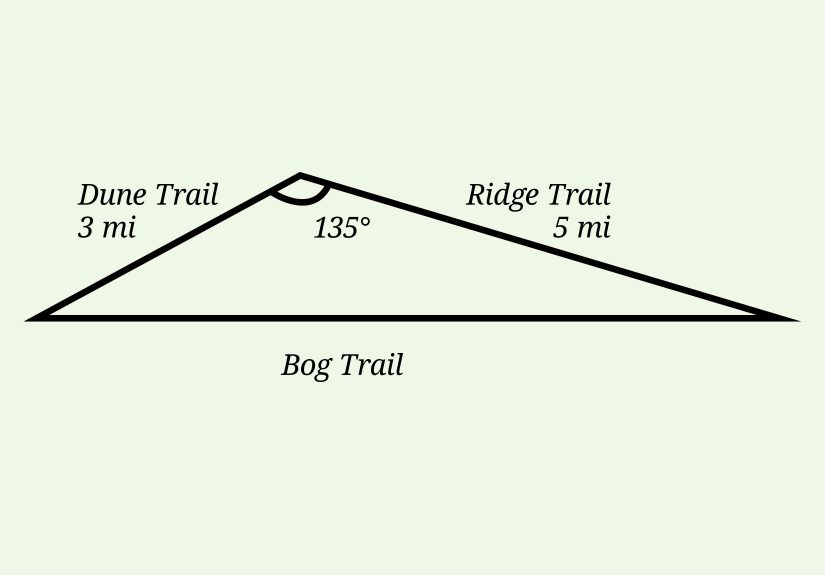
Real-life examples also make the cosine rule easier to remember. Picture two hiking trails starting from the same campsite. One trail is 4 miles long, another is 7 miles long, and the angle between them is 55 degrees. If you want to know the direct distance between the trail endpoints, the cosine rule gives you the answer. This is far more memorable than staring at variables floating on a worksheet like alphabet soup.
Another experience-based tip is to practice both directions: finding sides and finding angles. Students often become comfortable finding a missing side but hesitate when the formula is rearranged for an angle. The trick is to slow down and remember that inverse cosine is simply asking, “What angle has this cosine value?” Once that idea clicks, angle problems become less intimidating.
It also helps to keep a clean calculator routine. Type the full expression carefully, use parentheses around the denominator when finding an angle, and double-check whether the calculator is in degree mode. Many wrong cosine rule answers are not caused by misunderstanding the math. They are caused by tiny calculator slips, especially missing parentheses. The calculator is powerful, but it is not psychic. It will faithfully follow bad input like a loyal but confused robot.
Finally, the cosine rule becomes easier when you see it as a problem-solving strategy rather than just a formula. Ask three questions: What do I know? What do I need? Is the information SAS or SSS? If the answer is yes, the cosine rule is probably your best friend. Not the kind of best friend who helps you move apartments, perhaps, but definitely the kind who helps you survive trigonometry homework.
Conclusion
The cosine rule is one of the most useful formulas in triangle geometry because it works beyond right triangles. You can use it to find a missing side when you know two sides and the included angle, find a missing angle when you know all three sides, and solve real-world problems involving distances, directions, and angled measurements.
The key is recognizing the pattern. If the triangle gives you SAS or SSS information, the cosine rule is usually ready for action. Label your triangle carefully, choose the correct version of the formula, keep your calculator in degree mode when needed, and avoid rounding too early. Do that, and the cosine rule becomes less like a scary formula and more like a reliable geometry tool with excellent timing.
Note: This article is written as original educational content based on established trigonometry principles commonly taught in reputable math learning resources, textbooks, and academic references.