Table of Contents >> Show >> Hide
- What Does “Craic” Mean?
- How to Use Irish Slang Without Sounding Like a Tourist With a Phrasebook
- 85+ Funny Irish Sayings and Slang Words
- Why Irish Sayings Are So Funny
- Common Mistakes Americans Make With Irish Slang
- Mini Irish Slang Cheat Sheet
- Experience Section: What Irish Slang Feels Like in Real Life
- Conclusion
Irish slang is not just a collection of words; it is a full-contact sport for the ears. One minute someone says, “Ah, it’ll be grand,” and the next you are wondering whether things are actually fine, mildly disastrous, or on fire but socially unacceptable to mention. That is the beauty of Irish sayings: they are warm, witty, musical, and often delivered with the confidence of someone who has already decided the story will be better if it is a little confusing.
If you have ever watched Irish TV, visited Ireland, chatted with an Irish friend, or tried to understand a relative who talks faster than a kettle boiling, you have probably met words like craic, grand, eejit, banjaxed, and yer man. These funny Irish slang words are part of Irish English, also called Hiberno-English, a lively variety shaped by history, regional accents, the Irish language, humor, understatement, and a national talent for making ordinary conversation sound like dialogue from a great comedy.
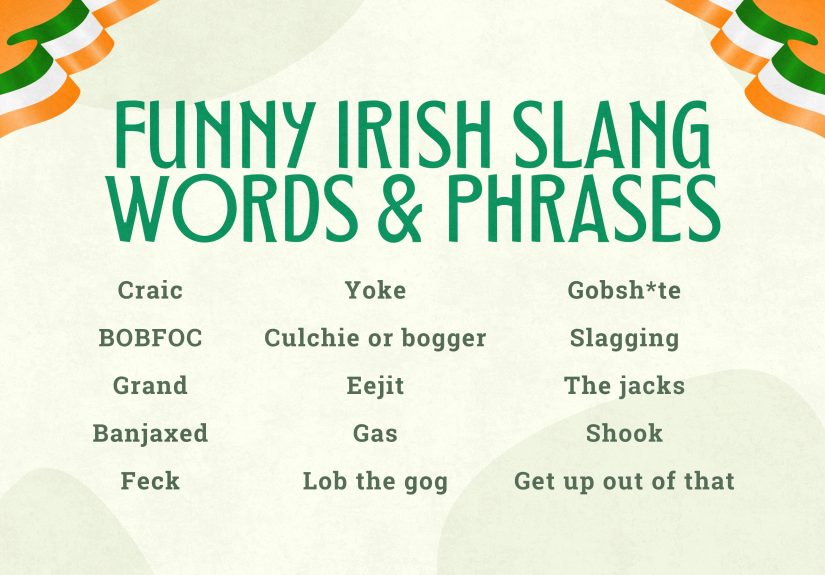
This guide explains 85+ funny Irish sayings and slang words for a good craic, with meanings, examples, and gentle warnings so you do not accidentally call your host a gobshite when you only meant “thanks for dinner.”
What Does “Craic” Mean?
Craic, pronounced like “crack,” usually means fun, entertainment, news, gossip, or the overall vibe of a situation. “What’s the craic?” can mean “What’s up?” or “Any news?” “Good craic” means a good time, while “the craic was mighty” means the night was excellent and probably produced at least one story nobody’s mother needs to hear.
One useful thing to know: Irish slang depends heavily on tone. A single word like “grand” can mean perfect, acceptable, suspiciously not perfect, or “I have no energy to explain this.” Context is king, queen, and the entire royal court.
How to Use Irish Slang Without Sounding Like a Tourist With a Phrasebook
The trick is moderation. Use one or two phrases naturally, not all 85 in the same sentence. Nobody needs to hear, “What’s the craic, ya gas eejit, that yoke is banjaxed, grand so,” unless you are auditioning to be a walking souvenir magnet.
Also, remember that Ireland has regional differences. Dublin, Cork, Galway, Belfast, Donegal, Kerry, and Limerick may use different slang, different rhythms, and different levels of verbal mischief. When in doubt, listen first, laugh kindly, and ask what something means. That question alone can start a great conversation.
85+ Funny Irish Sayings and Slang Words
Classic Irish Slang Words Everyone Should Know
- Craic Fun, gossip, news, or entertainment. Example: “The party was great craic.”
- Grand Fine, okay, no problem. Example: “I’m grand.” Translation: anything from “excellent” to “surviving.”
- Eejit A fool, often said affectionately. Example: “You forgot your keys again, ya eejit.”
- Gas Funny or entertaining. Example: “She’s gas altogether.”
- Deadly Excellent, brilliant, cool. Example: “That concert was deadly.”
- Savage Great, impressive, or intense. Example: “That was a savage meal.”
- Sound Reliable, decent, kind, or good. Example: “He’s sound.”
- Feck A milder Irish-style exclamation. Example: “Ah feck, I missed the bus.”
- Gobshite A foolish or annoying person. Use carefully; it is sharper than “eejit.”
- Banjaxed Broken, ruined, or exhausted. Example: “My phone is banjaxed.”
- Knackered Very tired. Example: “I’m knackered after that walk.”
- Yoke A thing, object, or gadget when the name disappears from your brain. Example: “Pass me that yoke.”
- Yer man That man, him, or the guy we both vaguely understand. Example: “Yer man from the shop was here.”
- Yer wan That woman, her, or the lady in question. Example: “Yer wan on the news said it.”
- Lad A boy, young man, friend, or general male human. Example: “How are ya, lad?”
- Lass A girl or young woman, more common in some regions than others.
- Wee Small, little, or sometimes just added for charm. Example: “A wee cup of tea.”
- Jacks The bathroom. Example: “Where are the jacks?”
- Cuppa A cup of tea. Example: “Will you have a cuppa?”
- Press A cupboard. Example: “The mugs are in the press.”
Funny Irish Sayings for Everyday Conversation
- What’s the craic? What’s up? Any news?
- Any craic? Anything happening?
- How’s she cuttin’? How’s it going?
- How’s the form? How are you feeling?
- Story? What’s up? Often used as a quick greeting.
- Well? Hello. Short, efficient, and mildly confusing.
- Ah sure look A flexible phrase meaning “that’s life,” “what can you do,” or “let us emotionally move on.”
- Sure you know yourself You understand how it is.
- It’ll be grand It will be fine, probably, hopefully, eventually.
- Grand so Okay then; agreement has been reached.
- Not a bother No problem.
- No worries at all Everything is fine; relax your eyebrows.
- Fair play Well done, good for you.
- Good on ya Nice job; approval granted.
- Thanks a million Thank you very much.
- You’re a star You are very helpful.
- Mind yourself Take care.
- Safe home Get home safely.
- Give it a lash Try it.
- I will, yeah Often means “I absolutely will not.” Tone matters.
Irish Slang for People and Personalities
- Chancer Someone who takes risks or pushes luck.
- Messer A joker or playful troublemaker.
- Header A silly, wild, or odd person.
- Character Someone memorable, usually funny or eccentric.
- Legend A great person. Example: “You brought snacks? Legend.”
- Dosser Someone avoiding work or effort.
- Cute hoor A crafty person who is clever in a cheeky way.
- Mad yoke A wild person or strange thing.
- Gom A fool; often regional.
- Gobdaw A foolish person; colorful and wonderfully dramatic.
- Amadán Fool, from Irish; often playful.
- Acting the maggot Behaving foolishly or messing around.
- Thick Angry, annoyed, or sometimes not very smart, depending on context.
- Scarlet Embarrassed. Example: “I was scarlet after tripping.”
- Mortified Deeply embarrassed, possibly forever in your own mind.
Irish Phrases for Things Going Wrong
- That’s banjaxed It is broken beyond reasonable optimism.
- It’s gone pear-shaped The plan has failed.
- What a dose What an annoying situation.
- That’s fierce awkward That is very awkward.
- I’m in bits I am very tired, emotional, or physically worn out.
- I’m wrecked I am exhausted.
- My head is melted I am overwhelmed or annoyed.
- Stop the lights An expression of surprise or disbelief.
- Go way outta that I don’t believe you; stop messing.
- Would you ever stop? Please stop, or I cannot believe what I’m hearing.
- Catch yourself on Get real; stop being ridiculous.
- You’re away with the fairies You are distracted or not living in reality.
- He hasn’t a clue He does not understand.
- Notions Acting fancy or self-important. Example: “He has notions now.”
- Pure madness Chaos, but possibly entertaining chaos.
Irish Slang for Praise, Fun, and Big Energy
- Mighty Excellent or strong. Example: “That was mighty craic.”
- Brilliant Great, smart, or impressive.
- Class Excellent. Example: “That movie was class.”
- Unreal Amazing or hard to believe.
- Quality Very good.
- Happy out Content and satisfied.
- Delighted Very pleased.
- Buzzing Excited.
- Having a laugh Joking around.
- Having the craic Enjoying yourself.
- The craic was ninety The fun was at maximum power.
- Great bunch of lads A humorous compliment for a group.
- That’s gas That is very funny.
- Fair funny Pretty funny.
- Some laugh A very funny experience.
More Irish Sayings Worth Keeping in Your Pocket
- Sláinte “Health,” often used as a toast, but also a cultural word many visitors recognize.
- Céad míle fáilte A hundred thousand welcomes.
- Póg mo thóin A rude phrase meaning “kiss my backside.” Use only jokingly with people who know you well.
- Soft day A damp, misty day. In Ireland, weather has poetry and a personal agenda.
- It’s lashing It is raining heavily.
- It’s bucketing down It is raining very hard.
- Come here to me Listen, I have something to say.
- Now we’re sucking diesel Now we are making progress.
- Put the heart crossways in me Gave me a fright.
- There’s a grand stretch in the evenings The evenings are getting longer; a beloved seasonal observation.
Why Irish Sayings Are So Funny
Funny Irish sayings work because they rarely attack a situation directly. Instead, they dance around it, wink at it, and invite everyone else to join the performance. If something is broken, it is not simply broken; it is banjaxed. If someone is acting foolishly, they are not merely silly; they are acting the maggot. If a plan has failed, it has not failed in a dull spreadsheet way; it has gone pear-shaped, which at least gives the disaster a nice silhouette.
Another reason Irish slang is memorable is its emotional range. “Grand” can be cheerful, neutral, suspicious, passive-aggressive, soothing, or heroic. “Ah sure look” can wrap up an entire philosophy of life in three words. “Fair play” is praise without fuss. “Mind yourself” is care without drama. The language often sounds casual, but underneath it is a rich social code.
Common Mistakes Americans Make With Irish Slang
Using “Top of the morning” too seriously
This phrase is strongly associated with stage-Irish stereotypes and is not a normal everyday greeting for most Irish people. A simple “How are you?” or “What’s the craic?” will sound more natural.
Thinking “grand” always means amazing
In American English, “grand” sounds big and fancy. In Irish English, it often means fine, okay, acceptable, or no problem. If someone says, “That’s grand,” they may not be praising your life’s work; they may simply be allowing reality to continue.
Forgetting that tone changes everything
Irish slang is music as much as vocabulary. “I will, yeah” may technically contain words of agreement, but in the right tone it can mean the opposite. This is why listening is more useful than memorizing.
Using insults with strangers
Words like “eejit” can be affectionate among friends, but stronger words like “gobshite” can offend. Use playful slang only when the relationship can carry the joke. Humor is grand; accidental social damage is less grand.
Mini Irish Slang Cheat Sheet
| Irish Saying or Slang | Meaning | American English Equivalent |
|---|---|---|
| What’s the craic? | What’s happening? | What’s up? |
| Grand | Fine or okay | No problem |
| Eejit | Foolish person | Goofball |
| Banjaxed | Broken or ruined | Toast |
| Knackered | Very tired | Exhausted |
| Fair play | Well done | Good job |
| Sound | Decent or reliable | Cool / solid |
Experience Section: What Irish Slang Feels Like in Real Life
The first experience many people have with Irish sayings is not from a dictionary. It is from a conversation that begins normally and then suddenly takes a scenic route through confusion. You ask someone how the day is going, and they say, “Ah sure, you know yourself.” You do not, in fact, know yourself. You barely know the weather. But somehow the phrase makes sense. It means life is doing what life does: making plans, breaking them, and expecting everyone to keep a sense of humor handy.
That is what makes Irish slang so enjoyable in real conversation. It turns ordinary moments into tiny stories. A broken umbrella is not just a broken umbrella; it is “banjaxed.” A friend who forgets the tickets is not simply forgetful; he is “an awful eejit,” probably said with affection while everyone still lets him buy the snacks as punishment. A long, rainy walk becomes “a soft day” if people are feeling poetic, or “lashing” if everyone’s socks have resigned from service.
One of the most charming experiences is hearing how Irish speakers use understatement. In some places, people might describe a difficult situation with dramatic precision. In Irish English, someone may look at a chaotic scene and say, “That’s not ideal now, is it?” This is not a lack of emotion. It is emotional engineering. The phrase keeps the mood light, gives everyone a chance to laugh, and prevents the problem from becoming bigger than the people dealing with it.
Another memorable experience is the friendliness built into everyday phrases. “Mind yourself” sounds simple, but it carries warmth. “Safe home” is practical and kind. “Thanks a million” feels generous even when the favor was only passing the salt. Irish slang often makes room for connection without becoming overly formal. It is conversational hospitality: a small verbal chair pulled out for the other person.
Then there is “craic,” the word that seems small until you try to translate it. Craic is not only fun. It is atmosphere, banter, timing, company, and the story you tell afterward. Good craic can happen at a family table, a music session, a sports match, a classroom, a road trip, or a quiet kitchen where someone says one dry sentence and everyone bursts out laughing. It is social chemistry, Irish edition.
The best way to experience these funny Irish sayings is to treat them as invitations, not decorations. Do not force them into every sentence. Listen for rhythm. Notice when people use “grand” to soften a response, “fair play” to praise without making a speech, or “come here to me” to signal that a story is about to land. Irish slang is not just vocabulary; it is timing, tone, and shared amusement. Use it with respect, and it will add sparkle to your English. Use it too aggressively, and someone may lovingly call you an eejit. Fair play either way.
Conclusion
Irish sayings and slang words are funny because they are practical, poetic, and slightly mischievous all at once. They can turn exhaustion into “knackered,” chaos into “pure madness,” embarrassment into “scarlet,” and a great night into “mighty craic.” Whether you are planning a trip, writing dialogue, learning Irish English, or simply collecting phrases that make life more colorful, these expressions offer a warm doorway into Irish humor and conversation.
The golden rule is simple: use Irish slang naturally, kindly, and with a good ear for context. Start with friendly phrases like “What’s the craic?”, “grand,” “fair play,” and “sound.” Save stronger words for close friends who understand your tone. And when everything goes sideways? Ah sure look, it’ll be grand.