Table of Contents >> Show >> Hide
- Why Rock-Paper-Scissors Feels So Perfect
- A Tiny Game With a Long Cultural Shadow
- Using Rock-Paper-Scissors to Settle Real-Life Stuff
- The Psychology Behind the Throw
- Rock-Paper-Scissors and the Science of Fairness
- How to Use It Well Without Turning Into a Weird Game Show Host
- Why This Tiny Ritual Still Feels Awesome
- Shared Experiences: Why Rock-Paper-Scissors Stays With Us
There are few inventions in human history as elegant, portable, and gloriously low-budget as rock-paper-scissors. You do not need batteries. You do not need Wi-Fi. You do not need a referee in a striped shirt blowing a whistle like the fate of civilization hangs in the balance. You just need two people, one tiny disagreement, and the shared willingness to let a fist, a flat palm, or two fingers decide who gets the last slice, the front seat, the remote, the top bunk, or the deeply meaningful privilege of not taking the trash out.
That is what makes rock-paper-scissors so weirdly wonderful. It turns conflict into comedy. It gives tiny disputes a finish line. It replaces endless bickering with one synchronized moment of absurdity. And somehow, despite being a children’s game, it has been used to settle decisions by friends, athletes, co-workers, drivers in traffic, and even people handling eye-popping amounts of money. The game is simple enough for a first grader and deep enough to make psychologists, mathematicians, and game theorists lean forward in their chairs.
So yes, this is an article about a playground classic. But it is also about fairness, human behavior, decision-making, and why one of the smartest ways to settle small stuff is to stop pretending it is big stuff. Sometimes the best solution is not another argument. Sometimes the best solution is to count to three and throw.
Why Rock-Paper-Scissors Feels So Perfect
The beauty of rock-paper-scissors is that nobody gets to claim the system was rigged. Unlike arm wrestling, it does not reward size. Unlike a debate, it does not reward whoever talks fastest and loudest. Unlike “let’s vote on it,” it does not produce a five-minute campaign speech about why one person really deserves the better parking spot. It is fast, mutual, public, and beautifully final.
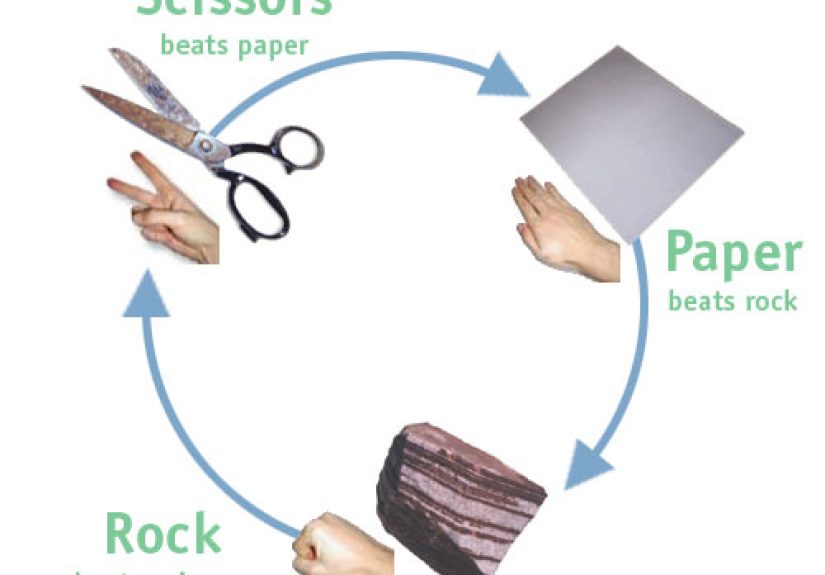
At its core, the game works because it is balanced. Rock beats scissors. Scissors beat paper. Paper beats rock. No option dominates the others, which is why the game has become such a classic example in game theory. If you play perfectly unpredictably, the ideal strategy is to choose each option one-third of the time. That structure gives the game its reputation for fairness and keeps it from collapsing into a boring routine where everyone just picks the same “best” move forever.
And yet, humans are not random little math robots walking around in sneakers. We come loaded with habits, feelings, ego, superstition, and the occasional deeply unserious conviction that “I’m feeling scissors today.” That gap between mathematical fairness and human predictability is what makes rock-paper-scissors both useful and hilarious. It is fair enough to end a dispute, but human enough to feel dramatic.
A Tiny Game With a Long Cultural Shadow
Rock-paper-scissors may feel like it has always been floating around elementary schools in America, but its roots go much deeper. Versions of the game trace back to China before evolving through Japan, where the familiar competitive structure became more standardized and culturally embedded. In Japan, the game is widely known as janken, and it has long been used not just by children but by adults making ordinary decisions. That detail alone says a lot. Some cultures never fully outgrow the wisdom of a clean, playful tie-breaker.
By the time the game spread more broadly into the United States in the early twentieth century, it had already proved its staying power. Even the name “roshambo,” which many Americans still use, carries its own odd little folklore. People often connect it to the French general Rochambeau, but there is no solid historical evidence that he had anything to do with the game. In other words, even the nickname comes with a side order of myth, confusion, and playground confidence. Which, if we are being honest, feels exactly on brand.
The endurance of the game says something important: people love rituals that feel fair and fun at the same time. Coin flips can do the fairness part, sure, but they lack theater. Drawing straws works, but it feels like paperwork. Rock-paper-scissors adds personality. It turns the dull machinery of decision-making into a tiny performance.
Using Rock-Paper-Scissors to Settle Real-Life Stuff
1. Family arguments that should never become Supreme Court cases
Who sits by the window? Who gets the first shower? Who has to walk to the mailbox in suspicious weather? These are not questions that deserve closing statements, witness testimony, or a detailed spreadsheet. Rock-paper-scissors keeps them in their proper category: small, survivable, and slightly silly. It prevents low-stakes friction from becoming high-volume drama.
2. Friend group decisions that would otherwise take forever
Anyone who has tried to choose a restaurant with four hungry friends knows that democracy can be messy. One person wants tacos, one wants sushi, one says “anything is fine” before vetoing six options in a row, and one is somehow still reading reviews. Rock-paper-scissors is not a solution to every group decision, but it is a brilliant tiebreaker when the real issue is not importance but indecision. Suddenly, dinner is back on schedule and nobody has to pretend the burger place won because of “strong consensus.”
3. Workplace moments that need speed, not ego
Used lightly, the game can be an excellent social lubricant at work. Who presents first? Who takes the aisle seat in the carpool? Who gets stuck making the coffee run? When the stakes are small and the tone is friendly, rock-paper-scissors can save time and keep power struggles from getting weird. It says, “Let’s not turn this into a personality contest.” That is a healthy sentence, even when spoken entirely through hand gestures.
4. Public moments where courtesy beats confrontation
One reason people love stories about strangers using rock-paper-scissors in public is that the game instantly transforms tension into cooperation. A famous traffic moment involved two drivers using the game to decide who would go first. That story spread because it offered a rare and beautiful sight: two humans encountering mild inconvenience and choosing play over rage. In the age of horns, sighs, and passive-aggressive lane behavior, that is practically poetry.
5. Serious decisions with surprisingly playful endings
The most famous upscale example may be the auction-house showdown in which Christie’s and Sotheby’s reportedly settled a major consignment decision with a game of rock-paper-scissors. The delicious absurdity of that story is part of why it keeps resurfacing: suits, strategy, pressure, millions of dollars, and then two people basically doing the same thing kids do before arguing over who was out first at recess. It is proof that simple rituals can survive even in polished, expensive rooms.
The Psychology Behind the Throw
Now for the really fun part: rock-paper-scissors looks random, but people often are not. Researchers studying repeated play have found patterns that show up again and again. One well-known tendency is “win-stay, lose-shift.” In plain English, people often repeat a move after it wins and change their move after it loses. That means the game is not only a method for resolving disputes; it is also a tiny laboratory for watching how humans respond to feedback.
There are other quirks too. New or casual players often seem drawn to rock, perhaps because a clenched fist is the default starting shape and because rock just feels strong. People also dislike looking too predictable, so they often avoid repeating the same move many times in a row, even though true randomness would allow streaks all the time. Our brains confuse “random” with “nicely mixed up,” which is one reason gamblers, sports fans, and people choosing between rock and paper all end up telling themselves stories.
Some studies have even suggested that players can subtly influence one another. In certain settings, people showed imitation effects, especially when visual cues entered the picture. That is partly why blindfold experiments became so interesting. Remove some of the social and visual feedback, and the game changes. Suddenly, rock-paper-scissors is not just a hand game. It is a window into how much of our behavior depends on reading, reacting to, and unconsciously copying other people.
Rock-Paper-Scissors and the Science of Fairness
It would be easy to dismiss the game as a goofy little pastime, except science keeps borrowing it. Game theorists use it to explain mixed strategies. Psychologists use it to study decision-making under uncertainty. Behavioral researchers use it to examine predictability and response patterns. Even biologists have used rock-paper-scissors as a model for systems in which no single strategy permanently dominates.
One famous example involves side-blotched lizards, whose mating strategies have been compared to a rock-paper-scissors cycle. One type outcompetes another, which outcompetes another, which circles back and outcompetes the first. It sounds like a setup for a children’s cartoon narrated by a professor, but it captures something real: balance can emerge not because one thing wins forever, but because strengths and weaknesses rotate.
That idea helps explain why rock-paper-scissors remains so satisfying. It feels fair because it is built on circular power, not hierarchy. Nothing stays on top. Every winner has a weakness. Every weakness has an answer. It is basically humility in hand-sign form.
How to Use It Well Without Turning Into a Weird Game Show Host
Keep the stakes appropriate
Rock-paper-scissors is great for minor decisions, equal claims, and situations where any outcome is acceptable. It is not ideal for matters involving safety, money that would genuinely hurt to lose, or decisions that deserve careful discussion. It is a tie-breaker, not a substitute for responsibility.
Agree on the rules first
Throw on “shoot” or on three. Decide whether ties mean replay. Keep hand shapes clear. Official organizations even recommend standardizing gestures to avoid confusion. This may sound hilariously formal for a game invented to decide who takes the last cookie, but clarity preserves the feeling of fairness. Nothing ruins the magic faster than someone saying, “No, that was sort of paper-ish.”
Accept the outcome with dignity
This is the unspoken social contract. You cannot suggest the game and then act like the legal team is filing an appeal because your scissors met a rock. The point of rock-paper-scissors is not just deciding. It is deciding without residue. Once the throw lands, the matter is done. That clean ending is the whole charm.
Why This Tiny Ritual Still Feels Awesome
There is something deeply comforting about a conflict-resolution tool that fits in your hands and lasts three seconds. In a world full of complicated systems, rock-paper-scissors remains beautifully analog. It is democratic without being heavy. Competitive without being mean. Strategic without requiring a user manual. And funny without trying too hard.
Most of all, it reminds us that not every disagreement deserves a thesis. Some moments improve when we stop grasping for control and agree to trust a tiny, shared ritual instead. Rock-paper-scissors does not solve humanity. It does, however, solve a shocking number of humanity’s small daily annoyances. And for that, it earns its place on any list of awesome things.
Shared Experiences: Why Rock-Paper-Scissors Stays With Us
If you grew up with siblings, cousins, classmates, teammates, or that one neighborhood kid who always acted like every kickball game was the World Cup, chances are rock-paper-scissors shows up somewhere in your memory like a tiny referee wearing invisible sneakers. It appears in the moments that are too small for adults to supervise and too emotionally charged for children to leave unresolved. Who bats first. Who goes down the slide next. Who gets the blue popsicle instead of the suspicious green one. Suddenly two people square up, fists bounce in rhythm, and the universe narrows to a three-count. For such a tiny ritual, it carries a ridiculous amount of suspense.
Part of the experience is physical. Everyone knows the feel of the countdown, the quick pulse of anticipation, the split-second after “shoot” when both players look down and start laughing, cheering, or claiming the other person definitely cheated by moving late. It is one of the first games many people learn that blends chance, performance, and social trust. You are not just making a hand sign. You are agreeing to a system. You are saying, “Whatever happens in the next second, we both accept it.” That is surprisingly mature for something mostly taught between arguments over snacks.
Then there is the social experience of watching personalities emerge. Some people always throw rock first with the confidence of a movie villain slamming a briefcase shut. Some go paper because they think everyone else will go rock. Some act casual and then become deeply philosophical after losing two rounds in a row, as if destiny itself has developed a personal issue with them. A quick game often reveals more than people expect: competitiveness, superstition, humor, stubbornness, even generosity when someone says, “Best two out of three,” in the tone of a benevolent monarch.
What makes the experience so memorable is not just the game but the emotional cleanup it provides. A lot of childhood disputes end badly because no one wants to back down. Rock-paper-scissors gives both sides a graceful exit. Nobody has to admit they were wrong. Nobody has to pretend they did not care. The game absorbs the tension and spits out an answer. That makes it feel almost magical. One second there is a standoff over who sits shotgun, and the next second everyone is moving on with life.
Even in adulthood, the experience keeps its charm. It shows up in road trips, offices, weddings, bars, family vacations, and random kitchen debates about who is going downstairs because someone forgot the takeout on the porch. Adults laugh when they use it because part of them knows this is gloriously unserious. But another part knows exactly why it still works. It is quick. It is fair enough. It is funny. And it turns ordinary friction into a shared story. Years later, people may not remember the argument, but they will remember the throw, the gasp, the triumph, and the ridiculous certainty that paper was absolutely the right move all along.