Table of Contents >> Show >> Hide
- Why the Information Paradox Became Such a Big Deal
- The First Lifeline: The Page Curve
- The Real Breakthrough: Replica Wormholes and Entanglement Islands
- Why This Feels Like a Genuine Solution
- The 2024 Twist That Made Headlines
- Could We Ever Test Any of This?
- Why Physicists Are Still Arguing Anyway
- So, Has the Information Paradox Been Solved?
- A Human-Sized Thought Experience of the Paradox
- Conclusion
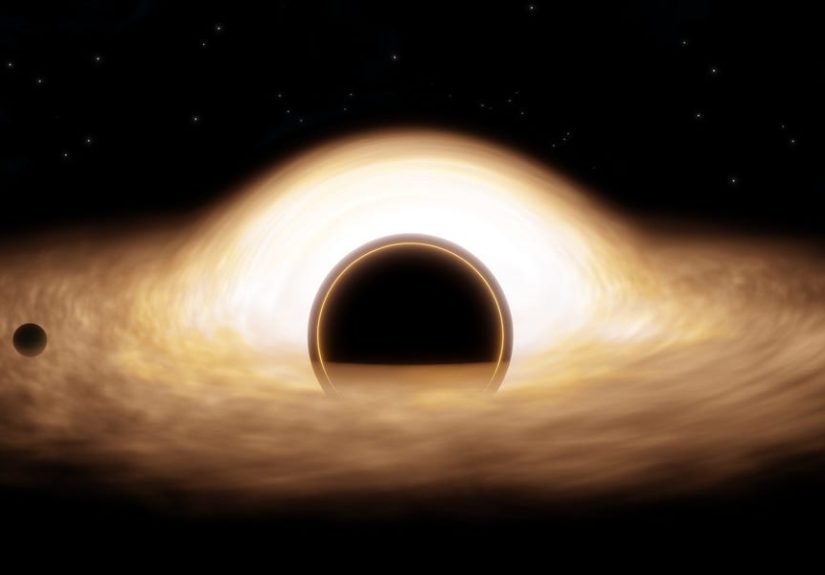
Black holes have a talent for making physics look like it misplaced its keys. On one side, Einstein’s general relativity says a black hole is a one-way trap: stuff goes in, and good luck getting it back. On the other side, quantum mechanics insists information cannot simply vanish from the universe like a magician’s rabbit on permanent vacation. Put those two ideas together, add Stephen Hawking’s discovery that black holes slowly leak radiation, and you get one of the nastiest puzzles in modern science: the black hole information paradox.
For decades, this paradox has been the cosmic version of an argument that ruins dinner. If black holes evaporate and the outgoing radiation is purely thermal, then the information about everything that fell in appears to be destroyed. But if information is truly destroyed, quantum mechanics takes a hit to the chin. Physicists do not enjoy punching quantum mechanics in the chin. So they went looking for a better answer.
Now, after years of dense calculations, strange wormhole math, and enough entropy talk to make your coffee go cold, researchers may finally have the strongest framework yet for explaining how black holes preserve information after all. The breakthrough does not mean every detail is settled. It does mean the field has moved from “this is impossible” to “okay, this might actually work.” In theoretical physics, that is the scientific equivalent of a marching band.
Why the Information Paradox Became Such a Big Deal
To understand the excitement, it helps to start with Hawking’s bombshell. In the 1970s, Hawking showed that black holes are not perfectly black. Quantum effects near the event horizon cause them to emit what we now call Hawking radiation. Because that radiation carries away energy, the black hole should eventually shrink and evaporate.
That sounds dramatic enough already, but the real problem is what the radiation seems to look like. Hawking’s original calculation suggested it is featureless thermal radiation. In plain English, it does not seem to remember whether the black hole formed from a collapsing star, a pile of textbooks, or your browser history. If the black hole disappears completely and all that remains is bland radiation, then the detailed information about what fell in appears to be gone forever.
And that is where the trouble starts. In quantum mechanics, the evolution of a closed system is supposed to be unitary. That means information is scrambled, hidden, and incredibly annoying to reconstruct, but not erased. Burning a book does not destroy its information in principle; it just spreads it into smoke, heat, light, and microscopic correlations. A black hole seemed to be different. It looked less like a shredder and more like a cosmic delete key.
Physicists quickly realized that this was not some minor bookkeeping error. If black holes truly destroy information, then either quantum mechanics needs revision, or our understanding of gravity is incomplete, or both. That is why the information paradox has been treated as a flashing neon sign pointing toward quantum gravity, the still-missing theory that must somehow combine general relativity with quantum mechanics.
The First Lifeline: The Page Curve
One of the most important clues came from physicist Don Page in the 1990s. Instead of accepting that information was lost, Page asked what should happen if black hole evaporation is unitary after all. His answer was elegant: the entropy of the outgoing radiation should rise at first, because the radiation is highly entangled with what remains inside the black hole, but later it should turn around and fall back down. This rise-and-fall pattern became known as the Page curve.
The Page curve mattered because it provided a target. If a correct theory of black hole evaporation preserves information, it should reproduce that curve. Hawking’s calculation gave a steadily increasing entropy, which implied information loss. A unitary theory had to do something different before the black hole fully disappeared.
For years, though, the Page curve was more of a brilliant expectation than a full derivation from gravity. Physicists knew what the answer should look like, but they could not get there cleanly using semiclassical gravity. That gap left the paradox wide open and the arguments spicy.
The Real Breakthrough: Replica Wormholes and Entanglement Islands
The modern breakthrough arrived when researchers revisited the problem using tools from quantum gravity, holography, and the gravitational path integral. The resulting calculations introduced two ideas that now dominate the discussion: replica wormholes and entanglement islands.
Replica wormholes sound like they were named during a sleep-deprived group project, but the basic point is important. When physicists compute entropy in quantum systems, they often use a trick involving multiple mathematical copies, or replicas, of the system. In black hole calculations, new gravitational saddles appear that connect these replicas through wormhole-like geometries. Those contributions had been neglected in simpler treatments. Once they are included, the entropy of Hawking radiation can follow the Page curve instead of climbing forever.
That result was a huge deal. It suggested Hawking’s original argument was not exactly wrong so much as incomplete. His calculation captured the early stage of evaporation, but it missed nontrivial gravitational effects that become essential later. In other words, the paradox may not require a wrecking ball through quantum mechanics. It may require a more complete version of gravity’s quantum bookkeeping.
Then came entanglement islands, which made the story even stranger and more compelling. The island rule says that when calculating the entropy of Hawking radiation, the relevant quantum region can include not only the radiation outside the black hole but also certain parts of what we would normally think of as the black hole interior. That is the weird, almost rude, twist. Information that appears trapped inside can count as part of the radiation’s entanglement structure outside.
Once islands are included, the math produces the Page curve naturally. Early on, there is no island, and entropy rises just as Hawking found. Later, an island appears, and the entropy begins to fall, consistent with unitarity. The paradox softens because the inside and outside of the black hole turn out not to be as cleanly separated as classical intuition suggested.
Why This Feels Like a Genuine Solution
What makes this framework so persuasive is not just that it offers a philosophical escape hatch. It actually reproduces the behavior physicists expected from information-preserving evaporation. That is why so many researchers describe the island-replica-wormhole program as the best progress in the field in decades.
It also connects beautifully with broader ideas in modern physics. Holography, especially the AdS/CFT correspondence, has long hinted that gravity and quantum information are deeply intertwined. The new black hole calculations fit that picture. They suggest that space-time geometry is not merely a stage where quantum information performs; in some sense, geometry itself may be built from patterns of entanglement.
That sounds lofty, but it has practical meaning. The black hole interior may not be a sealed vault. Instead, its informational content may be encoded in surprisingly nonlocal ways. What seems inaccessible from one description can reappear from another. That is one reason wormholes keep showing up in the math. They may be less like sci-fi tunnels you fly a spaceship through and more like signs that quantum gravity does not respect classical notions of separation as much as we thought.
The 2024 Twist That Made Headlines
If all of this already sounds wild, 2024 added an especially eye-catching twist. Raphael Bousso and Geoff Penington studied whether islands might extend beyond the event horizon in more realistic black holes, not just toy models. Their conclusion was startling: under the right conditions, the relevant island can protrude outside the horizon by a distance much larger than the Planck scale. For a supermassive black hole, the protrusion could be on the order of an atom’s size.
That may sound tiny, and it is. Nobody is parking a probe beside a black hole next Tuesday. Still, the conceptual importance is enormous. If part of the information-bearing region associated with the black hole is, in principle, outside the horizon, then the mystery is no longer locked behind an absolute wall. The paradox stops being purely metaphysical and becomes at least faintly testable in principle.
This is why headlines started getting bold. The logic was simple: if islands are not merely mathematical artifacts hidden forever inside the horizon, but extend far enough outward to matter operationally, then the information-preservation story gains a new level of seriousness. You still need technology that borders on science fiction to exploit it, but the laws of physics may not forbid the attempt.
Could We Ever Test Any of This?
This is where responsible science writing has to calm down a little. The breakthrough is theoretical, not observational. No one has directly measured Hawking radiation from an astrophysical black hole. It is far too faint for current instruments. And no one has flown a detector to within atomic distance of an event horizon, which is probably good news for the detector.
That said, the field is no longer devoid of test-related ideas. Some recent proposals suggest that if information is preserved through subtle nonlocal effects or black hole “hair,” future gravitational-wave measurements might reveal tiny deviations in the signals produced when black holes ring down after a merger. These proposals are speculative, but they matter because they begin translating the paradox from blackboard territory into observational language.
There are also laboratory analogs and quantum-computing experiments inspired by holography. These do not create literal astrophysical wormholes or solve the paradox on their own, but they explore related information-theoretic behavior in controllable systems. In a field where direct experiments are brutally difficult, even analog progress counts as a welcome breath of oxygen.
Why Physicists Are Still Arguing Anyway
If this framework is so good, why has the argument not ended? Because physics is physics, and no major paradox disappears without a few more rounds in the intellectual boxing ring.
First, the strongest results often arise in highly idealized settings, such as lower-dimensional models or holographic space-times that are easier to analyze than the messier universe we actually inhabit. Translating those successes into fully realistic four-dimensional black holes remains an ongoing project.
Second, not everyone agrees on what replica wormholes mean physically. Some researchers view them as profound windows into the structure of quantum gravity. Others worry they may reflect ensemble averages, bookkeeping tricks, or incomplete interpretations rather than a final microscopic explanation of how information escapes.
Third, competing ideas still exist. Fuzzballs in string theory, horizon modifications, remnants, quantum hair, and loop-quantum-gravity-inspired resolutions all remain active topics. Even within the research community, views differ sharply on which road really leads out of the paradox. So while the island framework has enormous momentum, the case is not closed with a tidy little stamp and a judge’s gavel.
So, Has the Information Paradox Been Solved?
The fairest answer is this: the black hole information paradox is not “solved” in the everyday sense of the word, but the leading theoretical framework for solving it has become dramatically more convincing. The island and replica-wormhole picture reproduces the Page curve, preserves unitarity, and offers a mathematically robust route around Hawking’s original conclusion. That is why so many physicists now speak of the paradox as nearing its end rather than sitting exactly where it was fifty years ago.
Still, there is an important difference between “we have a compelling resolution in quantum gravity calculations” and “we have experimentally confirmed the mechanism in astrophysical black holes.” We are much closer to the first statement than the second. If you like your science with closure, that may feel mildly rude. If you like your science with depth, mystery, and the occasional wormhole, it is pretty thrilling.
The real triumph may be broader than the paradox itself. Black holes have forced physicists to treat information as a fundamental ingredient of reality, not just a useful label on a chalkboard. They have pushed gravity, quantum theory, thermodynamics, and geometry into the same room and politely locked the door. Whether the final answer comes entirely from islands, or from some deeper theory that includes them as a clue, the paradox has already changed physics forever.
A Human-Sized Thought Experience of the Paradox
One reason this topic grabs people so hard is that it does not feel like an abstract math problem for very long. The moment you translate the paradox into ordinary terms, it becomes oddly personal. Imagine tossing a diary into a black hole. Or a family photo. Or every hard drive on Earth. Physics says all of that material contains information, not just in the obvious sense of words and pictures, but in the exact quantum state of every particle involved. If the black hole later evaporates into bland thermal radiation and the information is truly gone, then reality has done something that ordinary quantum theory does not allow.
That is what makes the paradox feel less like a niche problem in astrophysics and more like a stress test for reality itself. The universe is basically being asked, “Are you keeping the receipts?” And for decades the answer seemed to be, “Maybe not, and please stop yelling.”
There is also something emotionally strange about the horizon. In classical relativity, crossing the event horizon of a large black hole is not supposed to feel dramatic at the exact crossing point. No fireworks. No brick wall. No giant cosmic pop-up window saying, “Warning: you have entered forbidden geometry.” Yet from the outside, that same boundary appears to divide the visible universe from a place where information could be trapped beyond recovery. One boundary, two descriptions, and a lot of nerves.
That split is part of why the modern breakthroughs feel so satisfying. They do not simply rescue information by brute force. They suggest that the inside-versus-outside distinction may be more subtle than common sense allows. The information was never sitting in one neat little box labeled inside black hole while the radiation sat in another labeled outside. Quantum gravity may be telling us that the labels themselves were too classical, too rigid, too confident.
For readers trying to “experience” the paradox without the tensor calculus, the best way is to picture a mystery novel where every page seems to vanish into a furnace, yet the ending insists the full story still survives somewhere in the smoke. At first that sounds absurd. Then someone shows you that the smoke has hidden correlations, the furnace has a bizarre entropy law, the pages may count as being partly “outside” the furnace in a new description, and suddenly the impossible plot starts to look less like cheating and more like deep structure.
That is the emotional rhythm of this whole subject. First confusion. Then resistance. Then a strange flicker of recognition that the universe may be more unified than it looks. Gravity is not one world and quantum mechanics another. Black holes are not just monsters that swallow stars. They are pressure chambers for ideas. They take the assumptions physicists trust most, squeeze them until they crackle, and force better questions out of them.
And maybe that is the most human part of the story. The information paradox is not just about what happens to matter that falls into a black hole. It is about what happens when our best theories fall into each other. The breakthrough matters because it hints that the collision does not end in destruction. It ends in a harder, stranger, more beautiful picture of realityone where information survives, but only after teaching us that space, time, and inside-versus-outside were never quite what we thought they were.
Conclusion
The black hole information paradox has spent half a century acting like physics’ most stubborn houseguest, and recent work finally suggests it may be packing its bags. By combining the Page curve, replica wormholes, and entanglement islands, theorists have built the clearest explanation yet for how black holes could evaporate without destroying information. The newer idea that islands may even extend outside the horizon adds another layer of excitement, because it shifts the conversation from pure abstraction toward something that is, at least in principle, testable.
We are not at the finish line. But we may be close enough to see the tape. And for a paradox that once looked like a direct clash between the two greatest theories in physics, that is one heck of a breakthrough.