Table of Contents >> Show >> Hide
- What Is an Automotive Load Dump?
- Why Build a Load Dump Tester?
- Standards That Shape the Tester
- Core Blocks of an Automotive Load Dump Tester
- Protection Strategies the Tester Should Evaluate
- Designing for Safety Before Designing for Waveform Accuracy
- Common Mistakes When Building a Load Dump Tester
- How to Use a Load Dump Tester in Product Development
- Example Scenario: Testing an Aftermarket Telematics Module
- Experience Notes: Lessons From Building and Using Load Dump Testers
- Conclusion
Automotive electronics live a dramatic life. One minute they are sipping neat, polite battery voltage; the next, they are being smacked by cranking dips, relay chatter, alternator noise, reverse battery mistakes, and the electrical equivalent of a bowling ball through a window: the load dump transient. If you are designing a dashboard module, telematics box, lighting controller, ECU, DC-DC converter, or aftermarket accessory, understanding how to test against load dump is not optional. It is the difference between “reliable automotive product” and “mysterious smoke event with paperwork.”
Building an automotive load dump tester is less about creating a scary pulse generator for fun and more about building a controlled, repeatable, well-instrumented test environment. The goal is to simulate what happens when a vehicle battery is suddenly disconnected while the alternator is still producing charging current. Without the battery acting as a big electrical shock absorber, voltage on the supply rail can rise sharply and decay over hundreds of milliseconds. That long duration is what makes load dump so unpleasant: it is not just a tiny spike; it is a high-energy event with enough stamina to ruin your afternoon.
This article explains what an automotive load dump tester is, why engineers build one, what standards influence the design, which subsystems matter, and how to approach the project safely. It is written for engineers, technicians, product developers, and curious hardware builders who want a practical overview without turning the bench into a fireworks display.
What Is an Automotive Load Dump?
A load dump happens when the battery connection is lost while the alternator is charging and other electrical loads remain connected. In a normal vehicle, the battery stabilizes the electrical system. It absorbs energy, smooths transients, and generally behaves like the calm adult in the room. Remove it suddenly, and the alternator’s output can surge before the voltage regulator and field circuit settle down.
In testing language, this event is represented by a positive voltage pulse applied to the device under test, often called the DUT. Older automotive transient discussions commonly refer to ISO 7637-2 pulse 5a and 5b. Newer power-quality discussions often point to ISO 16750-2 test A and test B. In simple terms, one case represents an unsuppressed load dump, while the other represents a centrally suppressed system where the vehicle already includes some form of upstream clamping.
Why Load Dump Is Different From Ordinary Spikes
Many electrical transients are fast. They come and go in microseconds or nanoseconds. Load dump is different because it can last tens or hundreds of milliseconds. That duration matters because protection components must survive not just peak voltage, but energy. A small TVS diode that laughs at electrostatic discharge may faint dramatically when asked to absorb a long alternator surge.
This is why load dump protection often combines multiple strategies: input filtering, transient voltage suppressors, surge stopper ICs, MOSFET isolation, fuses, current limiting, and layout discipline. The tester exists to verify that these choices work together under realistic stress.
Why Build a Load Dump Tester?
A commercial automotive transient generator is the best choice for formal compliance testing. It offers calibrated waveforms, documented source impedance, controlled pulse timing, repeatability, safety interlocks, and traceable reporting. However, engineering teams often build a pre-compliance load dump tester to evaluate prototypes before paying for lab time. Think of it as proofreading your hardware before the standards lab grades it with a red pen and an invoice.
A practical tester helps answer questions such as:
- Does the input protection clamp at a safe level?
- Does the device reset gracefully or lock up?
- Does the DC-DC converter survive repeated pulses?
- Does the enclosure, cabling, or grounding arrangement change the result?
- Does the protection strategy overheat during repeated events?
- Does the product return to normal operation after the transient?
The value is not just in “pass” or “fail.” It is in understanding failure behavior. A module that reboots cleanly may be acceptable for one application but unacceptable for another. A lighting controller that flickers during a transient might annoy a driver. A brake-related controller that misbehaves is a much bigger problem. Context matters.
Standards That Shape the Tester
Automotive load dump testing is influenced by several standards and manufacturer specifications. ISO 7637-2 deals with conducted electrical transients on supply lines. ISO 16750-2 focuses on electrical loads and environmental conditions for vehicle electronic equipment. SAE J1113 covers immunity to conducted transients in automotive systems. Many OEMs also define their own test profiles, especially for modules connected close to the battery, alternator, or fuse box.
The important point is that a useful tester should not be designed around a random “big pulse.” It should be designed around a documented waveform family: peak voltage, rise behavior, pulse duration, source impedance, repetition, DUT supply condition, and acceptance criteria. Without those details, testing becomes theater. Loud theater, perhaps, but still theater.
Pulse 5a, Pulse 5b, Test A, and Test B
Older discussions often describe pulse 5a as an unsuppressed load dump and pulse 5b as a suppressed load dump. In newer ISO 16750-2 language, similar ideas appear as test A and test B. Test A generally represents a more severe event without central suppression. Test B represents a system where upstream suppression limits the voltage. Engineers should confirm the exact standard revision and customer requirement before deciding what the tester must simulate.
This detail matters because designing for a suppressed system is very different from designing for a severe unsuppressed transient. A protection circuit that is perfectly happy at a clipped voltage may not survive the full energy of a harsher event. Automotive electronics rarely reward assumptions.
Core Blocks of an Automotive Load Dump Tester
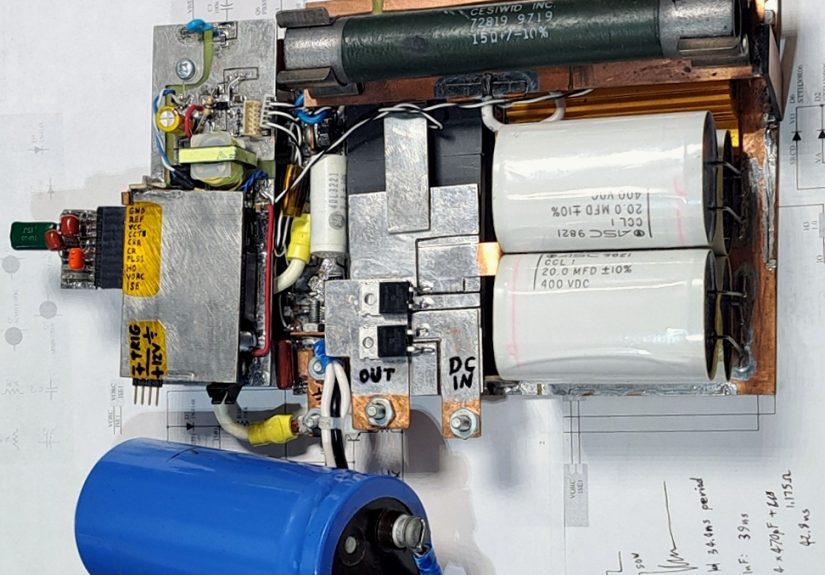
A professional-grade load dump tester is built around controlled energy delivery, known impedance, reliable switching, accurate measurement, and safety. A pre-compliance bench version should follow the same philosophy, even if it is less sophisticated than certified lab equipment.
1. Programmable or Controlled Energy Source
The tester needs a controlled source that can reproduce the intended voltage profile. In formal systems, this is handled by a calibrated generator. In engineering prototypes, the energy source must still be predictable, repeatable, and isolated from casual contact. The design should prevent accidental discharge, unexpected retriggering, and uncontrolled energy release.
This is not an area for improvisation. Any energy storage section must be treated as hazardous. Enclosures, bleeder paths, interlocks, warning indicators, and lockout procedures are not decorative accessories. They are the reason the test bench remains a test bench instead of becoming a cautionary tale.
2. Source Impedance Network
Load dump standards define source impedance because the impedance determines how much current and energy the DUT can receive. A tester with the wrong impedance may produce a waveform that looks impressive on an oscilloscope but does not represent the intended automotive condition.
Source impedance also affects how protection devices behave. A TVS diode, for example, clamps by conducting current. If the source impedance is too low, the current may be unrealistic and destructive. If it is too high, the test may be too gentle. Accurate impedance is the quiet hero of meaningful transient testing.
3. Pulse Shaping and Switching
The tester must create a controlled rise and decay profile. Load dump is commonly modeled as a surge that decays over time rather than a square pulse. The switching section should be designed for repeatability, low unintended inductance, and predictable behavior under stress.
Switching high-energy transients is not the same as blinking an LED with a microcontroller. Contact bounce, parasitic inductance, gate drive behavior, heat, and fault recovery all matter. A good design treats the switch as part of the measurement system, not just a convenient on-off device.
4. DUT Coupling and Supply Arrangement
The device under test usually operates from a normal automotive supply while the transient is superimposed or applied in a defined manner. The supply path, cable length, grounding method, and fixture layout can change the observed result. That is why standards describe test setups in detail.
In practice, a clean DUT fixture should include short, robust conductors, clearly labeled polarity, accessible measurement points, proper fusing, and a repeatable ground reference. The fixture should also make it easy to test the product in the same configuration it will use in the vehicle. A module that passes with tiny bench wires may behave differently with a real harness.
5. Measurement and Data Capture
A load dump tester without good measurement is just an expensive way to feel nervous. At minimum, engineers need to capture input voltage, DUT current, clamped voltage, output rails, reset lines, and key functional signals. A digital oscilloscope with suitable probes and bandwidth is essential. Current probes, differential probes, thermal imaging, and data logging can reveal problems that a simple pass/fail LED will miss.
Measurement equipment must be rated for the transient environment. Grounding mistakes can damage instruments or create unsafe conditions. Differential measurement is often safer and more informative than clipping a standard probe ground wherever it happens to fit.
Protection Strategies the Tester Should Evaluate
The tester is only useful if it helps evaluate real protection strategies. Most automotive modules use a layered approach. No single part should be expected to perform magic while the rest of the design eats popcorn.
TVS Diodes
Transient voltage suppressor diodes are common because they respond quickly and clamp voltage. For load dump, the challenge is energy rating. The selected device must handle the pulse duration, repetition, clamping voltage, thermal rise, and expected aging. Engineers should check load dump-specific ratings rather than relying only on short-pulse surge numbers.
Surge Stopper and Overvoltage Controllers
Surge stopper ICs and overvoltage controllers monitor the input rail and control a MOSFET to disconnect or regulate the downstream load. This can reduce the energy absorbed by the protected circuit. The tradeoff is design complexity: MOSFET voltage rating, safe operating area, thermal behavior, gate control, and fault timing all need careful review.
Input Filters and Bulk Capacitance
Filters can reduce fast noise and help stabilize the input, but they are not a complete solution for load dump by themselves. Bulk capacitors must be rated for voltage, ripple current, temperature, and lifetime. Ceramic capacitors, electrolytics, polymer capacitors, and film capacitors all behave differently under stress.
Fuses and Current Limiting
Fuses protect against sustained faults, not every transient. They are still important because a failed TVS or MOSFET can become a short. Resettable fuses, conventional fuses, and electronic current limiting each have different response times and failure modes. A load dump tester can reveal whether the protection system fails safe or fails smoky.
Designing for Safety Before Designing for Waveform Accuracy
The safest load dump tester is a commercial, certified instrument operated by trained personnel. If a team builds a pre-compliance fixture, it should be treated as laboratory equipment, not a weekend gadget. The enclosure should prevent access to energized nodes. The controls should make state obvious. The discharge path should be automatic and verified. The operator should not need heroic memory to stay safe.
Useful safety features include:
- A grounded metal enclosure or properly rated insulated enclosure
- Physical interlocks that disable operation when the cover is open
- Clearly visible charged-state indicators
- Automatic discharge after each test
- Manual emergency stop
- Input and output fusing
- Documented operating procedure
- Two-person review for first energization
- Remote triggering and hands-off operation during pulses
Safety also includes software behavior. If a microcontroller controls the sequence, it should default to a safe state after reset, brownout, watchdog timeout, or communication failure. A tester that becomes dangerous when its firmware crashes has missed the assignment.
Common Mistakes When Building a Load Dump Tester
Confusing Peak Voltage With Real Severity
A high peak voltage sounds impressive, but pulse duration and source impedance determine much of the damage potential. A brief high-voltage spike may be less stressful than a lower-voltage pulse that lasts much longer. Load dump testing is about energy, not bragging rights.
Ignoring Cable and Layout Effects
Wiring inductance can create ringing, overshoot, and measurement confusion. Long leads can turn a clean pulse into a messy one. Keep the fixture controlled, document the cable arrangement, and avoid changing three physical variables every time a board is tested.
Using Protection Parts Outside Their Real Ratings
A TVS diode data sheet may list a large peak power number based on a short waveform. Load dump can be much longer. Always examine ratings under comparable pulse duration and repetition conditions. Components do not care that the spreadsheet looked optimistic.
Testing Only Once
Some standards and customer requirements involve repeated pulses. Repetition exposes heating, degradation, and marginal design decisions. A device that survives one event may drift, weaken, or fail after multiple pulses. Reliability is a movie, not a snapshot.
How to Use a Load Dump Tester in Product Development
The smartest time to test is before the PCB is “final.” Early testing lets engineers adjust the input stage, improve layout, select better protection parts, and change connector strategy without begging management for a board re-spin. A load dump tester should be part of a broader automotive electrical validation plan that includes reverse polarity, cold crank, jump start, fast transients, ESD, conducted emissions, thermal stress, and functional testing.
Start with engineering characterization. Observe the waveform without the DUT, then with a protected dummy load, and only then with the prototype. Document every setting and fixture detail. During DUT testing, watch both survival and function. Did the device reset? Did communication recover? Did memory corrupt? Did the housing temperature rise? Did the input protection clamp as expected? Did the customer-visible function remain acceptable?
A good test report should include the waveform target, actual captured waveform, DUT operating mode, supply voltage, load condition, ambient temperature, number of pulses, interval between pulses, observed behavior, and post-test inspection notes. Future-you will be grateful. Future-you is usually tired and looking for the one detail current-you forgot to write down.
Example Scenario: Testing an Aftermarket Telematics Module
Imagine a small telematics module designed for 12-volt vehicles. It includes a cellular modem, GNSS receiver, microcontroller, CAN transceiver, and a switching regulator. The module connects near the fuse box, so it may see harsh supply conditions. The design includes input fusing, a reverse-polarity MOSFET, a TVS diode, an LC filter, and a wide-input buck regulator.
During pre-compliance testing, the load dump tester applies the selected transient profile while the module is actively transmitting data and logging position. The oscilloscope monitors input voltage, the protected rail, the 5-volt rail, the 3.3-volt rail, reset, and modem current. The first test shows that the input TVS clamps, but the buck regulator briefly drops out and the modem resets. That may be acceptable if the device reconnects cleanly, but not if it loses stored trip data.
The team then reviews input capacitance, regulator undervoltage behavior, firmware recovery, and nonvolatile memory timing. The solution may not be a bigger TVS alone. It may be better sequencing, a hold-up capacitor on the logic rail, improved reset supervision, or a surge stopper that isolates the downstream supply. The tester reveals the system behavior, not just the component limit.
Experience Notes: Lessons From Building and Using Load Dump Testers
The first practical lesson is that load dump testing humbles tidy theories. On paper, the protection network looks clean: pulse enters, clamp conducts, regulator survives, product smiles. On the bench, the waveform may ring, the enclosure ground may shift, the reset line may twitch, and the product may behave like it just heard a ghost. This does not mean the design is bad. It means the test is finally showing the real personality of the hardware.
One of the most useful habits is to separate waveform validation from product validation. Before testing an expensive prototype, validate the tester with a known safe load and measurement setup. Capture the open-circuit waveform, then the loaded waveform, then the clamped waveform. This creates a baseline. Without a baseline, every failure becomes a mystery novel, and not the fun kind with a charming detective.
Another experience-based rule: thermal behavior sneaks up on you. A protection device may look fine during the pulse, but its case temperature may keep rising afterward. Repeated pulses can reveal cumulative heating that a single-shot test hides. When evaluating TVS diodes, MOSFETs, resistors, connectors, and PCB copper, allow time for thermal observation. A part that survives electrically but chars the board is not a success; it is a strongly worded suggestion from physics.
Documentation also becomes more valuable than expected. Engineers often remember the dramatic failure but forget the exact supply voltage, cable length, pulse interval, DUT firmware version, or ambient temperature. Later, when the same product passes one day and fails the next, those missing details become painfully important. A simple test sheet with repeatable fields can save hours of confusion.
The best load dump testing culture is calm and methodical. Nobody should be leaning over the fixture during a pulse. Nobody should be adjusting clips while energy storage is active. Nobody should be guessing whether the tester is discharged. Good teams use checklists because checklists are cheaper than accidents. They label cables, review setups, and treat every first test as a controlled experiment.
Finally, the most important experience is that passing load dump is not only about surviving voltage. It is about graceful behavior. In automotive electronics, recovery matters. A product may be allowed to reset under certain conditions, but it should recover predictably. It should not latch into a strange mode, corrupt data, overheat silently, or require someone to disconnect the battery to revive it. A well-built automotive load dump tester helps engineers find those ugly edge cases early, while there is still time to fix them with dignity.
Conclusion
Building an automotive load dump tester is a serious engineering project, not a casual bench trick. Done properly, it gives designers a powerful way to evaluate input protection, power architecture, reset behavior, thermal margins, and system recovery before formal compliance testing. Done carelessly, it can damage equipment, mislead the design team, or create unsafe conditions.
The best approach is to use recognized standards as the target, commercial calibrated equipment for formal qualification, and carefully designed pre-compliance fixtures for early engineering learning. Focus on repeatability, documentation, safety, and real product behavior. Load dump testing may never be glamorous, but when your module survives a brutal automotive transient and keeps working like nothing happened, it feels a little like hardware poetry.