Table of Contents >> Show >> Hide
- The Bennington backdrop: why this town and why stoneware?
- From Cooperative Design to Bennington Potters
- David Gil’s big idea: good design belongs in everyday life
- What makes Bennington Potters pottery distinctive?
- The sweet spot between craft and production
- Why Bennington Potters still matters in American design
- Bennington Potters as an experience, not just a brand
- The experience of Bennington Potters: 500 extra words from the clay side of the story
- Final thoughts
- SEO Tags
Note: This article is formatted for direct web publication and cleaned of unnecessary reference artifacts.
Some brands sell products. Bennington Potters sells that rarest of household luxuries: a reason to look forward to doing the dishes. Founded in 1948 in Bennington, Vermont, the company has spent decades proving that handmade stoneware can be practical, artful, durable, and just handsome enough to make your kitchen feel like it has its life together, even when you absolutely do not.
The story of Bennington Potters is bigger than mugs, bowls, and dinner plates. It is also the story of American craft, modern design, and a Vermont town whose identity has long been tied to clay. What began as a small collaborative studio grew into one of the country’s most recognizable stoneware names, blending the spirit of a cooperative workshop with the discipline of production pottery. That mix matters. It means Bennington Potters has never fit neatly into one box. It is not purely studio pottery. It is not faceless factory ware. It lives in the sweet spot between the two, where thoughtful design meets daily use.
If that sounds a little lofty for a bowl, fair enough. But good pottery has a way of sneaking into your life. One day it is “just a mug,” and the next day you are emotionally attached to a piece of clay because your coffee tastes better in it. Bennington Potters understood that long before “elevated everyday objects” became marketing copy.
The Bennington backdrop: why this town and why stoneware?
To understand Bennington Potters, it helps to understand Bennington itself. This southern Vermont town has been associated with pottery since the late eighteenth century. Long before modern cookware catalogs and artisanal table settings, Bennington’s potteries were producing utilitarian wares for everyday life. Redware came first, and stoneware followed in the early 1800s, valued for its toughness and usefulness. In the nineteenth century, local pottery firms helped make Bennington a serious name in American ceramics.
That earlier industry eventually faded, as changing materials, manufacturing methods, and consumer habits reshaped the market. But the town’s ceramic identity did not disappear. It lingered in local memory, museum collections, and the physical landscape itself. So when a young potter named David Gil arrived after World War II and started building something new, he was not inventing pottery in Bennington from scratch. He was reviving a tradition with a distinctly modern attitude.
That historical continuity is one reason Bennington Potters still feels rooted rather than manufactured in the generic sense. The company did not land in Vermont because someone spun a map and pointed at a charming village. It grew in a place where clay, making, and utility already had deep cultural meaning.
From Cooperative Design to Bennington Potters
Bennington Potters began in 1948 as Cooperative Design, a collaborative venture started by David Gil, Gloria Gil, and fellow creatives in Bennington. The operation started humbly, in the kind of setting that sounds romantic now and probably felt freezing then: a small unheated barn. It was not polished. It was not glamorous. It was exactly the kind of place where American craft legends often begin, usually with equal parts talent, nerve, and stubbornness.
David Gil had studied ceramics, developed his skills early, and believed deeply in the idea that beautiful objects should not be reserved for elites with museum budgets and spotless linen cabinets. He wanted to create well-made ceramics in a production setting without losing the intelligence and humanity of design. That mission shaped the company from the beginning.
Over time, Cooperative Design evolved into Bennington Potters, and the business expanded far beyond its original barn beginnings. In 1964, the company moved to the County Street site in Bennington, where Potters Yard became both a working pottery and a destination. That move gave the business room to grow, but it did not erase its founding character. The cooperative spirit remained in the way Bennington Potters approached design, production, and collaboration.
Even the name “Co-op Stoneware Since 1948” captures something essential. It points back to the founding idea that pottery could be shaped by shared creative energy rather than by one-dimensional mass manufacture. Bennington Potters may have grown into a major brand, but it never stopped carrying traces of its workshop DNA.
David Gil’s big idea: good design belongs in everyday life
David Gil’s importance to Bennington Potters cannot be overstated. He was not simply the founder. He was the design engine, the technical problem-solver, and the person who insisted that functional ceramics could also be modern, elegant, and deeply democratic. His work drew from modernist ideals, including Bauhaus thinking, which championed good design for ordinary life rather than decoration for decoration’s sake.
That philosophy sounds obvious now because the design world has spent decades catching up to it. In the 1940s and 1950s, it was still radical in practice. Gil believed that a plate, pitcher, or mug should be visually smart and physically satisfying, but also reproducible enough to reach real households at real prices. In other words, he wanted beauty with a job description.
This approach helped him stand out nationally. During the 1950s, Gil built a reputation as a designer of unusual talent. His ceramics were recognized in major exhibitions, including the celebrated Good Design program associated with the Museum of Modern Art. He also gained attention as a production potter, a category that matters because it sits right at the intersection of art and industry. Gil did not reject machinery. He used it strategically, shaping a conversation between handcraft and production rather than letting one cancel out the other.
That balancing act became one of Bennington Potters’ greatest strengths. Too much mechanization and the work would lose character. Too much one-off studio purism and the work would become scarce, expensive, and disconnected from everyday use. Gil found the middle lane and drove it with style.
What makes Bennington Potters pottery distinctive?
First, the basics are strong. Bennington Potters is known for stoneware that is meant to be used, not admired from a safe distance like a nervous museum guard is lurking nearby. The pottery is functional, durable, and designed for real kitchens. Many pieces are lead-free and safe for the dishwasher and microwave, which is the sort of practical detail that rarely gets poetry written about it but absolutely deserves a standing ovation from busy households.
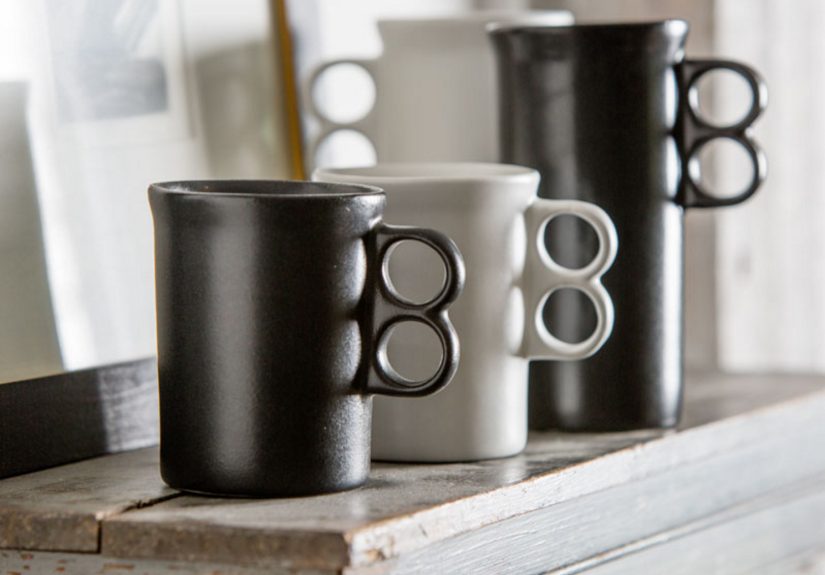
Second, the forms are confident without being fussy. Bennington Potters shapes often have a tactile intelligence to them. A handle feels intentional. A bowl sits with authority. A mug has enough visual personality to be recognizable across a table. The famous Trigger Mug is a perfect example. It is one of those objects that looks simple until you realize how hard it is to make “simple” feel iconic.
Third, the glazes matter. Bennington Potters has long offered a range of finishes that give its wares character without making them too precious to live with. Pieces like Blue Agate and White on White helped define the brand’s visual identity. Some dinnerware uses agated glaze effects to create subtle marbling and movement, giving each piece variation while preserving a coherent set. The result is consistency with personality, which is basically what everyone wants from a dinner party and a dish collection.
And finally, no two pieces are exactly alike. That is not a flaw. That is the point. Bennington Potters keeps enough variation in the work to remind you that people, not robots with emotional detachment, are part of the process. The pottery feels made, not merely manufactured.
The sweet spot between craft and production
One of the most fascinating things about Bennington Potters is how neatly it refuses the usual craft-world binaries. It is not “purely handmade” in the precious, one-piece-at-a-time mythology that sometimes shadows American ceramics. But it is also not generic industrial tableware stamped out with all the soul of an airport spoon.
Instead, Bennington Potters occupies a more interesting category: design-driven production craft. That means molds, kilns, presses, and systems are part of the story. But so are glaze application, finishing, firing judgment, and decades of accumulated know-how. Workers shape, trim, inspect, glaze, and fire pieces with a level of attention that keeps the work grounded in skill.
This model also explains why the brand has remained relevant across generations. Studio pottery can be thrilling but sometimes hard to scale. Mass-market stoneware can be affordable but forgettable. Bennington Potters built a third option, where objects remain collectible and aesthetically distinctive while still being practical enough to use every morning before your brain has fully clocked in.
That is also why collectors, designers, cooks, and ordinary homeowners keep coming back. The pottery carries artistic pedigree without requiring special handling or a special personality. You do not need to become a ceramics scholar to enjoy it. You just need a table.
Why Bennington Potters still matters in American design
Bennington Potters matters because it represents a durable American idea: that everyday goods can be intelligently designed, locally made, and culturally meaningful all at once. In a market flooded with throwaway housewares and trend-chasing decor, that is not a small achievement. It is a rebuke.
The company also matters because it helped keep Vermont’s craft reputation alive while proving that “regional” does not have to mean minor. Bennington Potters became a national brand without shedding its local identity. In fact, its local identity became part of the appeal. Bennington, Vermont was not incidental branding wallpaper. It was the place where the work happened, the place that shaped the company’s authenticity, and the place that connected modern pottery to a much older ceramic story.
There is also the David Gil factor. His legacy extends beyond individual products into a broader way of thinking about design. He treated pottery as a field where aesthetics, usability, affordability, and repeatability could cooperate rather than compete. That mindset helped make Bennington Potters influential well beyond New England.
And then there is the emotional piece, which no spreadsheet can measure very well. Bennington Potters has stayed in people’s homes for years, sometimes decades. These are wedding-gift dishes, favorite coffee mugs, serving bowls that appear every Thanksgiving, and pitchers that somehow survive three kitchens and two moves. In other words, this is pottery that becomes part of family choreography.
Bennington Potters as an experience, not just a brand
There is something wonderfully specific about the idea of buying pottery in Bennington, Vermont, where the town’s identity and the object’s identity still talk to each other. Bennington Potters has long been more than a product line. It has been a destination, a working pottery, and a visual expression of the town’s creative life.
That matters in an era when so many “heritage brands” feel suspiciously designed by committees who learned the word “heritage” last Tuesday. Bennington Potters still carries the real thing: a relationship between maker, place, and object that did not need to be invented for social media. Visitors and longtime fans are drawn not only to the finished pottery but also to the process behind it, the site itself, and the feeling of seeing labor turned into something sturdy and beautiful.
Even if someone first discovers the brand through a catalog, a shop display, or a hand-me-down casserole dish from a relative with excellent taste, the pull of the place remains strong. Bennington Potters feels local in the best way: specific, grounded, and impossible to confuse with anyone else.
The experience of Bennington Potters: 500 extra words from the clay side of the story
To talk about Bennington Potters only as a design success would miss half the fun. The full experience is sensory. It begins, as many good Vermont experiences do, with the feeling that you have accidentally wandered into a postcard that somehow makes room for hard work. Bennington has mountains, history, and old buildings with enough personality to make modern strip malls weep softly. Then you arrive at Potters Yard, and the story shifts from scenic to tactile.
You are no longer just in a pretty town. You are in a place where clay is still treated like a serious material, not a cute hobby. That changes the mood immediately. A Bennington Potters visit, or even a close mental picture of one, is about movement and texture: shelves of finished wares, stacks of forms, the quiet authority of tools, and the slightly miraculous fact that everyday dishes begin life as wet earth with ambition.
Imagine watching the process unfold. Liquid clay moves into molds. A shape begins to form with patient inevitability. Seams are cleaned. Surfaces are refined. Pieces dry, shrink, and toughen. Glaze is applied with care, because glaze is not just color. It is chemistry, surface, identity, and mood. Bennington’s classic finishes are part of why the brand is so recognizable. Blue Agate has that soft, marbled depth that feels both traditional and fresh. White on White has a quieter confidence, the pottery equivalent of someone who does not need to raise their voice to run the room.
Then there is the kiln, the great truth-teller of ceramics. Before firing, every piece is a promise. After firing, it has become itself. This is one reason handmade stoneware never feels trivial when you see it made well. Heat changes everything. It reveals whether form, glaze, timing, and skill were actually in agreement or just pretending to get along.
The emotional experience of Bennington Potters comes from seeing how much intelligence is packed into objects that are meant to live ordinary lives. A bowl is not trying to become conceptual art. A mug is not delivering a TED Talk. And yet, when made with this level of attention, these things become more than utilitarian. They shape the rituals around them. Morning coffee feels steadier. Soup feels slightly more respectable. Even leftovers appear to have regained some dignity.
That is why Bennington Potters tends to create loyalists rather than casual admirers. People do not just buy a piece and move on. They begin with one mug, then add two cereal bowls, then a platter, then suddenly they are the kind of person who can identify glazes across a crowded table. This is not obsession. This is home life with excellent taste.
There is also a deeper charm in the fact that Bennington Potters never separated beauty from usefulness. The company’s long appeal comes from honoring both. These are objects meant to be touched, washed, heated, stacked, gifted, chipped a little, loved a lot, and passed along. Their value does not depend on staying untouched. In fact, they become more meaningful when they are used.
And maybe that is the most satisfying part of the Bennington Potters experience. It reminds you that craftsmanship is not only about rarity or display. Sometimes it is about making the ordinary world better behaved. A well-designed plate can do that. A durable mug can do that. A bowl with just the right heft can do that. Bennington Potters has spent decades proving the point, one practical, handsome piece of stoneware at a time.
Final thoughts
Bennington Potters endures because it never lost sight of its founding promise: make ceramics that are beautiful, useful, well-designed, and rooted in place. From its beginnings as Cooperative Design in 1948 to its long role in Vermont’s craft identity, the company has shown how a regional pottery can become a national design classic without sacrificing character.
That is no small feat. Plenty of brands can be charming. Plenty can be practical. Plenty can be historic. Bennington Potters has managed to be all three, while also making dishes you will genuinely want to use on a random Wednesday night. In the grand hierarchy of domestic victories, that is pretty impressive.
So yes, the story is about stoneware. But it is also about American making at its best: collaborative in spirit, disciplined in execution, modern in outlook, and warm enough to survive everyday life. In Bennington, Vermont, that story has been firing since 1948. And thankfully, it still looks good on the table.