Table of Contents >> Show >> Hide
- Why stationery people keep talking about Postalco
- Quick specs (the stuff you actually want to know)
- The cover: pressed cotton that wears in, not out
- Spiral binding done right (a small miracle)
- The paper: Pin-graph’s tiny 1mm grid (and why it matters)
- How “Medium” fits into real life
- What the Postalco Medium notebook is best at
- Who should buy it (and who should pass)
- Practical tips to get the most out of it
- 500-word experience: living with the Postalco Notebook (Medium)
- Final thoughts
Some notebooks are basically disposable. You buy them, you write three heroic pages, then they vanish into the same alternate dimension that steals socks, hair ties, and your last good pen.
The Postalco Notebook (Medium) is not that notebook.
This is the kind of A6 spiral notebook that quietly changes your habits: you start jotting things down because it feels good, not because a productivity guru yelled at you through a thumbnail.
It’s minimalist without being sterile, durable without looking like tactical gear, and practical in a way that makes you think,
“Oh… so that’s what ‘good design’ means.”
Why stationery people keep talking about Postalco
Postalco has a reputation for treating everyday objects like they deserve engineering, not just decoration.
The Medium notebook sits right in that sweet spot: small enough to carry, big enough to be useful, and built with details you only notice after you’ve lived with it.
It’s a notebook that feels designed for real worknotes, sketches, lists, plans, half-baked ideas that become fully baked later.
If you’ve ever wanted a notebook that’s simple but not boring, premium but not precious, and tough enough to survive a tote bag full of chaos,
this one makes a strong casewithout making a big speech about it.
Quick specs (the stuff you actually want to know)
“Medium” in Postalco-speak generally maps to an A6 format with a clever, usability-first build.
Here’s what you can typically expect:
- Format: Medium / A6
- Binding: Spiral/coil bound, opens flat and folds over easily
- Paper: Postalco’s original Pin-graph paper with a subtle 1mm grid (printed in a calm blue)
- Page count: Commonly listed as 55 sheets (often described as 110 pages when counted front/back)
- Cover: Starched/pressed cotton bonded to sturdy covers; treated to be water-resistant
- Made in: Japan
- Size reality check: Some retailers list the paper as A6 while others list slightly larger overall dimensions due to the cover design and how it protects the edges
The headline takeaway: it’s a compact notebook with 1mm grid paper and a pressed cotton cover that’s meant to age gracefully.
Think “well-worn denim,” not “falls apart after two weeks.”
The cover: pressed cotton that wears in, not out
A lot of notebooks try to feel premium by going stiffhard covers, thick boards, shiny coatings, and the emotional warmth of a refrigerator door.
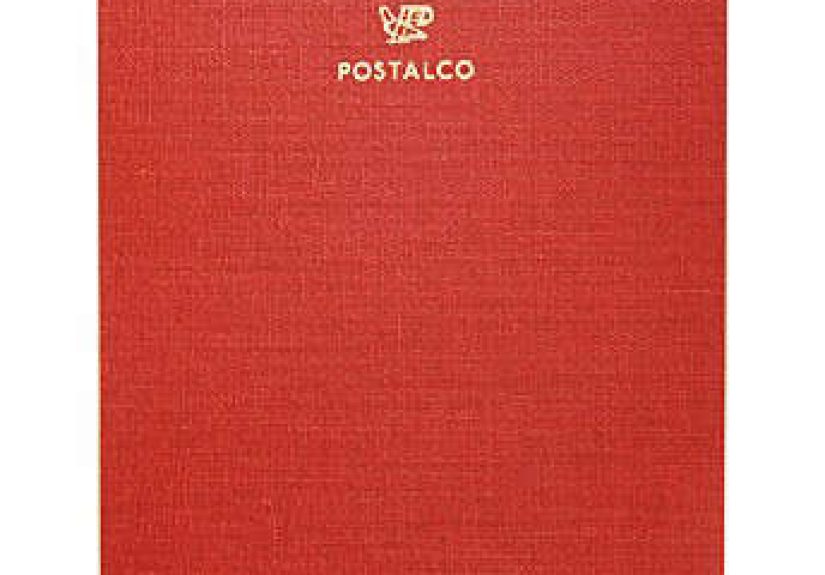
Postalco goes the other direction: the Medium notebook’s cover uses a starch-pressed cotton surface bonded to sturdy backing.
The result is tactile and understated, with a texture that becomes more noticeable over time.
The fabric is typically described as water-resistant, which is a small feature with huge real-life consequences.
You’re not buying a submarine, but you are buying timetime to rescue your notes if your iced coffee sweats all over your bag, or your weather app lies again.
And here’s the part stationery folks love: the cover is meant to change.
Colors can gently lighten, the weave can show more, and the notebook starts to look like it belongs to you instead of a display shelf.
It’s not “keep it perfect” energy. It’s “use it daily” energy.
Spiral binding done right (a small miracle)
Spiral notebooks have one job: stay out of your way.
Postalco’s approach is reporter-pad practicaleasy to open flat, easy to fold back, easy to write on whether you’re at a desk, standing at a counter,
or balancing your life choices on your knee in a coffee shop.
Many descriptions highlight thoughtful details like the ability to label the spine and design choices that keep the notebook comfortable in both portrait and landscape use.
The corners are often slightly angled, which sounds like a tiny aesthetic flourish until you realize it helps prevent dog-earing and keeps the notebook looking clean longer.
The paper: Pin-graph’s tiny 1mm grid (and why it matters)
Let’s talk about the star of the show: Pin-graph paper.
It’s a 1mm x 1mm grid printed in a soft bluefine enough to guide your writing and layouts without screaming “MATH HOMEWORK!”
The grid is especially useful because it doesn’t dictate how you work.
Want tidy lines? The grid supports that. Want sketches? It’s there as a gentle guide.
Want chaotic brainstorming with arrows, boxes, and one random doodle of a sad croissant? The notebook will not judge you.
For writing (fast notes, clean pages)
The tiny grid helps keep writing straight without the heavy visual weight of ruled lines.
If you take meeting notes, interview notes, or class notes, you’ll appreciate how quickly the page organizes itself.
It’s also great for listsespecially the kind that evolve from “Buy milk” into “Rebuild my entire personality.”
For sketching and diagrams (quiet structure)
The 1mm grid is a secret weapon for quick diagrams: floor plans, wireframes, design layouts, seating charts, flowcharts, and “here’s how this project is supposed to work”
drawings you make for your future selfwho, historically, is not great at remembering what past-you meant.
For pens (including fountain pens)
Paper feel matters. Many retailers describe Postalco’s paper as lightly textured with a thickness intended to reduce show-through in normal use.
In everyday terms: it tends to feel controlled and stable under the pen, not slick like cheap copy paper.
If you use fountain pens, you’ll likely find it behaves well with many inks, especially in fine and medium nibs.
Very wet inks or broad nibs can test any notebook, so consider a quick pen test on a back page if you’re particular (and if you’re reading this, you are).
How “Medium” fits into real life
The Medium size is a practical “carry it often” format.
It’s not tiny-pocket small, but it’s comfortable in a jacket pocket, tote, backpack, or the mysterious “bag within the bag” where chargers go to hibernate.
It’s also a sweet spot for real writing sessions.
You can use it as a daily notebook without feeling cramped, and you can still finish one without it turning into a multi-year emotional commitment.
What the Postalco Medium notebook is best at
This notebook shines when you want flexibility plus structure:
- Everyday carry notes: quick ideas, calls, reminders, “ask the mechanic about the noise”
- Work notes: meeting minutes, to-dos, client details, project sketches
- Creative planning: story outlines, recipe testing, songwriting notes, design concepts
- Sketch + text pages: because the grid supports both without forcing you to pick a side
- Travel logs: maps, lists, tiny itineraries, and the name of that place you swear you’ll remember
It’s also a great “thinking notebook”the one you reach for when you don’t need a system, you just need a page that feels like it’s on your side.
Who should buy it (and who should pass)
Buy it if…
- You want a premium Japanese stationery notebook that’s built to be used hard, not kept pristine.
- You like grid paper but hate bold, high-contrast grids.
- You want a notebook that opens flat and doesn’t fight your hand while writing.
- You appreciate materials that age and develop character over time.
Maybe skip it if…
- You strongly prefer lined pages for long-form journaling.
- You want ultra-white, ultra-smooth paper with no texture at all.
- You need a large-format notebook for heavy sketching or full-page layouts (Postalco’s larger sizes may suit you better).
Practical tips to get the most out of it
- Use the fold-over advantage: When space is tight, fold it back like a reporter’s pad and write one-handed.
- Try landscape mode: The grid makes horizontal use feel naturalgreat for timelines and lists.
- Let the cover evolve: Don’t panic when it lightens or shows texture; that’s the point.
- Pair it with one reliable pen: A simple “notebook + pen” combo you trust is how you actually keep using it.
500-word experience: living with the Postalco Notebook (Medium)
The first week with the Postalco Medium notebook is basically a honeymoon, but a calm onelike dating someone who owns a toolkit and remembers birthdays without making it weird.
You notice the cover immediately. It doesn’t feel like plastic pretending to be fancy; it feels like fabric that expects a real life.
The texture is subtle, but it has grip, which matters more than you’d think when you’re pulling it out of a bag with one hand while the other hand is juggling a phone, keys, and whatever snack you told yourself you wouldn’t buy.
Then the spiral binding starts winning you over. The notebook opens flat without the dramatic spine-cracking ritual.
You can fold it back and write standing up at the kitchen counterwhere all important decisions happen, like “Do we have garlic?” and “Why did I say yes to that meeting?”
It’s the kind of notebook you actually use because it removes friction instead of adding it.
The paper is where things get a little addictive. That 1mm Pin-graph grid is the stationery equivalent of background music: supportive, never bossy.
It keeps your handwriting from drifting into a sad diagonal, and it makes quick diagrams look like you meant to do that.
I used it for a grocery list once, then accidentally turned the next page into a mini floor plan because I started thinking about rearranging a workspace.
(This is how it begins. First a list. Next thing you know, you’re measuring shelves and calling it “a weekend project.”)
In work mode, the Postalco Medium becomes a “capture device.” You don’t open it to write beautifully; you open it to think clearly.
Meeting notes, action items, little boxes next to taskseverything feels tidy because the grid makes structure effortless.
Even when your notes are messy (and they will be), the page doesn’t look chaotic.
It looks like a person in motionsomeone collecting thoughts before they evaporate.
In creative mode, it’s surprisingly forgiving. The light texture gives pencil a little bite.
Pen lines feel controlled. You can sketch a layout, add notes, cross things out, circle them again, and the notebook doesn’t act like you ruined it.
It’s not precious. It’s useful. There’s a difference.
And the best part is what happens over time: the cover starts to change.
Corners soften. The fabric looks a little more lived-in.
It becomes your notebook, not just a product.
Eventually you stop thinking about it at alland that’s the highest compliment.
A great notebook doesn’t demand attention. It quietly makes you the kind of person who writes things down.
Final thoughts
The Postalco Notebook (Medium) is a rare blend: minimal but warm, premium but practical, structured but flexible.
Between the water-resistant pressed cotton cover, the smart spiral binding, and the tiny Pin-graph grid that works for both writing and drawing,
it earns its place as a daily companion.
If you want a notebook that feels good in your hands and makes it easier to think on paperwithout turning your life into a color-coded performance
this one is a seriously satisfying choice.