Table of Contents >> Show >> Hide
- Why the Dishwasher Safe Icon Matters More Than People Think
- Is There One Official Dishwasher Safe Symbol?
- Common Dishware Symbols and What They Usually Mean
- How to Read Dishware Symbols Without Guessing
- Examples That Show Why Symbols Matter
- Common Mistakes People Make With the Dishwasher Safe Icon
- Final Takeaway
- Kitchen Lessons From Real-Life Dishwasher Safe Disasters and Wins
If you have ever stood in your kitchen holding a plastic lid in one hand and a glass container in the other, wondering whether the dishwasher is about to clean your life or ruin it, welcome. You are among friends. The dishwasher safe icon looks like it should be easy to decode, but in real life, dishware symbols can feel like tiny hieroglyphics designed by a very confident raccoon.
This guide breaks down what the dishwasher safe symbol usually means, why it is not always as universal as people think, and how to read other common dishware symbols like microwave safe, freezer safe, oven safe, food safe, and BPA-free. Along the way, we will talk about materials, top-rack-only warnings, brand differences, and the kind of kitchen mistakes that turn a normal Tuesday into “Why is my lid shaped like modern art?”
The goal is simple: help you read labels like a pro, protect your favorite dishes, and stop guessing. Because while your dishwasher is powerful, it is not a mind reader. And unfortunately, neither is that lonely little icon on the bottom of your bowl.
Why the Dishwasher Safe Icon Matters More Than People Think
Many shoppers assume dishware symbols are just nice little extras on packaging. They are not. They are care instructions in miniature. When you understand them, you save money, extend the life of your kitchenware, and avoid a surprising number of annoyances, including warped plastic, dulled finishes, faded patterns, cracked glass, and the special heartbreak of discovering that your “microwave safe” lid was never meant for the oven.
The dishwasher safe icon matters because dishwashers combine heat, water pressure, and detergent. That mix is fantastic for cleaning yesterday’s lasagna pan, but not every material enjoys the experience. Some products can handle the full cycle. Others are only safe on the top rack. Some lids can survive a wash but not a heated dry setting. And some items should stay far away from the dishwasher no matter how badly you want to outsource the cleanup.
This is why symbols should never be treated as decoration. They are really a shortcut to the product’s use-and-care rules. Ignore them, and your dishware may not break immediately, but it may age faster, discolor, or lose the features that made it useful in the first place.
Is There One Official Dishwasher Safe Symbol?
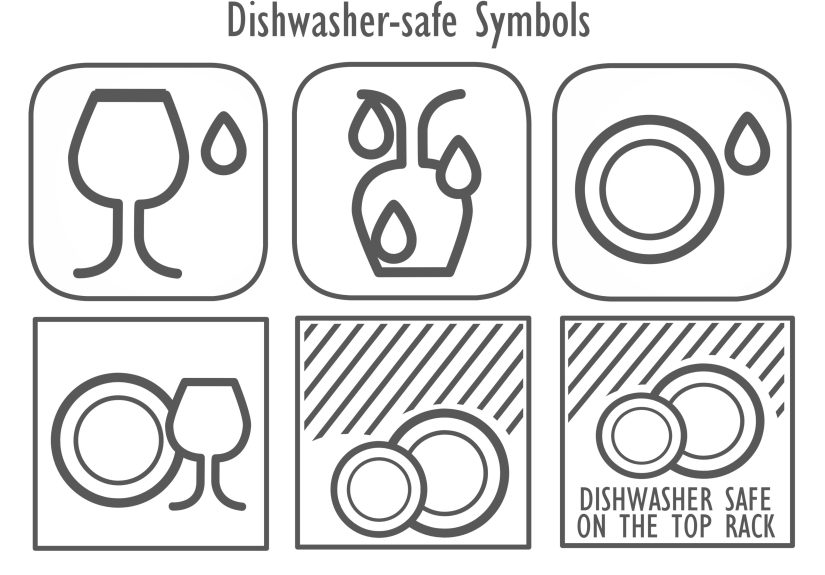
Here is the most important truth in this whole guide: there is not one universal, legally standardized dishwasher safe icon that appears on every product. That surprises a lot of people. We tend to act as though the symbol is as fixed as a stop sign, but manufacturers often use different pictograms, different wording, or both.
In other words, you may see dishes under water drops, plates inside a rack outline, cups with spray lines, or plain text that simply says “dishwasher safe.” You may also see added instructions such as top rack only, no heated dry, or lids top rack only. These details are not fussy little footnotes. They are the difference between “everything came out sparkling” and “why does this lid look emotionally exhausted?”
Because the symbol is not universal, smart readers do three things. First, they look for the icon. Second, they read any accompanying words. Third, they check the care note for the material itself. Glass, stoneware, plastic, silicone, bamboo, wood, melamine, and coated metals all behave differently under heat and detergent.
So if you remember only one lesson, make it this: the dishwasher safe icon is a helpful clue, not a magical one-size-fits-all promise. Context matters.
What “Top Rack Only” Actually Means
When a product says top rack only, it is telling you that the item is more heat-sensitive than fully dishwasher-safe pieces. On many traditional dishwashers, the bottom area is closer to the heated dry element or stronger heat exposure. That makes the upper rack the safer zone for lightweight plastics, lids, and other items that can warp or soften.
Top-rack-only items are not weak. They just have boundaries, and honestly, don’t we all? Respecting that label can mean the difference between years of use and a container lid that suddenly fits nothing in your kitchen except regret.
Common Dishware Symbols and What They Usually Mean
The dishwasher safe symbol meaning becomes much clearer when you compare it with other common care marks. Most brands use a family of symbols rather than one isolated icon. Here is how to think about the ones you are most likely to see.
Dishwasher Safe
This symbol or label generally means the item can tolerate dishwasher conditions without major damage when used as directed. That includes hot water, detergent, and spray pressure. But it does not always mean every part of the item is equally safe. A glass base may be fully dishwasher-safe while the lid is top-rack only. A ceramic plate may be dishwasher-safe, but a metallic trim may fade over time. Always check whether the label applies to the whole product or only part of it.
Top Rack Only
This is a variation, not a separate lifestyle. It usually appears on plastic lids, food containers, baby feeding accessories, some blender parts, and lighter materials. The product can go into the dishwasher, but only in the upper rack. Translation: “I enjoy cleanliness, not extreme heat.”
Microwave Safe
This symbol means the item can generally be used in the microwave, but the fine print matters. Some products are only safe for reheating, not long cooking sessions. Some lids must be vented or removed slightly to prevent warping or pressure buildup. And some containers may have microwave-safe bases while the lid has its own separate rules.
That is why “microwave safe” should never be read as “do absolutely whatever you want.” It means use the microwave according to the product’s instructions, not as an invitation to recreate a chemistry experiment.
Oven Safe
Oven safe is one of the most misunderstood dishware symbols. It does not always apply to the full product, and it rarely means all oven situations are fair game. A glass base may be oven-safe to a specific temperature, but the plastic lid may not be. A plate may survive a standard oven but not a broiler, toaster oven, stovetop, or sudden temperature swing.
This is where readers get into trouble by assuming that strong-looking equals oven-safe. That handsome dish may be dishwasher-safe and microwave-safe while still being absolutely not okay under a broiler. Kitchen confidence is wonderful, but packaging should win every argument.
Freezer Safe
A freezer safe symbol usually means the material can handle freezing conditions without cracking or becoming unusable under normal storage. But freezer-safe does not automatically mean it can go straight from freezer to oven. Thermal shock is real, and glass does not care that you are in a hurry.
If you see a product marked freezer-safe and oven-safe, read the instructions carefully. Some products are designed for that transition under certain conditions. Others are not. A symbol tells you the category; the care note tells you the limits.
Food Safe
A food safe mark means the material is intended for contact with food. This matters, but it is different from dishwasher safety. A product can be safe for food contact and still require hand washing. Likewise, a certification mark about material safety is not the same thing as a care icon about washing, heating, or freezing.
This is a key distinction. Consumers often treat all safety-related markings as interchangeable. They are not. Food-safe tells you about contact suitability. Dishwasher-safe tells you about cleaning conditions. One does not automatically grant the other.
BPA-Free
BPA-free is another common label that gets mixed up with care instructions. It refers to the absence of bisphenol A in the product material. Useful? Yes. Equivalent to dishwasher-safe? No. Equivalent to microwave-safe? Also no. BPA-free is about material composition, not how the item should be washed or heated.
Think of it this way: BPA-free answers “what is this made without?” Dishwasher-safe answers “how can I clean it?” Microwave-safe answers “can I heat food in it this way?” Three different questions, three different labels.
The Recycling Triangle
The recycling triangle may appear on plastic containers, and it often causes confusion. People see the triangle and assume it doubles as a kitchen care symbol. It does not. It identifies the type of plastic for recycling purposes, not whether the item is automatically dishwasher-safe, microwave-safe, or suitable for high heat.
If a container has a recycling code but no care instructions, do not invent good news. Look for the actual use-and-care guidance from the manufacturer. Optimism is great in relationships and sports. It is less useful when your lunch container is one cycle away from becoming abstract sculpture.
How to Read Dishware Symbols Without Guessing
If you want the easiest method for decoding dishware symbols, use this five-step approach.
Step one: identify the material. Is it glass, ceramic, stoneware, stainless steel, plastic, silicone, wood, or mixed-material? Material tells you the likely risk areas.
Step two: look for the care family, not just one mark. Dishwasher-safe, microwave-safe, freezer-safe, and oven-safe often appear together. Read them as a set.
Step three: check whether different parts have different rules. Bases, lids, seals, handles, decorative coatings, and trims may each have their own instructions.
Step four: watch for qualifiers like top rack only, reheating only, vent lid, not for broiler, or not for stovetop. These little phrases are the real bosses.
Step five: when the label is unclear, choose the gentler option. Hand wash it. Yes, this is less exciting. No, it does not make for a dramatic story. But it does preserve your dishes.
Examples That Show Why Symbols Matter
Let’s make this practical. Imagine a glass food storage container with a plastic lid. The base may be dishwasher-safe, freezer-safe, and oven-safe to a certain temperature. The lid may be dishwasher-safe too, but only on the top rack, and only vented during microwave reheating. If you treat the whole product as one giant yes, you miss the nuance and shorten the life of the lid.
Now imagine a lightweight plastic meal prep container. It may be top-rack dishwasher-safe and microwave-safe for reheating, but not intended for high-heat cooking or lower-rack washing. Still useful? Absolutely. Just not indestructible.
Or consider dinnerware lines from the same brand. One collection may be dishwasher-safe, microwave-safe, and freezer-safe but not oven-safe, while another line from that same company may be oven-safe up to a stated temperature. This is why reading the product-specific label matters more than trusting the brand name alone.
Common Mistakes People Make With the Dishwasher Safe Icon
Mistake 1: Assuming all plastic is dishwasher safe
It is not. Some plastic items are fully dishwasher-safe, some are top-rack only, and some should be hand washed. Never let “it looks sturdy” become your official testing method.
Mistake 2: Treating all symbols like universal standards
Many symbols are common, but not all are universal. Wording, icons, and restrictions vary by manufacturer. Read the full care language whenever possible.
Mistake 3: Forgetting that lids have separate rules
The base and lid are often living two different lives. Glass bases may handle ovens; lids usually do not. Lids may be top-rack-only, microwave-safe only when vented, or hand wash only.
Mistake 4: Confusing food-safe with dishwasher-safe
A product can be approved for food contact and still need hand washing. Material safety and care instructions are related, but not interchangeable.
Mistake 5: Ignoring heat settings
Even a dishwasher-safe item may last longer if you avoid aggressive heated-dry cycles when the manufacturer recommends it. Longevity loves moderation.
Final Takeaway
The dishwasher safe icon is helpful, but it is not a magic stamp that means every cycle, every rack, every temperature, and every accessory is fair game. The smartest way to read dishware symbols is to combine the icon with the words around it, the material of the product, and any instructions for lids, seals, or decorative finishes.
If you do that, you will make better buying decisions, keep your containers and dinnerware looking good longer, and avoid the classic household mystery of how one innocent wash turned a perfectly normal lid into something that now resembles a potato chip. In the world of kitchen care, a tiny symbol can save a lot of trouble.
Kitchen Lessons From Real-Life Dishwasher Safe Disasters and Wins
I learned more about the dishwasher safe symbol meaning the same way many people do: by being overly confident in a kitchen while half-awake. Years ago, I tossed a full set of food containers into the dishwasher because they all looked similar. Same shape, same size, same “surely this is fine” energy. The glass bases came out perfect. The lids, however, looked like they had been through a small emotional crisis. A few had warped just enough to stop sealing properly. One curled at the edge like it had opinions. That was the day I learned that a container is not one item. It is a team of parts, and every part has feelings.
Another lesson came from dinner plates. A relative of mine had a beautiful set that went into the dishwasher for years with no problem. So naturally, everyone assumed the matching serving pieces were also safe in exactly the same way. They were not. The decorative finish dulled, and the shine never really came back. Nothing exploded. No dramatic movie scene. Just a slow, annoying decline that could have been avoided if anyone had checked the actual care instructions.
On the happier side, learning to read dishware symbols properly has saved me time, money, and cabinet chaos. Once I started paying attention to labels like top rack only, microwave-safe for reheating, and oven-safe base, my kitchen started making a lot more sense. I stopped using the dishwasher as a gamble machine. Meal prep got easier because I knew which containers could go from fridge to microwave and which ones needed gentler treatment. Cleanup became less dramatic, which is not glamorous, but it is deeply satisfying.
I have also become that person who flips a mug, bowl, or storage container over in the store to inspect the bottom. Not because I enjoy decoding tiny symbols under bad lighting, but because it is cheaper than replacing things. The difference between a smart purchase and an annoying one often comes down to a few words: dishwasher-safe, hand wash only, or top-rack only. Tiny labels, big consequences.
The funniest part is that once you understand these symbols, you start seeing kitchen mistakes before they happen. You watch someone put a wooden lid in the dishwasher and want to tackle them in slow motion. You see a plastic vent lid headed for a hot oven and suddenly become a public service announcement. You spot a recycling triangle and know it is not a golden ticket to every appliance in the room. Knowledge changes a person.
So yes, the topic sounds small. It is just the dishwasher safe icon, right? But in real kitchens, these symbols quietly shape how long your dishware lasts, how well it performs, and how often you end up muttering at a sink. Once you learn them, you stop guessing. And that is the real win. Clean dishes are nice. Confidence is better.