Table of Contents >> Show >> Hide
- What Are Steam Trading Cards?
- How to Get Steam Trading Cards
- How Card Drops Work
- Do Free-to-Play Games Drop Steam Trading Cards?
- What Are Steam Badges?
- What Is the Point of Steam Level?
- Can You Make Money With Steam Trading Cards?
- Best Strategy: Craft, Trade, or Sell?
- How to Avoid Steam Trading Card Mistakes
- Safe Ways to Trade Steam Cards
- How to Find Games With Trading Cards
- Do Steam Achievements Affect Trading Card Drops?
- Extra Experience: What Getting Steam Trading Cards Feels Like in Practice
- Conclusion
Steam Trading Cards are one of those tiny digital collectibles that look harmless at first. Then one day you open your inventory, see a pile of cards from games you forgot you owned, and suddenly you are asking deep financial questions like, “Should I sell this for seven cents or craft a badge and become a person of culture?” Welcome to the wonderfully weird economy of Steam Trading Cards.
This guide explains exactly how to get Steam Trading Cards, how card drops work, how booster packs appear, what badges do, whether free-to-play games count, how to trade safely, and what you should actually do with the cards once they land in your inventory. No magic, no shady tricks, no “download this suspicious tool from a forum with twelve pop-ups.” Just the real system, explained in plain American English.
What Are Steam Trading Cards?
Steam Trading Cards are collectible digital cards connected to certain games on Steam. When you collect a full set for a game, you can craft that set into a badge. Crafting a badge gives you Steam XP and usually rewards profile-related items such as an emoticon, a profile background, and sometimes a discount coupon.
They do not improve your gameplay. They will not make your aim better in a shooter, your farm more profitable in a cozy sim, or your teammates less likely to blame you for everything. Steam Trading Cards are mainly about collecting, customizing your profile, leveling your Steam account, trading with other users, and occasionally earning a few cents through the Community Market.
How to Get Steam Trading Cards
There are several legitimate ways to get Steam Trading Cards. The most common method is simple: play a participating game. Not every Steam game has trading cards, but many do. If a game supports cards, Steam may drop cards into your inventory while you play.
1. Play Games That Support Trading Cards
The easiest way to get Steam Trading Cards is to play games that include trading card support. As you spend time in the game, Steam occasionally gives you card drops. These drops appear in your Steam Inventory automatically.
To check whether a game has trading cards, visit the game’s Steam store page and look at the feature list. You can also go to your Steam profile, open the “Badges” section, and review which games have card drops available. If Steam says you have card drops remaining for a game, that game can still give you cards through playtime.
2. Check Your Badges Page
Your Badges page is the control center for Steam Trading Cards. It shows which games have cards, how many card drops you have already earned, how many drops remain, and whether you are eligible for booster packs.
To find it, open Steam, hover over your profile name, and select “Badges.” From there, you can click each game badge to see your progress. Steam will show the cards you own, the cards you still need, and whether friends have cards that could help you complete the set.
3. Trade With Other Steam Users
Most games only drop about half of a full card set through playtime. That means you usually cannot complete a badge from drops alone. To finish the set, you need to trade with friends, trade with other Steam users, or buy missing cards from the Community Market.
Trading can be the cheapest route if you have duplicate cards. For example, suppose a game has eight cards in the set. You play long enough to receive four drops, but two of them are duplicates. You can trade your duplicate card for one you are missing. This is the Steam version of swapping lunch-table stickers, except nobody is physically blocking the cafeteria line.
4. Buy Cards on the Steam Community Market
The Steam Community Market lets users buy and sell eligible Steam items, including many trading cards. If you are only missing one or two cards from a set, buying them may be faster than waiting for a trade.
Prices vary. Some cards cost only a few cents. Others cost more because the game is old, the card supply is low, the badge is popular, or collectors have decided that today is the day a cartoon goblin card becomes an investment vehicle. Before buying, compare current listings and buy orders. A little patience can save money, especially during major Steam sales when many users are listing cards at once.
5. Open Booster Packs
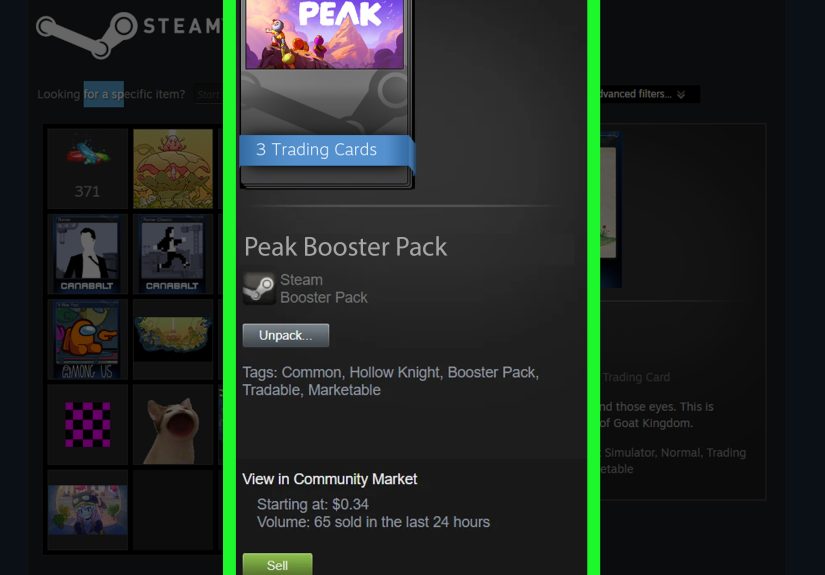
Once you have earned all available card drops from a game, you may become eligible for a booster pack for that game. A booster pack contains three random cards and can include regular or foil cards.
Booster packs are granted randomly to eligible users when members of the Steam community craft badges. Your Steam Level can increase your booster pack drop rate. For example, higher Steam Levels improve the rate at which you may receive booster packs, although receiving one is still not guaranteed. You also need to log in to Steam regularly to maintain eligibility.
6. Use Gems to Create Booster Packs
Steam also has a gem system. Some Steam inventory items can be turned into gems, and gems can be used to create booster packs for eligible games. This is useful when a game’s cards are scarce or expensive, but it is not always the best financial move.
Before using gems, compare the cost of creating a booster pack with the cost of buying the exact cards you need. If the badge needs only one missing card, buying that card directly may be smarter than creating a booster pack and hoping the Steam gods are in a generous mood.
How Card Drops Work
Steam card drops are tied mainly to playtime, not achievements. You do not need to beat the final boss, unlock every secret ending, or perform a perfect backflip while holding a controller. If the game supports trading cards and you have drops remaining, playing the game is what matters.
Most participating games drop a number of cards equal to about half the size of the full set. If a game has ten cards in its set, you may receive around five card drops from playtime. To complete the rest, you will need trading, buying, or booster packs.
Do Free-to-Play Games Drop Steam Trading Cards?
Yes, but free-to-play games work differently. For free-to-play games, card drops are usually based on eligible in-game spending. Steam’s system generally grants card drops based on approximately every $9 spent in that game. This means simply installing a free-to-play game does not automatically create endless trading card drops.
That rule exists for a good reason. Without it, people could create mountains of free accounts, idle free games, and flood the market with cards. Steam’s system is designed to keep trading cards connected to actual account activity and purchases.
What Are Steam Badges?
A Steam badge is a profile item created by collecting a full set of trading cards for a game. When you craft a badge, Steam consumes the card set and gives you rewards. Most game badges provide 100 XP, which helps increase your Steam Level.
Crafting a badge can also reward a profile background, an emoticon, and sometimes a discount coupon. These rewards are often themed around the game. Some are genuinely cool. Some look like they were designed by a wizard trapped in a 2007 forum signature. Both kinds have their fans.
Can You Upgrade a Badge?
Yes. Many regular game badges can be crafted up to five times. Each time you craft another full set for the same game, the badge upgrades and you earn more XP. There are also foil badges, which require a complete set of foil cards. Foil cards are rarer and usually more expensive, but foil badges do not provide special gameplay benefits. They are mostly for collectors and profile flexing.
What Is the Point of Steam Level?
Your Steam Level is connected to your profile XP. Higher levels can unlock more profile customization options, including showcases. They can also increase your friend list limit. For collectors, Steam Level is part trophy case, part hobby, part “I have spent too much time organizing tiny rectangles.”
Steam Level also affects booster pack drop rate once you are eligible. Every ten levels improves your booster pack drop rate, so users who craft many badges and maintain higher levels have better odds than brand-new accounts. However, booster packs are still random. A high level improves the rate; it does not install a booster pack vending machine in your inventory.
Can You Make Money With Steam Trading Cards?
Technically, yes. Realistically, do not expect to fund your retirement with cards worth three to eight cents. Many Steam Trading Cards can be sold on the Community Market for small amounts of Steam Wallet funds. If you have a large library with many unused card drops, the total can add up over time.
Steam Wallet funds can usually be used toward games, software, in-game items, and other Steam purchases. They are not the same as withdrawing cash to your bank account. Think of selling trading cards as turning digital clutter into small Steam discounts. It is less “get rich quick” and more “my next indie game is now 14% cheaper.”
Best Strategy: Craft, Trade, or Sell?
The best choice depends on your goal. If you want a higher Steam Level, craft badges. If you want specific profile backgrounds or emoticons, crafting may be worth it. If you do not care about badges, sell your cards and use the Steam Wallet funds later.
If you are close to completing a set, check the card prices before making a decision. Sometimes finishing a badge costs only a few cents. Other times, the missing cards are weirdly expensive because the game is old, removed, unpopular, or owned by twelve people and a confused raccoon.
A Simple Decision Rule
If the full set is cheap and you like the game, craft the badge. If the missing cards are expensive and you do not care about the badge, sell your cards. If you have duplicates and friends who collect, trade first. Trading often gives the best value because you avoid market fees and can help someone else complete a set too.
How to Avoid Steam Trading Card Mistakes
Steam Trading Cards are simple, but users still make common mistakes. The biggest one is buying cards without checking the full badge cost. A card that costs five cents is harmless. A badge that needs fifteen cards, five levels, and multiple expensive missing pieces can quietly become a tiny luxury hobby wearing a cheap hat.
Another mistake is accepting bad trades. Steam trades are final, so review every trade carefully before confirming. Do not trade for promises, external payments, gift cards, or anything outside Steam’s official trading interface. If someone says, “Trust me bro,” that is not a payment method. That is a siren with a keyboard.
Safe Ways to Trade Steam Cards
Use Steam’s official trade system. Check the items in the trade window. Confirm that you are receiving the correct cards. Be careful with users who pressure you to hurry. Scammers love urgency because panic is cheaper than skill.
Also watch out for impersonators. Some scammers copy profile names, avatars, or descriptions to look like trusted users. If a trade seems suspicious, cancel it. No trading card is worth losing valuable inventory items or access to your account.
How to Find Games With Trading Cards
You can find games with trading cards by checking the Steam store feature tags or browsing your Badges page. When shopping during a Steam sale, look at the right side of a game’s store listing for supported features. “Steam Trading Cards” will appear if the game includes them.
However, do not buy games only for cards unless the math makes sense. Most card drops are worth very little. Buying a $19.99 game to receive four cards worth $0.04 each is not strategy; it is comedy with a receipt. Buy games because you want to play them. Treat the cards as a bonus.
Do Steam Achievements Affect Trading Card Drops?
No, Steam Trading Card drops are not based on achievements. You can unlock zero achievements and still receive card drops if the game supports them and you have drops remaining. You can also unlock every achievement and receive no more cards if your drops are already exhausted.
This is useful because it keeps card collecting separate from achievement hunting. Achievement hunters can chase difficult goals, while card collectors can focus on badges, trades, and the market. Everyone gets their own flavor of digital obsession.
Extra Experience: What Getting Steam Trading Cards Feels Like in Practice
In practice, getting Steam Trading Cards is less like opening treasure chests and more like cleaning your desk and finding coins under old receipts. The first pleasant surprise usually happens when you visit your Badges page after owning Steam for a while. Suddenly, you notice several games with card drops remaining. Some may be games you played years ago. Others may be titles you bought in a bundle during a sale and then forgot so completely that seeing them feels like receiving mail from a past version of yourself.
A good routine is to start with games you already enjoy. Play normally, check your card drops afterward, and see what appears in your inventory. This keeps the process fun instead of turning your library into a spreadsheet with sound effects. If you are trying to build your Steam Level, choose badges carefully. Some sets are cheap and easy to complete. Others cost more than expected because one or two cards are rare or barely listed on the market.
One useful experience-based tip is to avoid crafting badges instantly just because you can. First, check the reward value and the card value. Sometimes the cards sell for more than the profile item rewards are worth to you. Other times, the badge matters because you love the game and want it displayed on your profile. There is no universal best answer. A badge from your favorite game can feel more satisfying than a slightly larger Steam Wallet balance.
Another practical lesson: duplicate cards are not bad. New collectors often groan when they receive duplicates, but duplicates are trade fuel. If you have two copies of one card and a friend has the card you need, you can both win. Even if your friends are not collecting, duplicates can be sold on the market or saved for future trades.
Booster packs are exciting, but they should be treated as a bonus rather than a plan. You may become eligible for booster packs after earning all drops from a game, but eligibility does not mean one will arrive quickly. Some users receive booster packs occasionally; others wait a long time. Higher Steam Levels improve the drop rate, but randomness still rules the room like a cat sitting on a keyboard.
The Community Market is often the fastest path to finishing a badge. Still, patience helps. If you buy instantly from the lowest listing every time, you may overpay compared with placing buy orders. For cheap cards, the difference may be tiny, but collectors completing many badges can save noticeable amounts over time.
The best overall mindset is simple: use Steam Trading Cards as a light collecting hobby. They are fun, optional, and sometimes useful for profile customization. They are not a financial strategy, not a gameplay advantage, and not a reason to buy games you do not want. Enjoy the drops, trade smart, sell what you do not need, and craft badges that actually make your profile feel more like yours.
Conclusion
Steam Trading Cards are a small feature with a surprisingly deep ecosystem. You can get cards by playing participating games, trading with other users, buying cards from the Steam Community Market, opening booster packs, or creating booster packs with gems. Most games only drop about half a set through playtime, so completing badges usually requires collecting the rest through trades or purchases.
The smartest approach is to decide what you want before spending time or Steam Wallet funds. Want XP and profile customization? Craft badges. Want small wallet credit? Sell cards. Want to complete favorite game sets? Trade duplicates and buy missing pieces carefully. Above all, stay inside Steam’s official systems and avoid suspicious offers. Steam Trading Cards are supposed to be fun, not a side quest called “Recover My Account.”