Table of Contents >> Show >> Hide
- What Makes the Hemp House in Israel So Special?
- Understanding Hempcrete: The Star Material with a Funny Name
- Why Hemp Makes Sense for Sustainable Architecture
- The Israeli Climate Challenge: Heat, Sun, and Sea Breeze
- Design Details That Make the House Feel Human
- Energy Efficiency Without the Gadget Parade
- Water Systems: Rainwater, Graywater, and Practical Conservation
- Is Hempcrete Legal and Practical for Modern Homes?
- Benefits of an Eco House Built from Hemp
- Challenges and Limitations of Hempcrete Homes
- Lessons from the Hemp House in Ein Hod
- Could Hempcrete Homes Become More Common?
- 500-Word Experience Section: Living with the Idea of a Hemp House
- Conclusion: A Small House with a Big Green Message
Some houses are built to impress the neighbors. Others are built to impress the planet. The eco house built from hemp in Israel does both, while quietly asking concrete, “Have you considered taking a little vacation?” Located in Ein Hod, an artists’ village on Mount Carmel overlooking the Mediterranean, this remarkable home proves that sustainable architecture does not have to look like a science project wearing sandals. It can be elegant, practical, sunlit, breezy, and deeply connected to the land around it.
Designed by Tav Group, the house uses hempcrete, local stone, lime plaster, timber framing, solar power, rainwater collection, graywater reuse, and other low-impact strategies to create a home that feels less like an object dropped onto a hillside and more like something that grew there politely. The result is a warm, textured, energy-conscious residence that turns industrial hemp into a serious building material rather than a punchline.
And no, hempcrete is not the same as marijuana, and the walls are not “relaxing” in that way. Hempcrete is made from hemp hurds, the woody inner core of the industrial hemp stalk, mixed with lime and water. It is used as insulation and wall infill, not as a party favor. Its real magic is quieter: carbon storage, thermal performance, humidity regulation, and a lower environmental footprint than many conventional materials.
What Makes the Hemp House in Israel So Special?
The Ein Hod hemp house stands out because it combines modern ecological design with ancient common sense. Before buildings became a contest to see how much concrete, steel, plastic, and air conditioning one family could fit into a mortgage, people built with what was nearby. Stone, earth, lime, timber, shade, ventilation, and smart orientation were not trends. They were survival tools.
This home brings those ideas back, but with a contemporary twist. Its lower level uses local stone, including material from the site itself. The main living floor uses hemp-lime walls cast within a timber frame. Interior partitions made with earth-based materials add thermal mass. Lime plaster and natural pigments finish the walls, giving the interiors a soft, organic texture that looks refined without feeling fussy.
The house also uses solar panels to generate electricity and is designed to reduce dependence on mechanical cooling. In a Mediterranean climate where summer heat can become very enthusiastic, that matters. The home’s layout captures sea breezes, while its thick natural walls help stabilize indoor temperatures. In other words, the building does not simply sit there waiting for the air conditioner to rescue it. It participates.
Understanding Hempcrete: The Star Material with a Funny Name
Hempcrete sounds like something invented by a contractor with a gardening hobby, but it is a real biocomposite building material. It is typically made from three main ingredients: hemp hurd, lime-based binder, and water. Once mixed, it can be packed or cast into wall cavities, formed into blocks, or used in prefabricated panels depending on the project.
Hempcrete Is Not Structural Concrete
Here is the first important clarification: hempcrete does not replace reinforced concrete in every situation. It is not usually used as a load-bearing material. A hempcrete wall still needs a structural frame, commonly timber, steel, or another engineered system. The hemp-lime mixture acts mainly as insulating wall infill, helping with thermal comfort, moisture balance, and acoustic softness.
That distinction matters because “hemp concrete” can make people imagine a skyscraper made of garden mulch and optimism. Not quite. Think of hempcrete less as the skeleton of the building and more as the breathable, insulating jacket wrapped around the skeleton. A very clever jacket, admittedly.
Why Builders Like Hemp-Lime Walls
Hemp-lime walls are valued because they combine several benefits in one material. They can provide insulation, thermal mass, vapor permeability, and carbon storage. They are also relatively lightweight compared with masonry and can help create interiors that feel calm and comfortable. Because lime is alkaline, hempcrete can also resist mold growth when properly designed and detailed.
Another advantage is breathability. In building science, “breathable” does not mean the wall is taking yoga classes. It means the material can manage moisture vapor rather than trapping it in ways that may cause condensation problems. In climates with humidity swings, that can help make indoor spaces feel more balanced.
Why Hemp Makes Sense for Sustainable Architecture
The construction industry has a carbon problem. Cement, steel, insulation foams, synthetic finishes, long-distance transport, demolition waste, and constant energy use all contribute to the footprint of modern buildings. A green home cannot solve the entire climate puzzle by itself, but material choices can make a meaningful difference.
Industrial hemp is attractive because it grows quickly and absorbs carbon dioxide during cultivation. When the woody core becomes part of a wall system, some of that biogenic carbon remains stored in the building. Lime binders also carbonate over time, meaning they absorb some carbon dioxide as they cure. The exact carbon balance depends on the formula, sourcing, transport, binder type, and construction method, but hempcrete is widely studied as a low-carbon or potentially carbon-storing building material.
For the Ein Hod house, hempcrete was paired with other low-impact choices. Local stone reduced the need for imported heavy materials. Timber framing supported the hemp-lime infill. Lime plaster offered a natural finish. Solar power addressed operational energy. Rainwater and graywater systems reduced water waste. The project works because it is not depending on a single green trick. It is a whole basket of better decisions.
The Israeli Climate Challenge: Heat, Sun, and Sea Breeze
Building an eco house in Israel is not just about choosing photogenic materials. The climate has opinions. In many regions, hot summers, strong sun, dry periods, and seasonal moisture shifts require careful design. A sustainable home must handle heat without turning into a stylish oven.
The Ein Hod hemp house uses a climate-responsive approach. Its hillside location overlooking the Mediterranean allows the architecture to capture breezes. The thick hemp-lime and stone walls help slow heat transfer. Courtyards, shaded openings, and natural materials create a more comfortable indoor environment without requiring constant mechanical cooling.
This is where hempcrete becomes especially interesting. In hot climates, insulation alone is useful, but insulation paired with thermal mass can be even more effective when designed correctly. Thermal mass helps absorb and release heat gradually, smoothing out temperature swings. Hempcrete is not as dense as stone or concrete, but it offers a useful balance of insulation and mass. Add stone, earth partitions, shade, and airflow, and the building begins to behave like it understands the local weather instead of arguing with it.
Design Details That Make the House Feel Human
Sustainable homes sometimes get described only in performance numbers: R-values, carbon metrics, kilowatt-hours, embodied energy, and so on. Those are important, but people do not live inside spreadsheets. They live inside rooms, morning light, kitchen smells, muddy shoes, tired evenings, and the occasional chair that squeaks for no reason.
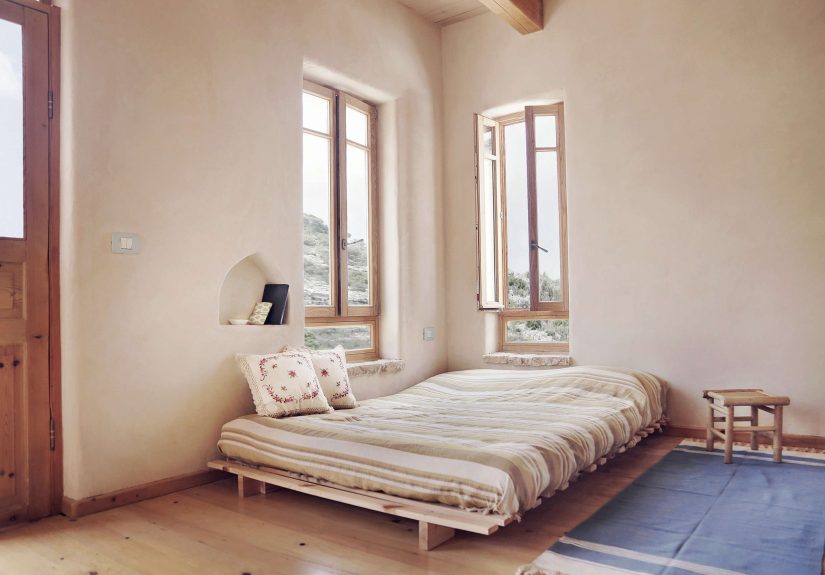
The hemp house in Ein Hod succeeds because its ecological features are integrated into a livable design. The home includes warm wood, lime-washed surfaces, natural pigments, built-in niches, stone textures, decks, and views toward the landscape. It has a grounded, handmade quality without feeling rustic in the “oops, we forgot comfort” sense.
Local Stone and Site Connection
Using stone from the site was more than an aesthetic decision. It reduced transport, respected the history of the hillside, and visually rooted the building in its surroundings. The stone base gives the home weight and permanence, while the hemp-lime upper walls add softness and insulation. It is a smart contrast: earth below, plant-based wall system above.
Natural Plasters and Healthy Interiors
Lime plaster and earth-based finishes help the interiors feel calm and breathable. Unlike many synthetic finishes, natural plasters can contribute to moisture regulation and reduce reliance on petrochemical-heavy materials. They also look beautiful in a way that does not require glossy perfection. Tiny variations, texture, and hand-finished surfaces become part of the charm.
Energy Efficiency Without the Gadget Parade
Many green homes get overloaded with gadgets, sensors, screens, smart systems, and enough blinking lights to make the living room look like a spaceship applying for a mortgage. The Ein Hod house shows another path: start with passive design, then add technology where it makes sense.
Solar panels provide renewable electricity. The house is designed to reduce energy demand before producing energy, which is exactly the right order. A poorly designed building with solar panels is like wearing a raincoat after jumping into a swimming pool. Helpful, but perhaps not the first strategy.
By using insulation, thermal mass, natural ventilation, orientation, and shading, the home reduces its need for heating and cooling. Then solar power helps cover the remaining demand. This layered approach is central to high-performance sustainable housing.
Water Systems: Rainwater, Graywater, and Practical Conservation
Water is another major part of the home’s ecological story. The house uses rainwater collection and graywater reuse, allowing water to serve more than one purpose before leaving the property. In a region where water conservation is a serious concern, these systems are not decorative eco-jewelry. They are practical.
Rainwater can be used for non-drinking purposes, while graywater from showers or sinks can support landscape irrigation when properly designed and permitted. Combined with gardens, citrus trees, and a more self-sufficient lifestyle, water reuse turns the home into a small ecosystem rather than a one-way consumption machine.
Is Hempcrete Legal and Practical for Modern Homes?
One of the biggest questions around hempcrete is not whether it works. The bigger question is whether codes, contractors, supply chains, insurers, and local officials are ready for it. In the United States, hemp-lime construction gained a major boost when it was added as an appendix in the 2024 International Residential Code. That does not automatically make every hempcrete project simple, because appendices often need local adoption, and engineered designs may still be required. But it gives builders and officials a clearer path.
For Israel and other countries, local rules, material availability, and professional experience matter. In the Ein Hod project, hemp reportedly had to be imported because local industrial hemp production was restricted at the time. That highlights a key challenge for sustainable building: a material is only as practical as its supply chain. If a project must import large volumes from far away, the environmental math becomes more complicated.
Still, pioneering projects are important. They teach builders, inspire clients, test details, and make unusual materials less mysterious. The first hemp house in a region may face raised eyebrows. The fifth may get curiosity. The fiftieth may get a contractor saying, “Sure, we’ve done that before.” That is how building culture changes.
Benefits of an Eco House Built from Hemp
Lower Embodied Carbon
Hempcrete can reduce the embodied carbon of wall assemblies because hemp stores carbon during growth and lime can absorb some carbon dioxide as it cures. The full calculation depends on the mix, transport, and binder, but compared with many conventional wall systems, hemp-lime construction has strong low-carbon potential.
Better Thermal Comfort
Hempcrete can help keep interiors cooler in summer and warmer in winter by slowing heat transfer and moderating temperature swings. In a Mediterranean setting, this can reduce the need for constant cooling and make rooms feel more stable throughout the day.
Moisture Regulation
Hemp-lime walls can absorb and release moisture vapor, helping create a more balanced indoor environment. Good detailing is still essential, especially around roofs, foundations, openings, and exterior finishes, but the material itself has helpful hygrothermal behavior.
Natural, Non-Toxic Feel
When paired with lime plaster, timber, stone, and earth-based finishes, hempcrete supports a low-toxicity interior environment. The result is not just green on paper, but pleasant in daily life. The walls feel warm, quiet, and soft rather than cold and sealed.
Design Character
Hempcrete encourages thick walls, deep window reveals, natural textures, and a slower visual rhythm. It is not the best material for every architectural style, but when used well, it gives a home a handmade dignity that modern construction often loses somewhere between the foam board and the vinyl trim.
Challenges and Limitations of Hempcrete Homes
Hempcrete is promising, but it is not magic dust. It needs knowledgeable design, careful moisture management, skilled installation, and appropriate structural support. Drying time can affect construction schedules, especially with site-cast hemp-lime walls. Material availability can also be an issue in regions without a mature hemp building industry.
Cost is another consideration. Early projects can be more expensive because contractors are learning, supply chains are young, and specialized materials may need to be imported. However, as local production grows and prefabricated hemp blocks or panels become more common, costs may become more competitive.
There is also the issue of perception. Some people hear “hemp house” and immediately imagine something unserious. That is changing as architects, engineers, researchers, and code officials treat hemp-lime construction as a legitimate building system. Still, education is part of every pioneering material’s journey. Bamboo, straw bale, rammed earth, and mass timber have all faced similar skepticism.
Lessons from the Hemp House in Ein Hod
The biggest lesson from the eco house built from hemp in Israel is that sustainable design works best when it is place-based. The home is not a generic green box with solar panels sprinkled on top. It responds to its site, climate, views, materials, and lifestyle.
It uses stone because stone belongs there. It uses hempcrete because insulation and carbon-conscious materials matter. It uses lime and earth because breathable finishes support comfort. It uses solar power because the sun is abundant. It uses water systems because conservation is practical. It uses breezes because free cooling is the best kind of cooling, mostly because it does not send a monthly bill.
For homeowners, designers, and builders, the project offers a clear message: eco-friendly construction is not about one heroic product. It is about systems thinking. Materials, energy, water, comfort, beauty, and daily habits all matter.
Could Hempcrete Homes Become More Common?
Yes, but not overnight. Hempcrete needs a stronger supply chain, more trained installers, more testing, more code adoption, and more public familiarity. The good news is that momentum is growing. In the U.S., hemp-lime construction is gaining recognition in residential code discussions. Companies are developing hemp blocks, insulation products, and prefabricated systems. Researchers continue to study thermal performance, carbon impact, moisture behavior, and durability.
As climate-conscious building becomes less of a niche and more of a necessity, materials like hempcrete may move from “interesting experiment” to “practical option.” The Ein Hod house is part of that shift. It shows that a hemp-based home can be beautiful, comfortable, and serious without losing its sense of warmth.
500-Word Experience Section: Living with the Idea of a Hemp House
Imagine walking into a hempcrete house after spending years in a typical apartment where the walls feel like they were designed by someone who disliked both sound and weather. The first thing you might notice is not a dramatic “wow” moment. It is quieter than that. The air feels steady. The walls seem to hold the room rather than merely divide it. Light lands softly on lime plaster. A window is open, and instead of the air conditioner roaring like a small aircraft, a breeze does the job with Mediterranean confidence.
That is the real experience behind an eco house built from hemp in Israel. It is not only about statistics. It is about the daily pleasure of a building that works with the climate instead of wrestling it into submission. In a conventional home, heat often sneaks through thin walls by noon, and by afternoon everyone is negotiating with the thermostat like diplomats at a climate summit. In a well-designed hemp-lime home, the temperature changes more slowly. The building gives you time. That may sound modest, but comfort is often made of modest things done very well.
The textures matter too. Natural materials have a way of making people touch the wall without realizing it. Lime plaster, stone, timber, and earth finishes do not shout. They hum. They show variation, shadow, and small imperfections that make a room feel lived in before the furniture even arrives. A hempcrete house has that quality. It does not feel manufactured in the glossy, sealed, wipe-clean sense. It feels crafted.
There is also a lifestyle shift. A house with rainwater collection, graywater reuse, solar power, gardens, and natural ventilation gently changes how people behave. You become more aware of where water goes. You notice when the breeze turns. You understand why shade matters. You begin to see the home as a partner rather than a machine. Of course, this can also mean more responsibility. Natural homes reward attention. Gutters, drainage, plaster, ventilation, and landscaping all need care. The house may be low-impact, but it is not no-maintenance. Nature is charming, but she still sends invoices in the form of leaves, dust, and seasonal repairs.
For families, the experience can be especially meaningful. Children growing up in a home like this learn that buildings are not just boxes plugged into power lines. They are made from fields, forests, quarries, hands, sun, rain, and design choices. That lesson is more powerful than any poster about sustainability. It is sustainability you can lean against while looking out at the sea.
The Ein Hod hemp house also suggests a broader emotional benefit: hope. Climate-conscious design can sometimes feel heavy, full of warnings and impossible numbers. But a beautiful hempcrete home offers a more inviting message. It says the future does not have to be uglier, colder, or less comfortable. It can be textured, bright, efficient, and deeply human. It can even have walls made from a plant that once suffered from bad public relations and is now quietly helping buildings behave better. Not a bad comeback story for a stalk.
Conclusion: A Small House with a Big Green Message
The eco house built from hemp in Israel is more than a memorable architectural headline. It is a practical example of how sustainable design can combine local materials, plant-based insulation, renewable energy, water conservation, and climate-smart planning. Tav Group’s project in Ein Hod proves that a low-impact home does not have to sacrifice beauty or comfort. In fact, the best ecological buildings often feel better because they are more connected to place, climate, and human experience.
Hempcrete is not a universal replacement for every building material, and it still faces challenges in cost, codes, supply, and construction knowledge. But as a wall system for insulation, moisture moderation, and carbon-conscious design, it has enormous promise. The Ein Hod house shows what happens when that promise is taken seriously: a home that is warm, breathable, efficient, and quietly radical.
If the future of housing is going to be greener, it will need more projects like this one. Not copy-paste versions, but homes that borrow the same wisdom: use what the place offers, reduce what the building demands, and choose materials that leave the world a little less bruised. Also, whenever possible, let the sea breeze do the heavy lifting. It has excellent references.
Note: This article is written as original web-ready content based on real information about the Ein Hod hempcrete house, hemp-lime construction, sustainable architecture, and current green building knowledge.