Table of Contents >> Show >> Hide
- What Does “GNU Radio Decodes Voyager Data” Actually Mean?
- Why Voyager’s Signal Is So Hard to Hear
- GNU Radio: The Open-Source Workbench for Signals
- The Role of the Green Bank Telescope and Breakthrough Listen
- Inside the Decoding Process
- Why This Matters Beyond a Cool Space Hack
- Voyager, Power, and the Race Against Time
- Lessons for Software-Defined Radio Enthusiasts
- Specific Example: From Telescope Recording to Telemetry Bits
- Experience Notes: What Working With Voyager-Like Data Feels Like
- Conclusion
Some technology stories sound like science fiction until you realize they are made from very real parts: a spacecraft launched in 1977, a radio telescope in West Virginia, a 16 GB chunk of recorded signal, and open-source software running on an ordinary computer. That is the charm of the story behind GNU Radio decoding Voyager data. It is not about someone casually plugging a laptop into deep space and downloading alien postcards. It is better than that. It is about how modern signal processing tools can reveal the faint digital heartbeat of one of humanity’s oldest and farthest machines.
Voyager 1 is the most distant human-made object, still operating in interstellar space decades after its original Jupiter and Saturn flybys. Its radio signal is extremely weak by the time it reaches Earth, and decoding it requires serious antennas, careful mathematics, and a patient relationship with noise. GNU Radio, a free and open-source software-defined radio toolkit, gives researchers, engineers, educators, and unusually determined hobbyists a way to build the signal-processing chain needed to study such data.
The result is a wonderful collision of eras: 1970s spacecraft engineering meets 21st-century open-source radio. Voyager speaks slowly, quietly, and from absurdly far away. GNU Radio helps us listen.
What Does “GNU Radio Decodes Voyager Data” Actually Mean?
To decode Voyager data, you do not simply point a small antenna at the sky and wait for the spacecraft to say hello. Voyager 1 transmits at microwave frequencies, and its signal is so faint that serious reception generally requires giant radio dishes such as NASA’s Deep Space Network antennas or large observatories like the 100-meter Green Bank Telescope.
In the well-known GNU Radio Voyager decoding project, the signal was not received live by a backyard antenna. Instead, it came from publicly available recorded data captured by the Green Bank Telescope during Breakthrough Listen observations. The recording was stored in GUPPI format, a radio astronomy data format containing raw IQ samples. In plain English, that means the file preserved the signal in a form that could later be processed almost as if the observer were replaying the telescope’s radio receiver.
The Voyager 1 signal occupied only a tiny portion of a much wider recorded bandwidth. The original observation covered about 187.5 MHz, while the spacecraft’s signal fit into less than 100 kHz. That is like trying to find a whisper in a stadium, except the whisper is 15 billion miles away and the stadium is filled with cosmic static.
Why Voyager’s Signal Is So Hard to Hear
Voyager 1 was launched on September 5, 1977, to explore Jupiter and Saturn. After its planetary flybys, it continued outward and crossed into interstellar space in 2012. Today, it communicates through NASA’s Deep Space Network, an international system of huge antennas located in California, Spain, and Australia. These facilities are spaced around Earth so that as the planet rotates, one station can hand off communications to another.
The difficulty is distance. Radio waves weaken dramatically as they spread across space. Voyager’s transmitter is tiny compared with terrestrial broadcast systems, and by the time its signal arrives at Earth, it is far below what a casual receiver could detect. NASA’s 70-meter Deep Space Network antennas are among the largest and most sensitive tools used for this work, and even then, every bit matters.
Voyager’s data rate is also modest by modern standards. We are not talking about streaming video, high-resolution selfies, or a cosmic TikTok feed. The spacecraft transmits engineering and science data at rates that feel ancient next to home broadband. Yet that slow trickle is priceless because Voyager is measuring a region no other operating spacecraft has directly sampled: interstellar space beyond the Sun’s protective bubble.
GNU Radio: The Open-Source Workbench for Signals
GNU Radio is a free and open-source software development toolkit for building signal-processing systems. It is widely used in software-defined radio, wireless communications, radio astronomy, digital communications research, education, and experimental engineering. Instead of relying only on fixed hardware circuits, users can create “flowgraphs” made of processing blocks: filters, mixers, demodulators, synchronizers, decoders, and visualization tools.
That block-based style is one reason GNU Radio is so powerful for the Voyager example. A deep-space signal is not decoded in one magic step. It must be isolated, shifted, filtered, tracked, demodulated, synchronized, and error-corrected. GNU Radio lets the operator build that chain in software, inspect the signal at different stages, and adjust parameters when the universe refuses to be polite.
It is also educational. A person studying the Voyager project can see the carrier, the sidebands, the effects of Doppler shift, the role of phase tracking, and the value of forward error correction. The software turns invisible radio energy into plots, bits, and patterns that can be studied. For learners, that is much more satisfying than reading “signal processed successfully” and being asked to clap.
The Role of the Green Bank Telescope and Breakthrough Listen
The Green Bank Telescope in West Virginia is one of the world’s major radio astronomy instruments. Breakthrough Listen, a large scientific program searching for evidence of technological civilizations beyond Earth, uses powerful telescopes and high-volume data systems to scan the sky for unusual radio signals. Voyager 1 is often useful as a known test signal because it is artificial, distant, narrowband, and affected by Doppler drift in predictable ways.
That makes Voyager a kind of cosmic calibration target. If a processing pipeline can detect and track Voyager’s signal, it gains credibility for finding other narrowband signals. Of course, Voyager is not a mystery transmission. We know who built it, when it launched, and why it is out there. But precisely because it is known, it becomes a valuable benchmark.
The public availability of some Breakthrough Listen data also matters. It allows independent researchers and skilled radio amateurs to work with real telescope recordings. That openness is a quiet superpower. It invites people outside large institutions to learn, verify, experiment, and sometimes produce stunning technical demonstrations.
Inside the Decoding Process
1. Reducing the Data
The original recording is large and wideband. The first practical step is to extract the frequency channel that contains the Voyager 1 signal. Since the spacecraft signal occupies only a narrow slice, most of the recorded bandwidth can be discarded. This is not wasteful; it is focus. A sculptor removes marble. A signal analyst removes bandwidth.
In the Voyager GNU Radio workflow, the relevant circular polarization is selected, the frequency axis is corrected, and the signal is reduced to a smaller stream of IQ samples. That smaller file is far easier to process while preserving the information needed for decoding.
2. Finding the Carrier
Voyager’s downlink uses residual carrier phase modulation, often described as PCM/PSK/PM. In the spectrum, the carrier appears as a strong, thin line, with data subcarriers offset from it. The carrier is important because it helps ground systems detect the spacecraft, track phase, and measure Doppler shift. In deep-space navigation, Doppler is not a minor inconvenience; it is a valuable clue about motion.
Because Voyager and Earth are moving relative to each other, the received frequency drifts. The signal-processing chain must account for that drift. GNU Radio tools such as frequency-translating filters, phase-locked loops, FFT displays, and decimators help isolate and visualize the signal with enough resolution to continue.
3. Demodulating the Data
Once the carrier and subcarrier behavior are understood, the next challenge is demodulation. This is the process of turning the received waveform back into symbols and then bits. Voyager’s telemetry includes convolutional coding, meaning the transmitted bitstream is intentionally structured to make error correction possible.
In the famous decoding example, the symbol rate was 320 baud, and after convolutional coding, the net data rate was 160 bits per second. That sounds tiny, but for a spacecraft launched when disco was still socially dangerous, it is heroic. A single full frame at that rate takes longer than the available short recording, so the decoded sample contained only part of the telemetry structure.
4. Applying Viterbi Decoding
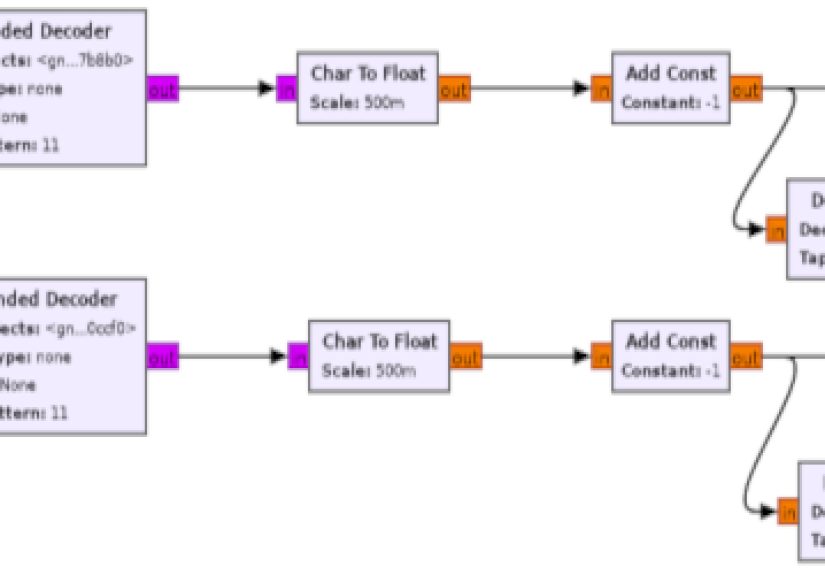
The Voyager probes used a convolutional code that can be decoded with a Viterbi decoder. This method helps recover the most likely original bit sequence even when some received bits are corrupted by noise. GNU Radio includes forward error correction tools that can be used for this kind of work.
Soft symbols are especially useful because they preserve more information than hard decisions. Instead of saying only “this is a 1” or “this is a 0,” soft information indicates confidence. In weak-signal decoding, confidence is currency. Spend it wisely, and you recover data that would otherwise look like digital confetti.
5. Finding the Frame Marker
Telemetry frames need synchronization. Voyager data uses an attached synchronization marker, a fixed bit pattern that helps locate the beginning of a frame. In the analyzed Voyager recording, the marker 0x03915ED3 was used to align the decoded bits. Finding that marker is like spotting the chapter heading in a book where all the letters arrived through a snowstorm.
Because the sample was short, it did not reveal a complete, easily interpreted stream of science data. Still, the achievement was real: the signal was detected, processed, demodulated, error-corrected, and aligned well enough to identify genuine Voyager telemetry structure.
Why This Matters Beyond a Cool Space Hack
The phrase GNU Radio decodes Voyager data sounds like a niche technical trick, but it points to a much bigger idea: advanced space communication is no longer completely hidden behind institutional walls. The antennas are still enormous, the math is still serious, and NASA’s operational systems remain in a class of their own. But open tools and public datasets let more people understand how deep-space communication works.
That matters for education. Students can learn digital signal processing from a real spacecraft signal instead of a canned classroom example. Engineers can study legacy telemetry methods and compare them with modern communication standards. Radio amateurs can see how the same principles used in everyday SDR experiments scale up to interstellar distances. And space fans can appreciate that Voyager is not just a museum piece drifting silently through the dark. It is still a functioning radio system.
There is also a cultural message here. Voyager 1 was built with technology that seems laughably old compared with modern consumer devices. Yet it continues to communicate across distances that stretch the imagination. GNU Radio, by contrast, represents the modern open-source approach: flexible, collaborative, and constantly evolving. Put them together and you get a bridge between engineering generations.
Voyager, Power, and the Race Against Time
Voyager’s continuing mission is not guaranteed forever. The spacecraft are powered by radioisotope thermoelectric generators, and their available electrical power decreases over time. NASA has been turning off instruments and heaters in carefully planned sequences to extend operations as long as possible. In 2026, NASA shut down Voyager 1’s Low-Energy Charged Particles experiment to conserve power, leaving only a small number of instruments still active.
That makes every remaining transmission more meaningful. Each bit returned from Voyager is a small victory over distance, age, radiation, and probability. When independent researchers decode recorded Voyager data, they are not merely performing a technical exercise. They are participating in the interpretation of one of the longest-running engineering stories in human history.
Lessons for Software-Defined Radio Enthusiasts
The Voyager decoding project teaches several practical lessons. First, good data matters. The reason this project worked is that a world-class telescope captured the signal. Second, bandwidth management is essential. Most of the original data was irrelevant to the narrow Voyager signal, so extracting the useful portion made the problem manageable. Third, visualization is not decoration. Spectrum plots, waterfalls, constellations, and correlation peaks help analysts understand what the receiver is doing.
Fourth, error correction is a superpower. Weak signals do not arrive perfectly. They stumble in, bruised and noisy. Coding theory gives receivers a way to reconstruct the intended message. Finally, documentation and community knowledge are priceless. Projects like this rely on old mission details, modern blog posts, open repositories, academic references, and people willing to explain what they discovered.
Specific Example: From Telescope Recording to Telemetry Bits
Imagine beginning with a large GUPPI file from a radio telescope observation. The file contains two polarizations and many frequency channels. The Voyager signal sits in one channel and one polarization. Using GNU Radio, the analyst extracts that channel, corrects the IQ orientation, shifts the Voyager carrier toward baseband, and decimates the stream so the sample rate becomes manageable.
Next, the analyst studies the spectrum. The carrier appears as a narrow peak. Data subcarriers appear at predictable offsets. After filtering and carrier tracking, the sideband is demodulated into symbols. A Viterbi decoder then works through the convolutionally encoded stream. Finally, the decoded bits are searched for the known synchronization marker. When the marker appears, the analyst has strong evidence that the processing chain has recovered real Voyager telemetry structure.
That is the beauty of the work. The final result is not a Hollywood computer screen flashing “Voyager decoded!” in green letters. It is a careful sequence of smaller confirmations, each one earned.
Experience Notes: What Working With Voyager-Like Data Feels Like
Working with a topic like GNU Radio Decodes Voyager Data feels different from ordinary software tinkering because the signal carries emotional weight. You are not just debugging a flowgraph. You are handling a trace from a spacecraft that left Earth before many modern programmers’ parents owned a home computer. That gives the work a strange mix of laboratory discipline and campfire wonder.
The first experience is humility. A beginner may expect the signal to leap out of the spectrum like a lighthouse. It does not. It is small, narrow, drifting, and surrounded by noise. Even when using a professional telescope recording, you still have to zoom, filter, average, and think carefully. The process teaches patience. It also teaches that signal processing is less about pressing the right magic button and more about asking the waveform polite but persistent questions.
The second experience is the thrill of visualization. When a waterfall plot begins to show a thin trace of the carrier, the abstract idea of “a spacecraft signal” becomes visible. It is no longer just a NASA fact sheet or a nostalgic mission poster. It is a line in data. That line has traveled across interstellar space, crossed Earth’s atmosphere, hit a giant dish, passed through receivers, landed in a file, and finally appeared on your screen. That is a lot of mileage for one skinny line.
The third experience is respect for old engineering. Voyager’s communication system was designed under constraints that would make modern teams sweat through their ergonomic keyboards. Limited power, limited onboard computing, harsh radiation, huge distances, and long command delays all shaped the design. Yet the system still works. Studying the decoding chain shows why conservative, robust engineering can outlive trendier technology by decades.
The fourth experience is community appreciation. No single curious person casually reconstructs this entire story alone. The work depends on telescope operators, NASA mission engineers, open-data programs, GNU Radio maintainers, independent researchers, documentation writers, and people who share notebooks and flowgraphs. Open-source culture turns a difficult technical achievement into a learning path others can follow.
The final experience is perspective. After wrestling with Doppler drift, symbol recovery, Viterbi decoding, and synchronization markers, everyday wireless problems look a little less mysterious. Wi-Fi, GPS, satellite links, radio astronomy, and spacecraft telemetry all share a family resemblance. The Voyager example simply stretches that family portrait to cosmic scale. It reminds us that communication is one of humanity’s signature talents: we build machines, send them into darkness, and then invent better ways to hear them whisper back.
Conclusion
GNU Radio Decodes Voyager Data is more than a clever headline. It is a story about distance, persistence, open tools, and the surprising accessibility of deep-space signal processing. Voyager 1 remains one of humanity’s greatest engineering ambassadors, while GNU Radio gives modern learners a practical way to understand the invisible craft of radio communication. Together, they show that even a faint signal from interstellar space can become a classroom, a laboratory, and a reminder that old spacecraft still have new lessons to teach.
Note: This article synthesizes publicly available technical and mission information from reputable sources, including NASA/JPL Voyager materials, NASA Deep Space Network resources, GNU Radio documentation, Green Bank Observatory and Breakthrough Listen information, and independent technical analyses of Voyager 1 signal decoding.