Table of Contents >> Show >> Hide
- What Is an Impossible Triangle?
- Why the Illusion Works
- What You Need to Draw an Impossible Triangle
- How to Draw an Impossible Triangle Step by Step
- Step 1: Draw a Regular Triangle Framework
- Step 2: Turn Each Side into a Thick Bar
- Step 3: Add the 3D Edges
- Step 4: Choose One Corner to Make “Correct”
- Step 5: Build the Second Corner in the Same Visual Style
- Step 6: Create the Impossible Connection at the Final Corner
- Step 7: Clean Up the Construction Lines
- Step 8: Add Shading for Depth
- Easy Beginner Method for Drawing an Impossible Triangle
- Common Mistakes and How to Fix Them
- Tips to Make Your Impossible Triangle Look Better
- Creative Variations to Try
- Why This Drawing Is Great Practice
- Experiences People Often Have While Learning to Draw an Impossible Triangle
- Final Thoughts
If you have ever looked at an impossible triangle and thought, “That shape is lying to my face,” congratulations: your eyes are working perfectly. The impossible triangle, often called the Penrose triangle, is one of the most famous optical illusions in drawing. It looks like a solid 3D object, but the geometry refuses to exist in the real world. In other words, it is the kind of shape that would make a ruler question its career choices.
This guide breaks the process into simple, beginner-friendly steps so you can draw an impossible triangle without needing a math degree, wizard license, or emergency pep talk. You will learn what makes the illusion work, which tools help most, how to avoid the common mistakes, and how to make your final drawing look crisp, clean, and convincingly impossible.
If your goal is to learn how to draw an impossible triangle in a way that is easy, fun, and actually understandable, you are in the right place. Grab a pencil, a ruler, and just enough confidence to draw three bars that absolutely should not cooperate, yet somehow do.
What Is an Impossible Triangle?
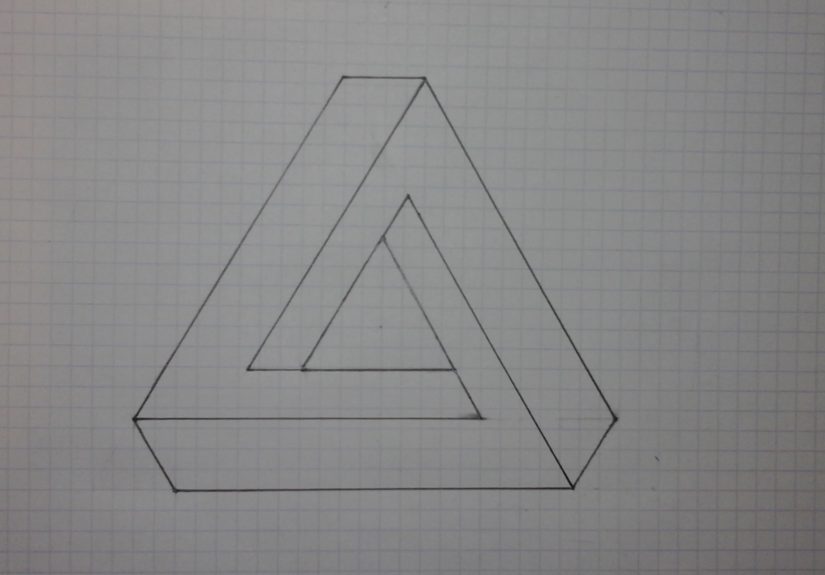
An impossible triangle is a classic optical illusion drawing made of three beam-like sides that appear to connect into a solid triangular object. At first glance, your brain reads it as a normal 3D shape. Then, somewhere between one corner and the next, logic slips on a banana peel.
The illusion works because the drawing suggests depth in inconsistent ways. Each individual section looks believable on its own, but the whole shape cannot exist as a real object in ordinary space. That tension between “this looks fine” and “wait, no it does not” is exactly what makes the Penrose triangle so memorable.
This image became widely famous through mathematics, visual perception research, and artists fascinated by impossible objects. It is often associated with M. C. Escher and with the broader world of perspective drawing, illusion art, and geometric sketching.
Why the Illusion Works
Before you draw it, it helps to know why it fools the eye. Your brain loves shortcuts. When it sees angled bars, overlapping edges, and consistent line directions, it assumes those parts belong to a real 3D object. The problem is that the object only behaves logically in small sections. When your eye traces the entire triangle, the depth relationships contradict each other.
Think of it like three coworkers who all seem organized individually but become chaos the second they try to schedule one meeting together. Each side of the impossible triangle makes sense alone. The whole team? Absolute nonsense.
That is why line placement, corner connections, and clean perspective cues matter so much. The illusion is not about wild detail. It is about convincing the viewer just enough for the brain to fill in the rest.
What You Need to Draw an Impossible Triangle
Basic Supplies
- Pencil
- Eraser
- Ruler
- Black pen or fineliner for final lines
- Optional: colored pencils, markers, or shading pencil
You can draw an impossible triangle freehand, but a ruler makes the illusion cleaner and far more effective. This is one of those rare moments when being a little precise is worth it.
Best Paper Setup
Use plain white paper and leave enough space around the shape. Crowding the triangle makes it harder to check the angles. Give your illusion room to breathe. Even fake geometry deserves decent working conditions.
How to Draw an Impossible Triangle Step by Step
Step 1: Draw a Regular Triangle Framework
Start by drawing a light equilateral-looking triangle or a balanced three-sided shape. It does not have to be mathematically perfect, but it should look even and stable. Keep the lines light because this is only the guide structure.
This first triangle is not the impossible triangle yet. It is the skeleton you will build on. Think of it as the rehearsal before the optical illusion starts stealing the show.
Step 2: Turn Each Side into a Thick Bar
Now draw parallel lines alongside each side of the triangle so every side becomes a thick beam. Keep the thickness consistent. If one side is much fatter than the others, the final illusion looks accidental instead of intentional.
You should now have three chunky sides that resemble a triangular frame. At this stage, it may look like a normal geometric logo, a futuristic warning sign, or a very confident pretzel.
Step 3: Add the 3D Edges
To create the illusion of depth, add short connecting lines at the ends of the thick bars so they look like solid beams rather than flat strips. These small edge lines suggest thickness and direction. Keep them consistent in length and angle where possible.
This is where the drawing begins to act three-dimensional. Your viewer’s brain starts assuming these are real beams in space. Excellent. We are about to betray that trust.
Step 4: Choose One Corner to Make “Correct”
Focus on one corner first and draw it like a believable 3D joint where two beams meet. Make that corner clean and readable. Do not overthink the whole figure yet. One convincing corner is enough to establish the illusion’s visual language.
This is important because impossible drawings often work best when they begin with something plausible. If the first corner already looks confusing, the entire shape can collapse into random lines.
Step 5: Build the Second Corner in the Same Visual Style
Move to the next corner and connect the beams in the same general style. Keep the outer edges neat. Maintain the same bar thickness. The goal is to preserve the illusion that the same object continues around the triangle.
By now, the drawing should seem almost logical. Almost. That “almost” is doing a lot of heavy lifting.
Step 6: Create the Impossible Connection at the Final Corner
Here is the magic step. At the last corner, instead of connecting the bars in a fully logical 3D way, draw the final joint so the beam appears to connect seamlessly from the viewer’s perspective, even though the implied depth does not make sense.
In practical terms, you will often erase one overlapping edge and redraw the connection so the top face of one bar visually meets the side face of another. This is the moment where the triangle becomes impossible. The lines still look neat, but the geometry quietly stops obeying reality.
If it helps, stop looking at the shape as a real object. Look at it as a flat arrangement of line segments designed to suggest a real object. That mental shift makes the final corner much easier.
Step 7: Clean Up the Construction Lines
Erase the guide lines you no longer need. Strengthen the final edges with darker pencil or ink. Clean, sharp line work matters a lot with illusion art. Sloppy overlaps make the viewer think the drawing is messy; crisp overlaps make the viewer think the drawing is mysterious.
This is where the illusion really clicks. Many beginners think they messed it up until they erase the extra lines. Then suddenly the triangle snaps into place and starts gaslighting the room.
Step 8: Add Shading for Depth
To make your impossible triangle pop, shade each visible face differently. Use one light tone, one medium tone, and one darker tone. Keep the values consistent around the shape. This helps the eye read each bar as a solid form.
Shading will not make the geometry more logical, but it will make the illusion more believable. And in impossible-object art, believable nonsense is the gold standard.
Easy Beginner Method for Drawing an Impossible Triangle
If the full beam construction feels tricky, use this beginner shortcut:
- Draw a triangle.
- Thicken all three sides evenly.
- At each corner, sketch the bar overlap that looks most natural.
- At the last corner, fake the connection by matching line direction instead of true depth.
- Erase the conflicting interior lines.
This simplified method is great for kids, beginners, and anyone who wants the illusion without turning the page into a geometry crime scene.
Common Mistakes and How to Fix Them
Uneven Bar Width
If one side is thinner or thicker, the shape loses visual consistency. Use a ruler and measure the width of each beam before darkening the final lines.
Messy Corner Joins
The corners are everything. If they look fuzzy or overdrawn, erase and redraw them neatly. Illusions are fragile. One awkward corner can make the whole drawing look like a confused road sign.
Too Much Shading Too Soon
Do not add heavy shading before the structure is correct. First make the line illusion work. Then add value. Decorating a broken illusion is like putting whipped cream on a flat soda.
Trying to Make It Physically Logical
This is the biggest trap. The shape is not supposed to make real-world sense. If you keep trying to “fix” it into a valid object, you will accidentally delete the impossible part that makes it fun.
Tips to Make Your Impossible Triangle Look Better
Use Confident Lines
Strong, clean edges help the eye accept the form. Sketch lightly first, then commit with smoother final strokes.
Keep the Faces Simple
Do not overload the triangle with patterns too early. Simple faces make the illusion easier to read. Once you understand the structure, you can decorate it later.
Rotate the Paper
If a certain edge is hard to draw neatly, rotate the page instead of fighting your wrist. Artists do this constantly. Your paper has no feelings.
Step Back and Check the Illusion
Every few minutes, hold the drawing at arm’s length. Illusions often look better from a short distance. Up close, you see the construction. A little farther away, your brain starts doing its wonderfully suspicious thing.
Creative Variations to Try
Color Block Version
Fill each face with a different color family to emphasize the faux 3D surfaces. This works especially well in digital art and poster-style designs.
Impossible Triangle with Shadow
Add a cast shadow underneath the object. Ironically, giving an impossible object a realistic shadow can make it feel even more convincing.
Escher-Inspired Scene
Place the triangle inside a surreal environment with stairs, floating platforms, or repeated geometric forms. Suddenly your sketchbook looks like it pays rent in a parallel dimension.
Ribbon Style Triangle
Instead of beam-like bars, draw the figure as a folded ribbon. The illusion becomes softer, more decorative, and a little easier for some beginners to manage.
Why This Drawing Is Great Practice
Learning how to draw a Penrose triangle teaches more than one cool illusion. It sharpens line control, improves spatial thinking, and trains you to understand how viewers interpret depth from flat images. That makes it useful for artists, designers, students, and anyone interested in visual storytelling.
It also teaches a sneaky lesson: drawing is not only about copying what is real. Sometimes great drawing is about understanding how the eye reads information, then bending those rules on purpose. That is a powerful skill whether you are sketching architecture, comics, logos, or pure brain-bending nonsense.
Experiences People Often Have While Learning to Draw an Impossible Triangle
One of the funniest things about learning this illusion is that nearly everyone has the same emotional arc. It usually begins with confidence. You draw the first triangle and think, “I have absolutely got this.” Then you add thickness to the sides, build the first corner, and still feel pretty good. By the second corner, you are basically the mayor of Geometry Town. Then the final connection arrives, and suddenly the pencil pauses in midair like it has seen a ghost.
That moment is normal. In fact, it is practically part of the lesson. The impossible triangle feels strange to draw because your hand wants to follow logic while your eyes want to follow appearance. Those are not always the same thing. Beginners often describe the experience as weirdly satisfying and mildly annoying at the exact same time. That is a very fair review.
Many artists also notice that the illusion looks wrong up close but right from farther away. This can be surprisingly reassuring. You may spend ten minutes staring at one corner, convinced you ruined everything, only to lean back and discover the triangle suddenly works. That experience teaches an important artistic habit: always step back from your drawing. Your eyes need distance to judge the image the way a viewer will.
Another common experience is overcorrecting. People try to fix the impossible part by making the structure more realistic, which accidentally destroys the illusion. Then they erase, redraw, and realize that the best version is not the most logical one. That can be a breakthrough moment. You start understanding that successful drawing is often about controlling perception rather than documenting reality.
There is also a confidence boost that comes with finishing one of these. An impossible triangle looks complicated, so once it works, it feels like you pulled off a small magic trick. Even a simple version can impress classmates, friends, or whoever happens to be nearby pretending not to be interested while obviously being interested.
For students, this drawing often becomes the gateway to other illusion art. After one impossible triangle, people want to try impossible stairs, warped cubes, anamorphic lettering, or surreal hallway sketches. The exercise opens the door to thinking differently about space, viewpoint, and design. It makes drawing feel less like memorizing rules and more like playing with them.
And maybe that is the best experience of all. The impossible triangle reminds you that art can be smart without being stiff, precise without being boring, and playful without being sloppy. It invites you to experiment, laugh at the strange parts, erase without panic, and keep going until the illusion clicks. When it finally does, the result feels less like finishing a drawing and more like catching your own brain in the act of being fooled.
Final Thoughts
Now you know how to draw an impossible triangle step by step. The secret is not superhuman talent. It is clean line work, consistent bar thickness, believable corners, and one carefully faked connection that tricks the eye into seeing a form that cannot exist.
Start simple. Use a ruler. Keep your construction lines light. Most importantly, do not panic when the middle of the process looks slightly cursed. That is often a sign you are doing it right.
Once you can draw one impossible triangle, you are not just making a cool sketch. You are learning how artists use perception, perspective, and visual suggestion to create images that stick in the mind. That is a pretty solid return on investment for three bars and a little delightful nonsense.