Table of Contents >> Show >> Hide
- First, Don’t Mix These Up
- What You’ll Need
- The Two Formulas You’ll Use Forever
- 8 Steps to Find the Area and Perimeter of a Rectangle
- Step 1: Confirm You’re Actually Working With a Rectangle
- Step 2: Identify the Length and Width
- Step 3: Make Sure Both Measurements Use the Same Unit
- Step 4: Write Down the Area Formula and Plug in Your Values
- Step 5: Add the Correct Units for Area (Square Units)
- Step 6: Write Down the Perimeter Formula and Plug in Your Values
- Step 7: Add the Correct Units for Perimeter (Regular Units)
- Step 8: Do a Quick Reality Check
- Worked Examples (Because Math Gets Friendlier With Examples)
- What If You’re Missing a Side?
- Common Mistakes (So You Can Avoid Them Like a Pro)
- Quick Practice Problems (With Answers)
- FAQ: Rectangle Area and Perimeter Questions People Actually Ask
- Real-Life Experiences That Make This Stuff Click (About )
- Conclusion
Rectangles are the golden retrievers of geometry: friendly, predictable, and always there when you need them.
Whether you’re sizing up flooring for a room, figuring out how much fence you need, or just trying to survive
a math worksheet with your dignity intact, two measurements matter most:
area (how much space is inside) and perimeter (how far it is around the edge).
In this guide, you’ll learn the formulas, the “why,” and the real-life shortcutsplus the
8-step method that makes rectangle problems feel less like a pop quiz and more like a victory lap.
First, Don’t Mix These Up
Think of a rectangle like a picture frame:
- Perimeter is the frame itselfthe distance around the outside edge.
- Area is the poster inside the framethe amount of surface it covers.
The easiest way to avoid confusion is to remember:
Perimeter = “around” and Area = “inside”.
What You’ll Need
- The rectangle’s length (L) and width (W)
- Units (inches, feet, meters, centimeters… choose your fighter)
- A calculator (optional, but helpful if numbers start doing backflips)
- If you’re measuring something real: a ruler or tape measure
The Two Formulas You’ll Use Forever
- Area of a rectangle:
A = L × W - Perimeter of a rectangle:
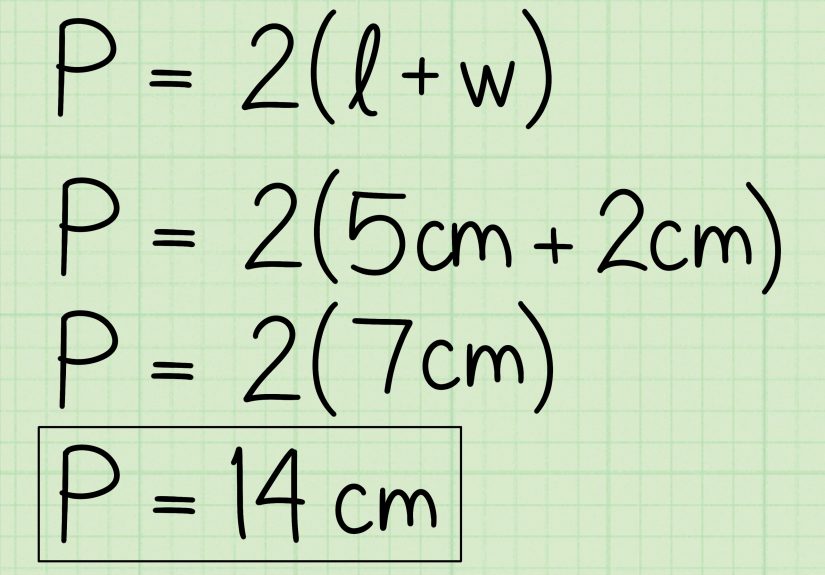
P = 2(L + W)(same asP = 2L + 2W)
8 Steps to Find the Area and Perimeter of a Rectangle
Step 1: Confirm You’re Actually Working With a Rectangle
A rectangle has four right angles (90° corners) and opposite sides that are equal.
If it looks like a rectangle but seems “tilted,” it might be a parallelogram in disguise.
(Geometry loves plot twists.)
Step 2: Identify the Length and Width
Label the longer side as length (L) and the shorter side as width (W).
If the rectangle is a perfect square, don’t panicthen L = W.
Step 3: Make Sure Both Measurements Use the Same Unit
This is where mistakes are born. If one side is in feet and the other is in inches, convert
before you calculate. Otherwise, your final answer will be “mathematically creative,” which is not a compliment.
Quick example: If L = 3 ft and W = 18 in, convert 18 in to feet:
18 in = 1.5 ft.
Step 4: Write Down the Area Formula and Plug in Your Values
Use A = L × W. Multiply the two side lengths.
Example: If L = 8 and W = 5, then A = 8 × 5 = 40.
Step 5: Add the Correct Units for Area (Square Units)
Area is measured in square units because you’re counting how many
1-by-1 squares fit inside the shape.
So if your sides are in meters, your area is in m². If your sides are in inches, your area is in in².
The tiny “²” matterswithout it, you’re basically saying, “I measured a floor in inches,” which is like measuring soup with a fork.
Step 6: Write Down the Perimeter Formula and Plug in Your Values
Use P = 2(L + W). Add length and width, then multiply by 2.
Example: If L = 8 and W = 5, then P = 2(8 + 5) = 2(13) = 26.
Step 7: Add the Correct Units for Perimeter (Regular Units)
Perimeter is measured in linear unitsthe same units as the side lengthsbecause you’re measuring distance around an edge.
So if your sides are in feet, your perimeter is in feet (not square feet). No “²” here.
Step 8: Do a Quick Reality Check
Before you call it done, ask two questions:
- Does the area seem reasonable? (Bigger sides should mean a bigger area.)
- Does the perimeter make sense? (It should be more than the longest side, and it’s basically “all the sides added up.”)
If your area got smaller when your rectangle got bigger, something went off the railslikely a unit mix-up or a calculator button betrayal.
Worked Examples (Because Math Gets Friendlier With Examples)
Example 1: A Simple Rectangle
Given: L = 12 in, W = 7 in
- Area:
A = 12 × 7 = 84 in² - Perimeter:
P = 2(12 + 7) = 2(19) = 38 in
Example 2: A Real-Life Room Problem
You’re buying carpet for a room that’s 14 ft by 10 ft.
Carpet is sold by area, so you need square feet.
- Area:
A = 14 × 10 = 140 ft² - Perimeter (useful for baseboards):
P = 2(14 + 10) = 48 ft
Translation: 140 square feet of carpet, and about 48 feet of baseboard if you’re trimming the whole room.
Example 3: The “Mixed Units” Trap
Given: L = 2 m, W = 50 cm
Convert first: 50 cm = 0.5 m
- Area:
A = 2 × 0.5 = 1 m² - Perimeter:
P = 2(2 + 0.5) = 2(2.5) = 5 m
What If You’re Missing a Side?
Rectangle problems often turn into detective work: you’re given the area or perimeter and asked to find an unknown length or width.
The good news: the algebra is straightforward.
Missing Side Using Area
Start with A = L × W. If you know area and one side, divide:
W = A ÷ L (or L = A ÷ W).
Example: A rectangle has area 54 ft² and length 9 ft.
Width: W = 54 ÷ 9 = 6 ft
Missing Side Using Perimeter
Start with P = 2(L + W). Divide perimeter by 2 first:
P/2 = L + W. Then subtract the known side.
Example: A rectangle has perimeter 50 cm and length 15 cm.
P/2 = 25, so 25 = 15 + W → W = 10 cm
Common Mistakes (So You Can Avoid Them Like a Pro)
- Mixing up formulas: If you add sides, you’re doing perimeter. If you multiply two sides, you’re doing area.
-
Forgetting square units for area: Area needs
cm²,ft²,m², etc. - Unit mismatch: Convert before calculating (feet and inches, meters and centimeters, and so on).
-
Half-using the perimeter formula: Don’t do
L + Wand stop. Perimeter is all the way around, so multiply by 2. - Rounding too early: If you’re working with decimals, keep a few extra digits and round at the end.
Quick Practice Problems (With Answers)
- Find the area and perimeter of a rectangle with
L = 9andW = 4. - A garden is
6 mlong and3 mwide. How much fencing is needed? - A rectangle has area
72 in²and width8 in. What is the length? - A rectangle has perimeter
64 ftand length18 ft. What is the width?
Show answers
-
1) Area:
9 × 4 = 36square units; Perimeter:2(9+4)=26units -
2) Fencing is perimeter:
2(6+3)=18 m -
3)
L = 72 ÷ 8 = 9 in -
4)
P/2 = 32, so32 = 18 + W→W = 14 ft
FAQ: Rectangle Area and Perimeter Questions People Actually Ask
Can area and perimeter be the same number?
Yes, sometimes. For example, a rectangle with L = 4 and W = 2 has
area 8 and perimeter 12 (not the same). But with other dimensions,
you can get a numerical matchjust remember the units are different:
area is square units, perimeter is linear units.
What if all I know is the perimeter?
Perimeter alone usually isn’t enough to find the area because many rectangles can share the same perimeter
but have different side lengths (and therefore different areas). You need at least one side length, a ratio,
or an extra condition to narrow it down.
Do rectangles always have a larger perimeter if they have a larger area?
Not always. Two rectangles can have the same area but different perimeters (and vice versa). Shape matters,
not just “how much” there is.
Real-Life Experiences That Make This Stuff Click (About )
Most people don’t meet rectangles in the wild and think, “Ah yes, a perfect moment for A = L × W.”
Rectangles usually show up disguised as everyday problemsand that’s exactly why area and perimeter become
so useful once you notice them.
One classic “rectangle moment” is home improvement. Picture someone measuring a bedroom for new flooring.
They’ll often start by pacing it out (very human), then realize that “about 14 steps” isn’t a valid unit at a hardware store.
Once the tape measure comes out, area becomes the hero: flooring, carpet, tile, and even paint coverage for a wall all boil down
to “how much surface do I need to cover?” It’s surprisingly satisfying to multiply two measurements and end up with a single number
that tells you how much stuff to buy. It’s also a little dangerous, because that satisfaction can make you forget the unit
and that’s how people end up ordering the right number in the wrong scale.
Perimeter has its own real-life fan club. Fences, trim, ribbon around a poster board, LED strip lights along a desk edge
these are all perimeter problems pretending to be “craft projects.” A common experience is to measure only one pair of sides
because it feels efficient (and it is… until you forget you need all four). That’s why P = 2(L + W) is so handy:
it builds in the “don’t forget the other two sides” reminder. It’s like the formula is politely saying,
“Yes, yes, you measured length and widthnow multiply by 2 so you don’t end up short.”
Another experience people recognize instantly is the “same perimeter, different area” surprise.
Imagine laying out a garden border with 20 feet of edging. If you make it long and skinny (say, 9 by 1),
the inside space is tiny. If you make it closer to a square-ish shape (like 5 by 5 is impossible with 20 feet exactly,
but you get the idea), suddenly you have much more planting room. That’s often the moment area stops being a worksheet
and starts being a strategy.
In schools, many learners remember the first time they mixed up area and perimeterusually because the answer was so wildly off
that it felt personal. The fix is almost always the same: connect perimeter to “walking around the edge” and area to “covering the inside.”
Once you can picture it, the formulas stop feeling like random letters and start feeling like shortcuts for ideas you already understand.
Conclusion
Rectangles may be basic, but they’re secretly powerful. If you can measure (or identify) the length and width, you can find:
area with A = L × W and perimeter with P = 2(L + W).
Keep units consistent, label your answers correctly, and do a quick reality checkand you’ll be solving rectangle problems like it’s your side quest.