Table of Contents >> Show >> Hide
- What Is a Junction Box, and Why Do You Need One?
- Before You Start: Important Safety Rules
- Tools and Materials
- How to Choose the Right Junction Box
- Step-by-Step: How to Install a Junction Box
- Step 1: Plan the box location
- Step 2: Turn off power and verify it is off
- Step 3: Open the wall or prep the mounting area
- Step 4: Mount the junction box securely
- Step 5: Add cable clamps or connectors
- Step 6: Feed cable into the box
- Step 7: Strip the wires
- Step 8: Connect the ground wires first
- Step 9: Connect neutral and hot wires
- Step 10: Fold wires neatly into the box
- Step 11: Install the cover plate
- Step 12: Restore power and test
- Common Mistakes to Avoid
- Practical Example
- What Real-World Experience Teaches You About Installing a Junction Box
- Final Thoughts
Note: This guide is for standard residential branch-circuit work. If your home has aluminum wiring, damaged insulation, a wet location, a crowded panel, or anything that makes you say, “Hmm, that seems spicy,” stop and call a licensed electrician.
Installing a junction box is not the flashiest home project. It will not make your neighbors gasp. It will not get its own before-and-after reel. But it will make your wiring safer, neater, and more code-friendly, which is the kind of boring heroism your house appreciates.
A junction box protects wire splices, helps contain sparks if a connection fails, and gives you a safe, accessible place to inspect or repair wiring later. In plain English, it keeps your electrical connections from rattling around inside a wall like a bad decision. If you need to extend wires, move a fixture, or contain an existing splice properly, learning how to install a junction box is a smart skill to have.
This step-by-step tutorial walks through the basics in a practical way, using standard American residential wiring concepts. You will learn how to choose the right electrical box, where to place it, how to mount it, and how to make clean, safe connections without turning a simple project into a “why is the breaker yelling at me?” situation.
What Is a Junction Box, and Why Do You Need One?
A junction box is an enclosed box designed to house wire connections. Anytime conductors are spliced together in a residential wiring system, those connections should live inside an approved box with a cover. No loose splices. No “I’ll tuck this behind the drywall and forget it ever happened.” Your future self deserves better.
Junction boxes serve several jobs at once:
- They shield connections from accidental contact.
- They help contain heat and sparks if a splice fails.
- They provide a secure entry point for cables or conduit.
- They keep electrical work accessible for inspection, troubleshooting, and upgrades.
If you are extending a cable, rerouting a light fixture, repairing damaged wiring, or cleaning up an old splice, a properly installed junction box is usually part of the answer.
Before You Start: Important Safety Rules
Electricity is not the place for fake confidence. Before you touch a single wire, follow these basics:
1. Turn off the circuit breaker
Shut off the breaker feeding the circuit you will be working on. If you are not completely certain which breaker controls that wiring, turn off the main breaker instead.
2. Test that the power is actually off
Never trust a panel label written in 2009 by someone named “Dave?” Use a non-contact voltage tester or an approved tester to confirm the wires are dead before handling them.
3. Know when not to DIY
Call a licensed electrician if the project involves a new circuit, service panel work, aluminum wiring, wet locations, conduit systems you do not understand, or local permit requirements you cannot verify. Confidence is great. Electrocution is a terrible hobby.
Tools and Materials
You do not need a truck full of gadgets, but you do need the right basics:
- Junction box rated for the job
- Approved cover plate
- Cable clamps or built-in clamps, depending on box type
- Wire connectors (wire nuts or other listed connectors)
- Screwdriver
- Drill/driver
- Wire stripper
- Needle-nose pliers or lineman’s pliers
- Drywall saw if installing in finished walls
- Non-contact voltage tester
- Mounting screws
- Ground screw or pigtail if using a metal box
- Safety glasses
How to Choose the Right Junction Box
Not every electrical box is the same, and choosing the wrong one is a classic way to turn a simple job into an expensive second trip to the hardware store.
New-work vs. old-work boxes
If the wall is open and framing is exposed, use a new-work box that fastens directly to a stud or joist. If the drywall is already in place, use an old-work box, sometimes called a remodel box, which clamps to the wall opening.
Plastic vs. metal
Plastic boxes are common for nonmetallic cable and are easy for many homeowners to use. Metal boxes are durable and often used when metal conduit or specific grounding methods are involved. If you use a metal box, the box itself must be bonded to ground.
Box size matters
Do not cram wires into a too-small box like you are packing for a weekend trip with emotional baggage. Junction boxes must have enough internal volume for the number and size of conductors, plus clamps, grounds, and devices if present. If the box feels crowded before the cover goes on, that is your clue to rethink the size.
Match the box to the location
For indoor dry areas, a standard interior box may be fine. For garages, basements, unfinished spaces, or outdoor locations, make sure the box and cover are listed for that environment. Exterior installations usually need weather-rated parts.
Step-by-Step: How to Install a Junction Box
Step 1: Plan the box location
Choose a location that is easy to reach later. A junction box should remain accessible, which means no burying it behind drywall, tile, paneling, cabinets, or your house’s best attempt at denial. Good locations include attics, basements, crawlspaces with access, unfinished utility areas, or finished walls where the cover will remain visible.
If you are installing the box in a wall, use a stud finder first. In a finished wall, avoid studs unless you are using a box designed to attach there. If the wall is open, position the box so the front edge will sit flush with the finished surface once drywall or paneling is installed.
Step 2: Turn off power and verify it is off
Flip the breaker, then test the wires. Test before you touch, and test again after you expose the conductors. This is the least glamorous part of the project and the most important.
Step 3: Open the wall or prep the mounting area
For an old-work installation, trace the box outline on the wall and cut the opening carefully with a drywall saw. Make the opening snug, not oversized. A box that flops around in drywall is not “character.” It is a problem.
For a new-work installation, place the box against the stud or joist and confirm the proper height and orientation before fastening it in place.
Step 4: Mount the junction box securely
Fasten a new-work box directly to framing with the appropriate screws or nails. For an old-work box, slide it into the opening and tighten the mounting screws until the retention tabs grip the back of the drywall. The front of the box should sit flush with the finished wall surface, not sunk too deep and not sticking out like it is trying to escape.
If you are surface-mounting a box in a basement or utility space, anchor it firmly to framing or another approved solid surface.
Step 5: Add cable clamps or connectors
If your box has built-in clamps, great. If it does not, install the correct cable connectors in the knockouts before bringing in the cable. These connectors protect the cable from sharp box edges and help secure it in place.
Metal boxes typically require separate connectors. Many plastic boxes already include clamping tabs. Either way, the cable should be held firmly without being crushed.
Step 6: Feed cable into the box
Run the cable into the box through the clamp or connector. Leave enough wire to work comfortably. A generous amount of conductor inside the box makes splicing easier and less frustrating. The outer cable sheath should extend into the box far enough to stay protected under the clamp, while the individual conductors should be long enough to splice without becoming tiny angry noodles.
Step 7: Strip the wires
Use a wire stripper to remove the appropriate amount of insulation from the hot and neutral conductors. Avoid nicking the copper. A damaged conductor is like a cracked coffee mug: technically still there, but not something you should trust.
If you are splicing two cables together, separate the wires by color and organize them before making any connections.
Step 8: Connect the ground wires first
Join the bare copper or green ground wires together with an approved connector. If you are using a metal box, attach a ground pigtail from the grounding bundle to the grounding screw in the box. That bonds the metal box so it is part of the safety path.
Plastic boxes do not need to be bonded in the same way, but all equipment grounding conductors still need to be joined correctly.
Step 9: Connect neutral and hot wires
Connect white to white and black to black using listed wire connectors sized for the conductors involved. Follow the connector manufacturer’s instructions. Tug each wire gently after tightening to make sure the splice is secure.
If the white wire is being used as a hot conductor in a special switch loop or similar setup, it must be re-identified correctly. If that sentence made you blink twice, that is your sign to pause and bring in an electrician.
Step 10: Fold wires neatly into the box
Fold the wires back into the box carefully, with grounding conductors tucked first and splices arranged neatly. Do not force the conductors. A clean box is easier to close, easier to inspect, and much less likely to make you invent new vocabulary.
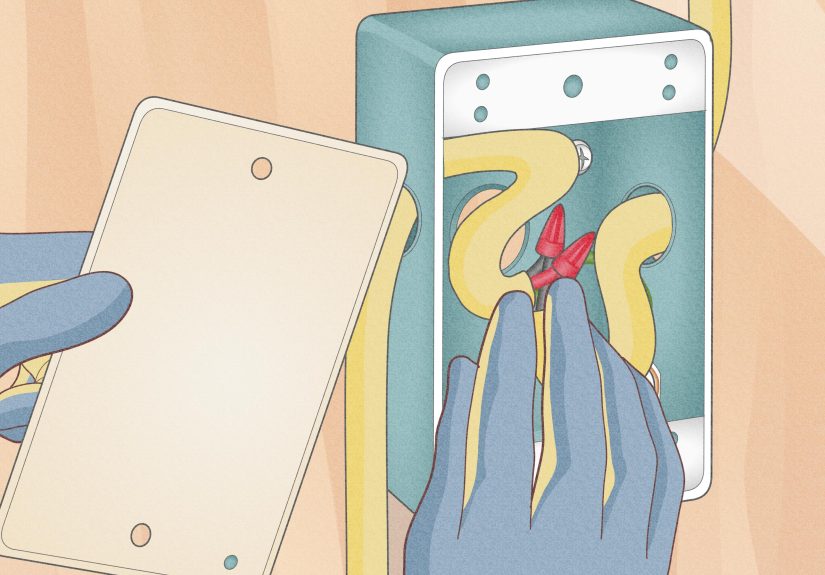
Step 11: Install the cover plate
Put the approved cover on the junction box and tighten the screws until secure. Every junction box needs a cover. No exceptions, no creative shortcuts, and definitely no “temporary” tape solution that somehow lives there for six years.
Step 12: Restore power and test
Turn the breaker back on and test the circuit or fixture served by the junction box. If something is not working, turn the power back off before reopening the box and checking your splices.
Common Mistakes to Avoid
- Hiding the box: A junction box must stay accessible.
- Using the wrong box size: Crowded boxes create safety and code problems.
- Skipping clamps: Loose cable entries can damage insulation.
- Forgetting to bond a metal box: Grounding matters.
- Mounting the box too deep: The front should align with the finished surface.
- Leaving splices uncovered: Always install the cover plate.
- Working without testing for power: This is how “small projects” become ambulance stories.
Practical Example
Let’s say you are moving a light fixture a few feet over in a finished room. The original cable is too short to reach the new location, so you need to extend it. Instead of making a hidden splice in the ceiling cavity, you install a junction box at the old fixture location, mount it securely, bring in the original cable and the new cable, make the splices inside the box, and cover it with an approved plate. That is the correct approach.
Is it glamorous? No. Is it safe, serviceable, and much more likely to pass inspection? Absolutely.
What Real-World Experience Teaches You About Installing a Junction Box
The funny thing about learning how to install a junction box is that the actual installation is only half the lesson. The other half is everything you notice while doing it. On paper, the project looks simple: cut hole, mount box, splice wires, install cover, move on with life. In real life, the project usually begins with standing on a ladder, holding a tester in one hand, and wondering why the breaker labels look like they were written during a windstorm.
One of the first lessons people learn is that planning saves far more time than speed ever will. If you rush the box location, you may discover the cover lands in the most awkward visible spot on the wall. If you rush the box size, you end up with a cramped interior that makes folding conductors feel like stuffing a sleeping bag into a sandwich bag. If you rush the mounting, the box may sit crooked or loose, which somehow becomes deeply annoying every time you see it.
Another common experience is realizing that “power off” and “power confirmed off” are two very different milestones. Plenty of DIYers have had the humbling moment where the breaker seemed correct, but the tester still lit up. That is not failure. That is exactly why the tester exists. A lot of electrical work is less about bravery and more about respect. The safest people are usually the ones who double-check everything because they know assumptions are expensive.
People also discover that neat wiring is not just about looks. A tidy junction box is easier to troubleshoot, easier to close, and less stressful to revisit months later. When the grounds are bundled cleanly, the neutrals are matched properly, and the hot conductors are connected with the right connector, the whole job feels calmer. It is the electrical version of making your bed. Nothing magical happened, but suddenly life seems slightly more under control.
Then there is the moment every homeowner remembers: the breaker goes back on, the fixture works, and nothing sparks, smokes, or trips. That tiny victory feels absurdly satisfying. You will probably stand there for a second pretending not to be proud, even though you are absolutely proud.
At the same time, real-world experience teaches humility. Maybe the drywall opening was a little too tight. Maybe the old cable route was weirder than expected. Maybe the attic was hot enough to qualify as emotional growth. Maybe you discovered that the previous homeowner believed in “creative electrical expression.” All of that is normal. Home projects rarely unfold like a polished tutorial. The goal is not perfection on the first try. The goal is safe, correct, serviceable work.
And perhaps the best lesson is this: a junction box is a small thing that represents a smart mindset. It says you are not hiding problems. You are containing them properly, labeling your work with good habits, and leaving the system better than you found it. Not bad for a little square box full of wires and dignity.
Final Thoughts
If you want a safer, cleaner way to handle wire splices, learning how to install a junction box is worth your time. The key ideas are simple: shut off power, verify it is off, choose the right box, mount it securely, make proper splices, ground everything correctly, and keep the box accessible with a cover in place.
Take your time, respect the circuit, and do not let impatience bully you into shortcuts. Houses have long memories. A properly installed junction box is one of those small decisions that pays you back with safety, reliability, and fewer headaches down the road.