Table of Contents >> Show >> Hide
- Step 1: Figure Out What You’re Actually Doing (New Lawn vs. Overseeding vs. Patch Repair)
- Step 2: Pick the Right Time (Because Seed Has a Calendar)
- Step 3: Choose the Right Seed (The “Right Plant, Right Place” Rule)
- Step 4: Prep the Site (This Is Where Lawns Are Won)
- Step 5: Spread the Seed Evenly (Without Creating “Lawn Leopards”)
- Step 6: Cover (Lightly) and Protect Your Work
- Step 7: Water Correctly (The Most Important Part After Timing)
- Step 8: Know What to Expect (Germination Timeline + First Mow)
- Step 9: Fertilizer and Weed Control (Do This Wrong and You’ll Regret It)
- Step 10: Troubleshooting Common “Why Is My Lawn Doing That?” Problems
- Quick Step-by-Step Checklist
- Wrap-Up: The “Secret” to Great Grass Seed Results
- Experience Notes: What Planting Grass Seed Really Feels Like (and What I Wish Someone Told Me)
Planting grass seed looks simple: toss seed, hope for rain, and wait for your yard to transform into a lush carpet like a home-improvement show
montage. In real life, though, grass seed is a tiny diva with three main demands: good timing, great seed-to-soil contact,
and consistent moisture. Nail those, and you’ll be shocked how “pro” your lawn can look without hiring a crew or sacrificing your weekend
to the Lawn Gods.
This guide walks you step-by-step through planting a new lawn, fixing bare spots, or overseeding a thin lawn. It’s written for real people with real
yardsslopes, sprinklers that “sort of” work, and at least one neighbor who waters at noon like it’s a sport.
Step 1: Figure Out What You’re Actually Doing (New Lawn vs. Overseeding vs. Patch Repair)
Planting a brand-new lawn from seed
You’re starting from bare soil (new construction, major renovation, or you removed a lot of weeds). This takes the most prep work but gives you the
chance to correct grading, compaction, and soil problems from the beginning.
Overseeding an existing lawn
Your lawn is thin, stressed, or patchy, but there’s still grass. Overseeding thickens turf, helps crowd out weeds over time, and improves color and density.
This is also the fastest “big improvement” move for most homeowners.
Fixing bare spots
You have a few bald patches (dog traffic lane, shady corner, sprinklers missing a spot). Patch repair is like lawn first aid: small area, quick turnaround
but the same rules apply: prep, contact, moisture.
Step 2: Pick the Right Time (Because Seed Has a Calendar)
The biggest difference between “it worked!” and “why is nothing happening?” is usually timing. Grass seed germinates best when soil temperatures match the
type of grass you’re plantingand when the weather won’t immediately punish young seedlings.
Cool-season grasses (fescue, Kentucky bluegrass, perennial ryegrass)
If you live in much of the northern U.S. or the transition zone, cool-season grasses are common. The sweet spot is typically late summer to early fall.
Warm soil helps germination, cooler air reduces stress, and there’s often less weed competition than in spring. If you miss fall, early spring can workbut it’s trickier,
because summer heat and weeds arrive fast.
Warm-season grasses (Bermuda, zoysia, St. Augustine)
In warmer regions, seed (where applicable) or establish warm-season turf when soils are warming and the grass is entering its strongest growth periodoften late spring into
early summer. The goal is to give seedlings time to develop roots before cooler fall weather returns.
A simple timing “cheat code”: check soil temperature
Instead of relying on the calendar, use a soil thermometer. Cool-season grasses typically do well once soils are roughly in the 50s–60s °F range; warm-season grasses prefer
warmer soils (often above the mid-60s °F). Soil temperature is a better predictor of germination success than air temperature.
Step 3: Choose the Right Seed (The “Right Plant, Right Place” Rule)
Grass seed isn’t one-size-fits-all. Choosing the right type for your region and yard conditions saves you years of frustrationand a suspicious amount of money spent on “miracle”
lawn products.
- Match your region: Cool-season mixes for cooler climates; warm-season varieties for hot summers.
- Match your sunlight: Full-sun mixes for open yards; shade-tolerant blends for tree cover and north-facing areas.
- Match your lifestyle: High-traffic yards benefit from tougher varieties; low-maintenance lawns often do better with blends.
- Overseeding tip: Try to match what’s already there. Mixing wildly different grasses can create uneven color and texture.
When in doubt, pick a reputable regional blend (not the bargain-bin mystery mix). Blends often perform better because they spread risk: if one cultivar struggles in a specific
microclimate, the others can carry the show.
Step 4: Prep the Site (This Is Where Lawns Are Won)
If you want grass seed to germinate, it needs a welcoming seedbed: loose enough for roots, firm enough that seed doesn’t fall into the Grand Canyon, and clean enough that
weeds don’t steal the buffet.
Clear and clean
- Remove rocks, sticks, and construction debris.
- Rake out dead grass (thatch) and loosen the surface so seed can reach soil.
- If weeds are a major issue, address them before seeding. Many weed killers can interfere with germination, so read labels and follow waiting periods.
Check the soil (yes, a soil test is worth it)
A soil test helps you understand pH and nutrient levels so you don’t guess-and-hope your way into a weak lawn. If your pH is off or nutrients are deficient, you can correct
them before you plantwhen it’s easiest to make changes.
Fix compaction and improve structure
Compacted soil is like trying to grow hair on concrete. For new lawns, loosen soil several inches deep (often 4–6 inches) and incorporate quality organic matter if needed.
For overseeding, core aeration can help open up soil and improve seed-to-soil contact.
Grade and smooth
Aim for a smooth surface that drains away from foundations and doesn’t create puddles. Fill low spots, level humps, and lightly firm the soil. A good rule of thumb: you
should leave a faint footprint, not sink like you’re walking on cake batter.
Step 5: Spread the Seed Evenly (Without Creating “Lawn Leopards”)
Uneven seeding leads to the classic “spotted” lawn look. You want consistent coverage, not a yard that resembles a dalmatian.
Measure your area (quick and painless)
Measure the length and width of the area (or break it into rectangles). Square footage helps you buy the right amount of seed and apply it at the recommended rate.
Most seed labels list rates for new lawns and overseedingfollow those.
Use the “two-pass” method
Divide your seed in half. Spread one half walking north-south, then spread the other half walking east-west. This crisscross approach helps even out coverage and reduces
missed strips.
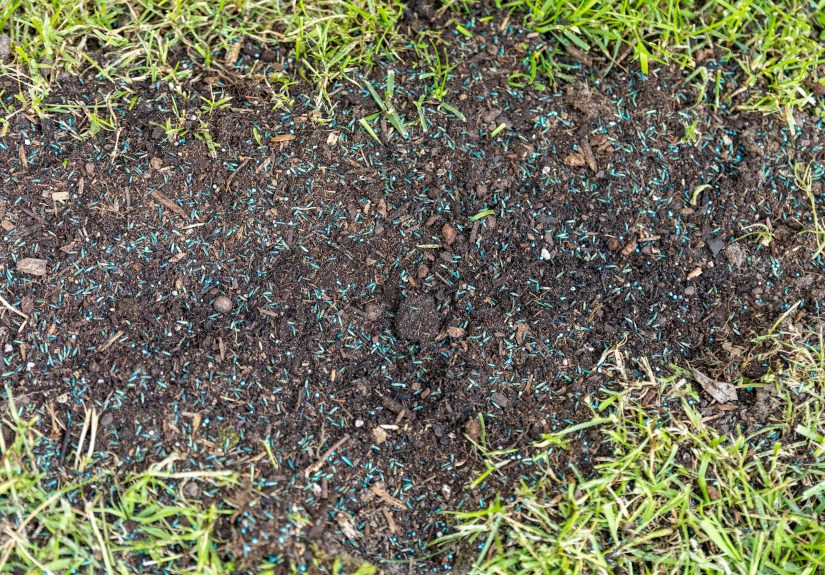
Lightly rake for seed-to-soil contact
After spreading, lightly rake so some seed nestles into the surface. You’re not burying treasureyou’re just making sure seed touches soil. Pressing the seed in with the
back of a rake or a roller can also help (especially on windy days, when your seed wants to move to a better neighborhood).
Step 6: Cover (Lightly) and Protect Your Work
Grass seed likes moisture, but it also likes not being eaten by birds or washed away in a storm. A light cover helps stabilize the seedbed and retain moisture.
Mulch with straw (the “blanket,” not the “mattress”)
Apply a light straw layer so you can still see roughly one-third to one-half of the soil underneath. Too much straw can smother seedlings. Many guides suggest
around one bale per 1,000 square feet (varies by bale size and how “fluffy” you spread it).
When to use erosion blankets
If you’re seeding a slope, straw alone may not hold. Erosion control blankets or mats can keep seed in place during heavy rain and are especially helpful in runoff-prone areas.
Step 7: Water Correctly (The Most Important Part After Timing)
Here’s the honest truth: most seeding failures happen because the seed dries out after germination beginsor because watering is so aggressive it turns the seedbed into a
tiny mudslide.
Phase 1: The “keep it moist” stage (before and during germination)
- Water lightly and frequently so the top layer of soil stays consistently moist (not soupy).
- In warm, dry, or windy conditions, you may need multiple short waterings per day.
- Use a gentle spray or sprinkler setting to avoid washing seed away.
Phase 2: The “train roots” stage (after seedlings appear)
Once grass starts to come up, gradually shift from frequent light watering to deeper watering less often. The goal is to encourage roots to grow downward instead of staying
shallow and fragile.
A practical example watering schedule
For many yards, this looks like: short waterings 1–3 times daily during germination (depending on weather), then tapering to once daily, then every other day with longer run times,
and eventually moving toward a standard “deep and infrequent” pattern once the grass is established. Adjust based on your soil (sand dries faster than loam or clay) and your weather.
Step 8: Know What to Expect (Germination Timeline + First Mow)
Grass seed doesn’t grow on your schedule. It grows on its schedule, influenced by soil temperature, moisture, and seed type.
Typical germination ranges
- Perennial ryegrass: often quickaround 5–10 days in good conditions.
- Tall fescue: commonly around 10–21 days depending on conditions.
- Kentucky bluegrass: sloweroften 14–28 days (patience required; dramatic sighing optional).
When to mow
Mow when the new grass is roughly 3 to 3.5 inches tall. Use sharp blades, avoid scalping, and follow the one-third rule (don’t remove more than about one-third of the blade at a time).
If the lawn is still tender, turn gently and avoid tight pivots that pull seedlings out.
Step 9: Fertilizer and Weed Control (Do This Wrong and You’ll Regret It)
Starter fertilizer: helpful, but only if it fits your situation
Many successful seedings use a starter fertilizer around seeding time because young seedlings benefit from nutrients that support early root development. If you’ve done a soil test,
follow those recommendations. If you haven’t, choose a starter product labeled for seeding and apply according to the label. Avoid over-applyingmore is not better.
Weed control: be careful with new seedlings
New grass is sensitive. Many herbicides shouldn’t be used until the new grass has been mowed multiple times. If weeds appear early, your safest options are often:
hand-pulling obvious offenders, improving mowing practices, and staying consistent with watering until the grass can compete.
Step 10: Troubleshooting Common “Why Is My Lawn Doing That?” Problems
Problem: Seed washed away after rain
- Next time: water more gently, use straw or an erosion blanket, and avoid seeding right before storms.
- Fix: re-grade small channels, roughen the surface, and reseed thin areas.
Problem: Patchy germination
- Usually caused by uneven watering, poor seed-to-soil contact, compacted spots, or old seed.
- Fix: scratch the soil surface lightly, reseed, press in, and keep consistently moist.
Problem: Birds treating your yard like a snack bar
- Use straw, light netting, reflective tape, or temporary sprinklers that scare them off.
- Press seed into the soilloose seed on top is basically bird popcorn.
Problem: You seeded…and then life happened
If you can’t water consistently, seeding becomes a gamble. It’s better to delay seeding until you can keep the seed zone moist through germination and early growth.
Grass seed is not a “set it and forget it” projectat least not at first.
Quick Step-by-Step Checklist
- Choose the right seed for your region and yard conditions.
- Seed at the right time (soil temperature and season matter).
- Prep the area: remove debris, loosen soil, and correct major issues.
- Spread seed evenly using a two-pass method.
- Rake lightly and press seed for strong seed-to-soil contact.
- Apply a light straw mulch (not a thick blanket).
- Water lightly and frequently until germination, then transition to deeper watering.
- Mow when new grass reaches ~3–3.5 inches, using sharp blades.
- Delay most herbicides until the new grass is established.
Wrap-Up: The “Secret” to Great Grass Seed Results
The secret isn’t a magic seed blend or a mysterious lawn potion. It’s the boring stuff that works: pick the right season, prep the soil so seed touches earth,
and keep the top layer consistently moist until the lawn can fend for itself. Do that, and your yard will start looking less like “before” and more like “after”
without needing a film crew or a dramatic soundtrack.
Experience Notes: What Planting Grass Seed Really Feels Like (and What I Wish Someone Told Me)
The first time you plant grass seed, you think you’re doing a single project. Surprise: you’re actually starting a short-term relationship with your yard.
For about two to six weeks, your lawn becomes the main character in your daily routine. You’ll walk outside in the morning, stare at the soil like it’s a
science experiment, and then confidently announce, “I saw one sprout yesterday,” as if you personally negotiated that seed into existence.
In week one, the biggest lesson is how fast the surface dries out. Even if the soil feels damp an inch down, the top layer can turn crusty in the afternoon
sun. The fix isn’t blasting the area with water like you’re putting out a fire. The fix is gentle, repeated moisturejust enough to keep the seed zone
consistently damp. That’s when you start appreciating timers, oscillating sprinklers, and the quiet joy of a spray nozzle with a “mist” setting.
Week two is where patience gets tested. If you planted a fast germinator (like perennial rye), you’ll see green early and feel like a lawn wizard. If you planted
Kentucky bluegrass, you’ll spend more time bargaining with the universe. This is also when uneven watering shows itself. One strip looks great, another strip looks
like it never got the memo. The “aha” moment usually comes when you notice a sprinkler pattern skipping a corner or when a slight slope causes water to run
off instead of soaking in. Tiny adjustmentsmoving a sprinkler two feet, shortening a watering cycle, adding a light mulch touch-upcan make a huge difference.
Week three and four are when the lawn starts feeling real… and when you’re tempted to “help” it too much. This is the danger zone for over-fertilizing,
over-watering, or mowing too early. The first mow is weirdly emotional. You’re excited, but also terrified you’ll rip seedlings out like you’re vacuuming
the carpet. The best move is to mow only when the grass is tall enough, keep the blades sharp, and treat turns like you’re driving a delicate parade float.
After that first mow, the lawn suddenly looks more uniform, and you’ll finally believe this is working.
The biggest practical takeaway from real-life seeding is that prep work pays you back. When you rake well, press seed into contact, and level the surface,
germination is noticeably more even. When you skip that step, you get “mystery bald spots” that require reseedingand you’ll end up doing the work anyway, just later
and with more annoyance. I’ve also learned that straw mulch is less about looking pretty and more about keeping moisture stable. A light layer makes watering more forgiving.
Without it, you’re playing moisture roulette every afternoon.
Finally, there’s the mental side: new grass teaches you to stop expecting overnight results. If you stick with the basicstiming, contact, and moistureyou’ll get a lawn that
thickens week by week. And one morning, you’ll look out and realize you stopped inspecting individual sprouts like a detective. You’ll just see… a lawn. That’s the moment you
understand why people get so proud about grass. It’s not just the greenery. It’s the fact that you pulled it off.