Table of Contents >> Show >> Hide
- Why It Matters (Even If You’re Mentally Checked Out)
- Before You Tell Coworkers: Get These Two Things Right
- Decide Who to Tell (and in What Order)
- What to Say: The “Goldilocks” Amount of Detail
- How to Tell Coworkers You’re Leaving: Best Methods by Situation
- The Core Script: Simple, Professional, Human
- Examples: What to Say in Common Scenarios
- 1) Telling a close teammate (friendly, direct)
- 2) Telling a coworker you’re not close with (polite and brief)
- 3) Telling cross-functional partners (focused on continuity)
- 4) A team announcement in a meeting (short and calm)
- 5) Slack / Teams message (clear, not dramatic)
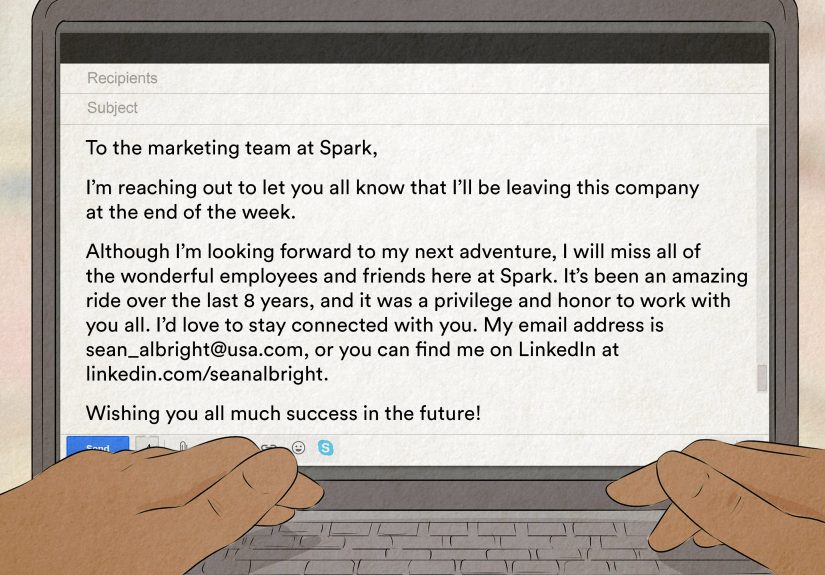
- 6) Email to your department (professional farewell)
- How to Answer the Questions Coworkers Will Definitely Ask
- What Not to Do (A Short List of Career-Saving Don’ts)
- Make It Easy on Everyone: The Transition Plan That Earns You Respect
- Quick Templates: Pick One and Customize
- If You’re Leaving on Bad Terms: How to Stay Professional Without Feeling Fake
- Conclusion: Leave Like Someone Who Might Want a Reference Someday
- Extra: Real-World Experiences and Lessons (The Stuff People Don’t Tell You Until You’re Packing Your Desk)
- Experience 1: The “I told one person and suddenly everyone knows” moment
- Experience 2: The coworker who takes your resignation personally
- Experience 3: The awkward “Where are you going?” interrogation
- Experience 4: The farewell email that turns into a networking magnet
- Experience 5: The last-week reality check (you won’t finish everything)
- Experience 6: Saying goodbye when you’re remote (it’s different)
- Experience 7: The “exit glow” is realso leave a paper trail of goodwill
Quitting a job is a weirdly emotional sport. One minute you’re updating a spreadsheet; the next you’re practicing
a calm, professional smile while your brain screams, “DON’T SAY SOMETHING WEIRD.” Telling coworkers you’re leaving
is part etiquette, part timing, and part “please don’t let me overshare in the break room.”
The good news: you don’t need a dramatic mic drop or a cryptic “You’ll hear soon…” message. You just need a
thoughtful plan, the right amount of detail, and a few ready-to-go scripts for the inevitable questions
(including the classic: “Wait… where are you going?”).
Why It Matters (Even If You’re Mentally Checked Out)
How you announce you’re leaving can shape your professional reputation longer than you’d expect. Coworkers become
references, future clients, hiring managers at other companies, or the person who forwards you the job that changes
your life. A graceful goodbye keeps doors openand keeps your last two weeks from turning into an awkward reality show.
Before You Tell Coworkers: Get These Two Things Right
1) Tell your manager first (always)
Even if you’re close with your teammates, your manager should hear it from you before it becomes office folklore.
This isn’t about loyaltyit’s about professionalism and control. Once your manager knows, you can align on the
timeline and message so you don’t accidentally contradict what leadership plans to communicate.
2) Confirm the “when” and the “how” of the announcement
Some companies prefer leadership to announce departures. Others want you to handle it. Some want the news shared
immediately; others wait until paperwork is complete or a transition plan is set. Ask your manager:
“When would you like the team to know, and what’s the best way to communicate it?”
Decide Who to Tell (and in What Order)
Not everyone needs the same message at the same time. Here’s a simple order that works in most workplaces:
- Your manager (first)
- Your closest collaborators (people whose work you impact daily)
- Your broader team / department (group update)
- Cross-functional partners and key stakeholders (especially if projects are mid-flight)
- Clients or external contacts (only if appropriate and aligned with your manager)
The guiding principle: tell the people who will be practically affected sooner, so they can plan. Tell casual
acquaintances later, closer to your final day.
What to Say: The “Goldilocks” Amount of Detail
Most coworkers don’t need your full origin story. They need three things:
- The headline: You’re leaving.
- The date: Your last day (or approximate timeline if you can’t share an exact date yet).
- The vibe: Positive, appreciative, forward-looking.
If you want to share what’s next, you canbriefly. If you don’t, that’s also completely fine. “I’m excited about
the next chapter” is a full sentence and a valid life choice.
How to Tell Coworkers You’re Leaving: Best Methods by Situation
Option A: In-person (or video) for your closest coworkers
Use this for teammates you work with daily, mentors, and anyone who would feel blindsided by a mass email.
Keep it short, kind, and clear.
Option B: A quick team announcement (meeting or group chat)
Perfect for the broader team: fast, consistent, and less likely to turn into a 47-message speculation thread.
Option C: A farewell email (usually near the end)
This is your “thank you + stay in touch” momentespecially useful if you won’t see everyone face-to-face.
It’s also a smart networking move when done well.
The Core Script: Simple, Professional, Human
Here’s a base script you can adapt to almost any scenario:
That’s it. Notice what’s not in there: complaints, a manifesto, or a suspiciously long pause.
Examples: What to Say in Common Scenarios
1) Telling a close teammate (friendly, direct)
2) Telling a coworker you’re not close with (polite and brief)
3) Telling cross-functional partners (focused on continuity)
4) A team announcement in a meeting (short and calm)
5) Slack / Teams message (clear, not dramatic)
6) Email to your department (professional farewell)
How to Answer the Questions Coworkers Will Definitely Ask
People are curious. Some are supportive. Some just love office news the way raccoons love shiny objects.
Prepare these answers so you don’t get caught improvising.
“Why are you leaving?”
Keep it positive and brief. If the real reason is “because my soul left my body in Q3,” you can still be classy.
“Where are you going?”
Share if you want. If you don’t, set a boundary without being weird about it (no mysterious cape swishes required).
“Are you leaving because of [boss/company/policy]?”
This is where professionalism matters most. Don’t fuel gossip. Even if the temptation is strong. Even if they say,
“It’s just us.” It is never “just us.” Offices have acoustics and memory.
What Not to Do (A Short List of Career-Saving Don’ts)
- Don’t tell coworkers before your manager (unless there’s a very specific reason and you’re 100% sure it won’t spread).
- Don’t trash-talknot in meetings, not in DMs, not in the parking lot “where nobody can hear.”
- Don’t over-explain your reasons or your new salary/title like it’s a TED Talk.
- Don’t promise what you can’t deliver (“I’ll finish everything before I go!” is how chaos is born).
- Don’t disappear mentallyyour last two weeks are still part of your reputation.
Make It Easy on Everyone: The Transition Plan That Earns You Respect
If you want coworkers to remember you fondly (and not as “the one who left mid-project and took the passwords”),
do these three things:
- Document your work: status, deadlines, owners, next steps.
- Hand off intentionally: schedule a walkthrough with whoever’s taking over.
- Communicate proactively: confirm what will be done before your last day and what won’t.
Quick Templates: Pick One and Customize
Template 1: Short and sweet (coworker you like)
Template 2: More formal (broader group)
Template 3: External partners / clients (coordination-focused)
If You’re Leaving on Bad Terms: How to Stay Professional Without Feeling Fake
You can be professional without pretending everything was perfect. Aim for “neutral-positive,” not “Oscar speech.”
Focus on gratitude for people (if you can honestly offer it), pride in the work, and commitment to a clean exit.
If you’re angry, vent to a friend outside work, write it in a draft you never send, or talk to a professional.
Your coworkers don’t need your unfiltered exit interview in the group chat.
Conclusion: Leave Like Someone Who Might Want a Reference Someday
Telling coworkers you’re leaving doesn’t have to be a stress festival. Keep the message simple, align with your
manager, share the news thoughtfully, and provide a clear path for transition. Add a sincere thank-you, offer a
way to stay in touch, and you’ll exit with your reputation intactand your relationships stronger than you think.
Extra: Real-World Experiences and Lessons (The Stuff People Don’t Tell You Until You’re Packing Your Desk)
Most advice about leaving a job sounds clean and organizedlike you’re calmly strolling out with a perfectly labeled
handoff binder and a single tasteful plant. In real life, leaving can be messy, emotional, and occasionally comedic.
Here are experiences and lessons that show what actually happensand how to handle it like a pro.
Experience 1: The “I told one person and suddenly everyone knows” moment
A common surprise: you tell a trusted coworker quietly, and by lunch the entire floor is making sad “nooo” faces at
you near the coffee machine. This is why timing matters. Once you share the news, you’ve basically released it into
the wild. The fix isn’t paranoiait’s planning. Tell your manager first, then tell your closest collaborators
quickly after the official go-ahead so the story doesn’t spread without you.
Experience 2: The coworker who takes your resignation personally
Sometimes people react like you’re leaving them, not the job. They might joke, “Wow, must be nice to abandon
us,” or they’ll go quiet and weird. In most cases, it’s not hostilityit’s anxiety. Your departure changes workloads,
routines, and the sense of stability. A helpful response is to validate without overpromising:
Experience 3: The awkward “Where are you going?” interrogation
This question can feel harmlessuntil it’s asked by someone who loves gossip like it’s a hobby. If you’re not ready
to share, keep it simple and repeatable. The key is consistency. The more you improvise, the more your story changes,
and the more people think there’s “something going on.” Pick one line and reuse it.
Experience 4: The farewell email that turns into a networking magnet
A well-written goodbye note can do more than say thanksit can quietly open doors. People reply with kind messages,
LinkedIn requests, and occasionally: “If you ever want to come back, call me.” The secret isn’t being overly emotional.
It’s being specific and human. Mention a project you’re proud of, thank people for collaboration, and include one
easy way to stay in touch. Keep it short enough that busy people actually read it.
Experience 5: The last-week reality check (you won’t finish everything)
Many departing employees try to be heroes: finish every project, answer every question, attend every meeting, and
also somehow plan their own life transition. This is how you end your job exhausted and still behind. A better approach:
prioritize what only you can do, document the rest, and set expectations early. Coworkers respect clarity more than
superhero promises.
Experience 6: Saying goodbye when you’re remote (it’s different)
Remote departures can feel oddly quiet. No cake, no hallway hugs, no final lap around the office. If you’re remote,
create your own closure: schedule a few short 1:1 calls with key teammates, send a warm but concise farewell message,
and consider a casual optional sendoff call. Also: write down personal contact info before your accounts get shut off.
You don’t want to lose touch with people you genuinely like because you forgot to connect outside the company tools.
Experience 7: The “exit glow” is realso leave a paper trail of goodwill
There’s a strange phenomenon where people suddenly become very nice once you’re leaving. They compliment your work,
tell you you’ll be missed, and sometimes confess you were the glue holding three processes together (which is equal
parts flattering and concerning). Use this moment wisely: thank them, leave clean documentation, and ask for LinkedIn
recommendations or references if it makes sense. Not aggressively. Just calmly:
In the end, the best “experience-based” advice is simple: be kind, be clear, and be consistent. You don’t need the
perfect speech. You need a thoughtful message, a smooth handoff, and enough professionalism to keep your future self
from cringing at 2 a.m. three months from now.