Table of Contents >> Show >> Hide
- What the Distance Formula Measures (In Plain English)
- Why the Distance Formula Works (No Magic, Just Geometry)
- How to Use the Distance Formula to Find the Length of a Line: 7 Steps
- Worked Examples (Because “I Get It” Hits Different After You Do One)
- Common Mistakes (And How to Avoid Them Like a Pro)
- Quick “Sanity Checks” Before You Circle the Answer
- Where You’ll See the Distance Formula (Besides Math Class)
- Practice Set (Try These Without Peeking)
- Conclusion
- Experiences That Make the Distance Formula “Click” (500+ Words)
If you’ve ever looked at two points on a coordinate plane and thought, “Cool… but how long is that line actually?”
congratulationsyou’re exactly where the distance formula shines. It’s the math equivalent of a tape measure that never runs out of batteries.
And yes, it works even when your points are negative (because math enjoys drama).
In this guide, you’ll learn the distance formula in a way that makes sense, use it in 7 clear steps, and walk through
examples (including the classic “watch the negative signs” situation). By the end, you’ll be able to find the length of a line segment
between two points quickly, accurately, and without whispering “please don’t be a weird radical” under your breath.
What the Distance Formula Measures (In Plain English)
The distance formula gives the length of a line segment between two points on a coordinate plane.
If your points are the endpoints of a line segmentsay A(x1, y1) and B(x2, y2)the formula tells you how far apart they are.
The standard distance formula in 2D is:
d = √((x2 − x1)² + (y2 − y1)²)
Notice what it’s doing: it measures the horizontal change and vertical change between the points, squares them (so negatives stop complaining),
adds them, and takes the square root to get a real distance.
Why the Distance Formula Works (No Magic, Just Geometry)
The distance formula is basically the Pythagorean Theorem wearing a coordinate-plane costume.
If you draw a right triangle using the line segment as the hypotenuse, the horizontal leg has length |x2 − x1|
and the vertical leg has length |y2 − y1|. Then Pythagorean says:
a² + b² = c²
So:
(x2 − x1)² + (y2 − y1)² = d²
Take the square root of both sides and you’ve got the distance formula.
Translation: You’re not memorizing a random equationyou’re applying a classic geometric idea to coordinates. Fancy, but not fussy.
How to Use the Distance Formula to Find the Length of a Line: 7 Steps
Step 1: Identify Your Two Endpoints
Write your points clearly as two ordered pairs:
(x1, y1) and (x2, y2).
These are the endpoints of your line segment. If you mix them up, it’s usually okayas long as you stay consistent.
Step 2: Label Which Coordinates Belong Together
Match x’s with x’s and y’s with y’s. Do not cross the streams.
(In coordinate geometry, crossing x and y is how you summon incorrect answers.)
Example labeling:
Point A = (x1, y1) and Point B = (x2, y2).
Step 3: Plug Into the Distance Formula
Use:
d = √((x2 − x1)² + (y2 − y1)²)
Substitute your numbers carefully, using parentheses especially when negatives are involved.
Parentheses are like seatbelts: you only notice you needed them after the crash.
Step 4: Subtract Inside the Parentheses
Compute (x2 − x1) and (y2 − y1) first.
Go slow heremost errors happen in this step, especially with negative values.
Step 5: Square Each Difference
Square the results from Step 4. Squaring turns negatives into positives, which is great because distance can’t be negative.
(A negative distance would mean you walked backward through a wormhole. Cool, but not on the test.)
Step 6: Add the Squares
Add the two squared values. This gives you the value inside the square rootoften called the radicand.
Step 7: Take the Square Root and Simplify
Take the square root to get d. If the result isn’t a perfect square, you may leave it as an exact radical
(like √52) or simplify it (like 2√13). If the problem wants an approximation, round to the requested decimal place.
Worked Examples (Because “I Get It” Hits Different After You Do One)
Example 1: Straightforward Coordinates
Find the distance between (2, 3) and (14, 8).
Step 3 (Substitute):
d = √((14 − 2)² + (8 − 3)²)
Step 4 (Subtract):
d = √((12)² + (5)²)
Step 5–6 (Square and add):
d = √(144 + 25) = √169
Step 7 (Square root):
d = 13
So the line segment length is 13 units. Nice and tidy.
Example 2: Negative Coordinates (The “Be Careful” Special)
Find the distance between (−2, −1) and (2, −4).
d = √((2 − (−2))² + (−4 − (−1))²)
d = √((4)² + (−3)²)
d = √(16 + 9)
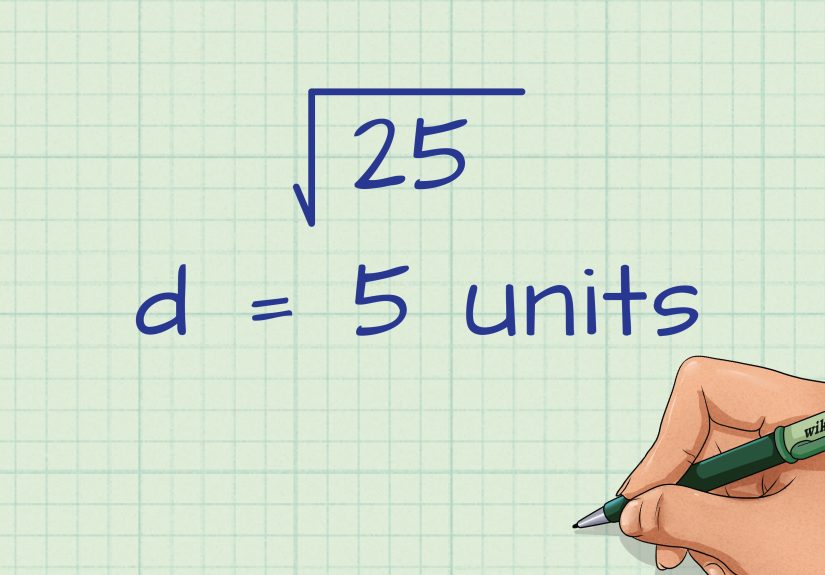
d = √25 = 5
The distance is 5 units. The negatives tried to cause trouble, but parentheses kept them in check.
Example 3: Horizontal and Vertical Lines (Shortcut Awareness)
Sometimes the distance formula is like bringing a spaceship to a grocery run. It works, but you can simplify:
- Horizontal line: y-values are the same, so distance is just the absolute difference in x-values.
- Vertical line: x-values are the same, so distance is just the absolute difference in y-values.
Example (horizontal): distance between (−2, 3) and (6, 3)
Distance = |6 − (−2)| = |8| = 8
The distance formula would also give 8, but this is quickerand your pencil lead will thank you.
Common Mistakes (And How to Avoid Them Like a Pro)
- Forgetting parentheses with negatives: Write (−3) instead of −3 when substituting.
- Mixing up x and y: Keep x-differences together and y-differences together.
- Not squaring both differences: The squares apply to the entire (x2 − x1) and (y2 − y1).
- Stopping before the square root: After adding squares, you still need √(…).
- Over-rounding too early: If you need a decimal, keep the radical exact until the final step.
Quick “Sanity Checks” Before You Circle the Answer
- Distance can’t be negative. If you got −7, something went off the rails.
- Distance is zero only if the points are identical.
-
Estimate using the graph idea: If x changes by 1 and y changes by 1, distance should be a bit more than 1 (about 1.41).
If your answer is 14, we need to talk.
Where You’ll See the Distance Formula (Besides Math Class)
The distance formula shows up in a lot of real-world and academic contexts:
- Mapping and navigation: estimating straight-line (“as the crow flies”) distances between locations on a grid.
- Computer graphics and gaming: checking how far a character is from an object (collision zones, targeting, movement).
- Data science basics: measuring “distance” between points in a coordinate-like feature space (especially in introductory clustering ideas).
- Geometry and circles: using distance from a center point to define a radius.
Practice Set (Try These Without Peeking)
- Find the distance between (0, 0) and (6, 8).
- Find the distance between (−5, 2) and (1, −6).
- How long is the segment with endpoints (3, 7) and (3, −1)?
- Find the distance between (−4, −3) and (2, 1). Simplify your radical if needed.
Tip: For #1, if you recognize 6–8–10, you’re allowed to smile.
Conclusion
The distance formula is one of those tools that feels intimidating for about five minutesright up until you realize it’s just the Pythagorean Theorem
with coordinates plugged in. Follow the 7 steps, lean hard on parentheses when negatives show up, and simplify at the end.
Once you’re comfortable, you’ll start noticing how often it appears: line segments, circles, coordinate geometry proofs, and plenty of applied problems.
And the best part? It always works the same way. Math can be surprisingly loyal like that.
Experiences That Make the Distance Formula “Click” (500+ Words)
Most people don’t struggle with the distance formula because it’s conceptually hardthey struggle because it’s a perfect storm of
small details. The experience often goes like this: you understand the idea (“distance between two points”), you remember there’s a square root
somewhere, and then the first time a negative coordinate appears, your confidence quietly leaves the building.
A super common “aha” moment happens when you actually draw the right triangle. Students often report that the formula feels random until they sketch
the horizontal move from (x1, y1) to (x2, y1), then the vertical move up or down to (x2, y2).
Suddenly, the pieces have a job: the x-difference is one leg, the y-difference is the other leg, and the distance you want is the hypotenuse.
Once you see that picture, the formula stops being a chant you memorize and becomes a shortcut you understand.
Another experience people run into: getting an answer like √85 and wondering if that’s “allowed.” In many classes, it absolutely isespecially if the
directions say “exact answer” or “simplify radicals.” The emotional arc here is real: at first √85 feels like an unfinished sentence, but then you learn
that radicals are a perfectly respectable way to represent a distance. (Not every distance in life is a whole number. Sometimes it’s irrationaljust like
group projects.)
Test-day experiences tend to reinforce the same lessons. If the problem gives you points like (−2, 3) and (5, −1), you can almost hear the question
whisper, “Will they forget parentheses?” The students who do best usually have a small personal rule, like:
“If a number is negative, it goes in parentheses every time.” That one habit prevents a shocking number of mistakes. It’s not about being “good at math”;
it’s about being consistent under pressure.
There’s also the experience of realizing when you don’t even need the full formula. For horizontal or vertical segments, people often feel a weird kind of
joylike finding money in a jacket pocketbecause the distance is just the difference in one coordinate. You still can use the formula, but spotting
shortcuts builds confidence and speed. And speed matters when you’re solving a set of problems where every minute counts.
Finally, a surprisingly motivating experience is seeing the distance formula show up outside of pure geometry. In basic programming projects, for example,
you might calculate how far a moving object is from a target point. In mapping contexts, you might compare two locations on a coordinate grid.
Even if real-world travel doesn’t happen in perfect straight lines, straight-line distance is still a useful baseline.
The formula starts to feel less like “school math” and more like a practical toolone you can carry into other subjects.
If your experience so far has been “I get it until I don’t,” you’re normal. Keep the 7-step process nearby, do a few practice problems with negatives,
and let repetition turn the process into muscle memory. Once that happens, the distance formula becomes one of the easiest points you can earn in coordinate
geometrybecause it’s consistent, reliable, and (unlike your Wi-Fi) rarely surprises you.