Table of Contents >> Show >> Hide
- Why Rick and Morty are perfect subjects for realistic portrait art
- The real trick: keeping the character while changing the medium
- How I built Rick’s portrait
- How I built Morty’s portrait
- What realistic Rick and Morty portraits reveal about good character design
- If you want to create your own realistic Rick and Morty portraits
- Extended studio notes: my experience creating realistic portraits of Rick and Morty
- Conclusion
Turning Rick and Morty into realistic portraits sounds like a fun weekend art project right up until you actually try it. Then you realize Rick’s face is basically an exhausted geometry problem, Morty’s entire personality is trapped inside two giant circles and a permanent state of panic, and one wrong line can make both of them look less like beloved animated icons and more like they escaped from a deeply cursed wax museum.
That, of course, is exactly why the idea is so irresistible. The show’s characters are simple on the surface, but they are loaded with visual shorthand. Rick is chaos in a lab coat. Morty is adolescent dread with sneakers. Their designs are cartoonishly economical, yet their attitudes are so sharp that even the smallest facial detail matters. Once you try translating that into realism, you discover something many portrait artists already know: likeness is not about copying every feature. It is about identifying which features are doing the heavy lifting and then giving those features the spotlight they deserve.
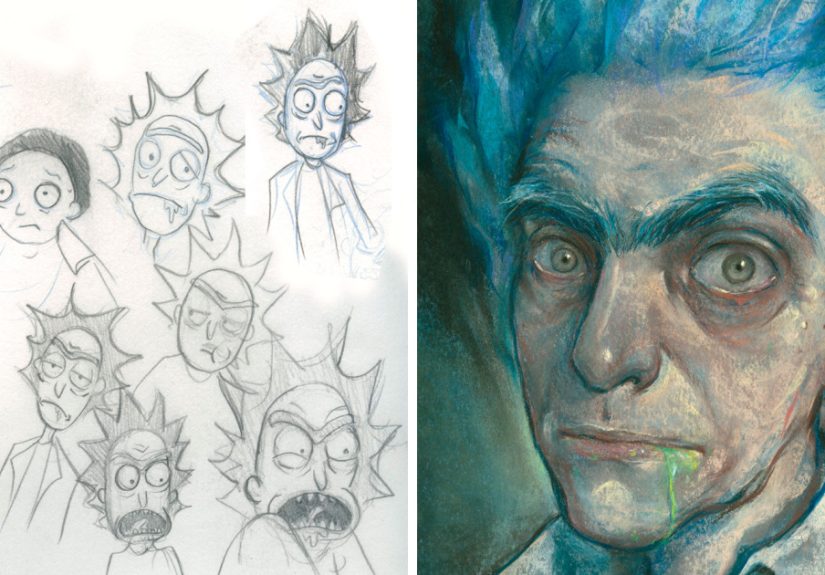
This challenge has fascinated artists for years, and for good reason. One of the most memorable real-world examples came from illustrator Ashly Lovett, who created realistic Rick and Morty portraits for Gallery 1988’s official art show. Her process hit the exact nerve of the problem: you have to preserve what makes the characters look like themselves without sanding away the weirdness that makes them interesting. That balancing act is the whole game, whether you work in chalk pastel, digital painting, 3D sculpting, or a combination of all three.
Why Rick and Morty are perfect subjects for realistic portrait art
Some cartoon characters practically beg to be reimagined as realistic humans, and Rick and Morty are prime candidates. Their faces are stylized, but not random. Rick’s hair shoots upward like his thoughts are trying to leave the planet before the rest of him does. His drooping posture, monobrow, drool, and permanently sleep-deprived eyes tell you he is brilliant, reckless, and probably one bad decision away from causing an interdimensional tax issue.
Morty, meanwhile, is the opposite kind of design challenge. Rick is loud. Morty is deceptively plain. His “average kid” face is exactly what makes him hard to translate into realism. When a character is meant to feel ordinary, the artist has less decorative material to lean on. That means expression, mood, head shape, and subtle age cues have to carry the portrait. In other words, Morty is not boring to paint. Morty is sneaky.
That contrast is what makes a realistic pair so satisfying. Rick lets you push texture, age, stress, posture, and attitude. Morty demands restraint. Put them side by side and you get a visual conversation: one face says, “I have seen the multiverse and it was sticky,” while the other says, “I was absolutely not told there would be this much screaming.”
The real trick: keeping the character while changing the medium
Silhouette comes first
Before I worried about skin texture, pores, wrinkles, or realistic eyes, I had to deal with silhouette. In character design, silhouette is the fast, blunt instrument that makes a figure recognizable before the viewer even studies the details. If Rick’s hair becomes too neat, too soft, or too fashionable, he stops being Rick. If Morty’s head shape becomes too conventionally handsome, he starts looking like an actor playing “Teen Boy #3” in a streaming drama about varsity lacrosse and secrets.
So the first rule was simple: do not “fix” the design. Realism is not cosmetic surgery. It is interpretation. Rick still needed that elongated face and jagged, electrically unwell hair. Morty still needed that rounded softness and mild nervous tension. If the silhouette disappeared, the portrait might become technically polished, but it would lose the joke, the charm, and the identity.
Anatomy matters, but personality matters more
Once the silhouette was locked in, anatomy stepped onto the stage. Realistic portrait work always depends on understanding bone structure, facial planes, eye placement, jaw rhythm, and how flesh sits over the skull. That sounds very serious, and it is, but anatomy alone can also make fan art weirdly lifeless. You can build a perfectly believable face and still miss the character by a mile.
For Rick, I leaned into the effects of age and abuse. Not “abuse” in a tragic prestige-drama way, but in the “this man has not respected hydration, sleep, or common sense for decades” way. His cheeks needed to look lean. His under-eye area had to feel heavy. His mouth had to carry sarcasm even when it was technically resting. Rick should never look comfortable in his own skin. He should look like his own bad idea.
Morty required the opposite approach. His face had to stay young, open, and slightly unsure of itself. Too much contouring would age him up. Too much polish would make him look artificial. I wanted him to feel like the kind of kid who still has softness in the cheeks but already carries stress in the brows. Morty’s realism lives in restraint.
Texture, lighting, and color do half the storytelling
Realistic portraits are not just line work with extra suffering. Texture and lighting do enormous narrative work. Skin needs variation. Hair needs shape, direction, and believable breakups. Eyes need moisture, shadow, and a clear focal point unless you are intentionally trying to make the viewer uncomfortable, which, to be fair, is not always the wrong move with Rick and Morty fan art.
Rick’s portrait practically demanded cool tones, sickly highlights, and rough transitions that suggested fatigue and chaos. His blue hair could not simply be “blue.” It had to feel like a stylized translation of the show’s palette into believable material. Morty’s palette had to be warmer and gentler, but still grounded in the same universe. If Rick looked like gritty sci-fi noir and Morty looked like a toothpaste commercial, the pair would collapse faster than one of Rick’s ethical boundaries.
How I built Rick’s portrait
Rick was the easier of the two, but only because he gives you so much to work with. The face shape came first: long, slightly gaunt, and full of angles that implied both intelligence and neglect. Then I built the eyebrows and eyes, which are the emotional epicenter of the whole operation. Rick’s eyes are wide in the show, but wide does not automatically mean awake. In realism, they had to feel alert, unstable, and annoyed at being observed.
Then came the mouth. This was crucial. A realistic Rick without the right mouth expression can accidentally turn into “retired physics professor who makes excellent soup.” That is not the vibe. I needed a mouth that suggested contempt, quick wit, and maybe a tiny bit of portal-fluid-adjacent drool. Not enough to feel grotesque. Just enough to remind the viewer this man has no interest in behaving normally for even five consecutive minutes.
Hair was the final boss. Rick’s hair is iconic because it is shape first and grooming never. Realistic hair tends to become pretty very quickly if you are not careful. I kept the clumps wiry, directional, and slightly explosive, almost like static electricity had entered a long-term relationship with bad decisions. The result was a face that looked human enough to exist, but still unmistakably Rick.
How I built Morty’s portrait
Morty surprised me. Rick arrives with built-in drama. Morty arrives with what seems like less visual information, which means every decision becomes more delicate. I started with youth. Morty had to look like a teenager, not a miniature adult wearing teenage anxiety like a Halloween costume. That meant softer transitions in the face, less hard shadowing, and a more modest level of texture.
The head shape mattered enormously. In the show, Morty’s proportions are simple and rounded. Translating that into realism meant resisting the urge to sharpen him up. His realism had to stay slightly awkward. Not unattractive, not exaggerated, just unfinished in the way real teenagers often look unfinished. He is still becoming himself, and the portrait needed to feel that way.
Expression carried everything. Morty’s face lives in the space between confusion, concern, and “I really should not be here right now.” I pushed that emotional uncertainty through the eyes and brow tension. Too much fear and he became a horror poster. Too much confidence and he became a completely different character. The sweet spot was vulnerability with a little stubbornness hiding underneath it.
What realistic Rick and Morty portraits reveal about good character design
The fun part of making realistic cartoon portraits is not just the final image. It is the forensic work of discovering why a character functions so well in the first place. Great character design survives translation. It can move from 2D animation to portrait illustration, from traditional media to 3D sculpting, from a joke-heavy sci-fi cartoon to a gallery wall, and still feel recognizable.
That is what makes Rick and Morty such a smart subject for artists. Their designs are readable, but their personalities are richer than their simple shapes suggest. The realism process exposes the logic behind the stylization. Rick’s silhouette is not random. Morty’s simplicity is not lazy. Every decision has a purpose, and when you decode that purpose, your art gets better across the board.
It also teaches a humbling lesson: realism is not the “upgrade” version of cartooning. It is just a different language. Stylization can say a lot with very little. Realism has to earn its clarity through structure, surface, and subtlety. When the two meet successfully, the result can feel fresh, funny, a little unsettling, and weirdly emotional all at once.
If you want to create your own realistic Rick and Morty portraits
Start with reference, but do not become a photocopier. Watch the show. Pause on expressions. Notice how Rick’s eyelids sit. Notice how Morty’s mouth corners change when he is scared versus embarrassed. Study the color relationships, costume shapes, and hair silhouettes. Then step back and ask the most useful portrait question of all: what absolutely cannot be lost?
After that, build the face like a portrait artist, not a fan with a panic attack. Think in planes. Think in rhythm. Think about age, skin behavior, eye focus, and how lighting changes mood. Then, once the realism is working, bring the weirdness back in. Rick should not become too noble. Morty should not become too cool. These are not makeover portraits. They are character translations.
Most importantly, let the final image keep some personality in the brushwork or rendering. A piece like this should not feel machine-clean. It should still have a pulse. Whether you work traditionally or digitally, the marks should suggest your point of view. That is where fan art stops being a technical exercise and starts becoming an actual piece of art.
Extended studio notes: my experience creating realistic portraits of Rick and Morty
By the time I was deep into the project, I realized I was not really painting two cartoon characters. I was negotiating with them. Rick, naturally, was a terrible collaborator. Every time I made him too handsome, the portrait lost its bite. Every time I made him too disgusting, it became a parody. I had to keep pulling him back toward that narrow strip of believable human mess where he still looked brilliant, dangerous, and deeply likely to ruin Thanksgiving on purpose. I spent an absurd amount of time on his eyes because they needed to say three things at once: intelligence, exhaustion, and the kind of confidence that only comes from thinking consequences are for other people.
Morty was stranger. I expected him to be quick because his design is simpler, but simplicity is a trap. With Rick, exaggeration gives you a lot of handles to grab. With Morty, the challenge is emotional truth. If his expression tipped too far toward fear, he looked melodramatic. If it drifted too neutral, he lost all personality. I kept returning to the same idea: Morty is not just scared. He is trying to keep functioning while scared. That tiny difference changed everything. His brow softened. His mouth became less theatrical. His whole face started reading as a kid doing his best in situations that would send most adults directly into a blanket burrito.
The most useful breakthrough came when I stopped asking, “How do I make them real?” and started asking, “What would reality do to these designs?” Reality adds gravity. It adds skin variation, asymmetry, texture, and the small imperfections that make faces convincing. But reality also reveals what the design was hiding in plain sight. Rick’s features are all about attack: sharp shapes, aggressive direction, visual noise. Morty’s features are about reaction: rounded forms, openness, uncertainty. Once I understood that, the portraits finally started cooperating.
I also learned that the line between “compelling” and “cursed” is hilariously thin. One over-rendered nostril and suddenly the whole piece looks like a streaming-service reboot nobody asked for. One overly glossy eye highlight and Rick looks moisturized, which is maybe the least believable artistic choice in the multiverse. So I embraced moderation. I let some edges stay rough. I kept certain areas more suggestive than literal. The portraits felt stronger when they still remembered they had once been cartoons.
In the end, that was my favorite part of the experience. Creating realistic portraits of Rick and Morty was not about proving that realism is smarter or harder or more “serious” than animation. It was about appreciation. The process made me notice how brilliantly these characters are built, how much personality lives in a few apparently simple shapes, and how much storytelling can survive a complete change in style. Also, I came away with a renewed respect for anyone who has ever tried to paint weird hair, tired skin, teenage anxiety, and cosmic nonsense in one coherent series. It is ridiculously fun, mildly unhinged, and absolutely worth doing again.
Conclusion
Creating realistic portraits of Rick and Morty is one of those ideas that sounds silly until you sit down and realize it is secretly a master class in character design. The project forces you to study silhouette, anatomy, expression, texture, lighting, and personality all at once. More importantly, it reminds you that the best fan art does not just imitate a property. It interprets it. It asks what makes these characters tick, what details make them instantly recognizable, and how those details can survive in a completely different visual language.
And that is why this kind of portraiture works so well. Rick is not memorable because he has spiky hair. Morty is not memorable because he has a round head. They work because every visual choice supports who they are. When a portrait artist respects that logic, realism does not flatten the characters. It reveals them. The final piece can be funny, eerie, affectionate, and technically satisfying at the same time. In other words, very on-brand for a universe where the science is outrageous, the emotions are messy, and nobody is getting through the day with clean shoes.
Note: This is original, publication-ready HTML body content written in standard American English and cleaned of unnecessary placeholder artifacts.